The logic of the Japanese timber frame
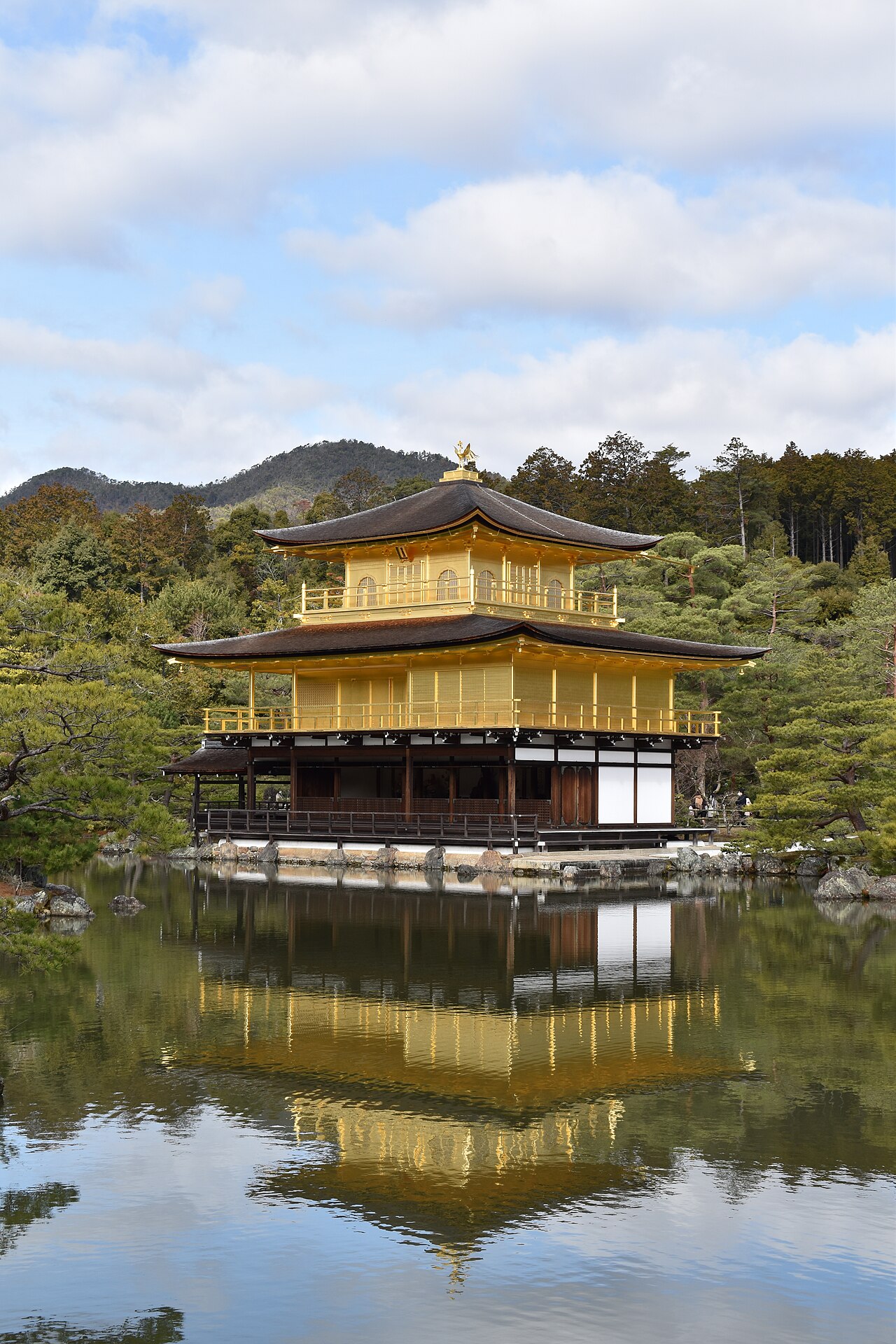
Japanese traditional architecture rests on a single governing idea: the post-and-lintel timber frame. Vertical columns transfer load to the ground; horizontal beams and brackets manage the span between them. Stone and brick play almost no structural role in the traditional canon, which is why Japanese buildings look so different from the load-bearing masonry walls of Europe or the Middle East. The whole structural logic is expressed on the exterior — you can see the column grid, the bracket arms, the purlin lines — and this transparency is itself an aesthetic statement.
At the top of each column sits a bracketing system known as tokyō. These interlocking wooden arms spread the load of the heavy roof across a wider bearing surface, preventing point concentration that would split the column. In the grandest temples and palace gates the bracket clusters grow extremely complex, stacking tier upon tier in ways that serve as much a decorative as a structural purpose. The visual effect is of a building that gets richer and more intricate the higher your gaze travels.
The most recognizable Japanese roofline is the curved, upswept eave, sometimes called karahafu when it takes a particular undulating gable form. These curves are achieved not by bending the timber but by carefully angling the bracket arms so that each successive purlin sits slightly higher as it approaches the corner. The result is an eave that sweeps upward at the corners — visually lightening a roof that is in fact extremely heavy, often layered with ceramic or copper tiles.
This timber frame is also seismically intelligent. In a rigid masonry building, an earthquake's horizontal force is transmitted directly through the structure until the weakest joint cracks. A Japanese timber frame, by contrast, has many small joints that can rack — shift slightly out of square — without collapsing. The building swaps rigidity for controlled flexibility, absorbing energy across hundreds of nodes rather than concentrating it in a few. Centuries before modern engineering, Japanese carpenters had discovered a structural principle that earthquake engineers now deliberately build into seismic-resistant frames.
Shinto shrines: identifying the grammar
The most immediately recognizable element of a Shinto shrine is the torii, a simple gate marking the transition from the profane world to sacred space. At its most basic the torii is two vertical posts joined by two horizontal rails, the upper one projecting beyond the posts and sometimes curving upward at the ends. Torii are typically painted vermilion — a color associated with vitality and the divine — though some are left in unpainted natural wood or are made of stone. A vermilion torii rising above green forest or a gravel approach path is one of the clearest single-image identifiers of Japan you will encounter in the game.
Beyond the torii, the shrine compound follows a consistent organizational logic. Worshippers approach through a series of gateways and pass the haiden, the worship hall where prayers are offered. Behind it stands the honden, the inner sanctuary that houses the shintai, the physical object in which the kami — divine spirit — is believed to reside. Ordinary visitors do not enter the honden; it is the hidden heart of the compound, often behind a fence or low wall that makes it partially visible but never fully accessible.
Shrine roof forms are varied but distinctive. The most common type is nagare-zukuri, characterized by an asymmetric roof in which the front slope extends further out than the rear, creating a sheltered porch over the entrance. The asymmetry is unmistakable once you know to look for it. The grandest example of a different tradition is the Ise Grand Shrine in Mie Prefecture, built in the shinmei-zukuri style: thatched thatch on a plain cypress frame, raised on posts above the ground, with crossed finials projecting above the roof ridge. What makes Ise extraordinary is not just its form but its practice — the entire complex has been rebuilt identically every twenty years for at least thirteen centuries. The current structure was completed in 2013, but its design is functionally identical to one used continuously since the seventh century. This ritual rebuilding preserves both the sacred form and the craft knowledge required to create it.
Buddhist temples: what changes from the shrine
Buddhism arrived in Japan from Korea and China in the sixth century, bringing with it a fully developed architectural tradition rooted in continental Chinese forms. Where Shinto is a native Japanese tradition expressed in simple timber forms that emphasize natural materials, Buddhist temple architecture is more elaborate, more gilded, and more visually complex — a distinction that holds broadly true even after fifteen centuries of mutual influence.
The signature element of the Buddhist compound is the pagoda (ta in Japanese), a multi-story tower derived from the Indian stupa. Its role is to house sacred relics. Japanese pagodas typically have three or five stories, each with its own projecting roof and bracket system that diminishes in scale as the tower rises, creating a silhouette that tapers toward the top. The stacked roofline of a pagoda is unmistakable and has no equivalent in Shinto architecture.
At the entrance to most temple compounds stands the sanmon, the mountain gate, typically a two-story structure housing fearsome guardian figures (niō) in its lower bays whose physical menace is intended to ward off malevolent spirits. These muscular, grimacing guardians — absent from Shinto shrines — are one of the clearest visual cues that you are looking at a Buddhist compound rather than a Shinto one.
The world's oldest surviving wooden building complex is Hōryū-ji in Nara Prefecture, founded in 607 AD. Its five-story pagoda and adjacent kondō (main hall) have stood for over fourteen centuries, making them living proof that Japanese timber joinery, properly maintained, is extraordinarily durable. To distinguish a shrine from a temple at a glance: shrines are simpler in decoration, using natural cedar or cypress wood (sometimes painted vermilion) and minimal ornament. Temples are typically more elaborate, incorporating gilded metalwork, carved guardian statues, stone lanterns lining the approach path, and incense burners in the courtyard. The presence of incense smoke, guardian sculptures, and a multi-story pagoda all point firmly toward Buddhist temple.
The Edo city: machiya and castle towns
For most of the period between the seventeenth and mid-nineteenth centuries, Japan was governed from Edo (modern Tokyo) under the Tokugawa shogunate. The political and economic structure of this period produced two characteristic urban building types: the machiya townhouse and the castle (shiro) that anchored each regional capital.
The machiya was the typical dwelling and workspace of the urban merchant and artisan class. Its form was dictated by the narrow plot widths of Edo's commercial streets: a long, thin building running deep into the block, with the street facade — typically only one or two bays wide — serving as a shop front. The facade was characterized by kōshi, slatted wooden lattice screens that allowed air and filtered light to pass through while maintaining privacy. Overhanging upper floors created a covered space at street level and maximized the upper-floor area on expensive urban land. Surviving machiya neighborhoods — most famously in Kyoto's Gion district — retain this narrow-deep grain as a direct imprint of Edo-period land economics.
The castle towns (jōkamachi) were urban settlements that grew up around the fortified residences of the regional lords (daimyo) during the Sengoku period of civil wars. The castle itself — with its massive stone base (ishigaki), whitewashed multi-story tower keep (tenshu), and layered defensive moats — was the most architecturally ambitious structure in the region. Himeji Castle (completed 1609) is the finest surviving example: its brilliant white plastered walls, tiered rooflines curving up at each corner, and complex arrangement of secondary towers earned it the nickname "White Heron Castle." The castle town of Kanazawa, capital of the Kaga domain, preserves its historic street grid and several samurai and merchant districts largely intact, offering one of the best surviving impressions of Edo-period urban planning.
Meiji modernization and the Western hybrid
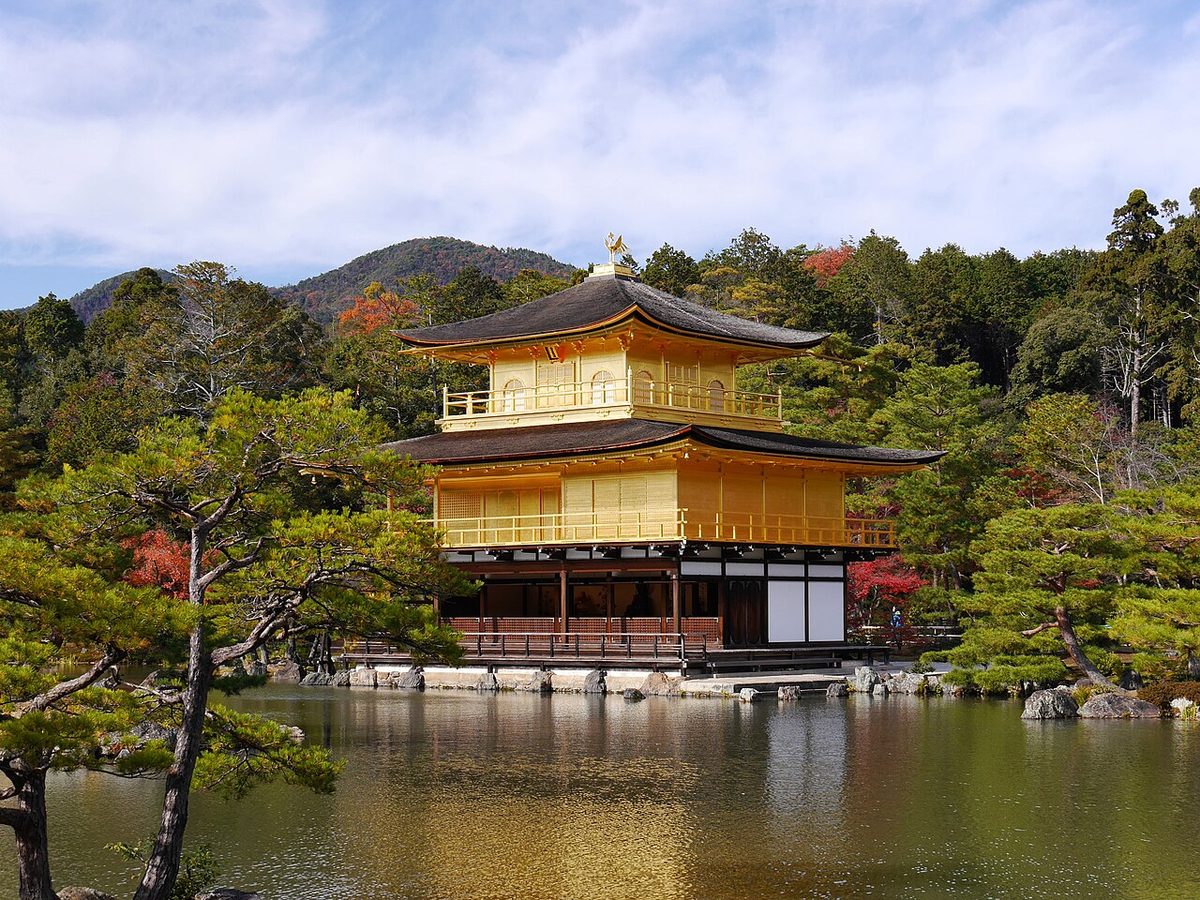
When the Meiji government came to power in 1868 after centuries of relative isolation, it embarked on a deliberate program of westernization. Architecture was one of the most visible instruments of this project: new government buildings, banks, schools, and railway stations were built in European styles to signal that Japan had joined the community of modern industrial nations. The policy was summarized in the phrase wakon-yōsai — "Japanese spirit, Western technique" — but in practice it often meant straightforward adoption of Western forms, sometimes executed by Japanese architects trained abroad.
The Bank of Japan (1896), designed by Tatsuno Kingo after studying in Europe, is a textbook Beaux-Arts composition: rusticated stone base, arched windows at the main floor, classical cornices and pilasters, a plan organized around a central hall. It reads as a credibly European bank building; only the archive records reveal its Japanese authorship. Akasaka Palace (1909), built as the Crown Prince's residence, went even further, producing a full Baroque and Neoclassical palace in the manner of Versailles, complete with French formal gardens — a building that would not look out of place in Vienna or Paris.
Tokyo Station (1914), also designed by Tatsuno Kingo, shows how these Western forms could be handled with considerable sophistication. The long red-brick facade, Beaux-Arts in its discipline and rhythm, is punctuated by two prominent domed pavilions at each end. Tatsuno had trained at the Architectural Association in the Netherlands, and the station's handling of brick detail and formal symmetry reflects genuine mastery of the European tradition rather than imitation from pictures. The station was heavily damaged in World War II and its domes removed, but a meticulous restoration completed in 2012 returned it to its 1914 appearance. The combination of red brick, formal symmetry, and domed corner elements remains its signature profile on the Tokyo skyline.
Metabolism: the 1960s radical rupture
In 1960, a group of young Japanese architects presented a manifesto at the World Design Conference in Tokyo that proposed rethinking the city as a biological organism rather than a fixed artifact. The movement called itself Metabolism, drawing on the biological concept of a living system that replaces its cells while maintaining its overall structure. The founders — Kisho Kurokawa, Kiyonori Kikutake, Fumihiko Maki, and others — argued that cities should have permanent infrastructure components (the equivalent of bones and circulation systems) and replaceable, interchangeable capsule units (the equivalent of cells) that could be swapped out as they wore out or became obsolete.
The most famous realized example is Kurokawa's Nakagin Capsule Tower in Shimbashi, Tokyo, completed in 1972. The building consists of 140 self-contained capsule units, each measuring approximately 2.3 by 3.8 meters — barely larger than a shipping container — bolted directly to two central concrete service cores containing elevators, plumbing, and electrical risers. Each capsule was fabricated off-site and attached with just four high-tension bolts, theoretically allowing individual units to be crane-lifted off and replaced. In practice the capsule replacement mechanism was never used; the building aged in place, its systems becoming increasingly outdated.
The aesthetic of the Nakagin Tower is unmistakable: a cluster of white rectangular pods each pierced by a single circular porthole window, stacked and offset in a three-dimensional arrangement that reads as simultaneously industrial and organic. The round windows — borrowed from the aesthetic of spacecraft and submarines — gave each capsule the look of a self-contained habitat module. Kurokawa explicitly connected the capsule concept to Japanese traditions of the tea house as a minimal, perfect personal space. The building was controversially partially demolished beginning in 2022, with some capsules preserved in museum collections, making surviving photographs and the remaining structure historically significant.
How to identify Japanese buildings in the game
Japanese buildings offer some of the clearest visual signatures you will encounter in a geography guessing game, but only if you know which tradition you are looking at. The key is to read the structural and decorative grammar systematically rather than responding to a vague impression of "Asian-ness."
A vermilion torii gate combined with unpainted timber buildings, raked gravel paths, or a forested hillside setting points unambiguously to a Shinto shrine. If the torii is stone rather than wood and the compound includes stone lanterns and a purification fountain, you are almost certainly in Japan rather than Korea or China, where equivalent gates take different forms. A multi-story pagoda with upswept eave tiers, accompanied by stone lanterns along the approach path and guardian statues at the main gate, signals a Buddhist temple complex. The combination of the two — temple and shrine in the same compound — is not uncommon in Japan given centuries of syncretism, but the architectural cues remain separately readable.
A white multi-story tower rising from a massive stepped stone base, with curved roof tiers at each level and subordinate towers around the perimeter, is an Edo-period castle keep. The whitewashed plaster walls above the rough stone base are the key identifier; the scale and the defensive character of the stone work distinguish this firmly from temple or shrine architecture. Round-windowed white pods stacked on concrete service cores are the Metabolist signature, and specifically point toward the Nakagin Tower or buildings in its tradition. Seeing circular windows as the dominant facade motif on a cluster of small-scale units is one of the most distinctive images in twentieth-century architecture. Finally, a formal brick or stone facade with classical European detailing — cornices, pilasters, arched windows, symmetrical composition — signals a Meiji-era government, commercial, or transportation building. The landscape context reinforces all these readings: green forested hillsides, rock gardens, or the dense narrow-street urban fabric of a traditional merchant district all anchor the image in Japan rather than anywhere else.
For more architectural traditions to compare, see our guides to reading religious architecture and Islamic architecture.
Regional Variations Within Japanese Architecture
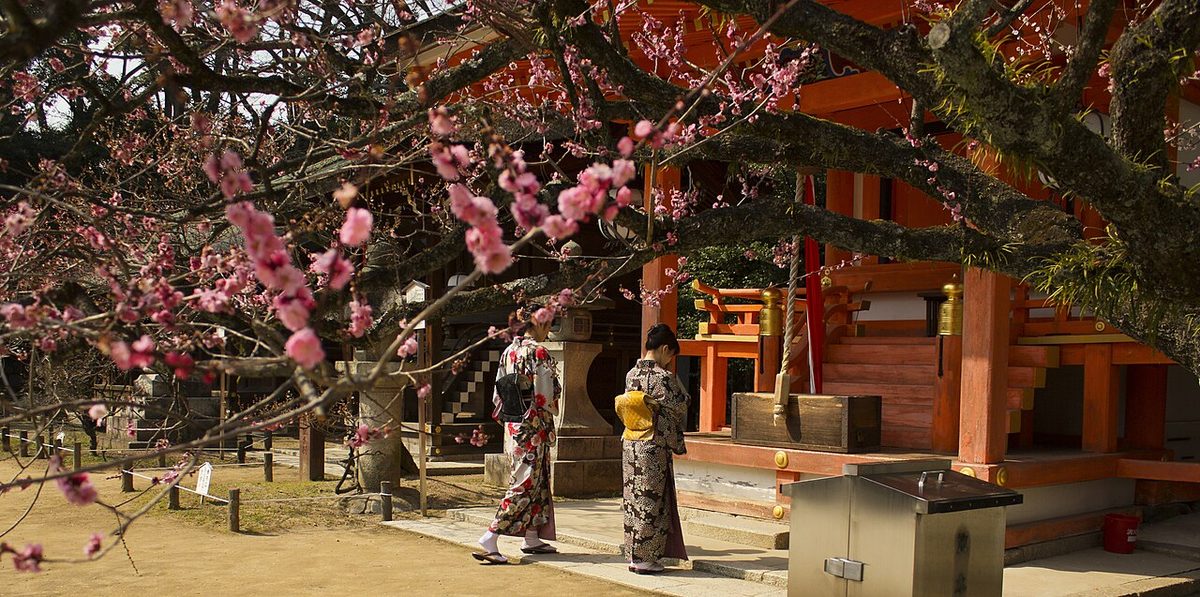
Shinto shrine architecture encompasses several distinct formal traditions that were codified in the Heian period and have been maintained with remarkable consistency ever since. The oldest and most austere is the shinmei-zukuri style seen at the Ise Grand Shrine: plain unpainted cypress timber, raised on posts, with a thatched roof and crossed finials (chigi) projecting above the ridge. This style emphasizes material honesty and the sacred character of raw natural wood. The nagare-zukuri style, which is the most common shrine type across Japan, uses an asymmetric roof with an extended front slope that creates a covered porch — more approachable for worshippers, and more adaptable to different site conditions. The kasuga-zukuri style, exemplified by the Kasuga Grand Shrine in Nara, applies cinnabar red pigment to the structural elements and bright orange-vermilion to the decorative boards, creating the vivid color palette most people associate with shrine architecture.
Buddhist temple architecture varies by sect. Zen Buddhist temples from the Kamakura period onward introduced the karayo (Chinese style) — a more refined, highly detailed form with slender columns, flared bases, and bell-shaped windows — in contrast to the wa-yo (Japanese style) favored by the older Nara-period sects, which used simpler, more massive forms. The Pure Land Buddhist tradition favored the Amida hall, a symmetrical building housing a large gilded Amida Buddha figure, exemplified by the Byodoin Phoenix Hall in Uji (completed 1053), whose elegant symmetry and reflection in the pond before it made it the model for Pure Land paradise architecture. Each tradition had preferred plan types, ornament conventions, and roof forms — distinctions that are visible in the buildings but require some familiarity to read confidently.
Edo-period castle architecture is a distinct tradition with its own internal typology. The tenshu (main tower keep) could be of the independent type (a single tower standing alone on its platform), the attached type (a central tower with attached secondary towers), or the compound type (multiple towers connected by enclosed corridors). The visual signature — multiple curved roof tiers diminishing in scale as the tower rises above a massive stone base — is consistent across types, but the plan complexity and the silhouette vary considerably. Himeji is the compound type and exceptional in its complexity; most surviving castle keeps are simpler independent or attached types.
Modern Japanese architecture developed its own distinct voice from the 1960s onward, rooted partly in the Metabolist movement's radical proposals and partly in the individual visions of architects including Kenzo Tange, Tadao Ando, and Toyo Ito. Ando's work is characterized by bare concrete surfaces (what he calls "the geometry of light and shadow"), narrow openings admitting precisely controlled light, and tight spatial sequences that require the visitor to move through the building before understanding its organization. Ito's work moves toward a more open, dissolving structural language — the Sendai Mediatheque (2001) uses irregular tubular steel columns instead of conventional floors and walls, making the structure fully visible and the building plan deliberately ambiguous. These represent a thread of modern Japanese architecture that engages directly with traditional Japanese spatial values — the threshold, the sequence of approach, the carefully framed view of nature — while rejecting historical ornament entirely.
Key Japanese Architecture Identifiers
- Upturned eave curve: the characteristic sweep of the Japanese roof corner — more exaggerated than Chinese or Korean equivalents, produced by angling bracket arms progressively upward toward the corners
- Tokyō (bracket system): the complex interlocking wooden arm assembly visible under the eaves — in grandest examples stacked in multiple tiers, serving both structure and ornament
- Post-and-beam construction: no load-bearing walls — the structural grid of columns and beams is expressed on the exterior, and walls are non-structural screens
- Torii gate: the simple post-and-lintel gate marking the approach to a Shinto shrine — vermilion-painted wood, stone, or bronze; no equivalent in Buddhist or Korean architecture
- Pagoda: the multi-story reliquary tower of a Buddhist temple — three or five stories with diminishing roof tiers; derived from the Indian stupa via China
- Stone lanterns (tōrō): carved stone lanterns lining temple and shrine approaches — present at both Buddhist and Shinto sites but more uniform in style at temples
- Ishigaki (stone base): the massive battered stone foundation of an Edo-period castle — rough-cut or carefully fitted stone in a trapezoidal profile; immediately distinguishes castle architecture from temple or shrine
- White plaster render: the whitewashed exterior of castle tower walls — applied over timber framing for fire resistance; combined with the curved roof tiers it creates the distinctive "White Heron" silhouette
- Natural material palette: unpainted cedar, cypress, copper roofing, and stone — emphasizes material honesty in Shinto architecture; contrast with the gilded and painted surfaces of Buddhist temple interiors
A Closer Look: Himeji Castle
Himeji Castle (completed 1609) stands on a modest hill above the city of Himeji in Hyogo Prefecture, and its whitewashed plaster walls and complex array of tiered rooflines have earned it both the UNESCO World Heritage designation (1993) and the sobriquet "White Heron Castle" — the white silhouette visible from kilometers across the flat Harima plain does indeed suggest a heron in flight. The main keep (tenshukaku) is a six-story structure (five exterior floors visible, with a hidden sixth floor inside for structural and defensive reasons) rising from a great stone base (ishigaki) of perfectly fitted cut stone without mortar, its upper portion swelling slightly inward before the final roof tier.
The castle's defensive intelligence is considerable. The approach from the town passes through three successive gate systems before reaching the main keep compound — each gate set at an oblique angle to its predecessor so that no straight line of advance is possible. The walls and rooflines are pierced by sama: narrow firing ports in three shapes (circular for firearms, triangular and rectangular for archery and dropping stones), each positioned to cover a specific zone of the approach paths. The white plaster render over the timber-frame walls was a significant technical improvement over earlier castle construction: it reduced fire risk from incendiary attack and deflected arrows and bullets better than bare wood, while the smooth surface prevented attackers from finding handholds for scaling. From a distance it creates the beautiful white silhouette; at close range it is an explicitly anti-climbing surface treatment.
The castle also illustrates the economic and social statement that Edo-period castle architecture was designed to make. The ishigaki stone base — the most expensive and labor-intensive element of castle construction — is disproportionately large relative to the keep it supports, a deliberate display of the lord's resources and his ability to mobilize skilled stone-fitting labor across his domain. The graduated roof tiers that diminish in scale as the keep rises are simultaneously a structural solution (keeping the upper floors lighter) and a visual rhetoric — they draw the eye upward and communicate the hierarchy of the lord above everyone else. In Building Guessr terms, the combination of the white plaster keep, the massive stone base, and the multiple diminishing roof tiers creates a silhouette found nowhere outside Japan, and in Japan itself almost always places you in a city that was a castle town during the Edo period.
Spotting It in Building Guessr
Japanese buildings in the game offer some of the clearest regional signatures available, but the key is distinguishing which of the four main traditions you are looking at — shrine, temple, castle, or modern — because they look very different from each other. The upturned eave curve is the common thread, but the degree of curvature, the surface treatment, and the surrounding landscape context all distinguish the traditions. A torii gate in the frame confirms Shinto shrine immediately; the gate form does not appear in Buddhist, Chinese, or Korean architecture. The pagoda — with its stacked identical-profile roofs diminishing in scale — is the Buddhist temple signature, and again has no equivalent in Shinto or castle architecture.
Distinguishing Japanese from Chinese architecture in the game requires attention to the specific degree of eave curvature and the roof ridge treatment. Chinese palatial roofs tend toward a more dramatic upswept curve at the corners with a heavy ornamental ridge covered in ceramic animal figures (chiwen, dragons); Japanese roofs have a subtler, more elegant curve and a cleaner ridge line. Korean architecture falls between the two traditions and is often the hardest to separate from Japanese without landscape and context cues. The presence of a torii, stone lanterns in the Japanese style, and raked gravel gardens are the most reliable Japan-specific indicators when the building form alone leaves ambiguity.
Ready to test your eye for East Asian landmarks?
Play Building GuessrFurther Reading
Sources & further reading
Reference material this page draws on, and where to read further. External links open third-party sites.
- Japanese architecture · Wikipedia
- Shinto shrine · Wikipedia
- Buddhist temples in Japan · Wikipedia
- Metabolism (architecture) · Wikipedia
- Ise Shrine · Wikipedia
- Himeji Castle · Wikipedia
- Kenzō Tange · Wikipedia
- World Heritage listing: Himeji Castle · UNESCO World Heritage Centre