The library is one of the few building types whose architectural form has changed completely three times — and is currently changing again. Each transformation has been driven not by architectural fashion but by a fundamental change in the technology of knowledge: from clay tablet to papyrus scroll, from scroll to bound codex, from manuscript to printed book, from print to digital. Every time the medium of knowledge changed, the building designed to store, protect, and provide access to that knowledge had to change with it. The scroll library, the monastic book room, the Enlightenment reading hall, and the 21st-century social library are four entirely different buildings serving one continuous human need: a place where knowledge can be gathered, preserved, and made available to whoever needs it.
The ancient library
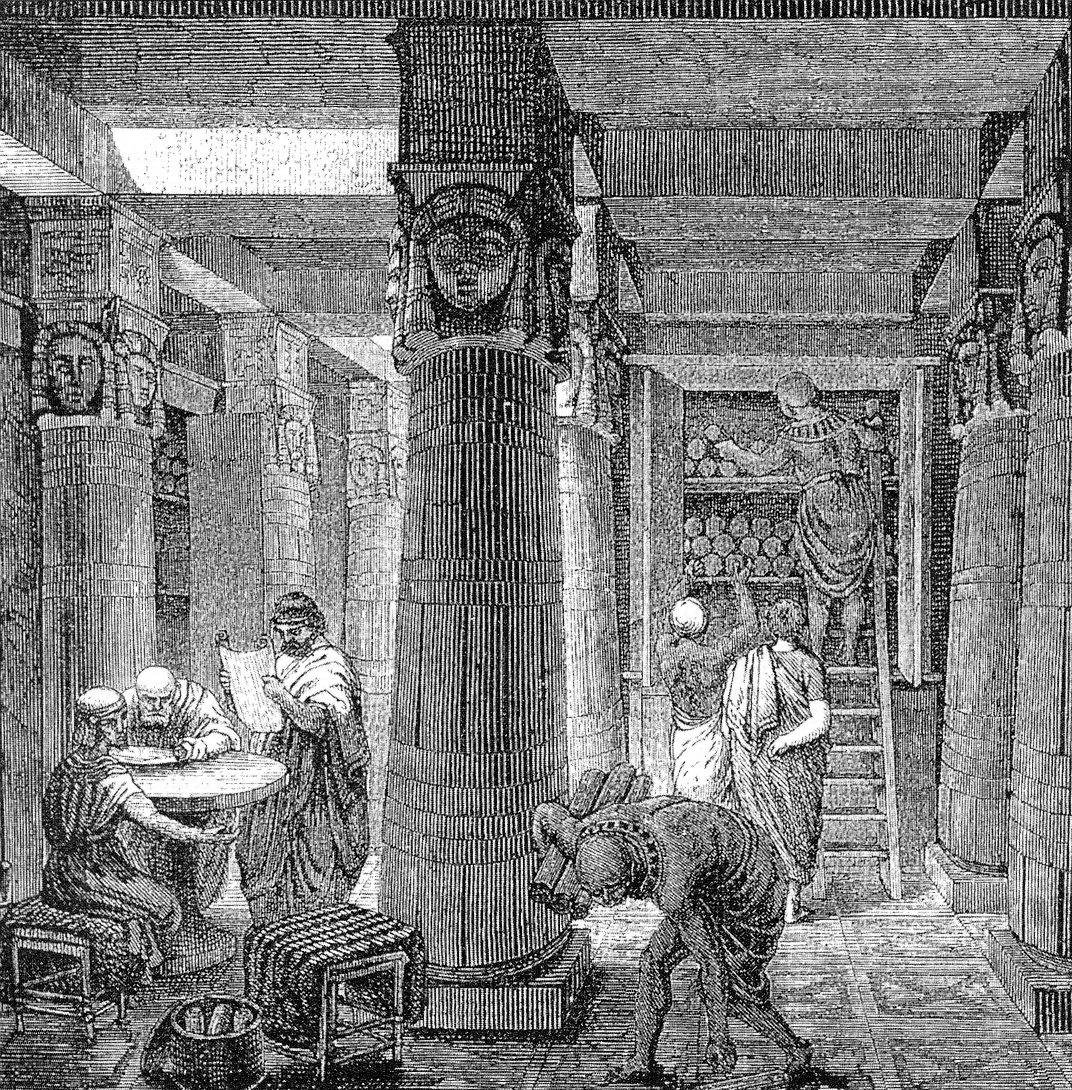
The most famous library of the ancient world, the Library of Alexandria, is famous primarily for its destruction — though there is more scholarly dispute about when, how, and how completely it was destroyed than the popular imagination suggests. What is less often discussed is its architecture, which we can only reconstruct from ancient accounts: it appears to have been part of a larger scholarly complex, the Mouseion (from which the modern word "museum" derives), that included lecture halls, gardens, a dining hall for scholars in residence, and the library proper. The library's collection — estimated at its height at between 400,000 and 700,000 scrolls, though these figures are debated — was organized in the systematic classification that became the basis of all subsequent Western library cataloging.
The architectural problem of the ancient scroll library was primarily one of storage and access. Papyrus scrolls are fragile, susceptible to moisture, insects, and rodents, and require particular conditions of temperature and humidity for long-term preservation. The scroll library used pigeonholes — small rectangular niches in masonry walls, each holding a scroll or a group of related scrolls in a cylindrical container — as its primary storage system. The niches were typically labeled with the title of the scroll and the name of the author, providing a system of identification that functioned as a catalog integrated into the physical storage arrangement. Reading rooms in the ancient world were separate from the storage rooms — you asked for a scroll, it was retrieved for you, and you read it in a dedicated space. The idea of open-stack browsing — walking through the storage area and choosing your own book from the shelf — was not part of the ancient library's spatial logic.
The Roman bibliotheca developed a distinctive architectural form that is well-documented through surviving examples and descriptions. The most studied is the Library of Celsus in Ephesus (completed 117 CE), whose elaborately ornamented facade is one of the best-preserved examples of Roman decorative architecture. The interior consisted of a large rectangular reading room with niched walls — the scroll-holding pigeonholes were arranged in shallow rectangular niches framed by columns and pilasters — surrounded by a narrow aisle that provided an air gap between the scroll-containing wall and the exterior, protecting the collection from damp. The upper levels of niches were reached by galleries that ran along the walls at the level of each tier, connected by internal stairs. The reading room was lit by large windows in the upper walls and possibly by a clerestory; the combination of generous windows and light-colored marble surfaces would have made it well-lit by ancient standards.
The monastic library
The tradition of the monastic library begins in the 6th century, when Benedict of Nursia's Rule for monasteries included provisions for reading as a daily spiritual practice and for the collection and copying of manuscripts as a form of work. The Benedictine monasteries of the early medieval period were the primary institutions for the preservation and transmission of ancient texts, and the library was one of the essential spaces of the monastery, alongside the church, the refectory, and the dormitory.
The early medieval monastic book collection was typically kept in a single room, often called the armarium — a word that originally meant a cupboard or chest, reflecting the small scale of early medieval collections. Books were chained to reading desks or shelves to prevent their removal, a practice that continued in larger libraries until the 17th century: a chained book could be read in place but not taken away, and the chain was long enough to allow the book to be carried to an adjacent reading desk but not removed from the room. The carrel — a small individual reading alcove, typically positioned against the exterior wall of the library to take advantage of north-facing windows — was the standard provision for individual study. The preference for north-facing windows was deliberate: north light is consistent throughout the day and does not change angle rapidly, providing a steady working light without the glare or bleaching effect of direct sunlight, which was known to damage the ink and parchment of manuscripts.
The great monastic libraries of the high medieval period — the abbey libraries of Cluny, St. Gall, Melk, and the Dominican and Franciscan convents of the 13th century — developed an architectural form that combined the book-storage function with the reading function in a single long hall. The typical layout placed double-sided bookcases at right angles to the exterior walls, creating a series of alcoves between the cases, each alcove lit by a window in the exterior wall and containing reading desks at which readers could work by the light of the adjacent window. This layout — which can be seen in surviving libraries at Trinity College Dublin, Wren Library Cambridge, and the Biblioteca Medicea Laurenziana in Florence — is elegant in its simplicity: the window provides light for reading at the desk immediately in front of it, and the bookcase flanking the alcove provides the books most immediately relevant to whoever is working in that alcove. The collection and the reading space are integrated at the scale of the individual alcove rather than separated into different rooms.
The Enlightenment reading room
The transformation of the library from a monastic or collegiate institution serving a small community of scholars into a public institution serving the general educated population began in the 18th century, driven by Enlightenment ideals of universal access to knowledge and the practical expansion of printing, which made books cheap enough to be owned by the middle class. The great public libraries of the 18th and 19th centuries were designed as civic monuments — buildings whose scale and architectural ambition announced that knowledge was a public good, not a private privilege.
Henri Labrouste is the central figure in the transformation of 19th-century library architecture. His Bibliothèque Sainte-Geneviève in Paris (1851) was the first major public building to express its iron structure aesthetically — to use the structural system not merely as an engineering solution concealed behind a conventional masonry exterior, but as a visible, designed element of the building's architectural character. The exterior of the Bibliothèque Sainte-Geneviève is masonry — a restrained stone facade in the classical tradition — but the interior of the reading room is entirely different: two parallel barrel vaults of cast iron and terracotta, supported on a row of slender cast-iron columns running down the center of the reading room, admit natural light through large arched windows at both ends of the hall. The iron columns are as slender as physically possible for their load — much slimmer than equivalent stone columns would have been — and their delicacy gives the reading room a lightness and spaciousness that masonry construction could not have achieved. Labrouste used iron not as a hidden engineering solution but as an architectural material with its own aesthetic possibilities: the tracery of the vault, the profiles of the columns, and the decorative spandrels between the arches are all designed with as much care as a stone building's ornamental details.
The British Museum Reading Room (Sydney Smirke, 1857), housed within the courtyard of Robert Smirke's earlier museum building, is the most celebrated 19th-century library interior in the English-speaking world. The circular reading room — a dome 42.6 meters in diameter and 32 meters high, supported on cast-iron ribs — was designed to accommodate 300 readers simultaneously, each at an assigned numbered desk arranged in radiating rows around the central catalog desk. The dome is lit by a glazed oculus at the crown and by two rings of windows in the drum below, giving the interior a quality of diffused, even light. Karl Marx, Charles Darwin, Lenin, and Virginia Woolf are among the celebrated readers who worked in the British Museum Reading Room; it was one of the most concentrated sites of intellectual production in the 19th and early 20th centuries. The Reading Room was decommissioned as a working library in 1997, when the British Library moved to its new building in St. Pancras, and it is now used as a public gallery and event space within the Great Court of the British Museum.
The 20th-century public library
Andrew Carnegie, the Scottish-American industrialist who made his fortune in steel, funded the construction of 2,509 library buildings between 1883 and 1929, in cities and towns across the United States, Britain, Canada, Australia, and beyond. The Carnegie libraries were explicitly civic institutions — free public libraries, owned by the community, open to all — and their architecture was designed to reflect their civic purpose. A typical Carnegie library is a dignified single-story or two-story building in a classical or Beaux-Arts style, with a stone or brick exterior, a prominent entrance, large windows, and an interior organized around a single open reading room lit from above or from large side windows. The Carnegie libraries were small enough to be intimate — the collection and the reading room could both be taken in at a glance — but substantial enough to be clearly civic rather than domestic in character.
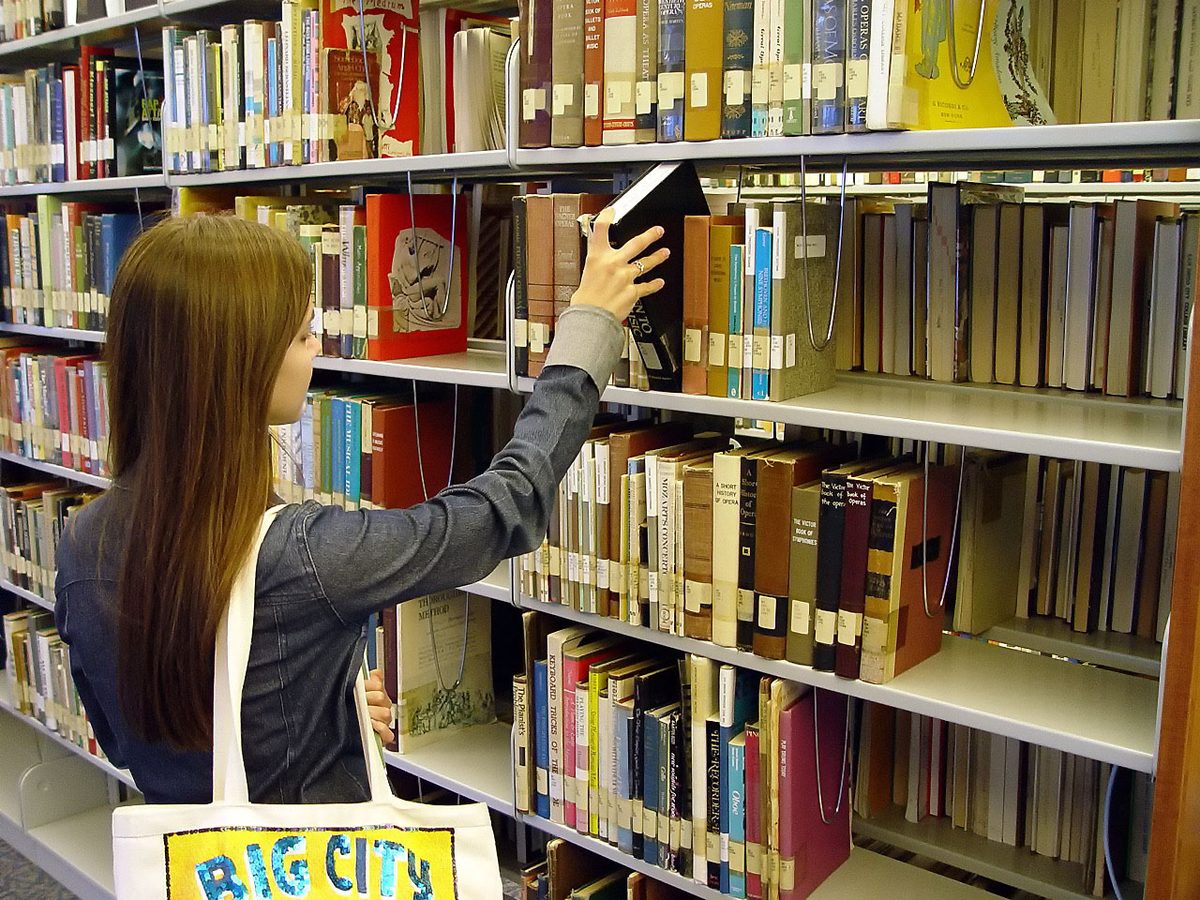
The mid-20th-century public library adopted the modernist aesthetic of the postwar period: flat roofs, glass curtain walls, open plan interiors, and the functional separation of book storage (typically in compact shelving in a basement or service area) from reading and study spaces (open, well-lit, with views to the outside). The shift from closed to open stacks — from a system where library staff retrieved books for readers to a system where readers browse and retrieve their own books from open shelves — transformed the spatial organization of the library, integrating the storage function with the circulation and reading functions in a single open space. This integration demanded careful attention to lighting: the reading requirement for natural light and the storage requirement for protection from ultraviolet degradation were in tension, requiring shading strategies and supplementary artificial light.
The late 20th century statement library
The last decades of the 20th century produced a series of landmark library buildings that were designed as major architectural statements as well as functional institutions. The British Library in St. Pancras (Colin St John Wilson, opened 1997) was one of the most expensive and most criticized public buildings in British architectural history — its construction took over twenty years and its red-brick exterior, in a humanist modernist style influenced by Alvar Aalto, was widely condemned by critics who preferred either the stripped Georgian classicism of its Bloomsbury context or the high-tech modernism that had become fashionable in the 1980s. The interior, however, is widely admired: the great entrance hall, with its view through glass walls into the six-story tower of the King's Library (a collection of books from George III's library, housed in a bronze-and-glass tower at the center of the building), is one of the most impressive public spaces in London. The building has been in continuous use since opening and has performed its function with a reliability that its troubled construction history did not predict.
The Bibliothèque nationale de France (Dominique Perrault, 1995) is the most controversial late 20th-century library building in France and one of the most debated library buildings of the period. President Mitterrand's decision to build a new national library — one of his Grands Travaux, the series of major public buildings that transformed central Paris in the 1980s and 1990s — generated a brief that called for the world's greatest library. Perrault's winning design placed four L-shaped glass towers at the corners of a rectangular site above the Seine, enclosing a sunken courtyard planted with full-grown pine trees transplanted from a forest in Normandy. The towers were designed to hold the open-access reading rooms and the storage stacks in a single vertical volume; the reading rooms were located in the lower floors of the towers, overlooking the sunken forest courtyard, while the stacks occupied the upper floors. The design was immediately criticized by librarians and conservators, who pointed out that putting books in glass towers exposed them to light and temperature fluctuation that would accelerate their deterioration; the towers were subsequently fitted with wooden shutters that are permanently closed, making the glass facades opaque and rendering the architectural concept largely meaningless in practice.
The 21st century library
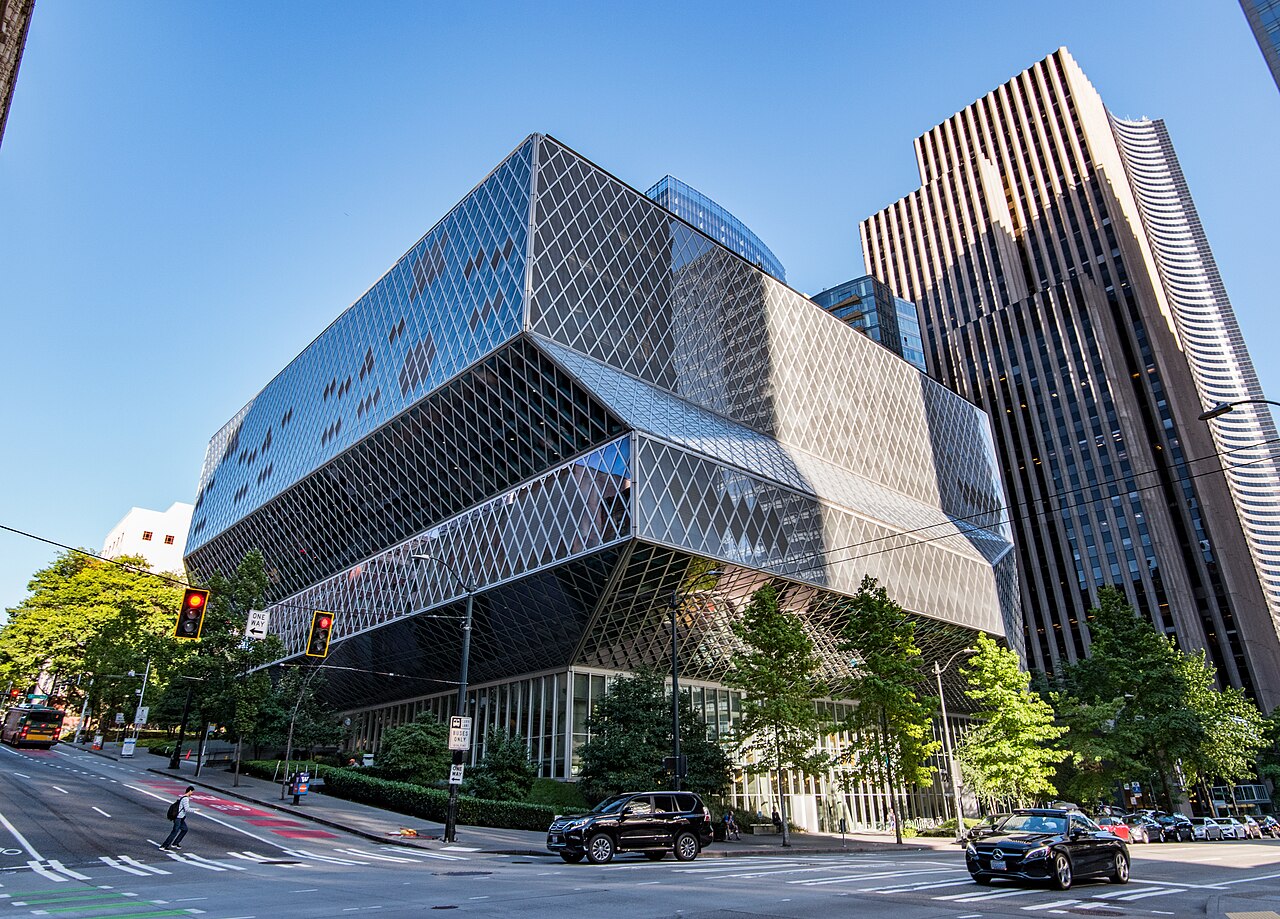
The Seattle Central Library (OMA/Rem Koolhaas, 2004) is the most influential library building of the early 21st century, and it is influential precisely because it abandoned the conventional assumption that a library's primary purpose is to store and provide access to books. OMA's design process began with a radical interrogation of the library's mission: what is a library for in an era when information is available on the internet, when the physical book is no longer the primary medium of knowledge, and when the community that a public library serves includes people who do not use books at all but need a place that is warm, accessible, and staffed by knowledgeable people?
The answer to this question produced a building organized around a book spiral — a continuous sloping floor that winds through several levels of the building, with the entire non-fiction collection arranged in continuous Dewey Decimal order along the spiral. The spiral eliminates the floor-to-floor breaks in the conventional library that interrupt the continuity of the classification system and require the reader to take an elevator or stairs to continue browsing. Walking along the spiral, the reader moves seamlessly from one subject to the next without any spatial interruption, and can always see both the subjects that precede and follow the one they are currently browsing. This is a spatial solution to a fundamentally organizational problem: the conventional library stack fragment the collection at arbitrary points determined by the building's floor levels, while the spiral presents the collection as a continuous sequence that matches the structure of the classification system.
The Seattle Central Library's exterior — a faceted glass-and-steel skin with a complex geometry that follows the internal organization of the building — is equally distinctive. The different functional areas of the library (the book spiral, the mixing chamber for informal social use, the reading room, the children's library) have different spatial requirements, and the building's section accommodates them by varying the height and orientation of different levels. The exterior envelope wraps these varying volumes in a single faceted skin that expresses the internal complexity without revealing it directly. The building was widely praised and widely imitated — though rarely matched — and it established the argument that a 21st-century library should be designed around the question of what people do, not around the assumption that what people do is look at books.
Regional Variations
The American public library tradition is the most extensive in the world, in part because of the Carnegie program and in part because the American tradition of public education placed the library at the center of civic culture in a way that European traditions, with their stronger emphasis on academic and national libraries, sometimes did not. American public libraries, from the Carnegie libraries of the 1880s to the branch libraries of the 21st century, have consistently been designed as welcoming, accessible community buildings — low thresholds, easy orientation, open hours — rather than as imposing institutional monuments. The recent generation of American library buildings, including libraries by Snohetta, Tod Williams Billie Tsien, and Allied Works, continues this tradition while incorporating the digital-era programming that now includes maker spaces, recording studios, 3D printers, seed libraries, and social services alongside books and reading rooms.
The Scandinavian library tradition has produced some of the most admired library buildings of the late 20th and early 21st centuries, combining the Nordic commitment to public welfare with a design culture that values quality of materials, quality of light, and the relationship between interior space and landscape. Alvar Aalto's library buildings — Viipuri (1935), Seinäjoki (1965), and the Mount Angel Abbey Library in Oregon (1970) — are among the most studied library buildings in the world, celebrated for the quality of their natural lighting (Aalto's skylights produce a diffused, shadowless light that is ideal for reading) and for the humanity of their spatial sequences. The Dokk1 library in Aarhus, Denmark (Schmidt Hammer Lassen, 2015) is the most recent addition to this tradition: a large public library on the waterfront, organized around a spiraling interior ramp that recalls the Seattle book spiral but in a more generous, civic register, with extensive space for children's programming, maker activities, and social services alongside traditional library functions.
In the United Kingdom, the library tradition is bifurcated between the great academic and national libraries — the Bodleian, the British Library, the university libraries of Oxford and Cambridge — and the much more modest public library network that has been severely cut since 2010. The academic libraries have continued to invest in major architectural projects: James Stirling and Michael Wilford's History Faculty Library at Cambridge (1968) is one of the most celebrated — and most criticized — library buildings of the 20th century, its glass roof producing spectacular light but also spectacular heat and glare. More recent academic library buildings, including the Weston Library at Oxford (Dixon Jones, 2015) and the Library of Birmingham (Mecanoo, 2013), demonstrate that major library architecture can be both functionally excellent and architecturally ambitious in a way that the public library network, with its constrained budgets and reduced ambitions, can rarely achieve.
The Asian library tradition has produced a wave of major library buildings in the early 21st century, particularly in China and South Korea, where rapid urbanization and strong government investment in public institutions have created opportunities for libraries of a scale and ambition rarely achievable in Western countries. The National Library of China in Beijing, the library quarter of Tianjin, and the Tianjin Binhai Library (MVRDV, 2017) — with its dramatic atrium of bookshelves rising from floor to ceiling in a continuous curved surface that has been widely photographed and widely reproduced in social media — are among the most visited library buildings in the world. The Tianjin library's bookshelves are partly ornamental — many of the books are replicas, and the highest levels of the shelving are not accessible to readers — but the spatial experience of the atrium is genuinely dramatic and has introduced millions of people to the visual possibility of the library as a spectacular interior space.
Key Identifiers: Library Architecture
- Reading room with top-lit dome or barrel vault — the central reading room lit from above, either through a glass dome or a barrel-vaulted skylight, is the defining image of the 19th-century library; the diffused, even overhead light is ideal for reading
- Iron or steel structure visible — from Labrouste's Bibliothèque Sainte-Geneviève onward, the expression of the structural system as an architectural element has been a recurring feature of library architecture; slender iron or steel columns and vaults are a strong period indicator
- Stacks visible through glass — in contemporary libraries, the book collection visible through glass walls or floors signals the integration of storage and public space that characterizes post-open-stack library design
- Generous natural light — libraries consistently prioritize natural daylight for reading; north-facing windows, skylights, and clerestories are all characteristic features of library design across periods
- Open plan ground floor — the contemporary library convention of a welcoming, open ground floor level with good sight lines and easy orientation differs from the cellular, stack-filled floors of older libraries
- Carrels and alcoves — individual reading alcoves against exterior walls, each with a window providing north or diffused light, are characteristic of monastic and collegiate library design and persist in academic libraries
- Classical stone exterior with large arched windows — the Carnegie library and 19th-century public library type typically presents a dignified classical or Beaux-Arts exterior with large arched windows indicating the reading room inside
- Continuous sloping floor or ramp — the 21st-century library innovation of the book spiral or reading ramp, used to integrate the collection with the circulation, is a distinctive spatial feature visible in section if not in exterior photographs

A Closer Look: Bibliothèque Sainte-Geneviève, Paris
Henri Labrouste's Bibliothèque Sainte-Geneviève (1851) is one of the pivotal buildings in architectural history, and its significance lies not in its program — a university library on the Left Bank of Paris — but in what it demonstrated was possible with the new industrial material of cast iron. Labrouste was trained in the Beaux-Arts tradition, but he was deeply influenced by the rationalist and archaeologically minded architectural theory of the Académie des Beaux-Arts, which argued that historical architectural forms should be understood as the expression of the structural and functional logic of their time. If this argument was correct, then the new structural possibilities of cast iron and wrought iron should generate new architectural forms, not be concealed behind conventional masonry facades. The Bibliothèque Sainte-Geneviève is the first major public building to make this argument in built form.
The exterior of the building is conventional — a two-story masonry building in a restrained classical style, its upper-story windows framed by arch-headed openings that run continuously around the facade. The windows are inscribed with the names of approximately 810 authors whose works are held in the library, etched in the stone of the window reveals. This inscription — the catalog made visible on the exterior — is an idea of remarkable originality: the building announces its contents not through iconographic sculpture (the conventional Beaux-Arts approach) but through direct, typographic listing of the works inside, as if the building is itself a bibliographic index. Walking around the exterior of the Bibliothèque Sainte-Geneviève, you are reading the library's collection in a literal sense.
The interior of the reading room is the moment of revelation. The ground floor is conventional — low, masonry, with book storage in cast-iron compartments along the walls. But the reading room on the upper floor opens into a two-bay hall whose roof is carried on two parallel barrel vaults of cast iron and terracotta, supported on a single row of slender cast-iron columns running down the center of the room. The vaults are semi-circular in section, approximately 20 meters wide across each bay and 16 meters high at the crown, and they are carried on iron ribs that spring from the capitals of the columns in a manner that recalls Gothic vaulting but is expressed entirely in the vocabulary of industrial construction. The iron is not disguised: the columns are iron, profiled in a way that acknowledges their iron nature; the ribs of the vault are iron, and the panels between the ribs are terracotta infill that is visibly different in material from the structural frame. The reading room is 80 meters long and can accommodate approximately 450 readers; the natural light from the large windows at both ends and from the glazed panels in the vault creates a working light that is bright, even, and diffused — exactly what readers need.
Spotting It in Building Guessr
Library buildings are among the most architecturally distinctive institution types in the game, and their visual signatures vary by period. A 19th-century public library can typically be identified by the combination of a classical or Beaux-Arts stone facade, large arched windows indicating the reading room on the upper floor, and a prominent entrance with steps — the Carnegie library formula is consistent enough that recognizable examples appear on several continents. The interior of the 19th-century reading room — the top-lit dome, the iron vaulted structure, the rows of reading desks with their green-shaded lamps, the card catalog in the center — is one of the most distinctive interior types in building photography, and its identification is usually unambiguous.
Contemporary library buildings are harder to identify without context, because the visual language of contemporary library design overlaps with offices, cultural centers, and civic buildings of all kinds. The strongest visual clue is the visibility of books — the book collection visible through glass walls or floor-to-ceiling shelving — combined with the distinctive quality of light (generous natural daylight, typically from above) and the presence of reading tables rather than workstations. The Seattle Central Library's faceted glass exterior is immediately recognizable to anyone who has seen it; similarly distinctive contemporary libraries include the Dokk1 in Aarhus (a large circular building with wooden fins on its exterior, on the waterfront), the Library of Birmingham (a building of concentric rings that step up from the street, with rooftop terraces at each level), and the Tianjin Binhai Library (the dramatic curved-shelf atrium, which has become one of the most widely reproduced architectural interior photographs of the 21st century).
Find library buildings and civic institutions in the Public Buildings filter.
Play Building GuessrFurther Reading
Sources & further reading
Reference material this page draws on, and where to read further. External links open third-party sites.
- Library · Wikipedia
- Library of Alexandria · Wikipedia
- Rem Koolhaas · Wikipedia
- Seattle Central Library · Wikipedia
- Bibliothèque nationale de France · Wikipedia
- Stadtbibliothek Stuttgart · Wikipedia