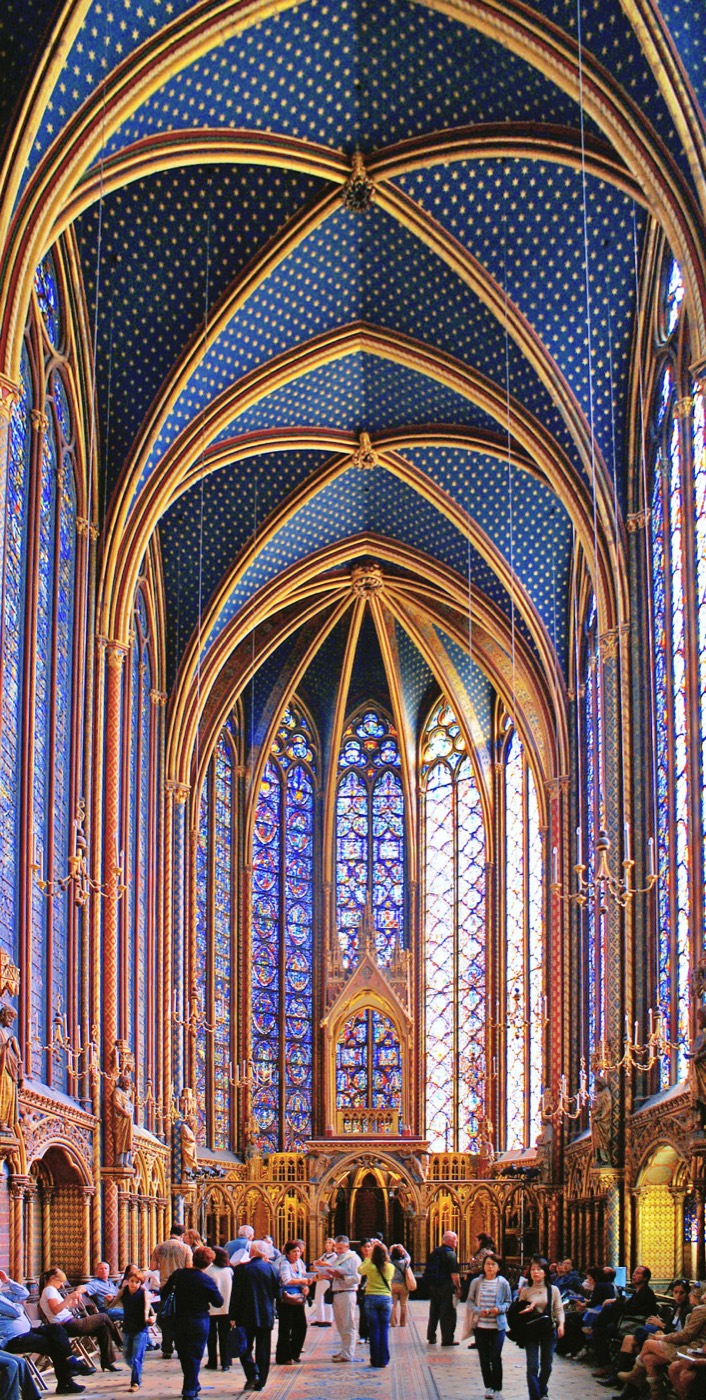
Medieval stained glass is one of the few art forms where the medium and the architecture are inseparable. The windows do not decorate the walls of a Gothic cathedral — they replace them. They exist because the Gothic structural system, with its pointed arches and flying buttresses, transferred the load of the vault away from the walls and onto external piers, freeing the wall to become something that had never existed in architecture before: a membrane of colored light that dissolved the boundary between interior and exterior, between the physical building and the light that animated it. To understand stained glass is to understand why Gothic cathedrals look the way they do, and to understand Gothic cathedrals is to understand why their windows say what they say.
How stained glass works
The basic technology of stained glass is older than the Gothic period — colored glass was being used in church windows at least as early as the 7th century — but the medieval achievement was to develop it into an art form of extraordinary complexity and refinement. The process begins with pot-metal glass: glass colored throughout its mass by adding metallic oxides to the molten batch before blowing. Copper produces blue-green and red; cobalt produces deep blue; manganese produces purple; iron produces yellow and green; gold produces the ruby red that became the most prized and expensive color in the medieval glazier's palette.
The colored sheets are then cut to the desired shapes using a hot iron or, from the 13th century, a grozing iron (a notched tool for nibbling away glass at the edges). The cut pieces are painted with grisaille — a mixture of iron oxide, copper oxide, and ground glass suspended in a binding medium — to add details: faces, hands, drapery folds, architectural backgrounds, inscriptions. The grisaille is fired in a kiln, fusing it permanently to the surface of the glass. The painted and cut pieces are then assembled by enclosing each piece in a channel of lead came — an H-shaped lead strip — and soldering the joints where came meets came. The completed panel is set into the window opening and stabilized with iron armatures (ferramenta) that prevent it from bowing under wind pressure.
The result is a surface that behaves unlike any other material in architecture. In transmitted light — sunlight passing through from outside — the colors are luminous, saturated, and brilliant in a way that no pigment on a wall can match. In reflected light — looking at the window from outside, or viewing it on a cloudy day — the same surface is dark and opaque, the colors muddy and indistinct. Stained glass only works in one direction: it is an art form that requires the sun. This dependence on natural light means that every window in a Gothic cathedral changes throughout the day as the sun moves, and throughout the year as the angle of light changes. The building itself changes with the weather and the season in ways that a painted interior cannot.
Why Gothic architecture created the conditions
The connection between Gothic architecture and stained glass is not accidental. It was the specific structural logic of Gothic building — the pointed arch, the ribbed vault, and above all the flying buttress — that made large-scale glazing possible. In Romanesque architecture, which preceded the Gothic, the walls were load-bearing: they carried the weight of the stone vault above, which meant they had to be thick, heavy, and largely solid. Windows could only be small without weakening the wall's structural capacity. The interiors of Romanesque churches are consequently dim, lit by small round-headed windows that let in relatively little light.
The Gothic structural revolution transferred the vault's load from the walls onto a skeleton of piers, arches, and external flying buttresses. The wall between the piers was no longer structural — it was simply an enclosure. If the wall was not carrying load, it could be as thin as the builders dared, or it could be replaced entirely by glass. This is what the great Gothic builders did: they dissolved the wall into a grid of stone tracery — the delicate stone framework that divides the window opening into sections — and filled the spaces between the tracery with colored glass. The wall became a grid of stone lines and glass panels, a structure that was technically a window but functioned architecturally as a wall.
The theological justification for this transformation was provided most influentially by Abbot Suger of Saint-Denis, near Paris, who rebuilt his abbey church between 1135 and 1144 in what is usually identified as the first fully Gothic building. Suger was deeply influenced by the Neo-Platonic theology associated with Dionysius the Areopagite, which identified divine light with spiritual illumination. For Suger, the flooding of the church interior with colored light was not merely aesthetic — it was a theological statement about the nature of the divine. Light did not simply reveal the material world; it was itself a manifestation of divine reality. A church whose walls were dissolved into light was a church that enacted this theology in its architecture.
Reading a window
Medieval stained glass windows were not simply decorative. They were one of the primary media through which the church communicated theological and narrative content to a congregation most of whom could not read. Understanding how to read a window requires understanding the organizational conventions that medieval glaziers used.
Most narrative windows are organized into medallion panels: circular, square, or quatrefoil frames enclosing individual scenes. These panels are stacked vertically in the window opening, and the sequence is read from bottom to top — the base of the window closest to the viewer contains the earliest scenes, and the story climbs toward the top of the window. Individual scenes within a medallion are read left to right, as in a text. The organizational logic is therefore literally that of a book: bottom to top, left to right, the reader moving through the window as through pages.
The narrative content of medieval windows typically follows one of several programs. The most common is the typological program, in which scenes from the Old Testament are paired with scenes from the New Testament that they are understood to prefigure. Abraham's sacrifice of Isaac, for example, prefigures the Crucifixion; the crossing of the Red Sea prefigures Baptism; Jonah emerging from the whale prefigures the Resurrection. These pairings were not invented for the windows — they were a standard feature of medieval biblical interpretation, derived from patristic sources — but the windows made them visually immediate in a way that a theological commentary could not. A worshipper who could not read could nonetheless learn the typological program of salvation history by looking up at the windows during the liturgy.
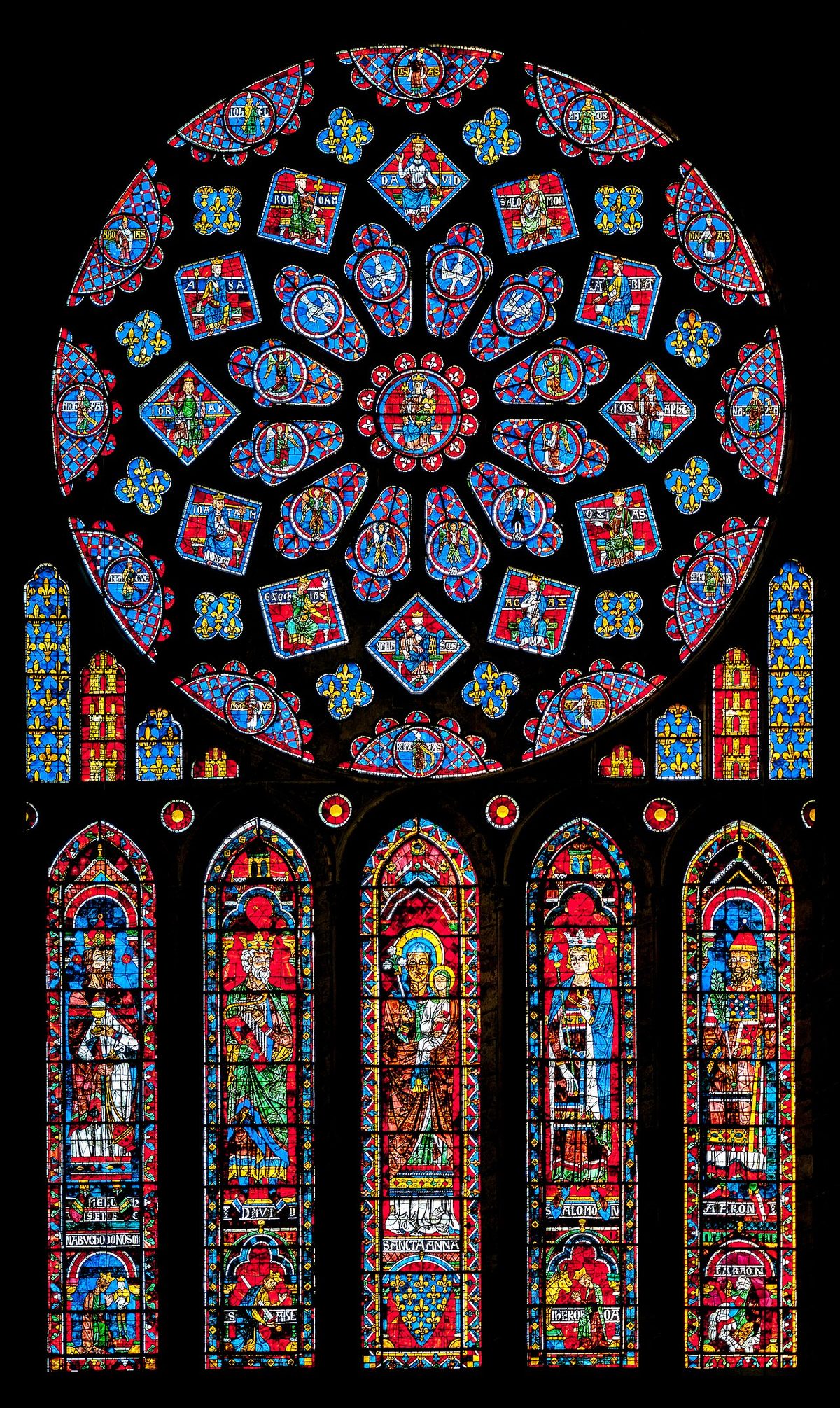
Alongside narrative windows, most Gothic cathedrals include donor portraits: images of the individuals, guilds, or institutions that paid for particular windows. These portraits are typically placed at the base of the window, beneath the narrative scenes, as if the donor is kneeling before the sacred story. The guilds of Chartres Cathedral are documented in exactly this way: the furriers, the money-changers, the water-carriers, the shoemakers, and dozens of other trades are shown in their occupational dress at the base of the windows they paid for. These images are now among the most important documents of 13th-century commercial and social life in northern France.
The great programs
Chartres Cathedral has the most complete surviving medieval glazing program of any building in the world. Of the approximately 176 windows, most of the medieval glass survives — an extraordinary survival given the building's age, the wars that have been fought across northern France, and the iconoclastic campaigns of the Reformation and the French Revolution. The windows at Chartres date from two main campaigns: the early 13th century, when the cathedral was rebuilt after a fire in 1194, and a slightly later campaign in the mid-13th century. The range of subjects covers the entire span of Christian history from the Creation to the Last Judgment, with dozens of saints' lives, Old Testament narratives, and typological programs organized across the windows of the nave, choir, transepts, and ambulatory chapels.
The Sainte-Chapelle in Paris (completed 1248) takes the Gothic logic to its extreme: the upper chapel has no wall at all, only 15 windows covering approximately 600 square meters of glass surface. The windows contain 1,113 biblical scenes arranged in 15 narratives, from Genesis through the Apocalypse, presented in a richly colored glass that makes the interior of the chapel one of the most extraordinary light environments in any building in the world. The Sainte-Chapelle was built by Louis IX of France (later canonized as Saint Louis) to house relics of the Passion, including what he believed to be the Crown of Thorns, and the building's entire architectural logic is organized around the idea that the relics are housed within a reliquary that has been expanded to the scale of architecture.
Canterbury Cathedral and Bourges Cathedral represent the English and French provincial traditions respectively. Canterbury's glass includes some of the oldest surviving English medieval glass, dating from the late 12th century, and its iconographic program is particularly focused on the cult of Thomas Becket, whose martyrdom in 1170 made Canterbury the most important pilgrimage site in England. The Becket windows in the Trinity Chapel show scenes of miracle cures performed through the saint's intercession, organized as documentary evidence of sanctity — essentially illustrated case studies of the miraculous. Bourges has particularly fine 13th-century glass in its double ambulatory, with typological windows that show the pairing of Old and New Testament scenes with exceptional clarity and formal elegance.
Post-medieval stained glass
The Gothic period was the golden age of stained glass, but the tradition did not end with it. What changed in the Renaissance was the dominant technique: as painters became increasingly interested in representing three-dimensional space and illusionistic figures, they applied the same approach to glass, using enamel paints — colored glass powders fired onto the surface of clear or lightly tinted glass — to paint entire scenes as if on a canvas. The result was less brilliant than pot-metal glass — enamel paint is fired onto the surface rather than saturated through the mass — but it allowed the glazier to work with the full range of painterly technique: shading, perspective, foreshortening, atmospheric recession. The 16th and 17th centuries produced a great deal of virtuoso glass painting in this mode, particularly in Germany and the Netherlands, that is technically remarkable but aesthetically very different from the medieval tradition.
The 19th-century Gothic Revival produced a new demand for traditional stained glass in the medieval manner. John Ruskin and A.W.N. Pugin argued forcefully that modern glass should follow medieval principles — pot-metal coloring, lead cames, flat figure drawing — rather than the Renaissance painted tradition. Firms like Clayton and Bell in England and Zettler in Germany produced enormous quantities of Gothic Revival glass, of varying quality, for the new and restored churches of the Victorian period. The best of this work is technically accomplished and can be difficult to distinguish from genuine medieval glass without careful examination; the worst is mechanical and lifeless.
The 20th century brought artists of major stature to the medium. Marc Chagall designed windows for the Hadassah Medical Center in Jerusalem (1962), the Fraumünster in Zurich, and most notably the reglazed apse windows of Reims Cathedral — the cathedral whose original medieval glass was largely destroyed in World War I. Chagall's windows at Reims use brilliant color and freely distorted figuration that is simultaneously influenced by the medieval mosaic tradition and entirely of the 20th century. Henri Matisse designed the entire interior decoration, including the stained glass, of the Chapelle du Rosaire at Vence in southern France (1951), working with a palette of pure primary colors and simplified leaf and flower forms that achieve a luminous clarity comparable to the best medieval work.
Regional Variations
The French tradition of medieval glass is characterized by mosaic glass: windows composed of many small pieces of richly colored pot-metal glass, each piece carrying a small amount of grisaille detail, assembled into complex pictorial compositions. The colors are typically saturated and intense — the deep blue of Chartres (made with cobalt imported from Germany at great expense) and the ruby red (made with gold, which made it the most expensive color) are the defining tones of the French tradition. The mosaic technique produces windows that are visually complex, reading from a distance as rich tapestries of color rather than as legible individual figures. The narrative content is communicated through repeated conventions — standard poses, standard attributes for saints, standard compositional schemes for familiar scenes — that a medieval viewer would have recognized immediately from other visual programs.
The German tradition of the same period developed in a different direction. German glaziers of the 12th and 13th centuries worked with larger pieces of glass, sometimes with figures that are painted more freely and with greater concern for the individual face and gesture. The painted glass tradition that became dominant in Germany from the 14th century onward — using enamel paints on clear glass to produce images that are essentially paintings on transparent surfaces — was partly a technical preference and partly a reflection of the German artistic tradition's stronger orientation toward naturalistic figure painting. The best German medieval glass, particularly the early work at Augsburg and the 12th-century windows at Poitiers (which show German influence), has a grandeur of individual figures that is different in character from the French mosaic tradition.
The English grisaille tradition represents a third major approach. Grisaille glass — panels composed of clear or lightly tinted glass painted with leaf and geometric patterns in gray-black grisaille paint, without the rich colors of French mosaic glass — was particularly favored in England, partly for theological reasons (Cistercian monasteries required aniconic glass) and partly because it let in more light while still providing a decorative and non-transparent window surface. The Five Sisters window at York Minster (1250s) is the most famous example: five narrow lancet windows, each approximately 16 meters high, filled entirely with gray-green grisaille glass in elaborate geometric patterns. The effect is austere and luminous in a way entirely different from the jeweled richness of Chartres or Sainte-Chapelle, and equally extraordinary in its own terms.
The English tradition also produced, in the late medieval period, some of the finest figured glass in Europe. The Great East Window at York Minster (John Thornton of Coventry, 1405–1408) is the largest area of medieval stained glass in the world — approximately the size of a tennis court — and it presents the entire narrative of Revelation alongside extensive Old Testament scenes and portraits of bishops and kings, all in a glass painting style of exceptional refinement. The window was cleaned and releaded in a major conservation campaign completed in 2018, which took over a decade and is one of the largest and most technically complex conservation projects ever undertaken on a medieval artwork.
Key Identifiers: Stained Glass Windows
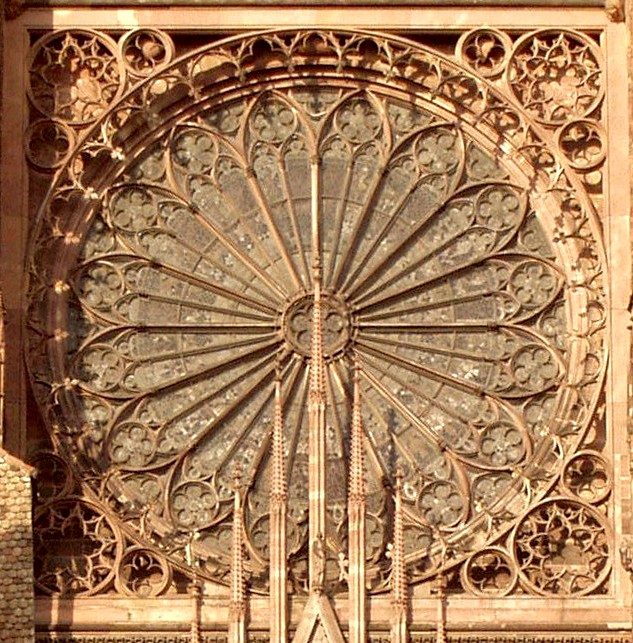
- Rose window — a circular window, typically at the west end of a Gothic nave or at the transept ends, filled with radiating tracery and colored glass; the definitive image of Gothic glazing
- Lancet window — a tall, narrow window with a pointed arch at the top; the basic unit of Gothic glazing, used singly or in groups of two, three, or five
- Medallion composition — circular, square, or quatrefoil frames enclosing individual narrative scenes, stacked vertically in the window opening and read from bottom to top
- Grisaille panels — windows composed of clear or pale glass painted with gray-black geometric or leaf patterns, without rich color; common in Cistercian and English contexts
- Clerestory position — the highest register of windows in a Gothic church, above the triforium (gallery level), admitting light directly into the nave and choir above the roof of the side aisles
- Tracery patterns — the stone framework dividing window openings into sections; the pattern of the tracery (plate tracery, bar tracery, flamboyant tracery) is a reliable indicator of period and regional origin
- Lead came network — the characteristic dark grid of lead lines visible through the glass from the interior, a necessary structural element that becomes a visual feature of the composition
- Donor portraits — figures in secular dress kneeling at the base of windows, or guild scenes showing the occupations of the craftsmen who paid for the glass
A Closer Look: Sainte-Chapelle, Paris
The Sainte-Chapelle in Paris is, by any measure, the most extreme expression of the Gothic idea that the wall should be dissolved into light. The upper chapel, completed in 1248 for Louis IX, has fifteen windows covering approximately 600 square meters, filling virtually every available wall surface between the structural piers. The windows are approximately 15 meters tall and contain 1,113 scenes arranged in 15 narrative sequences, beginning with Genesis in the first window and ending with the arrival of the Crown of Thorns in Paris in the last. The effect on entering the upper chapel is one of the most powerful spatial experiences in any building anywhere: the walls have ceased to be walls and the interior is flooded with colored light of a kind that has no counterpart outside the Gothic tradition.
The glass at Sainte-Chapelle is predominantly deep blue — cobalt blue — with red as the counterbalancing accent and smaller amounts of green, yellow, and purple. The dominance of blue gives the interior a cool, cerulean light on a clear day that photographers have found essentially impossible to reproduce accurately; the eye adapts to the colored light in a way that camera sensors do not. The scenes, while individually small (most are only a few centimeters across when examined close to), are organized with such clarity and compositional intelligence that they read legibly from the floor of the chapel even though the viewer is fifteen meters from most of the glass. The medieval glaziers understood that legibility at distance required strong value contrast (dark lines against light backgrounds, or vice versa) and clear silhouetting of the principal figures, and they organized their compositions accordingly.
The windows of Sainte-Chapelle suffered considerable damage during the French Revolution — the chapel was used as an archive and then as a courthouse, and much of the medieval glass was removed for safekeeping or damaged by neglect. A major restoration campaign in the 19th century, carried out by Jean-Baptiste-Antoine Lassus and Eugène Viollet-le-Duc, replaced missing sections with new glass designed to match the medieval original. The result is that some of what visitors now see is medieval and some is 19th-century reproduction; distinguishing the two requires close examination and expert knowledge. The restoration, whatever its limitations, preserved the overall effect of the glazing program and the spatial experience of the chapel, which would otherwise have been irreparably diminished.
Spotting It in Building Guessr
Stained glass windows are one of the most reliable indicators of Gothic or Gothic Revival architecture in the game. The presence of rose windows — circular windows at the west front or transept ends, filled with radiating tracery — immediately identifies a Gothic or Gothic Revival building. The lancet window (tall, narrow, pointed arch) combined with colored glass is equally specific. Any building with these features and a masonry exterior of stone or brick is almost certainly a cathedral, church, or major chapel, and the glazing program visible through the windows will often give clues to the period and regional tradition.
The distinction between genuine medieval glass and 19th-century Gothic Revival reproductions is often impossible to make from a photograph, but the building's overall condition and context provide clues. A building that appears well-maintained and relatively uniform in its materials is more likely to be a Gothic Revival building of the 19th century than a genuine medieval structure, which will typically show more evidence of repair, replacement, and accumulated alteration. The glass in a genuine medieval building is often visually inconsistent — different windows from different periods, different colors from different workshops — while Gothic Revival glass tends to be more uniform in quality and color palette. The geographic context also helps: medieval Gothic cathedrals are concentrated in northern France, England, Germany, and Spain; Gothic Revival glass is found worldwide, from American university chapels to Australian cathedrals.
Test your Gothic cathedral knowledge with the Religious Buildings filter.
Play Building GuessrFurther Reading
Sources & further reading
Reference material this page draws on, and where to read further. External links open third-party sites.
- Stained glass · Wikipedia
- Rose window · Wikipedia
- Chartres Cathedral · Wikipedia
- Sainte-Chapelle · Wikipedia
- Gothic architecture · Wikipedia
- Canterbury Cathedral · Wikipedia
- World Heritage listing: Chartres Cathedral · UNESCO World Heritage Centre
- World Heritage listing: Canterbury Cathedral · UNESCO World Heritage Centre