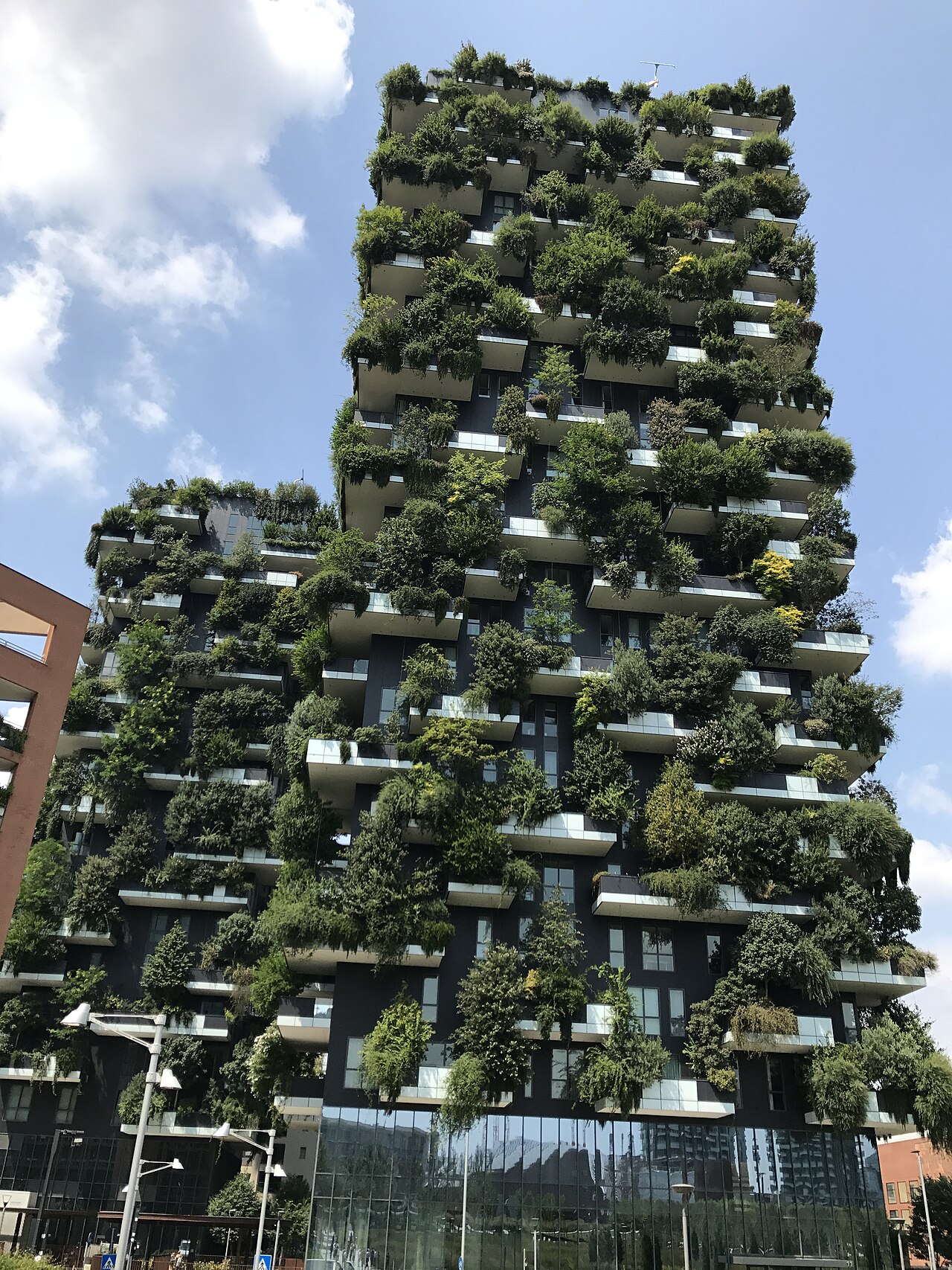
Architecture accounts for roughly 40% of global energy consumption. Across the lifecycle of a building — from the extraction and manufacture of its materials, through its construction, its decades of heating, cooling, lighting, and servicing, to its eventual demolition — the built environment is one of the largest contributors to carbon emissions of any human activity. How buildings are designed, built, and operated is one of the most consequential environmental questions of the 21st century, and architecture is only slowly catching up to the scale of the problem. The transition from buildings that consume energy to buildings that generate it, from buildings that destroy ecosystems to buildings that support them, and from buildings that make their occupants ill to buildings that make them well is underway — but it is nowhere near complete, and the gap between what is technically possible and what is actually built remains large.
The passive house standard
The Passivhaus (Passive House) standard was developed in Germany in the late 1980s by physicists Bo Adamson and Wolfgang Feist, and first implemented in a row of four terraced houses in Darmstadt in 1991. The standard is based on a straightforward physical principle: if a building's envelope is well enough insulated, and if the building is airtight enough to prevent uncontrolled heat loss, then the heat generated by the occupants' bodies, their appliances, and the sun through south-facing windows will be sufficient to maintain a comfortable interior temperature for most of the year without any conventional heating system. The energy required for the residual heating and cooling that is still needed can be delivered through a very small mechanical system — often a heat pump — whose energy demand is so low that it can be met by a small photovoltaic array on the roof.
The technical requirements of the Passivhaus standard are precise and demanding. The building envelope — walls, roof, floor, and windows — must be insulated to a level that limits heat loss to 15 kilowatt-hours per square meter per year, roughly one-tenth of the heating demand of a typical conventional building. The building must be airtight to a level that limits uncontrolled air infiltration to 0.6 air changes per hour at 50 Pascals of pressure difference (measured by a blower door test). A mechanical ventilation system with heat recovery — which draws fresh air in through a heat exchanger that recovers 80–95% of the heat from the outgoing stale air — is required to maintain air quality without the heat loss that would result from opening windows. Windows must be triple-glazed and thermally broken, with frames that do not conduct heat between the interior and exterior. Thermal bridges — junctions in the construction where heat can bypass the insulation layer — must be eliminated through careful detailing at every connection between wall, roof, floor, and window.
The result is a building that requires so little energy for heating and cooling that its energy bills are transformed. A certified Passivhaus building typically uses 75–90% less energy for space conditioning than a conventional building built to standard code. In cold climates, the elimination of the heating bill entirely is achievable: the residual heat demand is so small that it can be met by the heat generated by the occupants and their appliances. In hot climates, the same principle applies to cooling: a well-insulated, well-shaded, airtight building with controlled ventilation requires far less cooling energy than a conventional building that leaks heat and is not protected from solar gain.
Green roofs and living walls
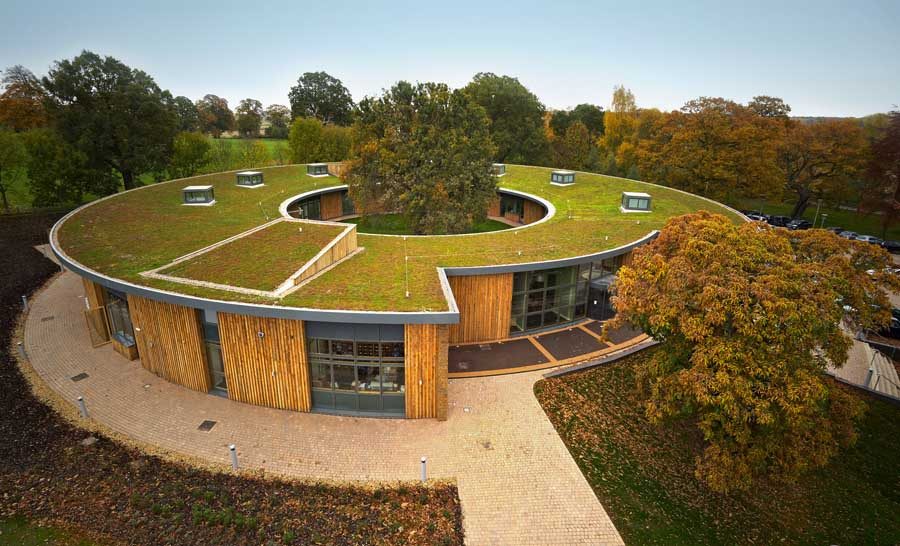
Green roofs — roofs partially or completely covered with vegetation, growing in a substrate of soil or engineered growing medium — have been used in Scandinavian vernacular building for centuries (the sod roof is a traditional feature of Norwegian farmhouses), but their contemporary application as a sustainable design strategy was developed primarily in Germany in the 1970s and 1980s. The German green roof industry is now the largest in the world, with green roofs mandatory on new construction in some German cities, and the technical systems for constructing them — waterproofing membranes, root barriers, drainage layers, growing media, and plant selection — have been extensively developed and refined over fifty years of practice.
A green roof provides multiple environmental services simultaneously. As a thermal layer, it adds insulation to the roof and moderates the temperature of the surface — a conventional dark membrane roof can reach 80°C on a hot day, contributing to the urban heat island effect; a green roof typically stays below 25°C on the same day, reducing cooling loads in the building below and contributing less heat to the surrounding air. As a stormwater management system, it absorbs rainfall and releases it slowly through evapotranspiration, reducing the peak flow into urban drainage systems and decreasing the risk of flooding. As a habitat, it provides foraging and nesting opportunities for insects and birds in urban environments that are otherwise almost entirely impervious surface. And as a visual amenity, it provides greenery in urban landscapes where ground-level planting is limited by the density of development.
Living walls — vertical surfaces planted with vegetation — provide similar benefits on the facades of buildings, with the additional advantage of shading the facade from solar gain. The most sophisticated living wall systems use hydroponic growing media — mineral wool or similar materials through which water and nutrients are circulated — rather than soil, reducing the weight of the system and allowing precise control of plant nutrition. Living walls have been most extensively developed in Singapore, where the government's mandatory Green Plot Ratio requires new buildings to provide a quantity of planted area equal to the footprint of the site, making vertical planting necessary in dense urban conditions where ground-level planting is insufficient to meet the requirement.
Biophilic design
Biophilic design is based on the hypothesis, developed by the biologist E.O. Wilson from the 1980s onward, that humans have an innate affinity for natural systems and living things — the product of our evolutionary history in natural environments over hundreds of thousands of years. If this hypothesis is correct, then buildings that provide contact with nature, natural materials, and natural light should support human wellbeing in ways that conventional buildings do not. The growing body of research on this question suggests that the hypothesis is substantially correct: exposure to natural light, views of vegetation, contact with natural materials, and the sounds of water and birdsong have measurable positive effects on stress levels, cognitive performance, mood, and recovery from illness.
The design implications are varied but coherent. Natural light should be maximized, not merely adequate: not just enough light to work by, but the full spectrum of daylight, varying through the day and the season, admitting views of sky and sun. Vegetation should be present in interiors, not merely as decoration but in quantities sufficient to be ecologically meaningful — not a potted plant in the corner but planted walls, atriums with trees, planted terraces visible from occupied spaces. Natural materials should be used where the occupant touches or sees them: timber floors and exposed timber structure, stone surfaces, wool and linen textiles, leather, clay plaster. Natural ventilation should be provided where climate allows: the ability to open a window and feel a breeze, hear the sounds outside, smell the air, is a basic human experience that sealed, air-conditioned buildings deny entirely.
The commercial case for biophilic design has been developed most influentially in the context of office buildings. Studies by CBRE, the World Green Building Council, and academic researchers have consistently found that employees in office buildings with good natural light, views of nature, and access to outdoor space report higher satisfaction with their work environment, lower stress levels, and higher productivity than employees in conventional sealed-box offices. The cost of the improvements required to achieve these outcomes is typically small relative to the salary costs of the employees who benefit from them. This argument has been persuasive enough to shift the mainstream of commercial office design toward larger windows, more vegetation, more natural materials, and more connection between interior and exterior space.
Net-zero and positive-energy buildings
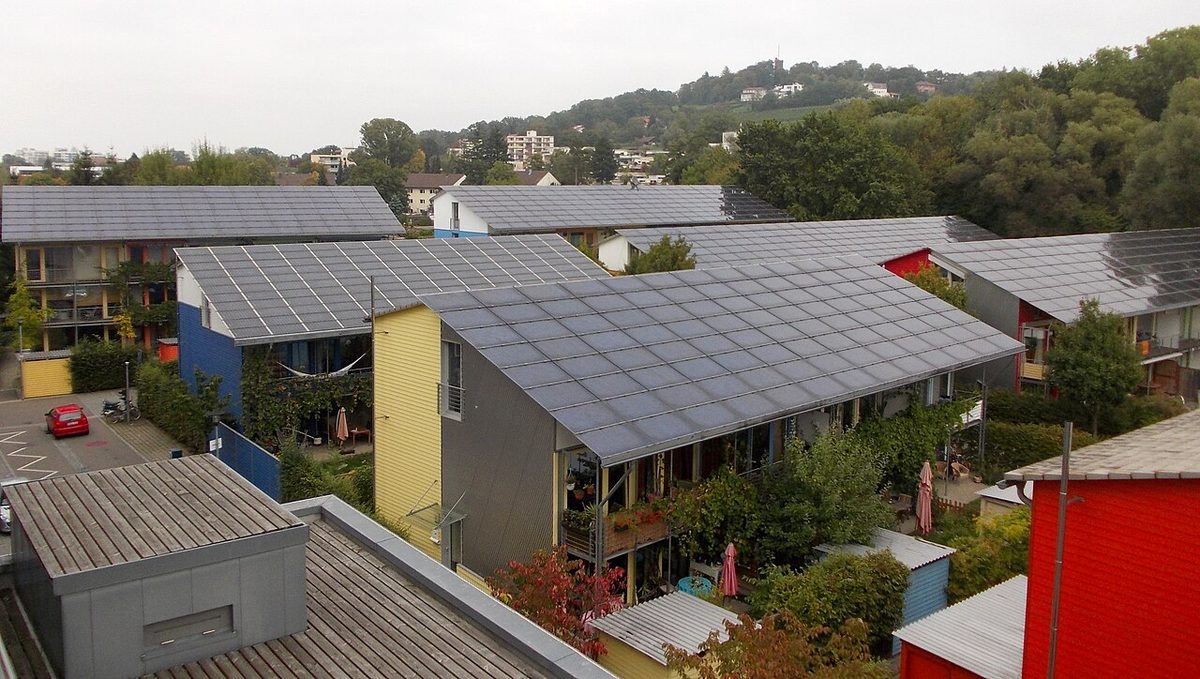
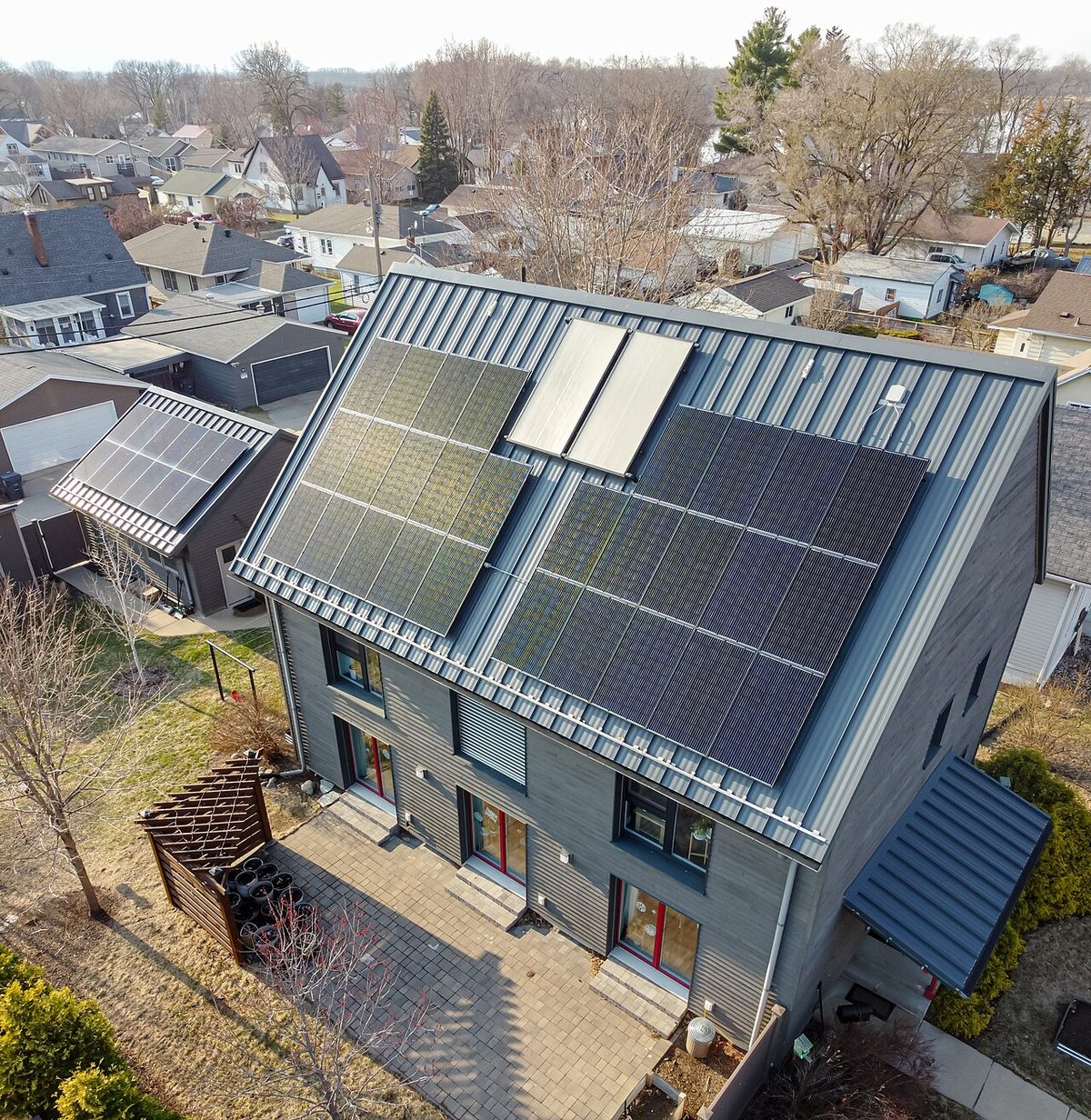
A net-zero energy building generates as much energy as it consumes over the course of a year, using on-site renewable energy — typically photovoltaic panels on the roof — to offset its energy use. A positive-energy building, or energy-plus building, generates more energy than it consumes, exporting the surplus to the grid. Both concepts require combining aggressive demand reduction (through insulation, airtightness, efficient mechanical systems, and passive design strategies) with on-site renewable energy generation sufficient to meet the residual demand.
The Bullitt Center in Seattle (The Miller Hull Partnership, 2013) is one of the first large commercial buildings in the world to meet a net-positive energy standard over a full year of operation. The six-story building generates all its energy from a 575-panel photovoltaic array on its roof, processes all its water on-site (including rainwater collection and blackwater treatment), composts all its organic waste, and uses no materials that appear on a list of approximately 800 prohibited chemicals. The building is designed for a 250-year lifespan, with a structural system and building envelope designed for disassembly and recycling rather than demolition.
The Brock Environmental Center in Virginia Beach (SmithGroupJJR, 2016) is the first certified Living Building in the American South — a climate zone where the combination of summer heat and humidity makes passive cooling far more challenging than in the Pacific Northwest. The building generates 83% more energy than it uses, collects and treats all its water on site, and achieves net-zero carbon emissions. Its design uses a combination of passive strategies (deep overhangs, cross-ventilation, thermal mass) and active systems (geothermal heat pumps, rainwater harvesting, photovoltaics) that had not previously been combined in this way in a hot-humid climate.
Mass timber skyscrapers
One of the most significant developments in sustainable construction in the early 21st century is the emergence of mass timber as a structural material for multi-story buildings. Mass timber — large-section structural timber products including cross-laminated timber (CLT), glued laminated timber (glulam), and laminated veneer lumber — can replace concrete and steel in buildings of up to 20 or more stories, with significant advantages in terms of embodied carbon: the carbon sequestered in the wood during growth, minus the carbon emitted in manufacturing, gives timber a substantially lower embodied carbon footprint than concrete or steel of equivalent structural capacity.
Brock Commons Tallwood House at the University of British Columbia in Vancouver (Acton Ostry Architects, 2017) was, at eighteen stories, one of the world's tallest mass timber buildings when completed. The hybrid structure uses CLT floor panels and glulam columns, with concrete cores for seismic resistance and a concrete podium, reducing the embodied carbon of the structure by approximately 2,400 tonnes compared to an equivalent concrete building. The building is also notable for the speed of its construction: the mass timber structure was assembled by a small crew in 70 days, less than half the time a concrete structure of equivalent size would have required.
Mjøstårnet in Brumunddal, Norway (Voll Arkitekter, 2019), at 85.4 meters and 18 stories, is one of the world's tallest timber buildings, with a glulam primary structure throughout. It contains apartments, a hotel, offices, and a swimming pool, and its exposed timber interior structure is a major part of its architectural character. The building was designed to demonstrate that mass timber could be competitive with concrete and steel for tall mixed-use buildings, not just for low-rise residential construction, and it has been widely studied as a result.
Regional Variations
The Nordic passive house tradition is the most technically advanced regional approach to sustainable building, driven by the combination of cold winters (creating high energy demand for heating), strong environmental regulation, and a cultural tradition of technical excellence and environmental responsibility. The Scandinavian countries — Norway, Sweden, Denmark, and Finland — have some of the highest rates of certified Passivhaus construction in the world, and the Nordic building tradition has contributed substantially to the development of the technical standards and construction details that the Passivhaus approach requires. Norway's energy code, updated in 2017, requires all new buildings to meet near-Passivhaus levels of energy performance, making very low energy consumption the legal minimum rather than an aspirational target.
Singapore's mandatory Green Plot Ratio, introduced in 2009 and strengthened in subsequent years, requires all new developments to provide a total area of planted surfaces — ground level, roof, and vertical — equal to or greater than the area of the development site. This requirement has driven a rapid development of green roof and living wall technology in Singapore, and has produced a distinctive urban landscape in which virtually every new building has planted surfaces visible on its exterior. The combination of the tropical climate (high rainfall and sunshine, warm temperatures year-round) and the government's strong regulatory commitment has made Singapore one of the most visible urban demonstrations of what mandatory green building standards can achieve.
The Middle Eastern vernacular developed, over many centuries, a sophisticated repertoire of passive cooling strategies for extreme hot-dry climates. The wind tower (barjeel or badgir), a tall shaft designed to catch prevailing breezes and direct them down into the living spaces below, was standard in traditional Gulf and Persian architecture. Mashrabiya screens — intricate wooden lattices that shade windows while allowing airflow — provided solar shading without blocking ventilation. Courtyard plans concentrated the building's mass around a shaded central space where evaporative cooling from a fountain or water feature moderated the temperature. These strategies are now being revived by contemporary architects in the Gulf as a response to the enormous energy cost of mechanically cooling buildings in a climate where outdoor temperatures regularly exceed 45°C. Norman Foster's Masdar City in Abu Dhabi is the most ambitious attempt to apply these vernacular principles at urban scale, using wind towers, shaded pedestrian streets, and compact urban form to reduce cooling loads in a zero-carbon development.
In northern Europe more broadly, the combination of the EU's energy performance regulations and the strong cultural commitment to environmental quality has produced a building stock that is, on average, significantly more energy-efficient than equivalent buildings in North America or Australia. The EU's Energy Performance of Buildings Directive has progressively tightened energy standards for new construction since 2002, and the requirement for near-zero-energy buildings (NZEB) for all new public buildings from 2018 and all new buildings from 2020 has made very high energy performance the legal standard rather than a premium option. The result is that a typical new office or residential building in Germany, the Netherlands, or Scandinavia would achieve what would be considered an exceptional energy performance standard in most of the rest of the world.
Key Identifiers: Sustainable Architecture
- Photovoltaic panels — solar panels visible on roofs or facades, generating electricity from sunlight; the most visually obvious indicator of an energy-conscious building
- Green roof or planted facade — vegetation covering the roof or growing on vertical surfaces; varies from sedum mat green roofs to full trees and shrubs on planted terraces
- Large south-facing glazing with external shading — generous windows on the south facade (in the northern hemisphere) to maximize solar heat gain in winter, combined with fixed or adjustable overhangs, louvers, or brise-soleil to prevent overheating in summer
- Timber cladding or exposed timber structure — natural wood used as the primary exterior material or left visible in the interior structural frame, signaling a preference for low-carbon natural materials
- Natural ventilation stack — a tall atrium, light well, or ventilation shaft designed to use the stack effect (warm air rising) to drive airflow through the building without mechanical fans
- Rainwater harvesting visible on facade — exposed downpipes leading to visible storage tanks, or rain chains replacing conventional downpipes, signaling active management of stormwater on site
- External shading devices — fixed or movable louvers, fins, or screens on the exterior of the building, providing solar shading that reduces cooling loads without blocking daylight
- Sedum or wildflower meadow roof — a low-maintenance green roof planted with drought-tolerant succulents or native wildflowers, visible as a textured green surface from adjacent higher ground or buildings
A Closer Look: The Edge, Amsterdam
The Edge in Amsterdam (PLP Architecture, 2015), built for Deloitte as its Dutch headquarters, was described by Bloomberg as the world's most sustainable office building when it opened, and its combination of energy performance, technology integration, and occupant wellbeing features makes it one of the most discussed sustainable buildings of the 21st century. The building achieved a BREEAM Outstanding score of 98.4 — the highest score ever recorded by any building under the BREEAM assessment system at the time — and generates more energy from its rooftop and south-facing facade photovoltaic array than it consumes in operation.
The building's south facade is covered with an array of approximately 4,000 square meters of photovoltaic panels, integrated into the facade as glass elements that provide both energy generation and solar shading. The combination of the photovoltaic array, a thermal energy storage system using underground aquifer storage, LED lighting throughout, and an occupancy-based management system that controls lighting, temperature, and ventilation individually for each desk gives the building its exceptional energy performance. The thermal energy storage system charges an aquifer beneath the building with cold water in winter and warm water in summer, then discharges the stored energy during the opposite season for heating and cooling, using the aquifer as a giant seasonal thermal battery.
The interior of The Edge is organized around a large atrium that floods the central circulation and social spaces with natural light. The atrium is surrounded by open-plan office floors that are managed without assigned desks — employees book workspaces via an app that matches them with an appropriate environment for their planned activities on that day (concentration, collaboration, phone calls, informal meetings). The app also controls the lighting and climate of the booked workspace, adjusting conditions based on the occupant's preferences and the outdoor conditions. This building management system generates approximately 80 terabytes of data per day about patterns of occupancy, movement, and environmental conditions, which is used to continuously refine the building's performance. The Edge is not merely a sustainable building in the conventional sense of low energy consumption; it is a building designed as a data-gathering and learning system, continuously adapting to its occupants and its environment.
Spotting It in Building Guessr
Sustainable architecture is among the hardest categories to identify from photographs alone, because many of its key features — insulation thickness, airtightness, heat recovery ventilation — are invisible. The visible indicators are the most reliable starting point: photovoltaic panels on roofs or facades are the single most distinctive external feature of an energy-generating building. Green roofs are visible from above or from adjacent taller buildings; living walls are visible on facades and are distinctive when well-established. External shading devices — louvers, fins, brise-soleil — are visible as projecting elements on the facade and are characteristic of buildings designed for passive solar control. The combination of any two of these features on a building of recent construction (post-2000) strongly suggests intentional sustainable design.
Mass timber buildings have a distinctive visual character both outside and inside. Timber cladding — whether as a primary facade material or as a secondary element — gives buildings a warm, natural appearance unlike any other contemporary material. Exposed timber structure inside — CLT floor panels, glulam columns and beams — creates an interior that is immediately distinguishable from concrete or steel-framed buildings. The color and grain of the timber, combined with the large dimensions of the structural members, is visually distinctive and is increasingly associated with high-ambition sustainable design. A building with exposed timber structure, high ceilings, large windows, and visible planted elements — indoors or on the exterior — is very likely to be a recent building designed with sustainability as a primary concern.
Find sustainable and contemporary buildings in the Modern Architecture filter.
Play Building GuessrFurther Reading
Sources & further reading
Reference material this page draws on, and where to read further. External links open third-party sites.
- Sustainable architecture · Wikipedia
- Green roof · Wikipedia
- Passive house · Wikipedia
- LEED · Wikipedia
- Biophilic design · Wikipedia
- Bosco Verticale · Wikipedia