What vernacular architecture is
Most of the buildings that have ever existed were not designed by architects. They were built by their occupants, by local craftspeople, or by builders working within a tradition transmitted through apprenticeship, family, and community rather than through professional training or printed pattern books. This is what vernacular architecture means: building using local materials, local knowledge, and local traditions — without reference to the professional architectural canon.
Vernacular building is the dominant form of construction for most of human history, and by raw count it remains the majority of buildings on Earth today. Its significance for understanding the built environment is enormous precisely because it is not arbitrary — vernacular forms have been refined over generations through a process of continuous selection, and the forms that survive in a region for centuries are almost certainly doing something right for that climate, that landscape, and those available materials. A house form that has been built the same way in the same place for five hundred years has solved the thermal, structural, and material problems of that place more thoroughly than any single architect could do in isolation.
For players of the game, recognizing vernacular forms is often the fastest and most reliable way to identify a continent or region. Professional architectural styles — Baroque, Neoclassical, Brutalist — were exported globally and can appear almost anywhere in the world. Vernacular forms are inherently local: a thatched communal longhouse on stilts looks completely different from a whitewashed adobe compound, which looks completely different from a German half-timbered village house, which looks completely different from a Norwegian stave church. The vernacular is a visual fingerprint for place, and once you learn the major vernacular traditions, large parts of the game become significantly easier.
This guide covers the major regional vernacular traditions that appear most frequently in architectural photography and game settings: adobe and earthen architecture of the arid world, the longhouse in its multiple independent iterations, the timber traditions of Northern Europe, the dry-stone traditions of the Mediterranean and British Isles, and the stilt and flood-adapted vernaculars of Southeast Asia and the tropical world.
Adobe and earthen architecture: the arid world
Adobe — compressed, sun-dried mud brick — is one of the oldest building materials used by human beings, and it remains in active use across the arid belt of the world: the Middle East, North Africa, the Sahel, the American Southwest, parts of Central Asia, and the Andean highlands. Its persistence is not conservatism but competence. Adobe walls, when built at the thickness typical of the tradition (40 to 60 centimeters), provide exceptional thermal mass: they absorb heat during the day and release it slowly at night, keeping interiors cool during daytime heat and warm after dark. In climates with large diurnal temperature swings — hot days, cold nights — this is an extraordinarily effective and entirely free form of climate control.
The visual signature of adobe construction is distinctive once you know it: rounded edges and irregular surface texture rather than the sharp corners of fired brick or cut stone; a uniform tan, ochre, or brown color derived from the local earth; flat or very gently pitched roofs (in arid climates, rain drainage is not the primary design concern); and an overall appearance of soft, sculptural solidity. Adobe buildings often look as if they have been shaped by hand rather than assembled from units — which, in a sense, they have.
The most dramatic expression of adobe construction is the old city of Shibam in Yemen (primarily 16th century, though the site has been continuously occupied for millennia), sometimes called the "Manhattan of the desert": a dense cluster of multistory mud-brick tower houses rising as high as nine stories from a desert plain. The towers, built to maximize density within the city's defensive walls, demonstrate that adobe is not a material limited to low, humble buildings — it can be used for ambitious vertical construction when the engineering traditions are well developed. The Great Mosque of Djenné (Mali, current structure rebuilt 1907 on medieval foundations) is the largest adobe building in the world, its facade studded with protruding wooden rods (torons) that serve both as permanent scaffolding for annual replastering and as a visual texture unmistakably of the Sahelian tradition. Taos Pueblo (New Mexico, USA) has been continuously inhabited for over a thousand years, its multistory apartment blocks of adobe construction set against the backdrop of the Sangre de Cristo Mountains as one of the most recognized vernacular ensembles in North America.
The longhouse: communal living from Norway to Borneo
Few architectural forms illustrate the principle of convergent design — similar solutions arising independently in different cultures in response to similar problems — more clearly than the longhouse. On three continents, in climates ranging from subarctic to tropical, cultures that had no contact with each other developed architecturally similar solutions to the problem of communal living: long, narrow buildings with a single ridge roofline, housing multiple families or an extended community under one roof, constructed from locally available organic materials.
The Norse longhouse of the Viking Age (approximately 800–1100 AD) was the basic unit of Scandinavian rural settlement. Typically 15 to 75 meters long and 5 to 7 meters wide, it was framed in timber with walls of wattle and daub, sod, or stone rubble depending on what was available locally, and roofed in turf or thatch. People and livestock shared the building through the winter — the animals' body heat contributing meaningfully to warmth at the far end of the hall. A central hearth ran along the main axis, with smoke escaping through a gap in the roof ridge. Norse longhouses have almost entirely disappeared from the landscape because their materials (timber, turf) decay rapidly, but reconstructions at sites like Borg in the Lofoten Islands give a vivid sense of the scale and character of the Viking-Age hall.
The Dayak longhouse (Borneo, Malaysia and Indonesia) is still in active use as a living building tradition. Raised on substantial timber piles to keep the floor above the marshy or seasonally flooded ground, a typical longhouse community builds a structure of 30 to 150 meters in length that houses anywhere from a few families to an entire village. A covered communal veranda runs the full length of the building along one long side — the social heart of the community, where meetings are held, crafts are made, and guests are received. Behind it, individual family apartments each open off the veranda through their own door. The Iroquois longhouse (northeastern North America) used a bent-sapling frame covered in sheets of elm bark, 20 to 30 meters long, with smoke holes along the ridge above a series of central hearths. Despite arising independently on three continents in completely different climate zones, all three longhouse traditions share: elongated plan, communal living, single-ridge roofline, and organic construction materials sourced locally.
Stave churches and timber architecture of Northern Europe
Timber is the defining building material of northern and central Europe wherever forests were available and stone was not, which is to say across most of Norway, Sweden, Russia, Germany, Poland, and England. The traditions of working in timber produced some of the most distinctive vernacular forms in the world — and some of the most immediately recognizable.
The Norwegian stave church is arguably the most architecturally complex vernacular timber building type in the world. The structural system uses vertical timber staves — large upright posts — as the primary structural elements, braced horizontally and supplemented by a complex system of diagonal corner braces, sill beams, and wall plates. The result is a building capable of great height relative to its plan area, with multiple overlapping roofs at different levels creating a dramatically tiered silhouette. Approximately 1,300 stave churches were built in medieval Norway; only about 28 survive, of which Borgund stave church (Sogn, Norway, circa 1180) is the best preserved and the most frequently photographed. Borgund's profile — four overlapping rooflines ascending to a central tower, with dragon-head finials at each gable peak — is one of the most immediately recognizable forms in European vernacular architecture, unmistakably Norwegian and unmistakably medieval.
The German Fachwerk (half-timbered) house extends this timber tradition into a different expressive register. The structural timber frame — posts, beams, diagonal bracing — is left visible on the exterior, and the infill panels between the timbers are plastered and whitewashed (or, in some regions, filled with brick in a herringbone or other pattern). The result is the characteristic visual of dark timber framing against white or cream-colored infill that defines village streetscapes across central Germany, Alsace, the Rhineland, and much of medieval England. Towns like Quedlinburg (Germany), Colmar (Alsace), and Chester (England) preserve extensive streetscapes of half-timbered buildings. For game players, a streetscape of white walls with dark exposed timber framing is one of the most reliable visual indicators of Germany, Alsace, or England — though similar traditions exist in Normandy and other parts of northern France.
Trulli, turf houses, and dry-stone traditions
Dry-stone construction — stacking stone without mortar, relying on the weight and interlocking geometry of the stones for structural integrity — appears in multiple climates and cultures worldwide. Its persistence is pragmatic: in areas where suitable stone is abundant at the surface and lime for mortar is scarce or expensive, dry-stone construction provides a durable, weather-resistant wall at minimal material cost. The techniques vary, but the characteristic visual of coursed stone without visible mortar joints is consistent.
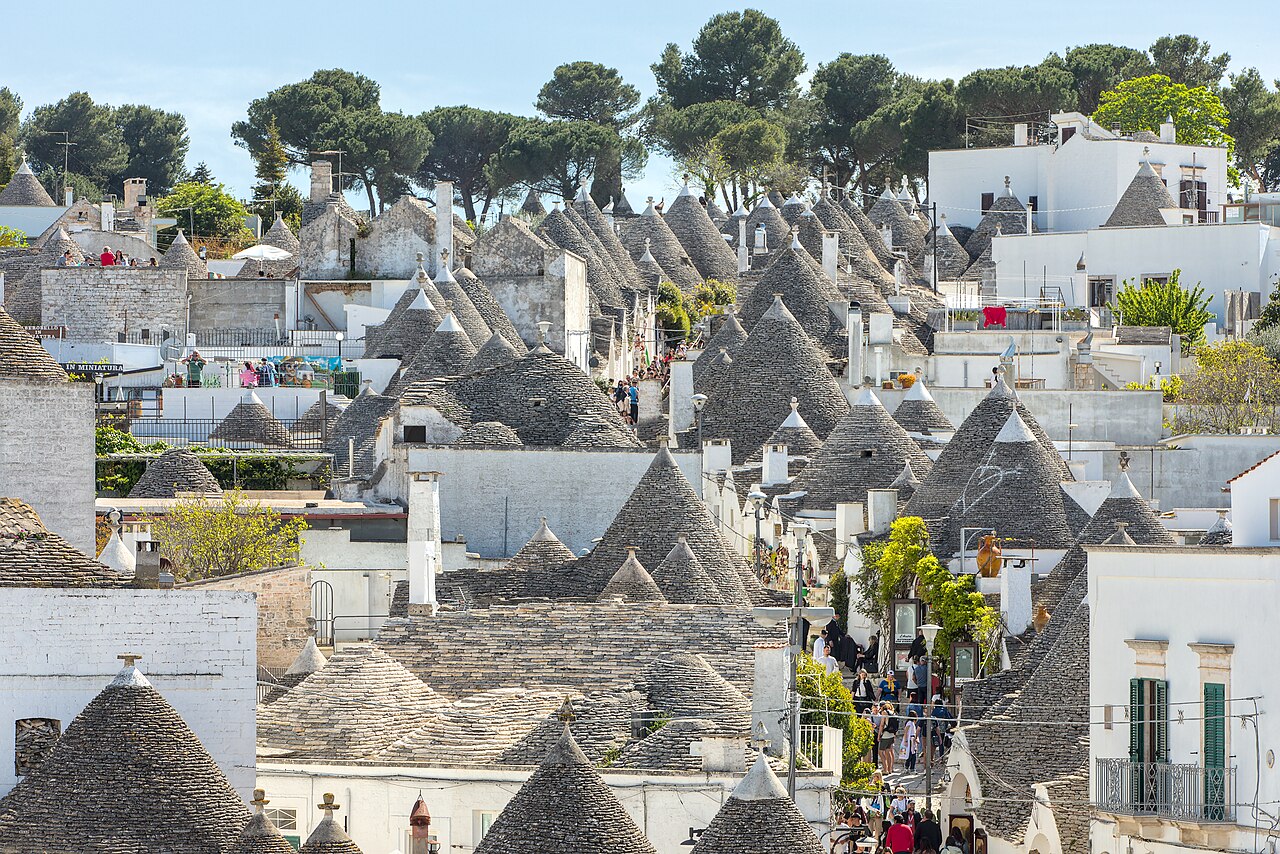
The most extraordinary dry-stone vernacular in Europe is found in Alberobello, in the Puglia region of southern Italy. The trullo (plural: trulli) uses a corbeling technique for its conical roof: each successive ring of flat limestone slabs overhangs the ring below by a small amount, so that the rings converge progressively toward the apex without any centering or temporary support — the structural principle of the corbeled arch applied in the round. The result is a conical stone roof of great elegance and structural ingenuity, whitewashed to reflect heat, sitting atop plain whitewashed cylindrical or rectangular walls. Alberobello's historic center, a UNESCO World Heritage Site, contains over 1,500 trulli; the roofscape of grey conical peaks against whitewashed walls is unique in the world and instantly identifiable.
Icelandic turf houses (built throughout Iceland's history and in widespread use until the early 20th century) represent the extreme of organic material construction. Thick walls and roofs of stacked sod over a timber frame provide insulation against subarctic cold that stone or timber alone cannot match — the turf acts as both structural material and thermal blanket. From the outside, an Icelandic turf farmstead looks almost entirely like a series of grassy hillocks: the building has been absorbed into the landscape, presenting only small windows and low doorways as evidence of human construction. The Cotswolds (England) offer a third regional dry-stone tradition: the local oolitic limestone splits naturally along horizontal planes into flat slabs suitable for roofing as well as walling, producing the distinctive golden-toned stone tiles and dry-stone walls that give the Cotswold village its characteristic warm color palette, entirely different from the grey limestone or dark millstone grit of other English stone building regions.
Raised structures and flood adaptation
In regions subject to seasonal flooding, persistent high humidity, venomous ground-level fauna, or hot airless conditions near the ground, raising a building on stilts or a high platform provides multiple benefits simultaneously: it keeps the floor above flood level, allows air circulation beneath the floor (critically important in humid tropical climates for preventing rot and mold), separates occupants from ground-level hazards, and — in some traditions — has symbolic significance as well. The stilt house appears across a wide geographic range, and its variants are among the most visually distinctive vernacular forms in the world.
The Thai stilt house and the Rumah Melayu (traditional Malay house) both elevate the main living floor on substantial timber posts, typically 1.5 to 3 meters above ground, with the space beneath used for storage, parking vehicles, or housing animals. Both traditions feature steep-pitched roofs for rapid rainwater shedding, elaborately carved and decorated gable ends (the barge boards and gable ornaments are the primary site of decorative investment), and a plan organized around a central covered veranda that is the main social space. Despite arising in Thailand and Malaysia respectively, the structural logic and social organization of these house types are closely parallel — a product of shared climate conditions and overlapping cultural influences across the mainland and island Southeast Asian world.
The Haitian gingerbread house represents a more complex hybrid. These elaborately ornamented wooden houses, concentrated in Port-au-Prince's historic districts, combine the structural logic of tropical stilt construction (raised on a high masonry base to clear flood level) with the decorative vocabulary of Victorian wooden architecture (intricate fretwork, turned balusters, elaborately carved vergeboards) and local adaptations for heat (large shuttered windows, deep covered verandas, cross-ventilated rooms). They are simultaneously colonial inheritance and local creation — a vernacular that assembled available influences into a form specific to Haiti's particular history and climate. The haus tambaran (spirit house) of the Abelam people (Papua New Guinea) takes elevation to its symbolic extreme: raised on a high platform, its painted facade rising 20 to 25 meters, elaborately decorated with clan symbols and ancestor faces, the spirit house is simultaneously the most important practical building in the village (the ceremonial and ritual center) and the most visually dramatic, its height connecting the community to the spirit world above.
Reading vernacular buildings in the game
Vernacular architecture is a powerful tool for game identification because vernacular forms are inherently regional — they encode climate, geology, and cultural tradition in their materials, shapes, and details. Once you can read the key signatures, a single establishing shot often provides a continent-level identification before you have even looked at other clues.
Rounded tan or ochre walls with flat roofs and no visible structural joints indicate adobe construction — place anywhere in the arid belt from Morocco to Yemen to the American Southwest. If the buildings are multistory and tower-like, lean toward Yemen (Shibam) or the Sahel. If they are single-story compounds around a central courtyard, lean toward Morocco, Algeria, or the wider Middle East. If they are terraced apartment blocks with ladder access between levels in a dramatic cliff or mesa setting, this is almost certainly Pueblo architecture of the American Southwest.
Whitewashed walls with conical grey stone roofs, no mortar visible in the stonework, densely packed in a village setting: this is Puglia, southern Italy, and almost nowhere else. The trullo is one of the most uniquely localized vernacular forms in the world. Dark timber framing on white or cream plaster infill on a multi-story building with overhanging upper floors and small casement windows: Germany, Alsace, or England — Fachwerk or Tudor half-timber. The specific proportion of timber to plaster, the color of the infill, and the urban density help narrow between these three.
Multiple overlapping timber rooflines ascending to a central peak with dragon-head finials or elaborate carved woodwork at the gable ends, on a relatively small building: Norwegian stave church — there is no other building type in the world that looks quite like this. An elongated building raised on substantial timber posts above water or marshy ground, with a covered communal veranda along one long side: a Southeast Asian longhouse or stilt village, most likely Borneo, Malaysia, or the Indonesian archipelago.
Low grass-covered mounds with small timber-framed windows and low doors almost flush with the turf surface: Icelandic turf farmstead, almost certainly — though similar forms exist in the Scottish Hebrides and the Faroe Islands. White cubic or rectilinear forms cascading down a steep hillside, with flat roofs and small windows, in intense Mediterranean light: Greek Cycladic vernacular — Santorini, Mykonos, Paros. The combination of brilliant white wash, flat roofs, and stepped hillside composition is instantly recognizable and geographically specific. For a deeper understanding of how climate drives these form decisions across regions, see our guide to how climate shapes architecture, and for the religious building traditions that often intersect with vernacular forms, see our piece on Gothic, Romanesque, and Byzantine.
Regional Variations: Vernacular Around the World
By definition, every vernacular tradition is regional — that is its entire point. But certain traditions repay closer study because they appear repeatedly in the game or because understanding them unlocks broader pattern recognition across large geographic areas. West African earthen architecture offers one of the richest examples. The Djennestyle mud-brick tower houses of the inland Niger Delta region (Mali, Burkina Faso) use a technique of hand-plastered earthen walls punctuated by projecting wooden torons, built in compact urban clusters that look almost otherworldly from a distance. The torons serve a practical purpose — they are permanent scaffolding, allowing the owner to replaster the exterior after each rainy season — but they also create a distinctive visual texture that is found nowhere else in the world. The Kasbahs of southern Morocco and the Draa Valley use rammed earth (pisé) rather than adobe brick, producing smooth, tapered towers with decorative geometric incised patterns in the upper reaches — a regional variant within the broader earthen tradition that is immediately distinguishable once you know it.
Norwegian stave churches have already been discussed, but the broader Scandinavian timber tradition extends across Finland, Sweden, and into Russia with the izba (traditional Russian log house). The izba uses horizontal logs notched at the corners, a construction system that produces a distinctive visual of rounded log ends projecting at each corner of the building. Russian log construction also produced the extraordinary wooden churches of the Kizhi archipelago in Lake Onega — multi-domed church complexes built entirely in timber without a single nail, using techniques of wooden joinery that are still studied by structural engineers today. Anatolian cave dwellings of Cappadocia (central Turkey) represent the most dramatic possible expression of the principle of building with what is locally available: the soft volcanic tuff of the Cappadocian landscape was carved directly into habitable rooms, churches, and entire underground cities without any construction material being added at all. The landscape of fairy chimney rock formations with carved windows and doors is one of the most alien and most immediately recognizable vernacular environments on Earth.
Scottish black houses (taigh dubh) of the Hebridean islands represent the opposite extreme from Cappadocian softness: thick double walls of dry-stone rubble, with the gap between inner and outer wall packed with earth for insulation, roofed in thatch weighted with stones against Atlantic gales, windowless, and built directly into hillsides to minimize exposure. The interior was divided between a living area for the family and a byre for the cattle, sharing a single unventilated peat fire. The buildings were called black houses because they were smoky inside and because their dark stone exterior reads as almost featureless against the grey-green Hebridean landscape. Mongolian ger (yurt) represent the apex of portable vernacular architecture: a circular felt-covered structure on a collapsible wooden lattice frame, capable of being erected or dismantled by two people in under an hour, providing insulation against steppe winters that can reach -40°C, and optimized for transport by pack animal across terrain with no roads. The ger is the most structurally efficient portable dwelling ever developed, and the form has been essentially unchanged for two thousand years.
The Japanese minka (folk house) presents a vernacular tradition of considerable sophistication. Minka are timber-framed with clay infill walls, deeply overhanging thatched or tiled roofs, and interiors organized around a flexible system of sliding screens (shoji and fusuma) that allow the floor plan to be reconfigured for different activities. The structural frame is left visible on the interior, and the quality of timber joinery — which uses no metal fasteners, relying entirely on precisely cut wooden joints — reflects centuries of accumulated technical refinement. Minka vary significantly by region: the gassho-zukuri style of the Shirakawa-go valley uses enormously steep thatched roofs (the name means "hands in prayer") designed to shed the heavy mountain snowfall; lowland minka have shallower roof pitches adapted to milder conditions. Andean adobe construction, used across Peru, Bolivia, and northern Chile from pre-Columbian times to the present, shows how the same material — sun-dried mud brick — is adapted to the particular cold-dry conditions of high-altitude Andean climate, producing the distinctive earthen towns of the altiplano against backgrounds of snow-capped mountains.
Key Identifiers of Vernacular Architecture
- Local natural materials used exclusively: stone, timber, adobe, thatch, turf — whatever the region provides most abundantly
- Absence of applied ornament unrelated to construction; decoration, when present, is part of the structural or material logic (carved timber joints, whitewashed surfaces)
- Forms derived from structural and climatic logic rather than stylistic convention: roof pitch driven by rainfall, wall thickness driven by thermal requirements, orientation driven by sun and wind
- Adaptation to local climate visible in every dimension: steep roofs in high-snowfall regions, flat roofs in arid zones, raised floors in humid tropical areas
- Strong similarity of buildings within a community: the vernacular is a shared tradition, so neighboring buildings built by the same community in the same generation look alike
- Raw, unfinished-looking surfaces: adobe rounded at corners, timber weathered to grey, stone uncut beyond basic dressing
- Integration with landscape: vernacular buildings use site topography rather than imposing order on it; they sit in hollows, terrace hillsides, and use natural slopes for shelter
- No professional architect involvement: the building reflects accumulated community knowledge rather than individual design intention
A Closer Look: The Trulli of Alberobello, Puglia
The trulli of Alberobello in the Puglia region of southern Italy are among the most visually distinctive vernacular buildings anywhere in the world — and their survival is inseparable from a piece of legal chicanery that tells us as much about vernacular building culture as the buildings themselves do. Trulli are constructed from the local limestone that lies in thin horizontal slabs just below the surface of the Apulian plateau, ideal for the corbeling technique: each layer of stone overhangs the previous one by a small amount, creating a self-supporting conical structure without any mortar, centering, or temporary support. The result is a roof that can be disassembled by hand — which, according to the most persistent local tradition, was exactly the point.
The story goes that the feudal lords of the region, in the 15th and 16th centuries, were required to pay tax to the Kingdom of Naples on any permanent settlements in their territory. By building in dry stone without mortar, they could instruct their tenants to dismantle the roofs whenever a royal inspector was sighted, presenting an empty field rather than a taxable village, then rebuild immediately after the inspector departed. Whether or not this story is entirely accurate — and historians debate its literal truth — the building technique clearly makes rapid disassembly possible. What resulted from generations of this practice is a corpus of over 1,500 surviving trulli in Alberobello alone, a UNESCO World Heritage Site since 1996, whose roofscape of whitewashed cylindrical bases topped with grey conical stone roofs is found nowhere else in the world.
The trulli illustrate a principle central to vernacular architecture: the form is always the product of the specific material, structural, economic, and social conditions of its place and time. The conical corbeled roof is not an aesthetic choice made by a designer — it is the inevitable consequence of building with thin flat limestone slabs using only gravity as adhesive. The whitewashed exterior is not a decorative convention — it is a practical response to Mediterranean heat that keeps the interior temperature bearable through the summer. The dense clustering of trulli in Alberobello is not a planning decision — it is the consequence of multiple generations of families subdividing and extending existing buildings within the constraints of the dry-stone construction system. Understanding the constraints produces the building. The buildings, read carefully, reveal the constraints.
Spotting It in Building Guessr
Vernacular buildings are among the most challenging in the game because they rarely appear in architectural history surveys, there is no single canon of famous vernacular buildings equivalent to the Gothic or Baroque canon, and photographs of vernacular buildings often show multiple similar examples in a single frame — a village street, a hillside settlement — rather than an isolated landmark. The strategy that works best is to treat the photograph as a pattern rather than a building: look at the consistency of material and form across all the buildings visible in the frame. Vernacular buildings built by the same community in the same generation all look alike, because they were built using the same materials, the same techniques, and the same social organization. If every building in the photograph is made from the same material, has the same roof form, and sits in the same relationship to the landscape, you are almost certainly looking at a vernacular settlement.
The absence of Classical ornament is the second diagnostic. Vernacular buildings do not have pilasters, cornices, pediments, or decorative keystones. They do not quote architectural history. Their surfaces are raw, honest, and textured by the material itself. When you see a building with no applied ornament at all, built from a single material throughout, with a roof form dictated by climate rather than style, and set in a landscape rather than on a street — that is very probably vernacular. The specific material and climate adaptation will then let you narrow the geography: rounded tan adobe walls and flat roofs say arid zone; conical grey stone roofs with no mortar say Puglia; multi-tiered overlapping timber rooflines with carved gable ends say Norway; whitewashed cubic forms on a steep hillside say Greek islands. Learning the key signatures is the work, but the payoff is that vernacular buildings, once you can read them, are often the most reliable regional identifiers in the entire game.
Try the regional filter and see how many folk building traditions you can place.
Play Building GuessrFurther Reading
- How Climate Shapes Architecture — the environmental forces that drive the forms vernacular builders discovered through practice
- Gothic, Romanesque, and Byzantine — the traditions that grew from vernacular roots and became canonical styles
- Reading Religious Architecture — many of the world's most important vernacular buildings are sacred structures
- Ten Famous Lost Buildings — vernacular buildings are among the most fragile; understanding loss helps explain what survives
Sources & further reading
Reference material this page draws on, and where to read further. External links open third-party sites.
- Vernacular architecture · Wikipedia
- Adobe · Wikipedia
- Thatching · Wikipedia
- Trullo · Wikipedia
- Yurt · Wikipedia
- Hakka walled village · Wikipedia
- Log cabin · Wikipedia