What it is
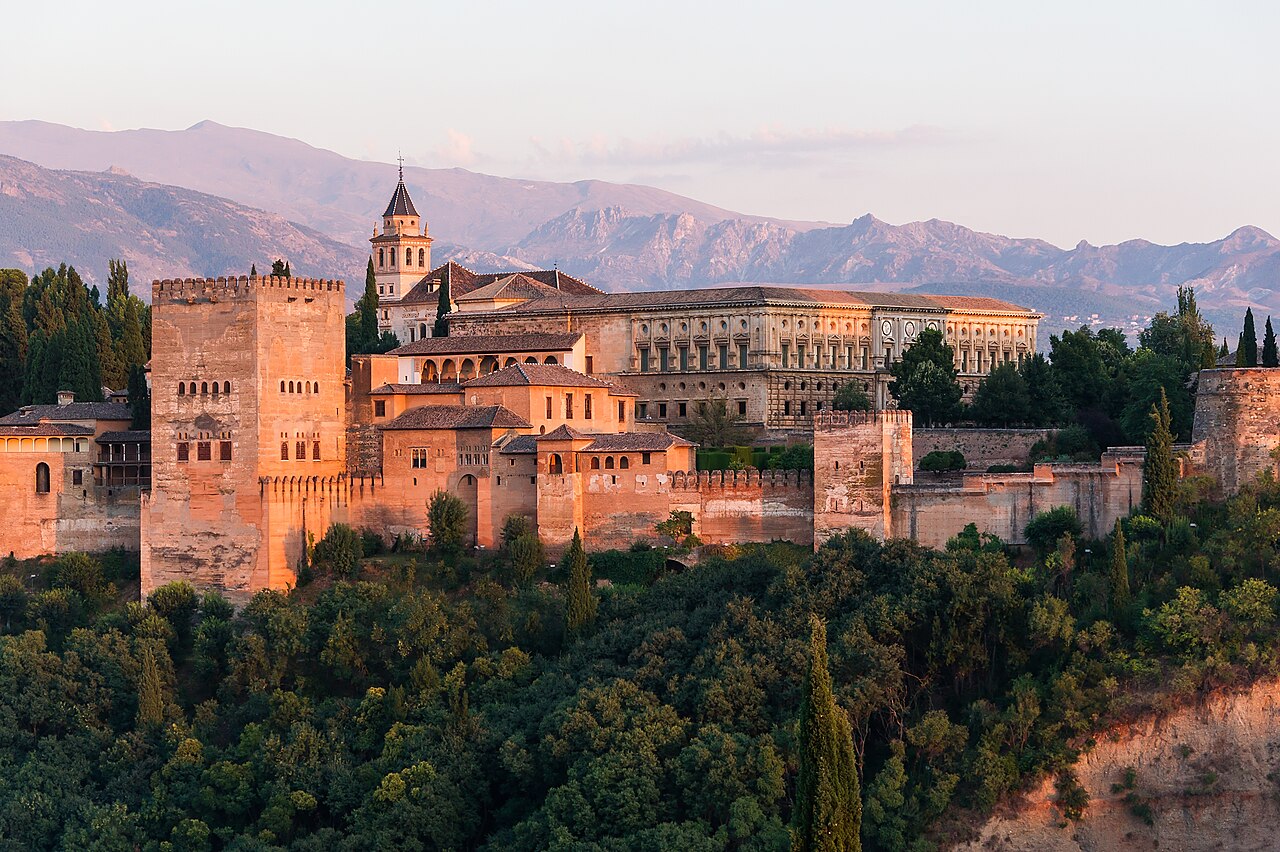
The Alhambra is a palace and fortress complex built on a hilltop above the city of Granada by the Nasrid sultans — the rulers of the last Islamic kingdom to survive the Reconquista, the centuries-long Christian reconquest of the Iberian Peninsula. The name derives from the Arabic al-Qal'a al-Hamra, "the Red Castle," a reference to the reddish color of the sun-dried brick used in the outer fortification walls. The site had been fortified since at least the ninth century, but the main palace complex was developed by successive Nasrid sultans across the thirteenth and fourteenth centuries. The two most important builders were Sultan Yusuf I (reigned 1333–1354), who built the Comares Palace and its great throne room, and his son Muhammad V (reigned 1354–1391, with interruption), who completed the Court of the Lions and the elaborate suite of reception rooms surrounding it. The Nasrid kingdom endured longer than any other Islamic state in Iberia, finally surrendering to Ferdinand and Isabella on January 2, 1492 — the same year Columbus sailed to the Americas.
The Alhambra survived intact after 1492 because the Catholic monarchs found it too beautiful and too useful to demolish. Ferdinand and Isabella established a royal court there, and subsequent Spanish monarchs continued to use the complex as a royal residence. Charles V commissioned a large Renaissance palace within the Alhambra precinct in the 1520s — a building of considerable quality in its own right, though startlingly out of scale and character with its Nasrid surroundings. The Alhambra fell into neglect and partial ruin in the eighteenth and early nineteenth centuries, before the Romantic period rediscovered it, most influentially through the American writer Washington Irving, who lived in the palace in 1829 and published Tales of the Alhambra in 1832, sparking international interest in the complex and contributing to the conservation efforts that followed.
Architectural significance
The Alhambra is the finest surviving example of Moorish architecture — the Islamic architectural tradition of Al-Andalus, the medieval Arabic name for Muslim Iberia. Its significance lies not primarily in structural innovation (the buildings are relatively modest in engineering terms) but in the extraordinary treatment of surface, light, and water as the primary architectural materials. The muqarnas — the three-dimensional geometric stalactite vaulting in plaster — reaches its highest known expression in the Hall of the Abencerrages, where an octagonal muqarnas dome of approximately 5,000 individual plaster cells rises above a star-shaped floor plan. The effect is of an infinitely complex, dematerialized ceiling that seems to dissolve upward into geometric abstraction. The mathematical precision required to design and execute these vaults — without computers, without the calculus that would later systematize such geometry — represents one of the great intellectual achievements of medieval craftsmanship.
The Court of the Lions, built under Muhammad V around 1370–1380, is the symbolic heart of the complex and one of the most analyzed spaces in Islamic architecture. One hundred and twenty-four slender marble columns support a muqarnas pavilion on a plan where two perpendicular halls cross at the central courtyard. An alabaster fountain with twelve stone lions — probably representing the twelve tribes of Israel or the twelve signs of the zodiac, repurposed from an earlier Jewish palace — stands at the center, feeding four water channels that run along the cardinal axes to the surrounding halls. The use of water as architectural structure — channels that guide the eye, pools that reflect and double spaces, fountains that fill rooms with the sound of running water without allowing them to become loud — is a central organizing principle of the entire complex. The Alhambra is a building that is more about sensory atmosphere than about load-bearing structure, and this makes it a genuinely different kind of architectural achievement from the Gothic or Roman buildings it roughly contemporized.
Key features
- Comares Tower and throne room: The largest tower in the Alhambra, housing the Sala de la Barca (antechamber with a boat-shaped muqarnas ceiling) and the throne room (Salón de Comares), which has a coffered wooden ceiling of 8,017 individual pieces arranged in a cosmological pattern representing the seven heavens of Islamic paradise.
- Court of the Myrtles (Patio de los Arrayanes): A long rectangular reflecting pool bordered by two rows of myrtle hedges and marble arcades, leading to the Comares Tower. The still water doubles the arcade and tower in reflection, creating a visual trick of doubled depth.
- Court of the Lions (Patio de los Leones): The most celebrated courtyard, with 124 slender white marble columns, muqarnas pavilion vaults, and the central alabaster fountain supported by twelve stone lions. Inscribed poetry by Ibn Zamrak frames the pavilion arches.
- Muqarnas vaulting: Found throughout the palace but particularly extraordinary in the Hall of the Abencerrages (stalactite vault of approximately 5,000 plaster cells) and the Hall of the Two Sisters (another elaborate muqarnas dome). These vaults are formed entirely in carved and assembled plaster, not stone.
- Arabic calligraphic inscription bands: The poetry of Ibn Zamrak and other court poets is inscribed in Arabic calligraphy around the arches and walls of the palace, making the building literally a work of written literature as well as visual architecture. The inscriptions include the phrase "There is no victor but God" repeated as a pattern throughout the walls.
- Generalife garden palace: The summer palace and gardens of the Nasrid sultans, located on the adjacent hill, with elaborately planted terraced gardens, water channels, and a summer residence that demonstrates the Nasrid integration of garden design with palace architecture.
- Red-brick and tile exterior: The outer walls of the Alhambra are deceptive in their plainness — rough reddish brick and tile that give little indication of the extraordinarily refined interior spaces. This contrast between plain exterior and elaborate interior is a consistent principle of Islamic palace architecture.
Preservation status
The Alhambra has been a UNESCO World Heritage Site since 1984, inscribed together with the Generalife gardens and the Albaicín quarter of Granada. The complex is in generally good condition, with serious conservation work underway since at least the 1980s. Some of the elaborate plaster stucco decoration has been restored at various points, and the Patio de los Leones underwent a major restoration from 2007 to 2012 that included cleaning, stabilization of the marble columns, and the removal and restoration of the central fountain. The restoration generated some controversy over choices made about which patina to preserve and which to clean, debates typical of major historic site interventions.
Overtourism is currently the most pressing management challenge. The Alhambra receives approximately 2.7 million visitors per year, making it the most visited monument in Spain. Timed-entry tickets for the Nasrid Palaces, the most sensitive interiors, have been implemented with daily visitor caps. The foot traffic and humidity introduced by large crowds is a genuine conservation threat to the plaster decoration, wooden ceilings, and tile floors. The Patronato de la Alhambra continues to invest in monitoring, climate control research, and visitor management strategies to balance access with preservation.
Think you can place this building on the map?
Play Building Guessr