What it is
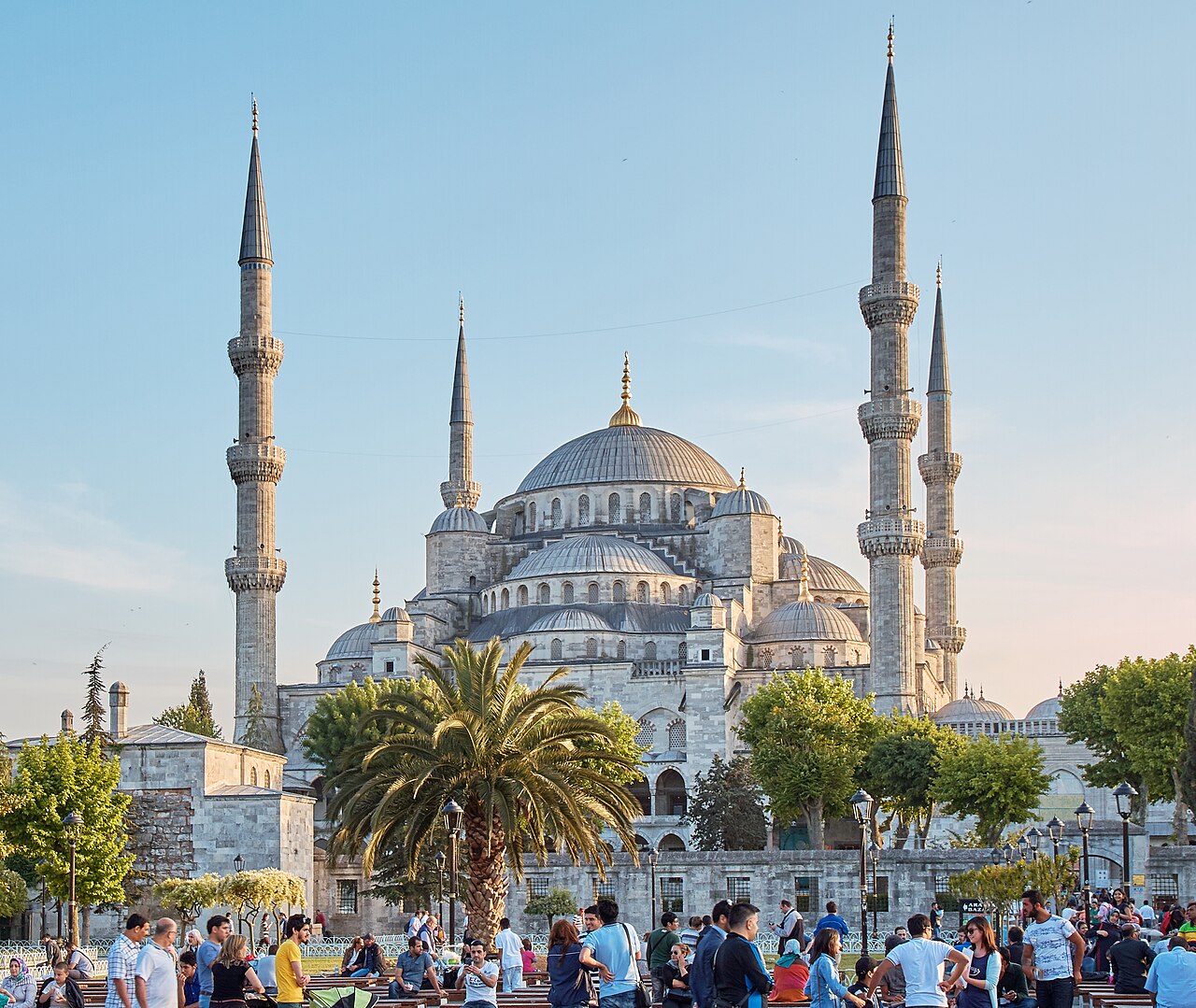
The Sultan Ahmed Mosque — universally known in the West as the Blue Mosque for the colour of its interior tile decoration — is an Ottoman imperial mosque built between 1609 and 1617 on the southern edge of the Hippodrome of Constantinople in Istanbul. It was commissioned by Sultan Ahmed I, who became sultan at the age of thirteen and died at the age of twenty-seven, just a year after the mosque's completion; the mosque is his principal legacy and the monument by which history remembers him. Its architect was Sedefkâr Mehmed Ağa, a student of the legendary Mimar Sinan — the greatest architect of the Ottoman Empire — and the mosque can be understood as Mehmed Ağa's attempt to honour, consolidate, and extend Sinan's architectural achievements.
The mosque faces the Hagia Sophia across the ancient Hippodrome, a placement laden with symbolic meaning: the new Muslim monument in deliberate dialogue with the greatest surviving monument of Christian Byzantium, the city's former rulers. Together the two buildings dominate the Sultanahmet peninsula, the historic heart of Istanbul, and form the visual anchor of a UNESCO World Heritage Site that encompasses the entire historic core of the city. The mosque is still an active place of worship — unlike the Hagia Sophia, which passed back from museum to mosque status in 2020, the Blue Mosque has remained in continuous religious use since its completion — and non-Muslim visitors are welcome outside prayer times, following a dress code and removing shoes before entry.
The six minarets
The most architecturally distinctive and historically controversial feature of the Sultan Ahmed Mosque is its six minarets. At the time of construction, only the Masjid al-Haram — the Grand Mosque at Mecca, the holiest site in Islam — had six minarets, and the addition of a sixth minaret to any other mosque was understood as a gesture of near-sacrilegious presumption. According to one account, Ahmed I instructed his architect to build "gold" minarets (in Turkish, altin), and the architect misheard or chose to interpret this as "six" minarets (alti). A more historically credible explanation is simply that Ahmed I, a young sultan who had not yet achieved the military victories that traditionally justified an imperial mosque — he ordered construction of the mosque before winning a significant battle, which was itself irregular — chose to assert his magnificence through architectural extravagance. Whatever the cause, the reaction from Mecca was swift: the Sultan responded by funding the construction of a seventh minaret at the Masjid al-Haram, restoring the holy mosque's unique status and resolving the theological controversy.
The six minarets are arranged in an unusual configuration: four full minarets with three balconies each at the corners of the main courtyard, and two shorter minarets with two balconies at the outer corners of the forecourt. From a distance — and particularly from the water of the Bosphorus — the silhouette of six minarets rising above the cascading half-domes produces one of the most complex and recognisable skyline profiles in Istanbul, rivalling the Hagia Sophia's simpler mass for visual drama.
Interior: tile and light
The interior of the Blue Mosque is one of the most sumptuously decorated in the Ottoman world. The walls, columns, and galleries are lined with over 20,000 hand-painted Iznik tiles, produced in the kilns of Iznik (ancient Nicaea, about 120 kilometres southeast of Istanbul), which had been the centre of Ottoman ceramic production since the mid-16th century. The Iznik tile industry reached its technical and artistic peak in the late 16th century, during the reign of Suleiman the Magnificent and the subsequent decades, producing tiles with a brilliant white ground, vivid cobalt blue, turquoise, sage green, and the distinctive tomato-red produced using Armenian bole — an iron-rich clay applied in relief over the glaze surface — a colour unique to the best Iznik production and never successfully replicated elsewhere. By the time of the Blue Mosque's construction (1609–1617), the Iznik kilns were in noticeable decline: the quality of colours was deteriorating, the technical consistency was falling, and prices were rising. The Blue Mosque consumed an enormous quantity of tiles at a moment of industrial stress, and some scholars argue that the commission accelerated the collapse of the Iznik industry in the decades that followed.
The dominant colours of the tilework — blue, turquoise, and white — give the interior its Western nickname, but in the context of the tiles themselves the name is a simplification: the patterns include stylised tulips, carnations, irises, and cypress trees in a full range of colours, and the red tones of the pomegranate flowers are as prominent as the blue at close range. The interior is lit by 260 windows, originally filled with stained glass that created a coloured luminosity amplifying the tile surface; much of the original glass has been replaced with plain glazing, but the effect of light filtered through the dome and half-domes onto the tilework remains extraordinary, particularly in the late afternoon when the western sun enters low through the windows.
Structure and architectural lineage
Structurally, the Blue Mosque continues the line of development begun by Mimar Sinan in his two masterpieces — the Süleymaniye Mosque (1557) and the Selimiye Mosque in Edirne (1574). The main central dome rises 43 metres above the prayer hall floor and spans 23.5 metres. It is supported by four massive columns — called elephant foot piers for their enormous diameter of 5 metres — from which four half-domes extend in the cardinal directions, each half-dome supported by two exedrae (smaller apses), creating a cascading descent of domed spaces from the central volume outward. This system, derived from Sinan's innovations, resolves the structural problem of supporting a large dome by distributing its thrust through a series of progressively smaller vaulted units rather than relying on thick solid walls.
The result is an interior of unusual openness and luminosity: the walls between the piers are not load-bearing and can be pierced with large windows at multiple levels without structural compromise. Mehmed Ağa increased the number of half-domes from Sinan's two (as at the Süleymaniye) to four, filling all four quadrants of the main dome's support structure — a decision that makes the interior feel more symmetrical and spacious than the Süleymaniye but also more formulaic. Architectural historians have debated whether the Blue Mosque represents a creative development of Sinan's ideas or a somewhat mechanical application of his solutions, lacking the spatial tension and variety of the master's best work. What is not disputed is the sheer accomplishment of its scale, its tile programme, and its skyline presence — qualities that have made it the most-visited mosque in Turkey.
Think you can place this building on the map?
Play Building Guessr