What it is
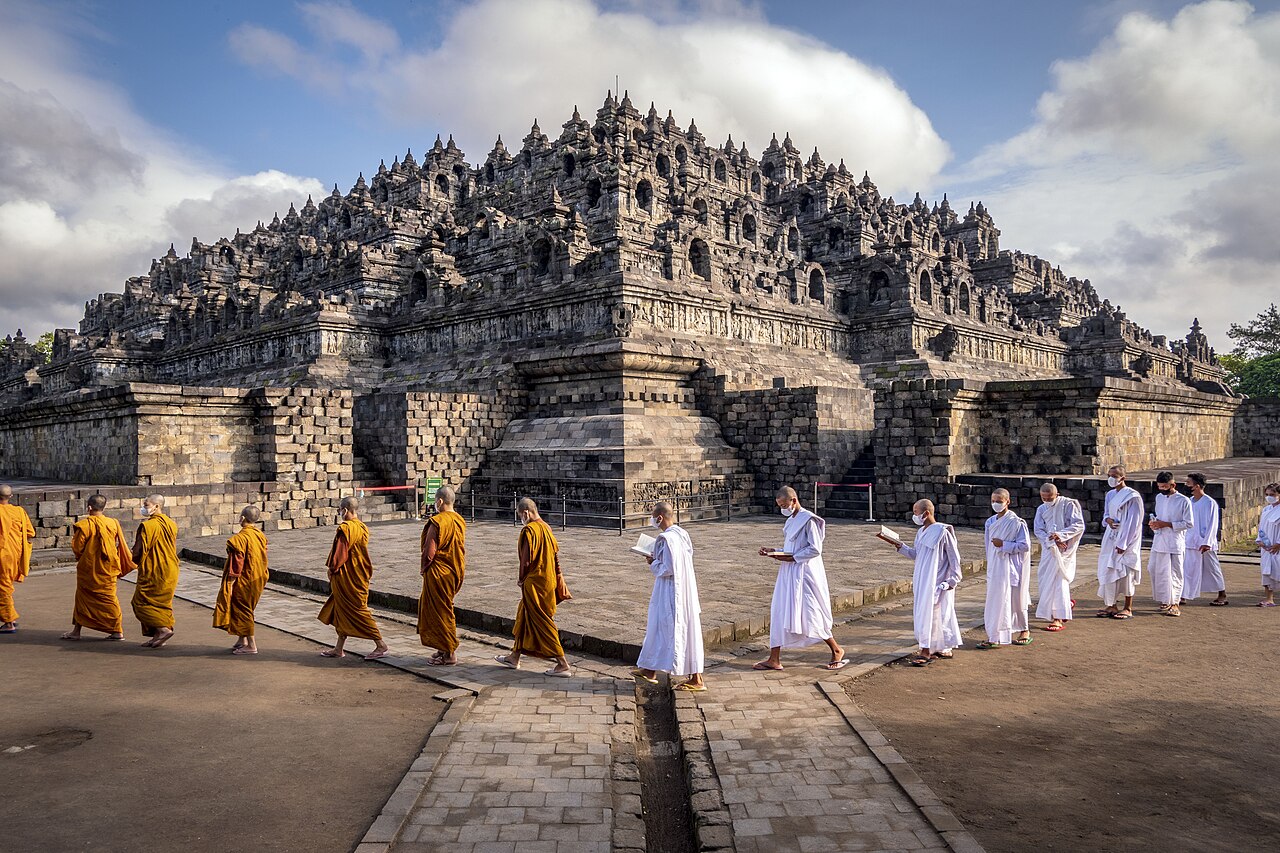
Borobudur is the world's largest Buddhist temple, located in the Kedu Valley of Central Java, Indonesia, approximately 40 kilometres northwest of Yogyakarta. Built during the reign of the Sailendra dynasty in the late 8th to early 9th century CE — construction is generally dated to around 778–850 CE, though precise dates remain debated — it is one of the greatest monuments of Asian civilisation and a masterpiece of Buddhist art and architecture. The monument was designated a UNESCO World Heritage Site in 1991 and receives millions of visitors annually, remaining a functioning pilgrimage site for Buddhists from across Southeast Asia and beyond.
The structure consists of nine stacked platforms built on a natural hill — six square platforms at the base and three circular platforms at the top — crowned by a large central stupa (a domed reliquary structure) at the summit. The overall form is that of a stepped pyramid approximately 35 metres high at its summit, with a base measuring 123 metres on each side. The construction technique is remarkable: the monument uses no mortar. Approximately 2 million blocks of volcanic andesite were fitted together using an interlocking dry-stone system, with detailed carving carried out after the blocks were set in place. The precision and scale of this mortar-free construction — over a structure of considerable height, in a seismically active region — represents a significant engineering achievement.
The three cosmological zones
Borobudur is not merely a temple but a three-dimensional mandala — a cosmological diagram of the Buddhist universe expressed in stone and walkable by pilgrims in a ritual circumambulation. The structure is organised into three distinct zones corresponding to the three realms of Buddhist cosmology:
The Kamadhatu (the sphere of desire, the lowest realm of existence) corresponds to the base of the monument. This level was originally decorated with 160 relief panels illustrating the consequences of good and evil actions — scenes of worldly desire and its karmic results. Unusually, this entire base was covered by an additional terrace very shortly after construction, probably for structural reasons to buttress the monument. The hidden panels were rediscovered only in the 19th century. A small section at the southeast corner has been left uncovered so that visitors can examine them.
The Rupadhatu (the sphere of form, the intermediate realm) comprises the four square gallery terraces above the base. These are lined with 2,672 individual relief panels — the longest continuous Buddhist narrative carved in stone anywhere in the world. If the panels were removed and laid end to end, they would extend approximately 5 kilometres. The reliefs depict scenes from the life of the Buddha, the Jatakas (stories of the Buddha's previous lives), and the Gandavyuha (the journey of the bodhisattva Sudhana toward enlightenment) — effectively the complete Buddhist canonical narrative illustrated in stone for pilgrims to study as they walked the galleries in clockwise procession. The galleries are lined with 432 Buddha statues in niched alcoves, each carved in the same seated posture but with different hand gestures (mudras) indicating different aspects of the Buddha's teaching depending on their orientation to the compass points.
The Arupadhatu (the sphere of formlessness, the highest realm) comprises the three circular upper terraces. Here the carved galleries and enclosed niches give way to open sky and a radically different aesthetic: 72 perforated stone stupas arranged in concentric circles, each containing a meditating Buddha statue visible through the diamond- and square-shaped perforations. The perforations are oriented so that the Buddha figures are partially visible — present but not fully revealed, an architectural metaphor for the Buddhist concept of enlightenment as a partial unveiling of ultimate reality rather than its complete disclosure. At the very apex stands the large central stupa, originally containing a relic but found empty when the monument was examined in the 19th century.
Abandonment, rediscovery, and restoration
Borobudur was apparently abandoned sometime around the 14th century — the probable period coincides with the decline of Buddhist influence in Java as Islam spread through the archipelago. The monument was gradually buried under layers of volcanic ash (Java's volcanic activity is continuous) and overgrown by jungle. Local oral traditions preserved knowledge of the site, but it was largely unknown to the outside world until the island of Java came briefly under British administration during the Napoleonic Wars.
In 1814, the Lieutenant-Governor of Java, Sir Thomas Stamford Raffles — better known as the founder of Singapore — heard reports of a great monument buried in the jungle and dispatched the Dutch engineer H.C. Cornelius to investigate. Cornelius found the monument and directed a two-month clearing operation, revealing its main structure. Systematic study and partial clearing continued through the 19th century, but the monument was in precarious condition: vegetation growth, water infiltration, and the weight of soil that had accumulated on the galleries were causing structural instability and the deterioration of the reliefs.
A major international restoration project, funded primarily by UNESCO and the Indonesian government and carried out between 1975 and 1982, was the most comprehensive archaeological restoration project ever undertaken in Southeast Asia. The entire monument was systematically dismantled, the stone cleaned and treated, a drainage system installed to prevent water infiltration, and the monument rebuilt with structural reinforcements concealed within its fabric. The restoration returned Borobudur to essentially its original form and halted the deterioration that had been threatening the irreplaceable relief carvings. The project also enabled detailed documentation of the monument's construction techniques, revealing the sophistication of the Sailendra dynasty's engineering.
Prambanan and the broader context
Borobudur was built in the same era and the same region as the great Prambanan Hindu temple complex, located approximately 40 kilometres to the east, near Yogyakarta. Prambanan, dedicated to the Hindu Trimurti (Brahma, Vishnu, and Shiva), was built by the rival Sanjaya dynasty during the 9th century CE — its main Shiva temple reaches 47 metres in height. The near-simultaneous construction of the world's largest Buddhist monument and one of the largest Hindu temple complexes in the world, within 40 kilometres of each other, reflects the religious complexity and dynastic competition of 9th-century Java. Both monuments lie within the cultural heartland of Central Java, in the shadow of Mount Merapi — one of the world's most active volcanoes — whose periodic eruptions have repeatedly affected both sites. Merapi's 2010 eruption deposited ash on Borobudur and closed the site temporarily, a reminder that the geological forces that shaped the region's landscape continue to interact with its architectural heritage.
Think you can place this building on the map?
Play Building Guessr