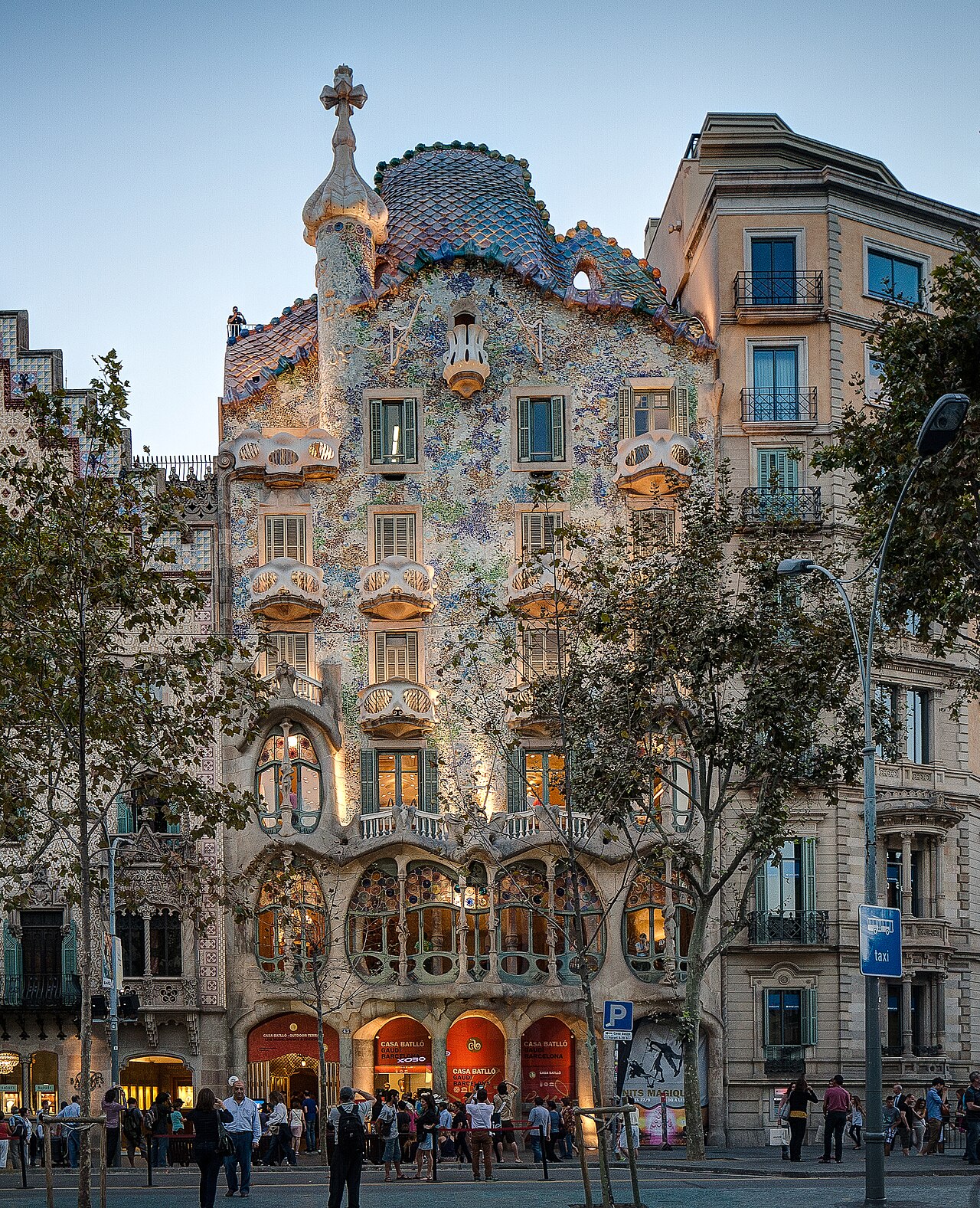
What it is
Casa Batlló at Passeig de Gràcia 43 in Barcelona's Eixample district was not built from scratch by Antoni Gaudí but entirely reimagined by him. The original building on the site was a conventional apartment block constructed in 1877; the Barcelona textile magnate Josep Batlló i Casanovas purchased it in 1900 and commissioned Gaudí to remodel it substantially. Gaudí worked on the project from 1904 to 1906, stripping the existing building back to its structural elements and rebuilding the exterior facades, the interior common areas, and the roof as a continuous organic composition. The result bears so little resemblance to its predecessor that the commission is better understood as a new building than a renovation. Gaudí submitted the project to the Barcelona City Council for building permits describing it as a "reconstruction and renovation" — a description that considerably understated the transformation he intended.
Casa Batlló stands at one of the most architecturally competitive addresses in Barcelona, on a stretch of Passeig de Gràcia known as the Manzana de la Discordia — the Block of Discord — because it contains major works by the three leading figures of Catalan Modernisme: Gaudí (Casa Batlló), Lluís Domènech i Montaner (Casa Lleó Morera), and Josep Puig i Cadafalch (Casa Amatller, directly adjacent to Casa Batlló). Batlló's original brief to Gaudí was apparently to demolish the existing building entirely and start fresh; it was Gaudí who decided to retain and transform the structure rather than replace it, reportedly because he saw potential in what was already there. UNESCO inscribed Casa Batlló as part of the Works of Antoni Gaudí World Heritage Site in 2005.
Architectural significance
Gaudí's Casa Batlló is understood today primarily as an allegory, though scholars debate exactly which allegory. The most widely accepted reading interprets the building as a marine scene: the facade as an underwater landscape, with the undulating blue-green ceramic tiles suggesting water in motion, the skull-shaped balconies in polished white stone representing bones and skulls of the dragon's victims, and the roof ridge — covered in overlapping ceramic scales in green and blue — as the spine and back of a dragon. Within this reading, the building represents the legend of St. George (patron saint of Catalonia) and the dragon — the cross rising above the dragon-back roof is St. George's lance. But Gaudí did not publicly explain his iconographic program, and the building resists any single definitive interpretation; what is undeniable is that it constitutes a total organic composition in which structural, ornamental, and symbolic elements are fused.
The interior light well — the patio de manzana — demonstrates Gaudí's integration of natural light with decoration at its most precise. The light well is tiled with graduated ceramics: deep cobalt blue at the top (where light arrives most intensely and most directly), transitioning through progressively lighter blues and turquoises toward white at the base (where the light has been diffused and reduced by its passage down the shaft). The tiles are also graduated in size, becoming larger toward the top to compensate optically for the foreshortening of the narrowing shaft when seen from below. The effect is that the light well appears uniformly lit throughout, when in reality the bottom receives far less natural light than the top. This is not decoration applied to architecture; it is a technical problem solved through decoration.
Key features
- Ceramic tile facade in blue and green: The entire street facade is covered in a mosaic of broken ceramic tiles (trencadís) in shifting blues, greens, and silvers that suggest the movement of water; the tiles were fired in a specific range of glazes to produce the aquatic color gradation Gaudí specified.
- Dragon-back roof ridge: The roof is covered in overlapping ceramic scales of green and blue that form a continuous ridge suggesting a dragon's spine; seen from the Passeig de Gràcia, the roofline of Casa Batlló reads as a single animated creature crouching above the facade.
- Bone-like balconies in white stone: The balcony parapets on the lower floors of the street facade are formed from polished stone carved to resemble skulls and femur bones — within the allegory of St. George, these are the remains of the dragon's victims.
- Mushroom-cap chimney pots: The twisted, sculptural chimney stacks on the roof terrace — wrapped in ceramic tile and topped with cap-like forms — are among Gaudí's most expressive roof elements, visible from neighboring rooftops and anticipating the more elaborate warrior-helmet chimneys of Casa Milà.
- Internal light well with graduated tile: The patio's ceramic tiling graduates from deep cobalt at the top to white at the base, both responding to the differential light levels and creating the optical illusion of uniform illumination throughout the shaft.
- Undulating staircase and ceiling forms: The common stairwell and the apartment interiors share Gaudí's characteristic refusal of the right angle — ceilings ripple in organic curves, door frames flow without straight lines, and the overall effect is of spaces shaped by natural forces rather than drafted by a draughtsman.
Preservation status
Casa Batlló has been owned by the Batlló family since its construction and is currently operated as a museum, event venue, and cultural center. It opened to daily public visitors in 2002. The building is in excellent condition; the ceramic cladding of the facade and roof is maintained through regular inspection and targeted replacement of damaged tiles using pieces fired to match the original glazes. The building's designation as a UNESCO World Heritage Site (as part of the Works of Antoni Gaudí inscription of 2005) provides additional regulatory protection. The Passeig de Gràcia location and the building's extraordinary cultural profile — it appeared in every architectural survey of Barcelona and in countless films and television productions — ensure sustained public and institutional attention to its condition.
Think you can place this building on the map?
Play Building Guessr