What it is
The Cathedral of Our Lady of Chartres — Cathédrale Notre-Dame de Chartres — is a Gothic cathedral in Chartres, about 80 kilometers southwest of Paris, and is widely considered the most complete, best-preserved, and most architecturally consistent Gothic cathedral in France. The current building was largely constructed between 1194 and 1220, replacing a Romanesque cathedral destroyed by fire in 1194. The speed of construction was remarkable: the main body of the cathedral, from the foundation level to the vaults, was completed in approximately 26 years, which accounts for the unusual stylistic unity of the building — it was built quickly enough that a single architectural vision could be sustained across the project, rather than the piecemeal revisions and additions that characterize most Gothic cathedrals built over longer periods.
Chartres was already a major pilgrimage destination before the 1194 fire, because the cathedral housed the Sancta Camisia — the tunic said to have been worn by the Virgin Mary at the birth of Christ, given to the cathedral by the Emperor Charlemagne in 876. When the fire broke out, the relic was reportedly saved by clergy who sheltered in the cathedral crypt and emerged unharmed three days later with the tunic intact. This was interpreted as a miraculous sign, and it generated an extraordinary outpouring of donations from across France that funded the rapid reconstruction of the cathedral. The reconstruction was also supported by donations of labor — large numbers of pilgrims reportedly helped haul building materials to the site, a phenomenon documented in contemporary accounts as the "cult of the carts." UNESCO recognized Chartres Cathedral as a World Heritage Site in 1979.
Architectural significance
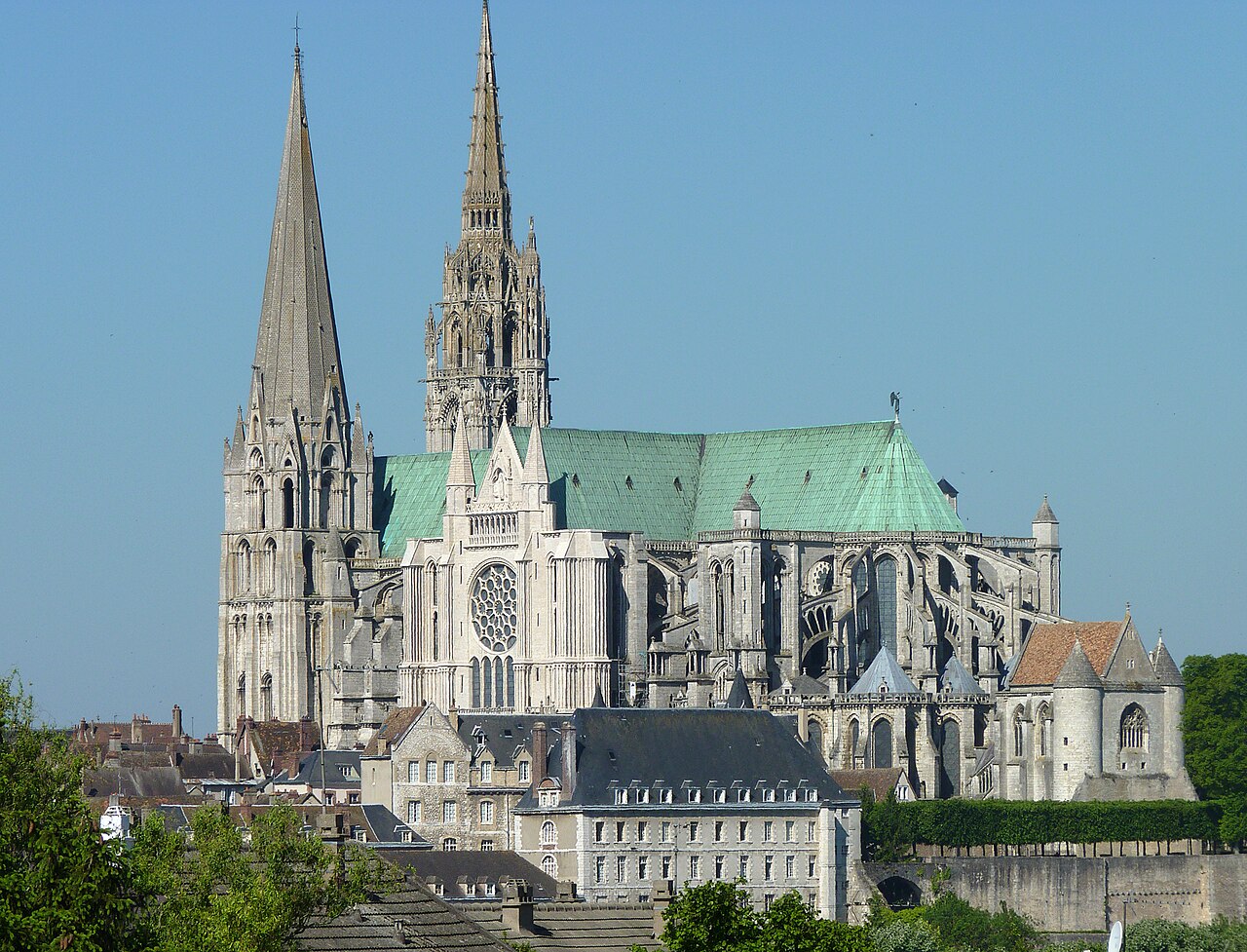
Chartres represents the transition from Early Gothic to High Gothic at the moment when the two are most clearly visible in a single building. The west facade of the cathedral, including the famous Royal Portal and its sculpture program, was built in the 1140s and 1150s — before the fire — and is therefore Early Gothic or even proto-Gothic in character. The main body of the cathedral, built after 1194, is fully High Gothic in its three-story elevation (arcade, triforium, clerestory), its use of flying buttresses to thin the nave walls, and its systematic replacement of solid wall with stained glass. Looking at Chartres is therefore like looking at two different moments of architectural history fused into one building. The two asymmetrical spires are the most visible expression of this temporal complexity: the south spire, begun in the 1140s on the Romanesque tower base that survived the fire, is a simple, elegant Early Gothic pyramidal spire of restrained geometry; the north spire, begun in 1506 — three and a half centuries later — is Flamboyant Gothic, with elaborate decorative tracery and crockets that are visually much busier than the south tower. The two towers side by side are often described as a mistake or an oversight, but they are in fact a record of the building's history made visible in stone.
The stained glass program at Chartres is the largest and best-preserved medieval glass ensemble in the world. Of the 176 windows, approximately 152 retain substantial portions of their original medieval glass — a survival rate unparalleled among Gothic cathedrals, most of which lost their glass in the Wars of Religion, the French Revolution, or the World Wars. The most celebrated individual window is the Notre Dame de la Belle Verrière (Our Lady of the Beautiful Window), in the south ambulatory, which dates partly to about 1180 — predating the fire, and therefore one of the oldest pieces of glass in situ anywhere in France. The famous "Chartres blue" — a deep cobalt blue with a luminous quality achieved through a specific medieval glassmaking technique involving cobalt oxide — is visible throughout the cathedral's windows and has been the subject of chemical analysis revealing glass formulas that have not been fully replicated by modern manufacturers.
Key features
- Two asymmetrical spires: The south tower (base c. 1140s, spire c. 1160s) is a simple Early Gothic pyramidal form rising 105 meters; the north tower (base c. 1140s, spire 1506–1513) is a later Flamboyant Gothic addition rising 113 meters. The deliberate asymmetry has fascinated architects and historians for centuries as a record of the cathedral's construction history made permanently legible.
- Royal Portal (Portail Royal): The west facade portal program (c. 1145–1155) is the earliest surviving complete High Medieval cathedral portal. Its characteristic feature is the column figures — elongated human figures carved into the jamb columns flanking the portal entrances, their bodies merged with the column shafts in a treatment that is specific to this generation of Early Gothic sculpture and was soon replaced by more naturalistic approaches.
- 176 stained glass windows: Covering approximately 2,600 square meters of glass, including rose windows in the west, north, and south facades. The north and south rose windows (both c. 1235) are approximately 10.5 meters in diameter and contain complex narrative programs arranged in concentric rings.
- Flying buttresses: Among the earliest large-scale examples of the mature flying buttress, the buttresses at Chartres were a decisive technical step that influenced all subsequent High Gothic construction in France. They are particularly visible from the south side, where the double-arch form of the later buttresses can be clearly distinguished from the single-arch form of the original construction.
- Choir labyrinth: A large circular labyrinth inlaid in the nave floor in dark and light stone, approximately 12.9 meters in diameter, dating to about 1200–1220. Medieval labyrinths served as symbolic pilgrimage routes — walking the labyrinth was a form of penance or devotion for those unable to travel to Jerusalem. Chartres has the largest and best-preserved surviving example.
- Notre Dame de la Belle Verrière: The "Blue Virgin" window in the south ambulatory, dating partly to c. 1180, is one of the oldest pieces of in-situ stained glass in France. The deep cobalt blue of the Virgin's robe is the most celebrated example of the "Chartres blue" glassmaking tradition.
Preservation status
Chartres Cathedral is in good structural condition and has benefited from careful conservation over many decades. The most significant conservation event of recent years has been a controversial program of cleaning the interior stonework, begun in 2009, which removed centuries of accumulated grime and biological crust from the nave walls and piers to reveal the original painted polychrome decoration beneath. The cleaning revealed that the medieval interior was not the austere grey stone that visitors had experienced for generations but was painted in rich yellows, reds, and blues — a discovery that transformed understanding of the Gothic interior. The cleaning program has been controversial, however, because some conservators and architectural historians argued that the darkened stone was itself part of the building's authentic character, and that the bright cleaned result looks disconcertingly new.
The stained glass windows were removed and carefully stored during both World Wars, returned in 1945, and are in generally good condition. Some individual panels require periodic consolidation and releading, and the glass is monitored for deterioration from atmospheric pollution. The UNESCO World Heritage designation is maintained, and the cathedral receives approximately 1.5 to 2 million visitors annually. Visitor management focuses on protecting the floor, the labyrinth, and the windows from the humidity and carbon dioxide introduced by large crowds. The labyrinth is only fully visible when the chairs are removed, which happens on Fridays when the cathedral allows visitors to walk it — a practice that continues medieval tradition.
Think you can place this building on the map?
Play Building Guessr