What it is
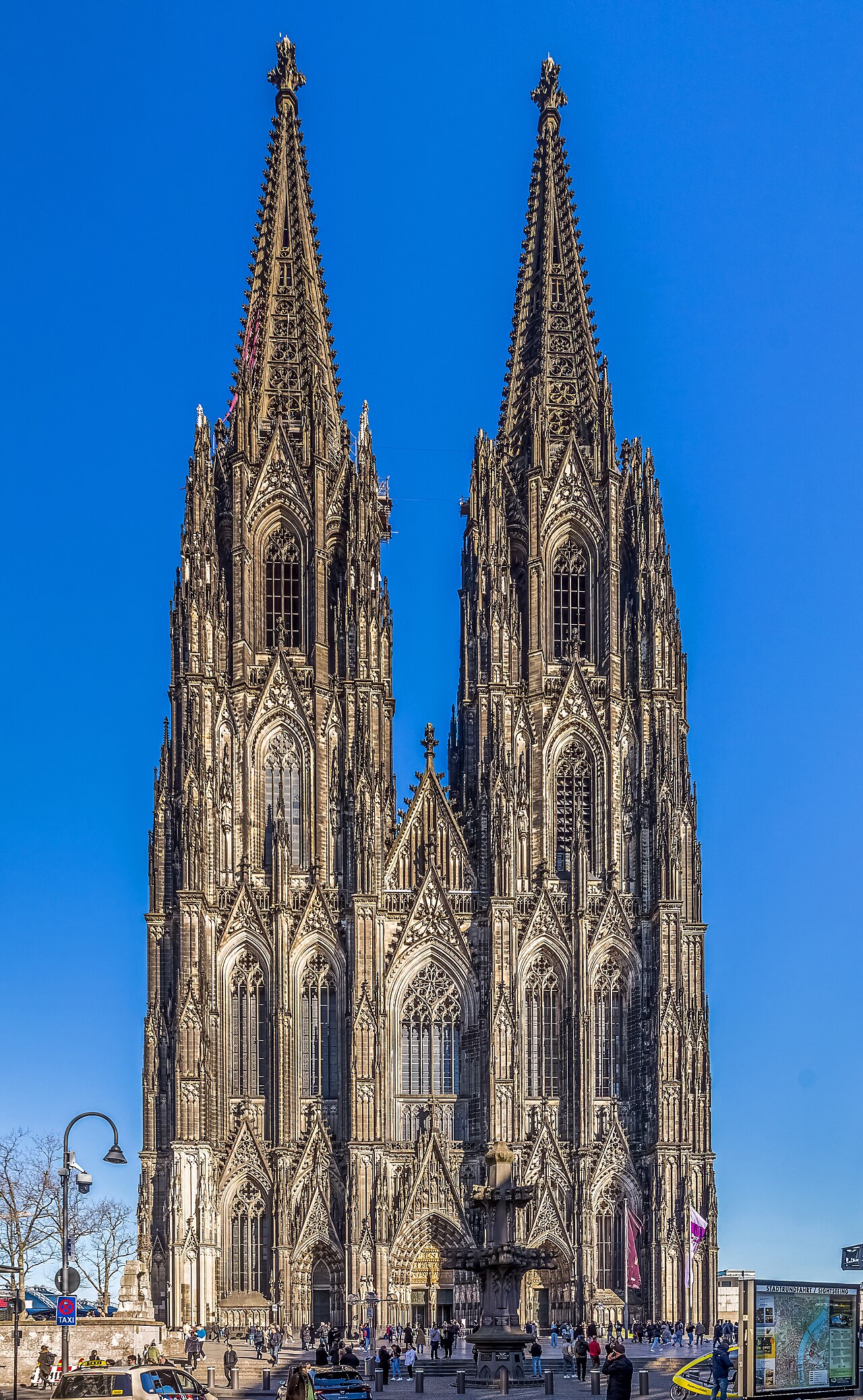
Cologne Cathedral — Kölner Dom, formally the Cathedral Church of Saint Peter — is the seat of the Archbishop of Cologne and the largest Gothic church in northern Europe. Its construction spanned 632 years, from the laying of the foundation stone in 1248 to the completion of the north tower spire in 1880, making it the longest continuously built Gothic structure in history. The building's twin spires rise to 157 metres and dominate the Cologne skyline from every direction; for four years after completion, from 1880 to 1884, they were the tallest man-made structures in the world, surpassing the Rouen Cathedral spire and briefly holding the record before the Washington Monument overtook them.
The cathedral stands on the east bank of the Rhine in the heart of Cologne's historic centre, on a site with religious significance dating back to Roman times — excavations beneath the cathedral have revealed Roman buildings from the 1st century CE. The motivation for the 13th-century building campaign was the acquisition, in 1164, of the relics of the Three Magi — the Biblical Wise Men — by Archbishop Rainald of Dassel, who brought them from Milan after the capture of that city by Frederick Barbarossa. The relics made Cologne one of the most important pilgrimage destinations in medieval Europe, and the cathedral was built to house them in appropriate splendour and to demonstrate Cologne's status as a major ecclesiastical power.
Architectural significance
Cologne Cathedral was designed in the High Gothic style as a deliberate exercise in surpassing every previous Gothic building in height, structural refinement, and spatial ambition. The master builder Gerhard of Rile based the design on the French Gothic tradition — specifically on Amiens Cathedral, which was nearing completion in the 1240s — and pushed its structural logic to an extreme. The choir, completed in 1322, is the tallest medieval choir in the world at 43.35 metres, and its system of double ambulatories, radiating chapels, and flying buttresses represents the most sophisticated example of High Gothic engineering in Germany. The nave, finally completed in the 19th century, matches the medieval choir's proportions exactly — a deliberate fidelity to the original medieval design drawings, which had survived largely intact and were used directly in the 19th-century completion campaign.
The 19th-century completion is itself a significant chapter in architectural history. Work resumed in 1842 after a fundraising campaign that mobilised German nationalist sentiment — the completion of the cathedral became a symbol of German cultural achievement and political aspiration in the decades before unification in 1871. The architect Ernst Friedrich Zwirner and his successor Richard Voigtel directed the completion using the original medieval elevation drawings preserved in the cathedral archives, supplemented by detailed surveys of the medieval portions of the building. The result is an extraordinarily seamless building: it is very difficult, even for a trained eye, to distinguish the medieval stonework from the 19th-century additions. The twin facades and towers, completed in 1880, were built to tolerances of millimetres across sections 100 metres tall.
Key features
- The Shrine of the Three Kings: The Reliquary of the Three Kings, completed around 1225, is the largest medieval reliquary in the Western world and one of the great masterpieces of medieval goldsmith work. It is a triple-apsed basilica form in gilded silver and gold, decorated with enamel, filigree, precious stones, and antique cameos, measuring 153 cm long and 110 cm tall. It stands behind the high altar and was the primary object of medieval pilgrimage to Cologne.
- Stained glass: The cathedral contains some of the finest medieval stained glass in existence, including the 13th-century windows of the Three Kings Chapel, the 14th-century windows of the south aisle, and the magnificent Bayernfenster (Bavarian Windows) donated by King Ludwig I of Bavaria in 1848. A controversial 2007 window by the Cologne artist Gerhard Richter — an abstract composition of 11,500 randomly coloured glass squares in 72 colours — was installed in the south transept; the Archbishop described it as "the work of the devil."
- Survival of World War II: Cologne was one of the most heavily bombed cities in Germany; RAF and USAAF raids destroyed over 90% of the city centre. The cathedral received 14 direct bomb hits and was severely damaged — windows shattered, roof sections destroyed, the interior badly damaged — but the main structural fabric survived. Allied navigators used the cathedral's intact twin spires as a landmark for locating the city during bombing runs.
- The Gero Cross: The carved oak crucifix known as the Gero Cross, dating from around 970 CE, is one of the oldest surviving large-scale figural sculptures in medieval Europe and a landmark in the history of Christian art. It depicts Christ with closed eyes in death — a departure from the triumphant living Christ of earlier Carolingian art — and influenced the subsequent development of devotional crucifixes across Europe.
- UNESCO World Heritage: The cathedral was inscribed as a UNESCO World Heritage Site in 1996. It was briefly placed on the List of World Heritage in Danger in 2004 due to threatened high-rise development in the surrounding area, but was removed from the danger list in 2006 following the adoption of protective planning regulations by the city of Cologne.
Construction and history
The foundation stone was laid on 15 August 1248, the feast of the Assumption, by Archbishop Konrad von Hochstaden. The choir — the eastern end, containing the high altar and the Shrine of the Three Kings — was consecrated in 1322, a construction period of 74 years for a single section of the building. Work on the nave and transepts continued through the 14th century but slowed dramatically after about 1400 as Cologne's economic fortunes declined and medieval enthusiasm for Gothic building generally waned across Europe. By 1560 the building stood incomplete, a giant crane perched on the south tower stump a symbol of construction abandoned. The crane became a Cologne landmark in its own right, appearing in historical views of the city for nearly three centuries.
The resumption of construction in 1842 was driven partly by the aesthetic movement of German Romanticism and partly by political ambition. King Friedrich Wilhelm IV of Prussia laid a new foundation stone in the presence of thousands, describing the completion as a national cause. The campaign combined private fundraising with royal and state patronage, and construction proceeded with 19th-century efficiency — what had taken 600 years for the medieval builders to leave incomplete was finished in 38 years. The twin towers were topped out on 14 August 1880. The building was simultaneously an authentic medieval Gothic structure and a 19th-century nationalist monument, and this dual identity has shaped its reception ever since.
Preservation and status
Cologne Cathedral is a functioning cathedral and a major tourist destination, receiving approximately six million visitors per year. It is maintained by the Zentral-Dombau-Verein, a building association founded in 1842 that has never stopped operating and continues to fund and manage stone conservation work. The cathedral's black-grey exterior colour is the result of centuries of coal combustion pollution depositing soot on the stone — recent cleaning campaigns have revealed the original cream-coloured limestone beneath in some sections. Stone conservation is continuous: the cathedral's surface area is so large that by the time one complete cycle of restoration is finished, the first sections worked are ready for attention again.
Think you can place this building on the map?
Play Building Guessr