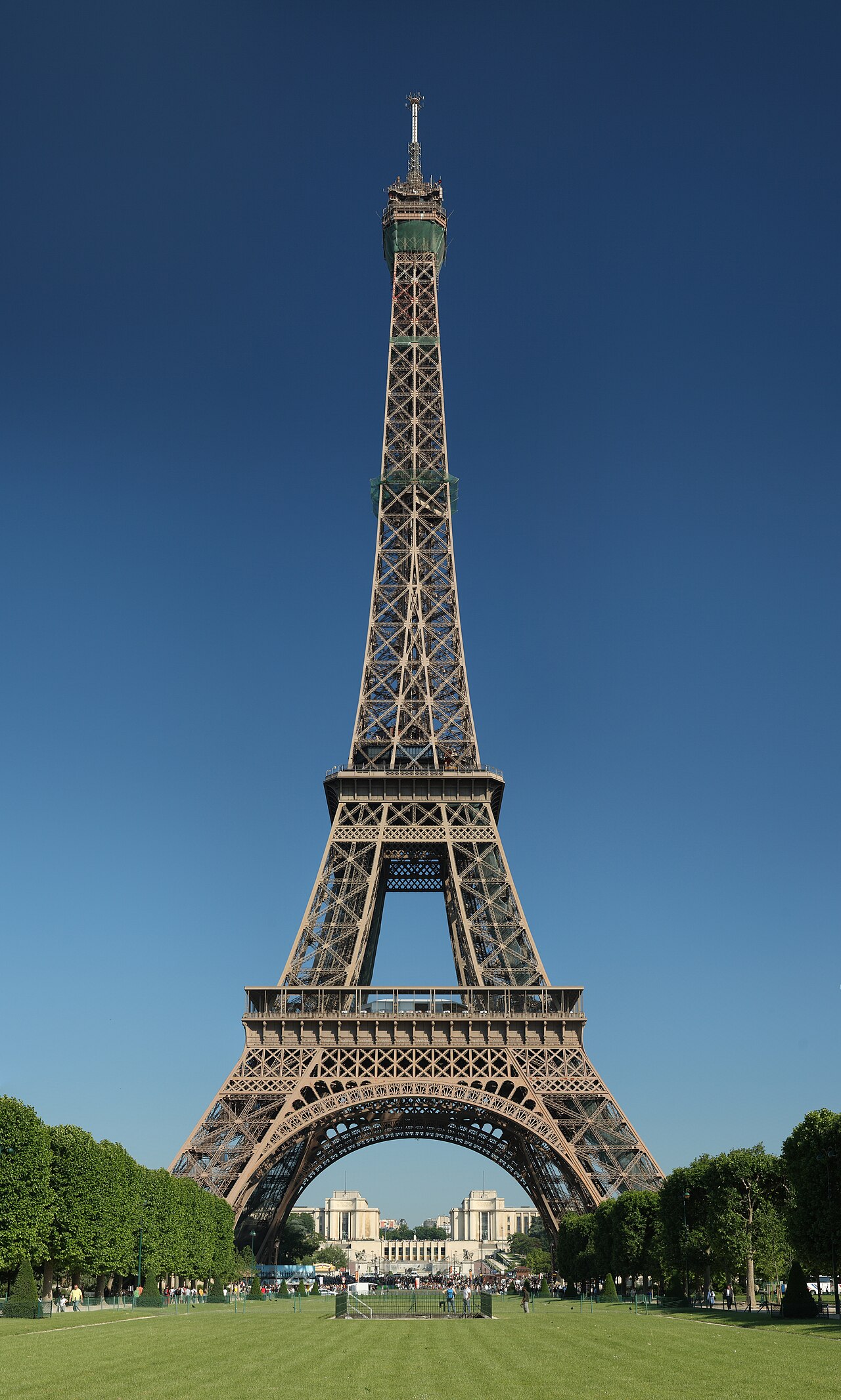
What it is
The Eiffel Tower is a wrought-iron lattice tower standing on the Champ de Mars in Paris, one of the most recognised structures in human history. It was designed by the engineer Gustave Eiffel — more precisely, by the engineers of his company, principally Émile Nouguier, Maurice Koechlin, and architect Stephen Sauvestre — and built as the centrepiece entrance arch for the 1889 Exposition Universelle, the World's Fair held in Paris to mark the centenary of the French Revolution. At the time of its completion it stood 300 metres tall, making it by a large margin the tallest man-made structure ever built, surpassing the Washington Monument by more than 100 metres. It held that record until 1930, when New York's Chrysler Building overtook it.
The tower was always conceived as a temporary structure: the original plan called for its demolition after 20 years, in 1909. It was saved almost entirely by its practical utility as a radio transmission tower. The French military used it for radio telegraphy from 1903, and during World War I it jammed German communications and intercepted vital intelligence. Today the tower has been repainted 19 times and carries broadcasting antennae at its summit, which bring its total height to 330 metres. It receives approximately 7 million visitors per year, making it the most visited paid monument in the world.
Architectural significance
The Eiffel Tower was a radical statement about what engineering could achieve when freed from the decorative conventions of 19th-century architecture. The architects of the Beaux-Arts tradition, which dominated French public building in the 1880s, regarded the tower with undisguised hostility. A petition signed by 300 leading French artists, architects, and writers — including Guy de Maupassant and Charles Gounod — was published in the press before construction was complete, condemning it as "a truly tragic street lamp" and "a gigantic black factory chimney," an "odious column of bolted sheet metal." Gustave Eiffel responded that the mathematical precision of its curved form had its own aesthetic logic: the profile of each leg is derived from the equations governing wind resistance, so the tower's shape is not arbitrary but a direct expression of the forces it must resist. The curves are, in a literal sense, the signature of the wind.
The structural system that makes this possible is the wrought-iron lattice framework: 18,038 individual iron pieces, connected by 2.5 million rivets, assembled using prefabricated components manufactured off-site and lifted into place by cranes that rode up the structure as it grew. The construction precision required was extraordinary — each of the 18,038 pieces was designed to fit exactly one position in the tower, and they did. The four great arched legs meet at the first platform at 57 metres and taper to a single shaft above the second platform at 115 metres. The open lattice design minimises wind resistance while maximising structural efficiency — a steel box of the same height would have needed to be far heavier to achieve the same stability. The tower thus influenced a generation of engineers who saw in it proof that iron and calculation could produce beauty as well as strength.
Key features
- Three observation levels: The first platform at 57m includes a glass floor section and a restaurant; the second at 115m has panoramic views across Paris; the third, at 276m, is the highest accessible point and offers views extending up to 70km on a clear day. The summit at 300m houses the original Gustave Eiffel private apartment, now restored.
- Thermal expansion: The tower grows approximately 15cm in summer due to the thermal expansion of iron in heat. The top of the tower can also lean up to 18cm away from the sun on hot days as the sun-facing side expands more than the shaded side — an invisible but measurable seasonal movement built into the structure's behaviour.
- Repainting every 7 years: Each repainting requires approximately 60 tonnes of paint applied by hand by a team of 25 painters working without scaffolding. The current colour is a custom "Eiffel Tower Brown" — a warm bronze-brown chosen in 1968. The tower has also been painted red-brown, yellow, and various other tones in its history.
- Evening light show: Since 1985 the tower has been illuminated at night, initially with sodium vapour floodlights and now with LED. Since 1999 it has also sparkled for five minutes at the top of each hour after dark, using 20,000 light bulbs and strobes — a lighting display that was itself the subject of a copyright lawsuit in the 2000s, settled by ruling that photographs of the lit tower at night could not be freely reproduced commercially.
- Hydraulic and electric lifts: The original lifts in the curved legs were hydraulic, using water-pressure rams to climb the angled tracks. The two lifts in the south and east legs retain their original Otis hydraulic mechanism, now restored; the north and west leg lifts were replaced with electric motors in the 1980s.
Construction and history
Construction began in January 1887 and was completed in March 1889 — a total of 26 months, including two years of on-site assembly by a crew that averaged 150–300 workers. The prefabricated iron elements were delivered by horse-drawn cart from Eiffel's factory in Levallois-Perret and assembled using 150-tonne mobile cranes. No worker died during the construction of the tower itself, a remarkable safety record for the era, achieved partly through the installation of safety screens beneath working areas. The foundations for the four legs, which rest on cofferdams sunk into the Champ de Mars gravel and sand above the Paris gypsum layer, were completed by June 1887.
The tower opened to the public on 6 May 1889, three weeks before the Exposition Universelle officially opened. Gustave Eiffel climbed to the summit himself on opening day to plant the French tricolour. During the fair, approximately 2 million visitors climbed the tower. After 1909, when the demolition order was rescinded on account of the radio antenna, the tower remained in continuous operation, surviving both World Wars intact — Hitler ordered its lift cables cut in 1944 to prevent General de Gaulle from reaching the summit, but the cables were quickly repaired and the German flag was replaced by the tricolour on 25 August 1944 as Paris was liberated.
Preservation and status
The Eiffel Tower is owned by the city of Paris and managed by the Société d'Exploitation de la Tour Eiffel (SETE). Its iron structure requires continuous maintenance: the seven-year repainting cycle is the most visible aspect, but the tower also undergoes regular inspection of its riveted joints and structural elements. The original wrought iron — a material distinct from the cast iron used in earlier structures and the mild steel that would dominate later ones — has performed exceptionally over more than 130 years, developing a stable oxide layer that protects it from deeper corrosion. There are no current threats to the tower's structural integrity, though crowd management on the ground and within the structure remains an operational challenge at peak visitor periods.
Think you can place this building on the map?
Play Building Guessr