What it is
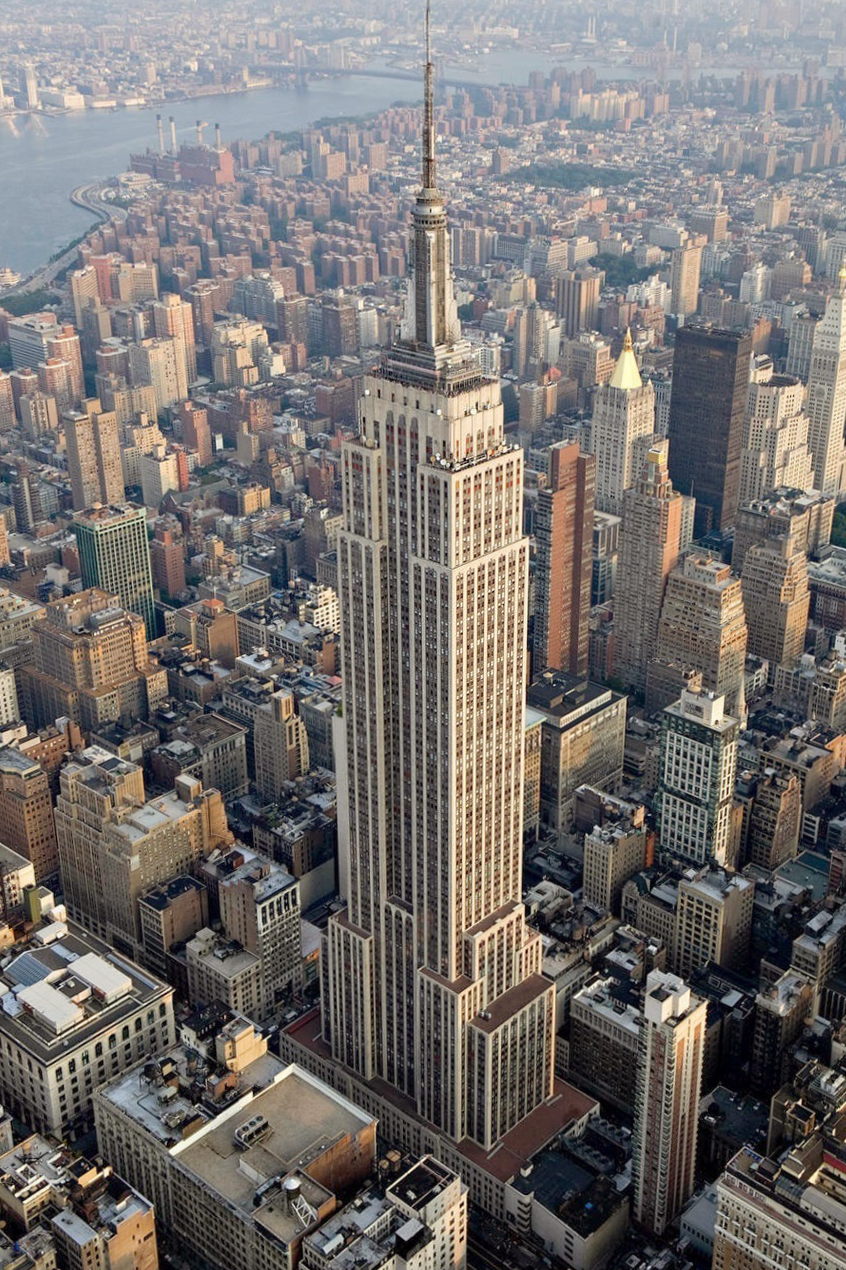
The Empire State Building is a 102-story Art Deco skyscraper in Midtown Manhattan, rising 443 meters to the tip of its antenna mast. It was designed by the firm Shreve, Lamb and Harmon for the developer and former General Motors executive John J. Raskob, and was built with a speed that remains staggering by any standard: construction began on March 17, 1930, and the building was opened on May 1, 1931 — 410 days from groundbreaking to opening. During the construction peak, the structural steel rose at a rate of approximately 4.5 floors per week. At the height of the project, more than 3,400 workers were on site simultaneously, working in shifts around the clock. Seven people died during construction — an exceptionally low number for a project of this scale at that period. The total cost was approximately 40.9 million dollars, which was actually under budget: the original estimate had been 43 million dollars, and the Depression-era collapse in construction costs allowed the project to come in cheaper than anticipated.
The building became the world's tallest structure on the day it opened, surpassing the Chrysler Building (completed 1930) by approximately 62 meters. It held the record for 41 years, until the North Tower of the World Trade Center surpassed it in 1972. The Empire State Building was conceived and designed during the late 1920s boom years of the New York skyscraper race, when several developers competed to build the world's tallest building, each revising their designs upward as rivals announced new heights. Raskob reportedly pointed at a pencil during an early design meeting and told the architects "How high can you make it so that it won't fall down?" The mooring mast at the very top was his response to the question of what to put above the observation deck — it was intended as a dock for transatlantic dirigible airships, which would moor to the mast and allow passengers to disembark directly into the Manhattan skyline. Two dirigibles docked there successfully in September 1931, but the practical difficulties of wind, updrafts, and the impossibility of controlling a large airship over a dense urban area made further attempts dangerous, and the mooring mast was repurposed as a broadcasting antenna.
Architectural significance
The Empire State Building is the culminating expression of the New York skyscraper tradition that developed in the 1920s under the influence of the 1916 Zoning Resolution — the first comprehensive zoning law in the United States, which required buildings in New York to step back progressively from the street as they rose above certain heights, to prevent the complete blocking of light and air from the streets below. This requirement produced the characteristic setback ziggurat silhouette — the tiered, pyramidal profile — that defines the Empire State Building and most of the iconic skyscrapers of its generation. The building steps back in five major tiers from its full-block base to the relatively slender tower at the top, creating a three-dimensional composition that reads as a coherent sculptural form at a distance while efficiently maximizing rentable floor area within the zoning constraints. The setback profile of the 1920s New York skyscraper was the direct formal result of a regulatory requirement, which makes the Empire State Building one of the clearest examples of how building codes shape architectural form.
The construction system used for the Empire State Building pioneered several techniques that became standard in subsequent American skyscraper construction. The aluminum and Indiana limestone cladding was prefabricated in off-site workshops in standardized panel units and delivered to site ready to install, allowing the cladding to proceed in close sequence with the structural steelwork rather than lagging behind it. The spandrel panels (the horizontal bands between floors), window surrounds, and limestone courses were assembled into modular units that could be lifted and set in place quickly, contributing to the four-floors-per-week installation rate. This prefabrication approach — treating the building facade as an industrial assembly rather than a craft exercise in applied stone — was a decisive step in the evolution of the modern building envelope. The Art Deco aesthetic of the building — the stylized eagle heads at the setback corners, the aluminum and chrome detailing of the lobby, the vertical emphasis of the window bays articulated with chrome-plated aluminum — represents one of the most fully realized Art Deco building programs in the world, consistently developed from the granite base to the antenna tip.
Key features
- Art Deco lobby: The original lobby, preserved largely intact, features aluminum murals of the building and the New York skyline, a marble-clad interior, and chrome-accented elevator doors and mailboxes. The lobby was substantially restored in 2009, reversing decades of incremental modification and returning it close to its original appearance.
- Setback silhouette in five tiers: The building steps back at five levels as it rises — at the 25th, 72nd, 86th, and 102nd floors — creating the characteristic stepped pyramidal profile that is the building's most immediately recognizable formal quality. The five setbacks were designed to comply with the 1916 zoning law while creating a visually unified composition.
- Silver-colored aluminum spandrels and limestone facade: The alternating bands of polished aluminum spandrel panels and Indiana limestone create the building's vertical rhythm. The aluminum was an unusual choice for 1930, chosen for its reflective silver quality that complements the stainless steel decorative elements.
- 86th floor observation deck (open-air): The outdoor observation deck at 320 meters has been a major tourist attraction since 1931, and is regularly cited as one of the most famous views in the world. It is surrounded by a parapet and enclosed observation areas added in later years for safety.
- 102nd floor observation deck: A smaller enclosed observation space near the top of the building, originally intended as a dirigible passenger lounge, converted to a cramped but spectacular upper observation area that was reopened to the public after renovation in 2019.
- Illuminated top: The building's upper floors are illuminated in colors that change to mark holidays, causes, sports team victories, and cultural events. The system has been in use since 1976 and has become a form of civic communication — New Yorkers read the color of the Empire State Building's top as a daily signal about what the city is marking or celebrating.
- Mooring mast: The 62-meter mooring mast that forms the top of the building was designed for dirigible airships — a genuinely conceived if ultimately impractical idea in 1929, when transatlantic airship travel seemed like the transport mode of the future. It now serves as an antenna and broadcast tower, and its silhouette is what makes the Empire State Building's profile immediately distinct from all other tall buildings.
Preservation status
The Empire State Building is standing and in active commercial use as an office building and major tourist destination. It was designated a New York City landmark by the Landmarks Preservation Commission in 1981, and a National Historic Landmark in 1986. The landmark status restricts significant exterior alterations, though the building's owners have undertaken major renovation work to the interior systems, lobby, and observation decks over the decades.
A comprehensive energy renovation completed in 2011 reduced the building's energy consumption by approximately 38 percent through window replacement, insulation upgrades, and mechanical system modernization — an influential project that demonstrated the feasibility of deep energy retrofits in historic skyscrapers without compromising their architectural character. The Empire State Building REIT (Real Estate Investment Trust) continues to manage the building as a commercial office property and tourist attraction. It receives approximately 4 million visitors per year to its observation decks, making it one of the most visited paid attractions in New York City. The building is expected to remain in active use indefinitely; its landmarked status and its cultural significance make demolition essentially unthinkable, and its structural steel frame, designed with significant overcapacity by the standards of its time, continues to perform well.
Think you can place this building on the map?
Play Building Guessr