What it is
The Great Wall of China is not a single wall but a vast system of fortifications, walls, watchtowers, beacon towers, and garrison stations built, rebuilt, and connected by successive Chinese dynasties across more than two thousand years. The total length of all sections across all dynasties, measured by China's State Administration of Cultural Heritage in a survey completed in 2012, comes to approximately 21,196 kilometres — a figure that includes walls, trenches, and natural defensive barriers such as rivers and ridgelines incorporated into the system. The figure that most people associate with the Wall — around 8,850 kilometres — refers specifically to the Ming dynasty sections built between 1368 and 1644, the most substantial and best-preserved stretch, running from Shanhaiguan on the Bohai Sea coast in the east to Jiayuguan in the Gobi Desert in the west.
The impulse to fortify China's northern frontier is far older than the Ming dynasty. The earliest precursor walls date to the 7th century BCE, when the Qi, Yan, and Zhao states began constructing earthen ramparts to defend against raiding nomadic peoples from the steppe. The decisive unification came under Qin Shi Huang, the first emperor of a unified China, around 221 BCE. After conquering the warring states and declaring himself emperor, Qin Shi Huang ordered his general Meng Tian to connect the existing walls of the northern kingdoms into a single continuous barrier and push it further north, creating a formal boundary between the Chinese agricultural world and the nomadic territories beyond. This project mobilised hundreds of thousands of soldiers, conscripted peasants, and convicted criminals — one of the largest construction mobilisations in the ancient world. The human cost was catastrophic: estimates suggest that hundreds of thousands died during the Qin construction phase alone, giving rise to the grim description of the wall as the world's longest cemetery, a reference to the widespread practice, reported in ancient chronicles, of burying the dead within the wall itself.
Material and construction
The materials used to build the Wall changed dramatically across dynasties and regions. The earliest Qin-era walls were built primarily of rammed earth (hangtu) — layers of compacted soil, sometimes mixed with gravel and organic material, beaten down between wooden frames. This technique was fast, required no kilns, and could be performed by unskilled labour, but it was also vulnerable to erosion, particularly in wet climates. In desert regions, rammed earth walls have survived remarkably well because of the dry conditions; in wetter eastern China, most early sections have dissolved back into the landscape.
The Han dynasty (206 BCE–220 CE) extended the Wall far to the west into the Gobi Desert, using whatever materials were available locally — in many western sections, the walls were built from reeds, tamarisk branches, and gravel in layered sandwiches, a technique adapted to an environment with no clay or timber. The resulting structures look nothing like the iconic brick walls of the Ming dynasty but survive in surprising condition in the arid northwest.
It was under the Ming dynasty that the Wall assumed the form most people recognise: broad battlemented ramparts built of fired brick and stone, wide enough for five horsemen to ride abreast, punctuated at regular intervals by watchtowers and garrison forts. The Ming builders faced a different military environment than the Qin — gunpowder weaponry and the threat from the Mongols under Altan Khan required more substantial defensive works — and they had access to centuries of accumulated construction knowledge and to established kiln industries that could supply standardised brick at scale. Many Ming bricks are stamped with the name of the manufacturing garrison and the supervising official, a quality-control system that allowed defective sections to be traced back to their builders.
Beacon towers and signal relay
The Wall's most important military function was not to stop invaders directly — a determined force could breach or bypass any section — but to slow, channel, and signal. The network of beacon towers spaced at regular intervals along the Wall provided a communication system of remarkable speed. Each tower was designed to relay signals using a combination of smoke during the day and fire at night; the specific signal — the number of smoke columns and the number of cannon shots fired simultaneously — encoded information about the size of the attacking force. A message warning of a major invasion could travel the entire length of the Ming Wall, from the eastern coast to the western desert, in a matter of hours: far faster than any mounted messenger.
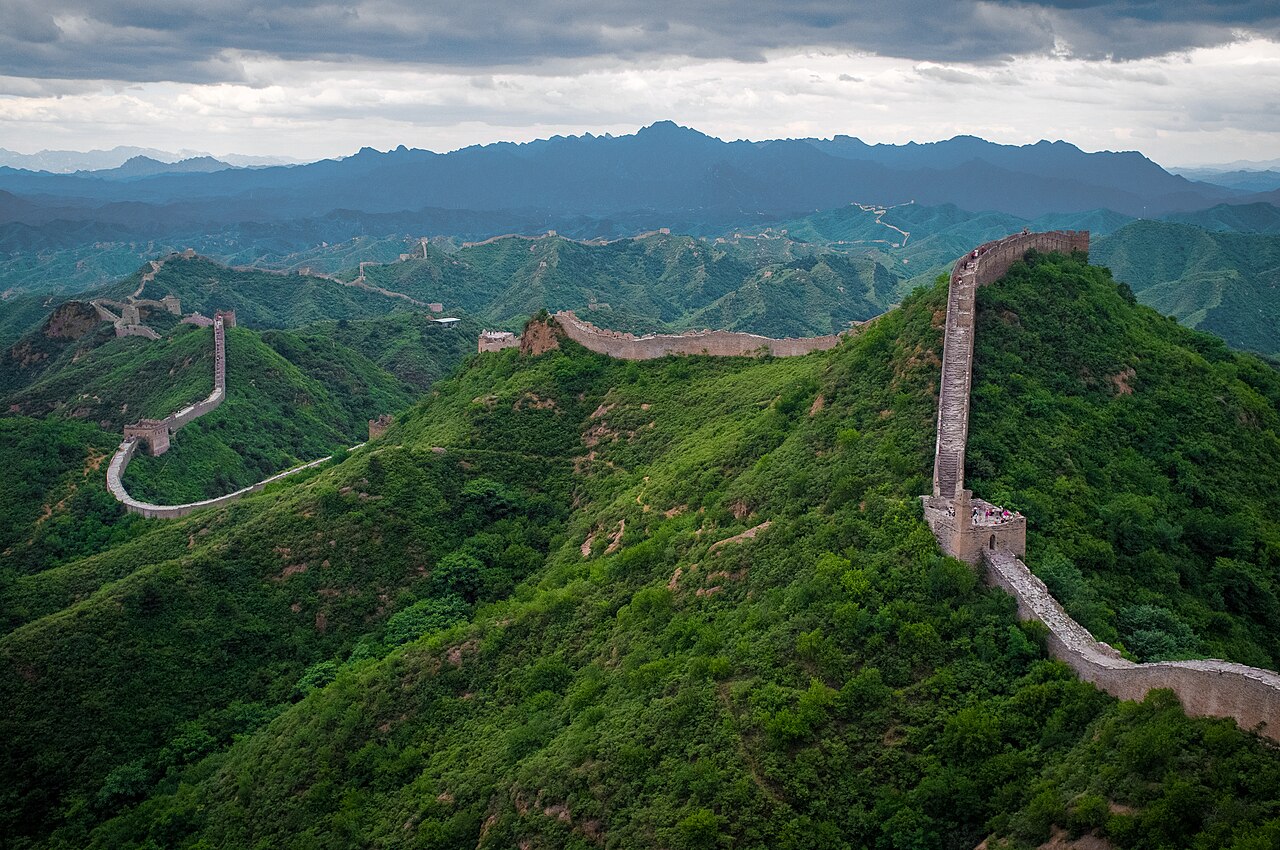
The Mutianyu and Badaling sections near Beijing are the best-preserved and most visited portions of the Ming Wall. Badaling, which opened to tourists in 1957 and was the section shown to foreign dignitaries including Richard Nixon during his 1972 China visit, has been so heavily restored and partially reconstructed that historians debate how much of the existing structure is original. Mutianyu, opened later and restored with more archaeological care, is generally considered a better representation of the Ming construction. Both sections sit in dramatic mountain landscape — the Wall snaking along ridgelines, climbing and descending steep slopes in long staircases — a visual effect that is partly practical (following high ground maximised the defensive sight lines) and partly a result of the terrain that the Wall was built to cross.
The visible-from-space myth
One of the most persistent popular beliefs about the Great Wall is that it is visible from space with the naked eye. This claim has been repeated in guidebooks and encyclopaedias for over a century, but it is false. The Wall, even at its widest Ming-era sections, is only about 9 metres wide — narrower than a highway, and far too thin to be resolved by the naked human eye from low Earth orbit. The myth was definitively put to rest when Chinese astronaut Yang Liwei, who became China's first person in space in October 2003, reported that he could not see the Wall from orbit. Satellite imagery can detect the Wall under the right conditions of lighting and contrast, but the human eye cannot. The Chinese government, which had included the claim in school textbooks for decades, subsequently removed it from the curriculum.
UNESCO and conservation
The Great Wall was designated a UNESCO World Heritage Site in 1987. Conservation of the Wall is one of the most complex heritage challenges in the world. The sheer length of the structure means that only a tiny fraction can be actively monitored or maintained. The Chinese government focuses resources on the most-visited sections, while thousands of kilometres of remoter Wall — particularly the older earthen sections — continue to erode and collapse without intervention. In some areas, local farmers have quarried bricks and stones from the Wall for use in houses and farm buildings, a practice that has been continuous since the end of the Ming dynasty and has caused significant damage. Tourists at popular sections have contributed to erosion of walking surfaces and, historically, to the removal of loose bricks as souvenirs. Modern visitor management, including the fencing of the most fragile sections and the construction of visitor infrastructure that channels foot traffic, has improved the situation at the main sites, but the Wall's sheer scale ensures that conservation will remain an ongoing challenge for generations.
Think you can place this building on the map?
Play Building Guessr