What it is
The Hagia Sophia — Hagia Sophia means "Holy Wisdom" in Greek — is Emperor Justinian I's great cathedral, raised in Constantinople between 532 and 537 CE in the aftermath of the Nika riots, which had burned the earlier church on the same site to the ground. Justinian reportedly entered the finished building and declared, "Solomon, I have surpassed thee," measuring himself against the Temple in Jerusalem. For nearly a thousand years after its dedication, the Hagia Sophia was the largest enclosed space in the world, and it remained the largest Christian church until the construction of the Seville Cathedral in 1520.
The building's history is a palimpsest of civilizations. It served as the patriarchal cathedral of Constantinople for the Eastern Orthodox Church from 537 until 1453, when Mehmed II conquered the city and converted it to a mosque the same day, adding minarets over the following decades. The Ottoman sultans prayed there for nearly five centuries. In 1934, Mustafa Kemal Atatürk secularized the building as a museum — a deliberate act of cultural diplomacy. In July 2020, a Turkish court annulled the 1934 decree and returned it to mosque status, a decision that prompted international criticism from UNESCO, Greece, the United States, and the Eastern Orthodox Church.
Architectural significance
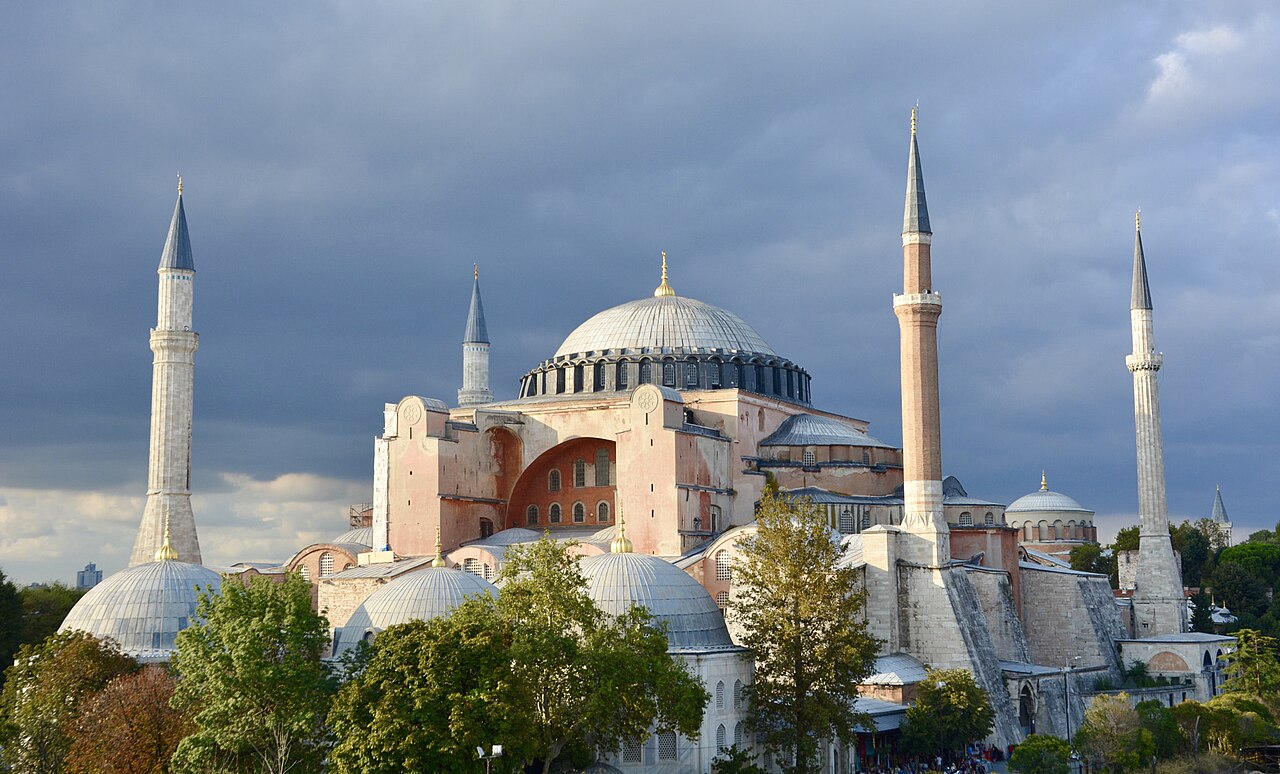
The defining engineering achievement of the Hagia Sophia is the pendentive dome — a solution to a problem that had defeated earlier builders: how do you place a circular dome on a square or rectangular base? The architects Anthemius of Tralles and Isidorus of Miletus used four curved triangular masonry elements (pendentives) to transition from the four massive arches of the nave to the circular base of the dome. The dome itself is 31 meters in diameter and rises 55 meters above the floor, and its base is pierced by 40 windows arranged in a continuous ring, so that daylight enters from all sides simultaneously. The effect — which ancient observers described as the dome "hanging from heaven on a golden chain" — is that the dome appears to float without visible support, especially at midday when the windows create a bright band of light that optically separates dome from wall. This was not accidental: Anthemius and Isidorus were mathematician-engineers who understood optics as well as structure.
The spatial system of the Hagia Sophia — a central domed bay buttressed on two sides by large semi-domes, which are in turn flanked by smaller exedrae — became the template for almost every subsequent monumental domed building in the Byzantine and Ottoman worlds. Sinan, the great Ottoman architect who designed the Süleymaniye and Selimiye mosques in the sixteenth century, explicitly studied the Hagia Sophia and regarded it as the problem he spent his career trying to equal. The building's influence on the geometry of sacred architecture across Islam, Eastern Orthodoxy, and later the Renaissance (which rediscovered its structural logic through Byzantine intermediaries) is almost impossible to overstate.
Key features
- Central dome: 31 meters in diameter, 55 meters above the floor, visually supported by a ring of 40 arched windows that flood the base in light and create the illusion of the dome hovering unsupported above the nave.
- Cascading semi-domes: Two large half-domes extend the central space along the east-west axis, themselves buttressed by smaller conch-shaped exedrae, producing a complex layered spatial expansion inward from the exterior.
- Four Ottoman minarets: Slender pencil minarets at each corner of the exterior — added by different sultans between the fifteenth and sixteenth centuries — are the most immediately recognizable exterior feature distinguishing the building's silhouette from its Byzantine predecessors.
- Gold mosaic surfaces: The interior walls and vaults were originally sheathed in gold mosaic depicting Christ, the Virgin, saints, and emperors. Many were plastered over during the Ottoman period and partially restored during the museum years; since 2020, several have again been covered by curtains or screens during prayer times.
- Marble revetment walls: The lower interior walls are clad in polychrome marble panels — verde antico, porphyry, Proconnesian white — cut and matched in book-page patterns to create symmetrical veining. The marble came from quarries across the Roman world.
- Galleries on three sides: Upper galleries run along the north, south, and west walls, accessed by ramps rather than stairs; the southern gallery was reserved for the empress and contains two of the finest surviving Byzantine mosaic panels.
- Massive piers and arches: The four enormous piers from which the dome's pendentives spring dominate the interior corners; their bulk is disguised by the screens of columns and windows set into them at multiple levels.
Preservation status
Structurally, the Hagia Sophia is in sound condition, maintained by the Turkish Directorate of Religious Affairs (Diyanet). The main dome was damaged by earthquakes in 553 and 558 CE (the latter causing a partial collapse), rebuilt by Isidorus the Younger, and has remained intact since. Ongoing seismic monitoring is critical because Istanbul sits on active fault lines and a major earthquake is a statistically near-term risk.
The more acute preservation concern is cultural. UNESCO expressed "great regret" over the 2020 reconversion and called on Turkey to ensure universal access and protection of the building's outstanding universal value. Byzantine mosaics — including the famous Deësis panel in the south gallery, considered one of the greatest surviving works of Byzantine art — are currently covered during the five daily prayers. Conservation experts worry about long-term damage from increased humidity, foot traffic, and the covering materials. The World Monuments Fund has repeatedly listed the site as a property under threat not from physical neglect but from political decisions about use.
Think you can place this building on the map?
Play Building Guessr