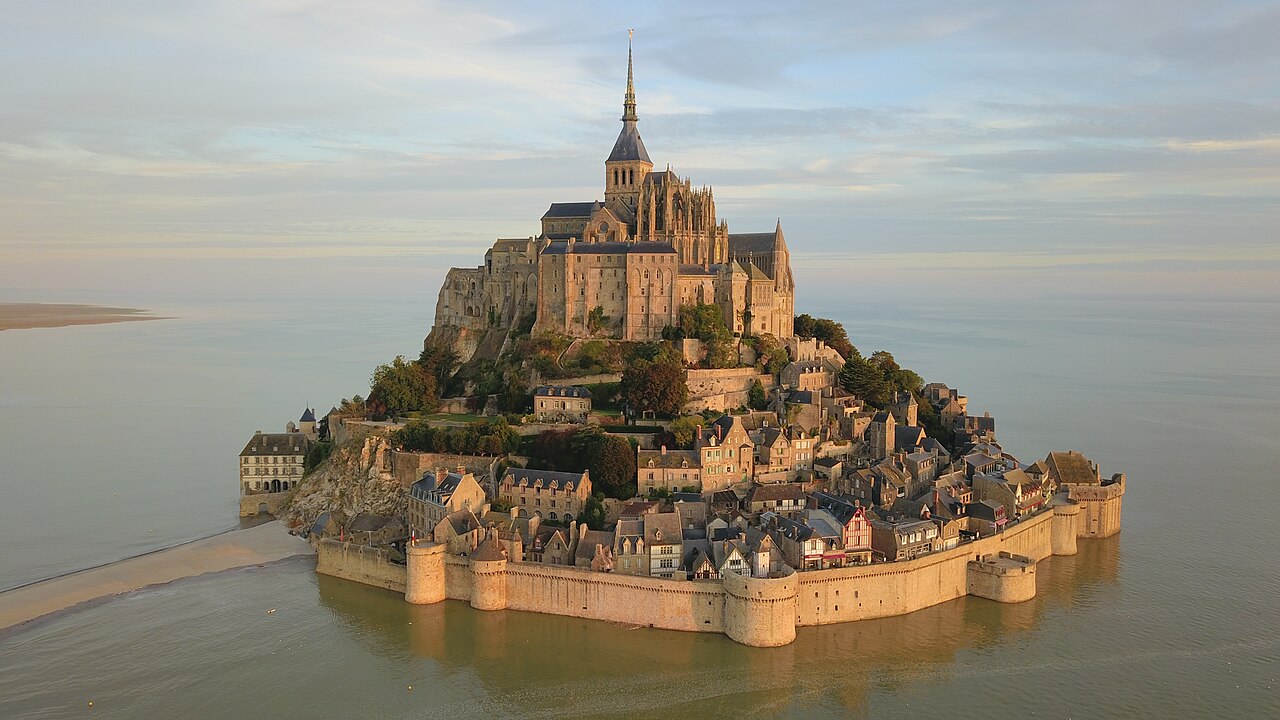
What it is
Mont Saint-Michel is a tidal island rising 92 metres from the tidal flats of the bay of the same name, approximately 600 metres off the coast of Normandy in northwestern France. Perched on the island's granite summit is a Benedictine abbey that has been a centre of Christian pilgrimage for over 1,300 years. Below the abbey, a medieval village of streets, ramparts, houses, and towers cascades down the rocky slopes toward the sea. At high tide — which can reach 14 metres in height, the second highest tidal range in Europe after the Bay of Fundy — the island is completely isolated, accessible only by boat. At low tide an enormous expanse of tidal flats extends for kilometres in every direction. The combination of architectural drama, tidal extremity, and medieval history makes Mont Saint-Michel one of the most visited sites in France, receiving over three million visitors annually.
The island has been inhabited since at least the Neolithic period, and Celtic peoples are known to have regarded it as sacred. The specific identity of Mont Saint-Michel as a Christian sanctuary dedicated to the Archangel Michael dates from the early 8th century. According to medieval tradition, Aubert, Bishop of Avranches, received three nocturnal visions in 708 CE in which the Archangel Michael commanded him to build a sanctuary on the rocky island then known as Mont Tombe. Aubert initially hesitated — the tradition holds that the Archangel eventually burned a hole in his skull with his finger to compel compliance — and the oratory he built on the summit became the nucleus around which the entire subsequent architectural complex developed.
Architectural significance
Mont Saint-Michel is one of the supreme examples of medieval architecture adapted to an extreme site. The underlying challenge is that the abbey church at the summit sits on a conical granite outcrop with no flat ground: every element of the complex had to be built either by cutting into the rock or by constructing platforms and vaulted undercrofts to create artificial level surfaces on the slopes. Over eight centuries of building activity, successive abbots and architects created a layered system of crypts, chapels, and halls that simultaneously serve as the foundations of the structures above and as spaces in their own right — each level a functional building supported by the one below it. The result is a geological stratification of architecture, where Romanesque crypts of the 11th century support Gothic halls of the 13th century, which in turn support the church above.
The abbey church itself is built in two phases visible in the fabric: the Romanesque nave, begun around 1017–1023 under Abbot Hildebert de Birnard, and the Flamboyant Gothic choir, built between 1446 and 1521 to replace an earlier Romanesque choir that collapsed in 1421. The Romanesque nave is austere and powerful — thick walls, round arches, simple mouldings — while the Gothic choir is exuberant, with slender columns, elaborate tracery, and large windows that flood the east end with light. The contrast between the two halves of the church captures in stone the transition from Romanesque gravity to Gothic luminosity that defines 12th-century European architecture. The abbey's most celebrated secular space is the Merveille (Marvel), a triple-storey Gothic complex built on the north face of the mount between 1211 and 1228, comprising the almshouse, guests' hall, and cellar at the lowest level; the knights' hall and refectory at the middle level; and the cloister and scriptorium at the uppermost level — each space a masterwork of early Gothic design.
Key features
- The tidal bay: The bay of Mont Saint-Michel has one of the most extreme tidal ranges in Europe. The tidal bore — a wave of water that advances rapidly when the tide turns — can reach speeds of several metres per second in tidal channels — fast enough to overtake a running person — earning a historical reputation for swallowing unwary pilgrims. The causeway built in 1879, which ended the island's isolation, inadvertently caused sediment to build up around the island and the bay to silt. The new tidal bridge completed in 2014 was designed to restore natural tidal circulation and reverse the silting.
- La Merveille: The three-storey Gothic complex on the north face, built 1211–1228, is considered one of the masterpieces of early French Gothic architecture. The cloister at the top level is particularly fine — its double row of small columns arranged in offset courses creates an intricate visual rhythm, with colonnade reflected in itself to produce an effect of multiplication. The refectory below uses concealed windows in its side walls — the light seems to appear from nowhere — in a subtle spatial trick that Cistercian architecture would later develop into a distinctive principle.
- Medieval pilgrim route: Mont Saint-Michel was one of the great pilgrimage destinations of medieval Europe, ranking alongside Santiago de Compostela, Rome, and Jerusalem. Pilgrims known as miquelots came from across France, England, and further afield, crossing the tidal flats at low tide following guides who knew the quicksand channels. The route from Paris to Mont Saint-Michel remains a marked pilgrimage path used today.
- Military significance: During the Hundred Years War (1337–1453), the entire Normandy coast fell to English forces — but Mont Saint-Michel, protected by its tides and by the determination of its garrison, was never taken. It is the only fortified site in western France that held out against the English throughout the war. The ramparts, towers, and barbican at the island's base date largely from the 14th and 15th centuries, built during and after the siege period.
- Prison history: During the French Revolution, the abbey was suppressed and the monks expelled; from 1793 to 1863 the island served as a state prison, housing political prisoners including members of the clergy. Victor Hugo campaigned publicly against the use of a great medieval monument as a prison, and the building was finally restored to cultural and religious use in the 1860s under Napoleon III's heritage policy.
Construction and history
The building history of Mont Saint-Michel spans eight centuries of continuous addition, modification, and partial reconstruction. The pre-Romanesque sanctuary of the 8th century gave way to a Carolingian monastery, which was replaced by the great Romanesque abbey church begun around 1017 under Abbot Hildebert, with the nave completed by about 1135. The construction of La Merveille between 1211 and 1228 was extraordinarily rapid — 17 years for a triple-storey complex of six distinct rooms, driven by the abbacy of Jourdain and funded partly by the patronage of Philip II of France. Work continued throughout the 13th and 14th centuries with the addition of refectories, chapels, and defensive walls.
The 15th century brought both damage and renewal: in 1421 the Romanesque choir collapsed, and a new Flamboyant Gothic choir was built between 1446 and 1521 — the last major medieval building campaign. In 1879 a causeway linking the island to the mainland was completed, replacing the pilgrim crossing of the tidal flats and permanently altering the island's character. The Benedictine community returned in 1966 after more than a century's absence, and a small monastic community remains in residence today alongside the monument administration and visitor services.
Preservation and status
Mont Saint-Michel and its bay were inscribed as a UNESCO World Heritage Site in 1979, one of the first sites on the World Heritage List. The main 20th-century conservation challenge was the progressive silting of the bay caused by the 1879 causeway. Between 1995 and 2015 a major restoration project designed by Dietmar Feichtinger Architects replaced the causeway with a slender bridge on stilts — transparent to tidal flow — and relocated the car parks to the mainland, requiring visitors to arrive by foot, bicycle, or shuttle bus across the new bridge. Tidal measurements since 2015 show the silting process reversing, with the natural tidal scour beginning to restore the bay's historic depth around the island.
Think you can place this building on the map?
Play Building Guessr