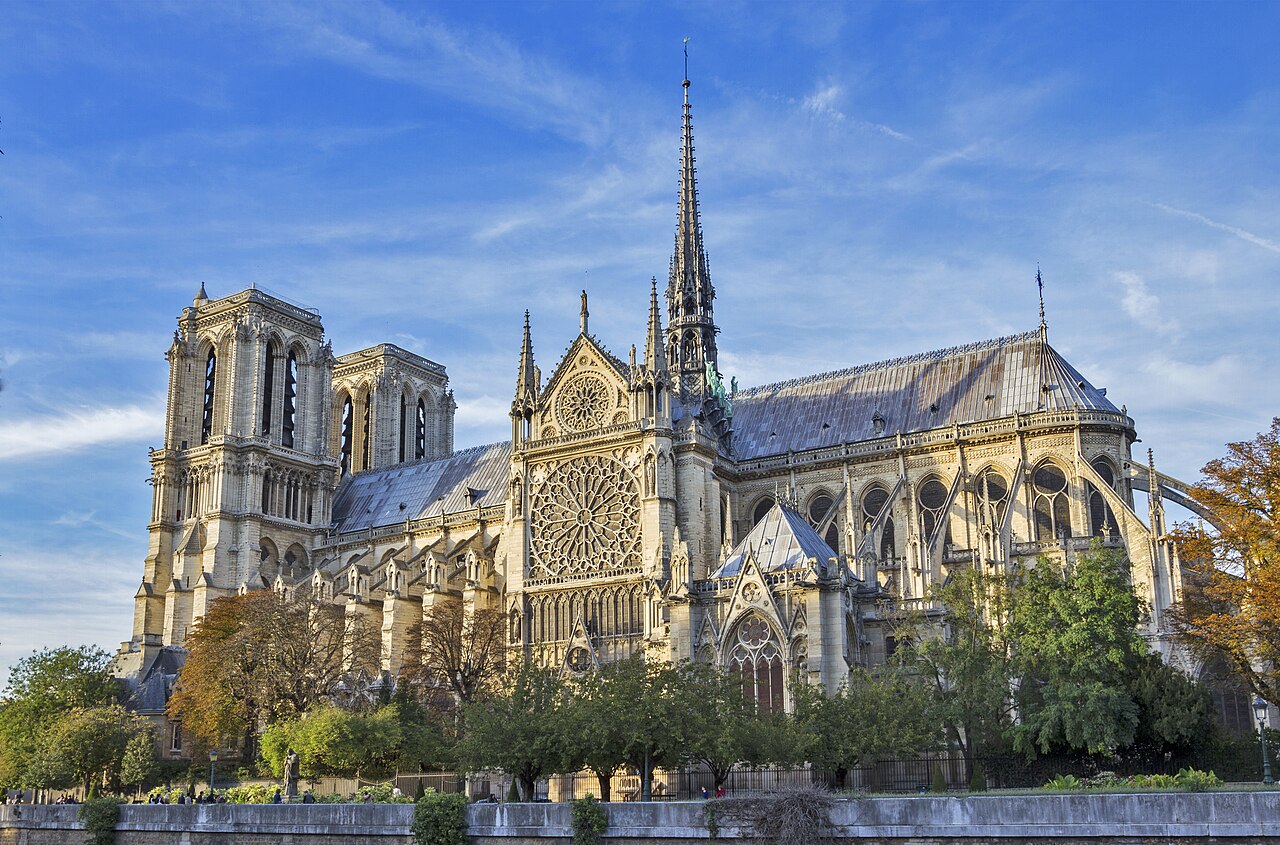
What it is
Notre-Dame de Paris is the medieval cathedral that defined French Gothic architecture and set the standard against which all subsequent Gothic cathedrals in France would be measured. Construction began in 1163 under Bishop Maurice de Sully on the Île de la Cité in the heart of Paris, replacing an earlier Romanesque church on the site. The building proceeded in phases over nearly two centuries: the choir was largely complete by around 1182, the nave was finished by the mid-thirteenth century, and the two famous west towers were complete by approximately 1250. The nave reached its final form — including the raising of the aisles and the deepening of the clerestory windows — by roughly 1345. Along the way the design was repeatedly revised upward in ambition, with each successive master builder pushing the walls higher and the windows wider than the previous generation had thought structurally possible.
The cathedral underwent a major nineteenth-century restoration by Eugène Viollet-le-Duc, who added the famous stone spire over the crossing — a replacement for the original medieval spire that had been dismantled in 1786 due to structural instability. Viollet-le-Duc's spire, completed in 1859, became one of the defining elements of the Parisian skyline. On the evening of April 15, 2019, a fire broke out during restoration works, destroying the Viollet-le-Duc spire entirely and burning through most of the historic oak roof timbers — the so-called forêt (forest), named for the sheer volume of medieval timber it contained. The fire was extinguished before the twin towers collapsed. A massive international restoration effort, funded in part by donations exceeding 846 million euros, resulted in the reconstruction of a new oak roof and a faithful recreation of the Viollet-le-Duc spire. The cathedral reopened on December 7, 2024, in a ceremony attended by world leaders.
Architectural significance
Notre-Dame represents one of the earliest and most complete realizations of the flying buttress as a primary structural device. Earlier Romanesque churches relied on thick, window-limiting walls to carry the lateral thrust of stone vaulting. By transferring that thrust outward through arched masonry bridges to freestanding piers — the flying buttresses — Notre-Dame's builders were able to thin the nave walls dramatically and fill them with large stained-glass windows. The flying buttresses of Notre-Dame, which were added and reinforced over several construction phases, are visible from the exterior as a forest of arching stone limbs around the choir and nave, and they represent the essential engineering breakthrough that made the Gothic style architecturally coherent rather than merely decorative. The cathedral's development of the French Gothic double-tower west facade — two towers flanking a tripartite portal composition with a rose window above the central portal and a gallery of kings below — became the dominant template for French cathedral facades for the next century.
The three rose windows at Notre-Dame — the west rose (c. 1225), the north transept rose (c. 1250), and the south transept rose (c. 1260) — represent the pinnacle of medieval stained-glass program planning. Each window is approximately 13 meters in diameter and contains dozens of individual narrative panels arranged in concentric rings. The north rose, which survived the 2019 fire largely intact, is one of the best-preserved thirteenth-century stained-glass windows in existence. The theological programs of the three windows — Old Testament, New Testament, and apocalyptic themes — are coordinated across all three faces of the cathedral in a systematic way that required decades of planning and execution. The cathedral also represents an important step in the transition from Early to High Gothic, with the elevation of the nave showing evidence of the designers working through and then abandoning an intermediate gallery stage (the triforium) before arriving at the classic High Gothic three-story elevation.
Key features
- Twin west towers: The two western towers rise to approximately 69 meters and are not quite identical — they differ slightly in plan, in the detailing of their openings, and in the profiles of their corner buttresses, a result of the decades between the construction of the south tower (completed c. 1220) and the north tower (c. 1240–1250).
- Three portal sculpture programs: The three portals of the west facade depict the Last Judgment (center), the Virgin Mary (left, Portal de la Vierge), and Saint Anne (right). The tympana, jamb figures, and archivolts constitute one of the most extensive Gothic sculptural programs in France, though much was destroyed or damaged during the French Revolution and subsequently restored.
- Flying buttresses: The most architecturally innovative element, visible as double-arched stone bridges carrying the thrust of the high vaults from the nave clerestory walls out to freestanding piers. The choir buttresses, added and modified in the thirteenth century, are particularly dramatic in scale.
- Three rose windows: West (c. 1225), north transept (c. 1250), and south transept (c. 1260), each approximately 13 meters in diameter and containing extensive narrative stained-glass programs. The north rose retains most of its original thirteenth-century glass.
- Gargoyle water spouts: The famous gargoyles and chimera figures on the towers and upper levels serve a dual purpose — as water spouts carrying rainwater away from the masonry, and as decorative grotesques. Many of the most iconic chimera figures were added during Viollet-le-Duc's nineteenth-century restoration.
- North and south transepts: Added in the mid-thirteenth century by master builder Jean de Chelles, the transepts feature elaborate portals with carved gables and large rose windows that extended and transformed the original twelfth-century design.
Preservation status
The April 2019 fire was the most severe structural damage Notre-Dame had sustained in its modern history. The Viollet-le-Duc spire collapsed through the crossing vault, and the burning timbers of the roof destroyed approximately two-thirds of the medieval oak roof structure — the forêt, so called because the sheer number of oak trunks required for the roof was equivalent to a small forest. Some medieval stained-glass windows survived intact; others, particularly in the nave, were damaged or destroyed by heat and falling debris. The north rose window, considered among the most precious, survived in reasonable condition. The stone vaults of the nave and choir, while damaged, held in most places, preventing complete collapse.
The restoration effort that followed was extraordinary in its speed and scholarly rigor. New oak timbers were sourced from forests across France, with the oak trees selected specifically to match the dimensions of the original medieval beams. The Viollet-le-Duc spire was reconstructed using the detailed survey records and drawings made before the fire, including digital models created during pre-fire restoration work. Some conservators and architects debated whether to use the restoration as an opportunity to install a contemporary spire, but the French government ultimately chose faithful reconstruction. The cathedral reopened December 7, 2024. Some windows that were removed for the restoration continue to be carefully reinstalled. The cathedral remains a UNESCO World Heritage Site as part of the Banks of the Seine.
Think you can place this building on the map?
Play Building Guessr