What it is
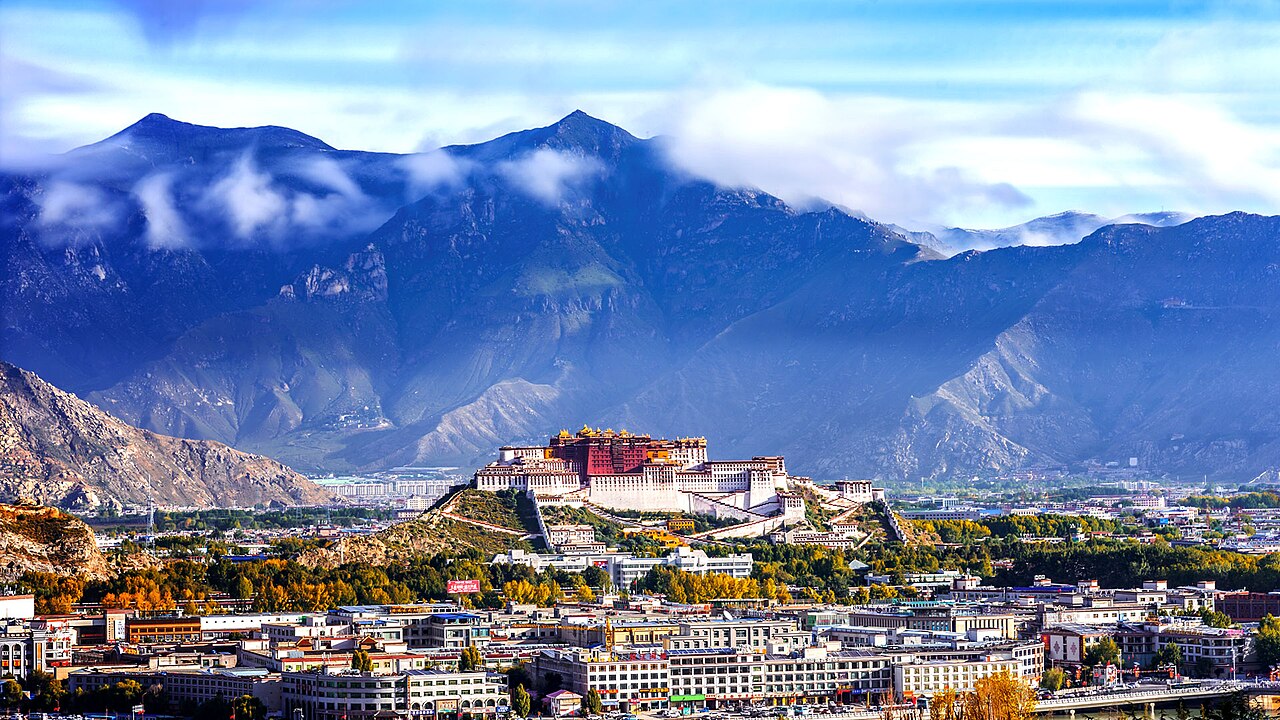
The Potala Palace is a thirteen-storey palace and monastery complex rising 117 metres from the summit of Marpo Ri — the Red Hill — above the city of Lhasa in Tibet, at an elevation of approximately 3,700 metres above sea level. For more than three centuries it served as the winter residence of the Dalai Lamas, the spiritual and temporal rulers of Tibet, as well as the administrative centre of the Tibetan government and one of the most sacred sites in Tibetan Buddhism. Its silhouette — the massive white base of the White Palace topped by the deep red of the Red Palace, their walls tapering inward as they rise — is the defining image of Tibetan architecture and one of the most recognisable buildings in Asia.
The name "Potala" derives from Mount Potalaka, the mythical mountain paradise of the bodhisattva Avalokiteshvara (Chenrezig in Tibetan), who is considered the patron deity of Tibet. The Dalai Lamas are understood in Tibetan Buddhism to be incarnations of Avalokiteshvara, so the name of the palace is a direct statement of theological identity: this is the earthly dwelling of the living bodhisattva of compassion. The hill on which it stands had been the site of a palace and meditation retreat built by the Tibetan king Songtsen Gampo in the 7th century CE, who is credited with bringing Buddhism to Tibet. That earlier structure was destroyed by wars and lightning, and only a small chapel — the Chogyel Drupuk — survived to be incorporated into the later palace. The current structure was commissioned and begun by the Great Fifth Dalai Lama, Ngawang Lobsang Gyatso, from 1645 onward and completed under his regent after his death in 1682.
The White Palace and Red Palace
The Potala is divided into two clearly distinct functional zones, visible in its exterior as the contrast between the white-plastered lower structure and the deep red-ochre of the upper section. The White Palace (Potrang Karpo), completed first in 1648, served as the administrative centre and residence: it contained the living quarters of the Dalai Lamas and their attendants, government offices, a printing house, storerooms, and the monastic school. The white colour of its walls, produced by annual whitewashing with lime plaster mixed with milk, sugar, and honey, expresses the secular and administrative functions of the lower palace.
The Red Palace (Potrang Marpo), completed in 1694 under the regent Sangye Gyatso (who concealed the Fifth Dalai Lama's death for fifteen years to maintain political stability during the construction), occupies the central upper section of the complex and is exclusively religious in function. It contains the great assembly halls, chapels, libraries, and most critically the funerary stupas (chortens) of eight Dalai Lamas, from the Fifth through the Thirteenth (excluding the Sixth, who died in exile). These gold-plated stupas, which house the mummified remains of the Dalai Lamas in jewel-encrusted golden towers, are among the most sacred objects in Tibetan Buddhism. The largest — the stupa of the Fifth Dalai Lama — is 14.85 metres tall and encased in 3,721 kilograms of gold, studded with thousands of diamonds, rubies, emeralds, pearls, and corals. The total wealth concentrated in the Red Palace in jewelled offerings, thangka paintings, sacred texts, and golden objects made it one of the greatest treasure houses in Asia.
Construction and materials
Building the Potala on top of a steep rocky hill at altitude presented construction challenges of the first order. The palace has approximately 1,000 rooms (some accounts put this as high as 10,000 if every storage space, corridor, and small shrine is counted separately), and contains an estimated 200,000 statues and 10,000 shrines. The outer walls are built of granite quarried from the surrounding hills, with walls reaching 5 metres thick at the base and tapering at an inward angle of approximately 9 degrees as they rise — a deliberate structural strategy that provides earthquake resistance by lowering the centre of gravity and distributing lateral loads more effectively than vertical walls. This is not an aesthetic convention but a calculated engineering response to Tibet's seismic environment.
The mortar binding the granite blocks contains an unusual ingredient documented in Tibetan construction records: yak milk, yak hair, and red ochre mixed into the lime-based mortar. The yak hair acts as a reinforcing fibre that increases tensile strength and reduces cracking; the milk adds organic compounds that improve cohesion. Similar mixtures appear in other Himalayan and Tibetan construction traditions, representing a sophisticated indigenous building technology adapted to the available materials and climatic conditions of the plateau. The whitewashing applied annually to the White Palace — a major communal event involving thousands of workers lowering buckets on ropes from the roof — contains similar organic additives: local accounts describe milk being mixed into the whitewash for adhesion and sheen.
Historical significance and present status
The Potala remained the winter seat of government and the principal residence of the Dalai Lamas for 314 years, from its completion in 1694 until 1959, when the Fourteenth Dalai Lama, Tenzin Gyatso, fled to India following the failed Tibetan Uprising against Chinese rule. He has lived in exile in Dharamsala, India, since that year, and the Potala has functioned as a museum under Chinese administration since 1961. It was listed as a UNESCO World Heritage Site in 1994, along with the Jokhang Temple and Norbulingka Palace as the "Historic Ensemble of the Potala Palace."
The palace survived the Cultural Revolution (1966–1976) largely intact, reportedly because Premier Zhou Enlai personally ordered its protection from the Red Guards who destroyed Buddhist sites across Tibet and China. It remains a major site of Tibetan Buddhist pilgrimage, and thousands of Tibetan pilgrims circumambulate the hill on which it stands each day. Visitor numbers are controlled by the Chinese government, and restrictions on daily access — including a cap on the number of tourists and a limited time inside the Red Palace — are intended to protect both the physical fabric and the devotional atmosphere. The combination of altitude, humidity, and the heat generated by butter lamps burning in the chapels creates a challenging conservation environment; ongoing work focuses on ventilation, structural stabilisation, and the preservation of thangka paintings and gilded surfaces.
Think you can place this building on the map?
Play Building Guessr