What it is
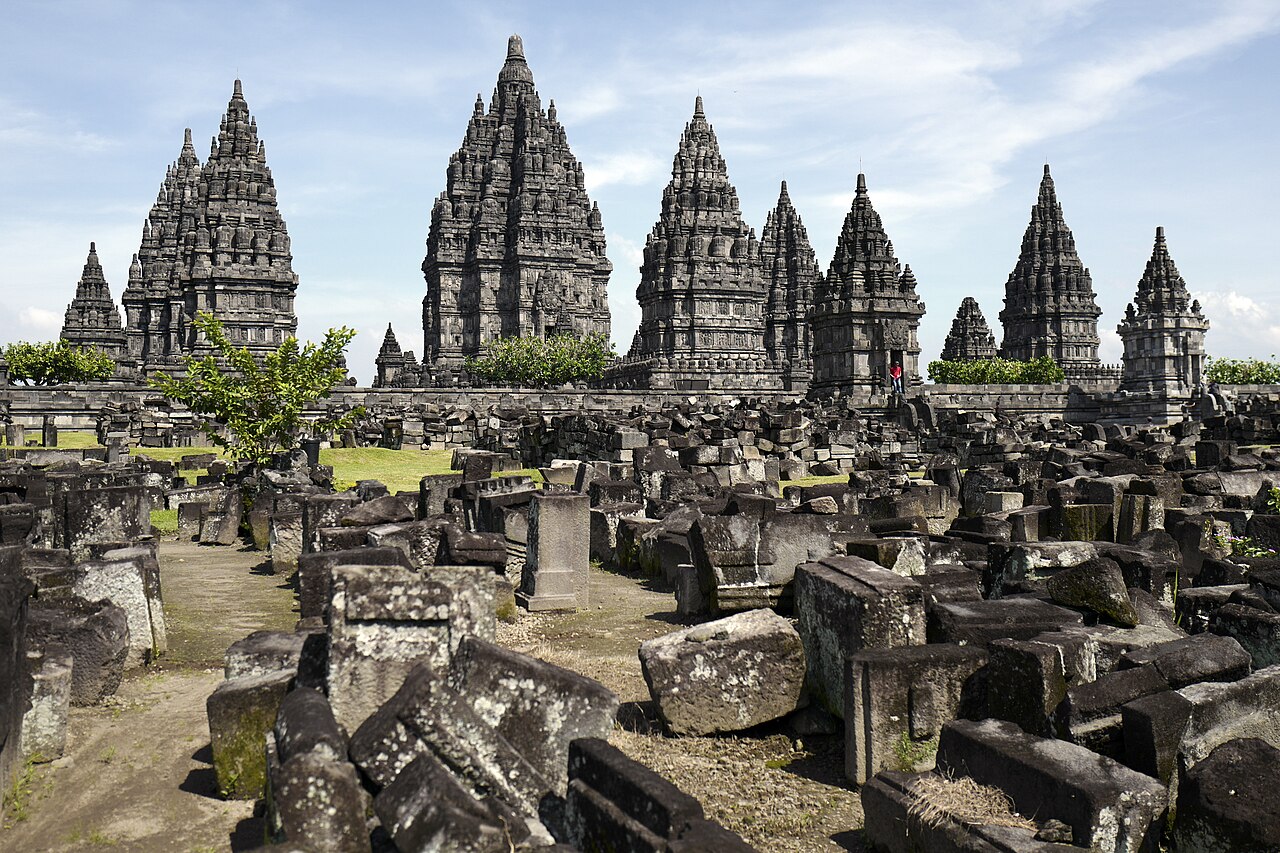
Prambanan is the largest Hindu temple complex in Indonesia and one of the greatest Hindu monuments in Southeast Asia, a cluster of soaring stone towers rising from the flat agricultural plain of Central Java approximately 17 kilometres east of Yogyakarta. Built around 850 CE by the Sanjaya rulers of the Mataram Kingdom — a Hindu dynasty that controlled much of Java during the 8th and 9th centuries — the complex is dedicated to the Trimurti, the Hindu divine triad of Brahma the Creator, Vishnu the Preserver, and Shiva the Destroyer. The six largest temples are arranged in two rows facing each other across the central compound: the eastern row contains the three Trimurti temples, and the western row contains three smaller vahana temples housing the sacred vehicles (mounts) of the gods — Nandi the bull for Shiva, Garuda the eagle for Vishnu, and Hamsa the goose for Brahma.
In its complete original form, the complex contained 240 temples arranged in concentric squares around the central Trimurti group. Most of the outer rows were smaller shrine structures, and most have been reduced to rubble by earthquakes and centuries of neglect. Of the original 240, approximately 1,549 temple foundations and fragments have been identified in the surrounding area — a number that reveals the extraordinary scale of what was once one of the grandest religious sites in Asia. The main Shiva temple, known locally as Loro Jonggrang (the "Slender Virgin"), is the tallest structure in the complex at 47 metres, making it the tallest Hindu temple in Indonesia and one of the tallest in Southeast Asia.
Architecture and decoration
The architectural vocabulary of Prambanan belongs to the Central Javanese tradition, which synthesised Hindu temple forms from South India with local Javanese aesthetics and construction techniques. The temples are built of grey andesite stone, a volcanic rock quarried from the surrounding region, assembled without mortar using precisely cut interlocking blocks. The tower form — a tall, steeply tapering sikhara crowned with a circular stone finial — follows North Indian (Nagara) temple architecture, but the Javanese builders adapted the form with more pronounced horizontal articulation and the characteristic Javanese ornamental vocabulary of kala (monster-face) gargoyles, makara (sea-beast) waterspouts, and densely carved panels of narrative relief.
The most celebrated decorative feature of Prambanan is the 267-metre-long series of bas-relief panels running around the inner balustrade of the Shiva temple, depicting scenes from the Ramayana — the Hindu epic of Prince Rama's quest to rescue his wife Sita from the demon king Ravana with the help of the monkey general Hanuman. The panels are read in a clockwise direction, following the Hindu ritual practice of pradakshina (circumambulation to the right). The carving is of exceptional quality, with panels showing dynamic battle scenes, court ceremonies, and forest landscapes populated by hundreds of individual figures, each with distinct poses and expressions. The Ramayana sequence continues on the outer wall of the Brahma temple, while the Vishnu temple carries panels from the Krishnayana (episodes from Krishna's life).
Abandonment and rediscovery
Prambanan was a functioning royal temple for less than a century. Around 930 CE, the political centre of the Mataram Kingdom shifted from Central Java to East Java — possibly following a major eruption of Mount Merapi, the active volcano visible to the north of the site, or possibly as a result of political changes that displaced the Sanjaya dynasty. The temples were apparently abandoned within a generation of the political shift, and without maintenance and royal patronage, the complex began its long decline. The wooden roofs and doors that would have covered the shrines rotted away; vegetation colonised the stone; a series of earthquakes, probably in the 16th century, collapsed most of the remaining towers into rubble-filled mounds.
The site was never entirely forgotten by local Javanese communities — the name Loro Jonggrang refers to a figure in a popular Javanese legend associated with the main temple — but it was largely unknown to the outside world until 1811, when a British colonial surveyor named Colin Mackenzie discovered the site while working under Stamford Raffles's brief administration of Java. Systematic archaeological investigation began in the Dutch colonial period, and restoration work started in 1918. The main Shiva temple was substantially restored by the Dutch and later by the independent Indonesian government, with the main tower reopened to visitors in 1953. The Brahma and Vishnu temples were restored in the 1990s. The restoration of the outer compound's smaller temples has been slower; many remain as numbered piles of stone blocks awaiting sufficient identified fragments for reconstruction — a process called anastylosis that requires at least 75% of original material to be present.
Prambanan and Borobudur
One of the most remarkable facts about 9th-century Java is that it produced two of the greatest religious monuments in Asian history within approximately 40 kilometres of each other and within the same century. Borobudur, the enormous Buddhist stupa complex located 40 kilometres to the northwest of Prambanan, was built by the Sailendra dynasty — the Buddhist rivals and at times rulers of the Mataram Kingdom — between approximately 780 and 840 CE, just decades before the construction of Prambanan. The two monuments represent a period of intense creative and religious energy in Central Java, and their proximity raises fascinating questions about the relationship between the Buddhist and Hindu courts of 9th-century Java: they were apparently building simultaneously, at enormous expense, in different religious traditions, on the same plain.
Both complexes were abandoned within a similar timeframe following the shift of Javanese political power to the east. Both were rediscovered by colonial-era explorers. Both have undergone major restoration programs. Both are now UNESCO World Heritage Sites — Borobudur since 1991 and Prambanan also since 1991 — and both are major tourist destinations that together constitute one of the most extraordinary concentrations of ancient religious architecture in the world. The contrast between the two — the Buddhist Borobudur a broad horizontal mandala landscape, the Hindu Prambanan a vertical cluster of aspiring towers — mirrors the broader contrast between Buddhist and Hindu architectural symbolism.
The 2006 earthquake and ongoing restoration
Prambanan suffered significant structural damage in the Yogyakarta earthquake of May 2006, a magnitude-6.3 event that killed over 5,700 people across the region. The temples, already fragile after the earlier 16th-century earthquake damage and the 20th-century restoration work, sustained new cracks, displaced stones, and partial collapses in several structures. The main Shiva and Brahma temples were closed to visitors for over two years following the earthquake while engineers assessed the damage and carried out emergency stabilisation. The experience highlighted the ongoing seismic vulnerability of the site — it sits in one of the most geologically active landscapes on Earth, flanked by Mount Merapi — and has prompted updated conservation strategies that prioritise seismic resilience alongside aesthetic restoration. The Ramayana Ballet, performed at an open-air theatre with the illuminated Prambanan towers as backdrop during full moon nights, remains one of the most atmospheric cultural events in Indonesia, a continuation of the performing arts tradition that would have accompanied the temple during its 9th-century active life.
Think you can place this building on the map?
Play Building Guessr