What it is
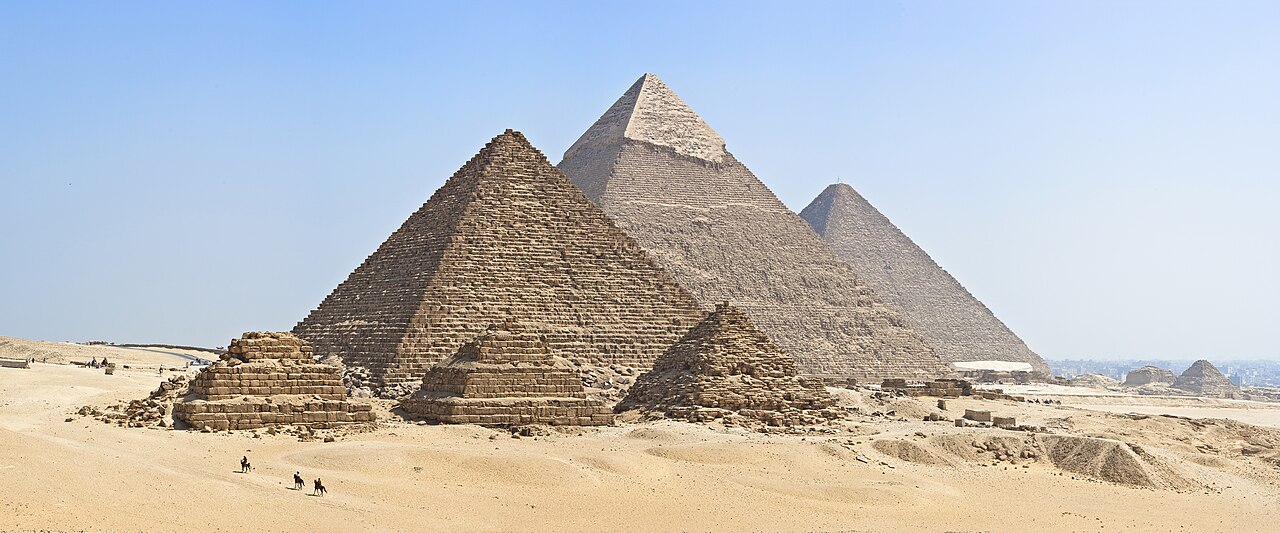
The Pyramids of Giza are a complex of three major pyramid monuments built on the Giza Plateau on the western bank of the Nile, about 8 kilometres southwest of central Cairo. The complex was constructed over roughly half a century during the Fourth Dynasty of the Old Kingdom, between approximately 2560 and 2510 BCE. The three pyramids — named for the pharaohs who commissioned them — are Khufu (the Great Pyramid, the largest), Khafre (slightly smaller but appearing taller due to its elevated position and retained summit casing), and Menkaure (the smallest of the three). Each pyramid was a royal tomb — not merely a burial container but a theological machine designed to facilitate the pharaoh's resurrection and ascent to the gods, and to serve his eternal cult in perpetuity.
The Great Pyramid of Khufu is the oldest and largest. Its original height was 146.5 metres — a figure that held the record for the world's tallest man-made structure for approximately 3,800 years, until the spire of Lincoln Cathedral in England overtook it around 1311 CE. Erosion and the deliberate removal of its capstone and outer casing have reduced its current height to approximately 138.5 metres. Its base covers 230 metres on each side, an area of roughly 53,000 square metres. The construction required an estimated 2.3 million blocks of stone, averaging approximately 2.5 tonnes each, with some granite blocks in the internal chambers weighing up to 80 tonnes. The precision of the construction is remarkable: the four base sides differ from perfect equality by less than 0.1%, and the base is level to within 2.1 centimetres across its entire area — a surveying achievement of extraordinary exactitude for any period, let alone the third millennium BCE.
Construction and workforce
The question of who built the pyramids and how has been one of archaeology's most persistent subjects. The popular image of slave labour — reinforced by the biblical Exodus narrative — has been definitively overturned by modern archaeology. Excavations of the workers' village at Giza, carried out by Zahi Hawass and Mark Lehner from the 1990s onward, revealed a well-organised community of paid workers with access to medical care (healed bone fractures recovered from skeletal remains indicate surgical treatment), a varied diet including substantial amounts of beef and fish, and a system of rotating labour gangs that left their names scratched onto stone blocks. The workforce is now estimated at approximately 20,000 workers at its peak — not hundreds of thousands as was once imagined — organised into crews, gangs, and divisions with documented chain-of-command structures.
The construction technology, while debated in detail, almost certainly relied on copper tools, wooden sledges, wetted sand to reduce friction (a technique documented in a Middle Kingdom tomb painting showing workers wetting the path ahead of a colossus sledge), and an extensive system of internal ramps, external ramps, or some combination of both. The logistics of quarrying, transporting, and placing up to 12,000 blocks per day at the height of construction represent one of the great organisational achievements of the ancient world, regardless of the specific mechanical techniques involved.
The original appearance
The pyramids as they appear today — stepped and sandy, with the rough inner limestone core exposed — look nothing like they did when completed. The outer surface of the Great Pyramid was originally sheathed in smooth white Tura limestone casing stones, quarried across the Nile at Tura and brought by barge to Giza. This casing was fitted with joints measured in fractions of a millimetre, creating a gleaming, smooth-sided monument that would have been visible from a considerable distance and caught the desert sun with dramatic effect. The casing was almost entirely stripped away during the medieval period by Arab builders who used the cut stone as construction material for Cairo — including, most significantly, for the mosque complexes of the Mamluk period. Only a small section of original casing remains near the base of Khafre's pyramid today. The Great Sphinx, carved from a natural limestone outcrop and believed to represent Pharaoh Khafre, guards the eastern approach to the complex and was originally also brightly painted.
Internal structure
The Great Pyramid's internal arrangement is complex and was modified at least twice during construction, suggesting changes of plan. The final arrangement includes three main chambers. The lowest, now called the Subterranean Chamber, was cut into the bedrock and may represent an abandoned original burial plan. Above it, inside the pyramid body, is the Queen's Chamber — a misnomer, since it was almost certainly not intended for a queen but may have housed the pharaoh's ka (spiritual double) or a cult statue. The uppermost and most elaborately finished space is the King's Chamber, a granite-lined room containing the sarcophagus of Khufu. Its ceiling is formed by nine granite slabs weighing approximately 400 tonnes in total, above which five stress-relieving chambers distribute the weight of the pyramid mass above. The topmost stress-relieving chamber features a corbelled (pointed) ceiling — a rare variant. Leading to the King's Chamber is the Grand Gallery, a corbelled ascending passage approximately 47 metres long and 8.5 metres high, its walls stepping inward in seven overlapping courses to create a pointed vault — one of the most architecturally impressive spaces inside any ancient monument.
Astronomical precision
The Great Pyramid is oriented to the cardinal directions with extraordinary accuracy. The north face deviates from true north by only 3/60ths of a degree (approximately 3 minutes of arc) — a precision that required careful astronomical observation, most likely using the circumpolar stars to establish north with a method that the Egyptians appear to have mastered centuries before the Great Pyramid was built. The precision of this alignment, maintained across a base of 230 metres, reflects a level of surveying skill that is difficult to overstate. The pyramid's two so-called "air shafts" — narrow channels running from the King's Chamber and Queen's Chamber through the pyramid body — are now understood to have been directed toward specific stars at the time of construction, linking the king's tomb to the eternal circumpolar stars and to Orion's Belt, associated with the god Osiris.
Evolutionary context
The Great Pyramid did not appear without precedent. The evolution of the pyramid form can be traced in a remarkably clear sequence. The Step Pyramid of Djoser at Saqqara (c.2650 BCE), designed by Imhotep, was the first large-scale dressed-stone structure in the world — a mastaba tomb extended upward in six diminishing steps. The transition to a true smooth-sided pyramid was explored at Dahshur by Pharaoh Sneferu, Khufu's father: the Bent Pyramid (c.2600 BCE) shows a change of angle midway up — likely a structural response to cracks appearing in the lower courses — while the Red Pyramid (c.2590 BCE), the first true smooth-sided pyramid to be successfully completed, established the geometry that Khufu's architects refined and scaled to an unprecedented size. The Giza complex thus represents the culmination of a century of pyramid-building experimentation, not an isolated technological leap.
The Pyramids of Giza remain the only one of the original Seven Wonders of the Ancient World still standing. They have survived because of their sheer mass — there is simply too much stone to destroy — and because the desert environment has been relatively kind to limestone and granite. Their status as a UNESCO World Heritage Site since 1979, along with the surrounding necropolis including the Sphinx and many mastaba tombs of court officials, provides some protection, though urban encroachment from the expanding Cairo metropolitan area has been a persistent concern for conservation planners.
Think you can place this building on the map?
Play Building Guessr