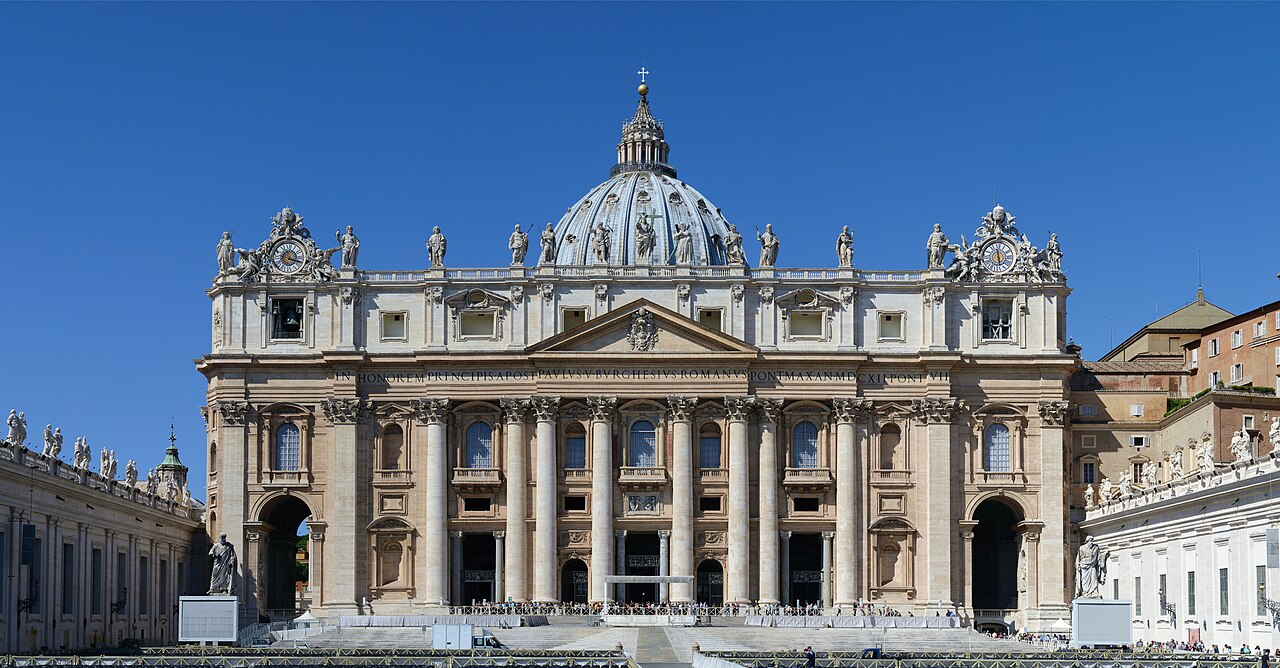
What it is
St. Peter's Basilica is a Renaissance and Baroque church standing on the site of the ancient Circus of Nero in Vatican City, built over the traditional burial place of Saint Peter the Apostle. It is the largest Christian church in the world by interior volume — 5 million cubic metres of enclosed space — and for most of the period between its dedication in 1626 and the mid-20th century it was simply the largest church in the world by any measure. Its dome, designed by Michelangelo and completed after his death by Giacomo della Porta, has set the template for civic and religious domes on every continent: St. Paul's Cathedral in London, the United States Capitol, the Panthéon in Paris, the Sacré-Coeur in Paris, and dozens of state capitols across the Americas all derive their visual language directly from Michelangelo's design for St. Peter's.
The site's religious significance is foundational. The ancient church that preceded the current basilica — Old St. Peter's, built under the Emperor Constantine in the 4th century — stood for over a thousand years on the spot where Peter, the leader of the early Christian church and the first Pope in Catholic tradition, was believed to have been crucified and buried in Nero's Circus around 64–68 CE. Excavations beneath the current basilica in the 1940s–1960s (the Scavi) discovered a Roman necropolis and, beneath the high altar, the remains of a memorial structure (tropaion) from the 2nd century CE marking what Christians have venerated as Peter's tomb since at least that date. Whether the bones found in a niche adjacent to this tropaion are genuinely those of the apostle remains a matter of faith rather than certainty, but the physical connection between the basilica's altar and a continuous tradition of veneration going back nearly 2,000 years is archaeologically substantiated.
A century of architects
No other building in Western architectural history has accumulated as many major architects or required as many fundamental redesigns as St. Peter's. The decision to demolish Constantine's deteriorating basilica and build anew was made by Pope Julius II, who commissioned Donato Bramante in 1506. Bramante's original design was a Greek cross plan — a symmetrical plan with four equal arms — surmounted by a great dome. It was the boldest architectural concept of the Renaissance: a complete break with the medieval Latin cross tradition of long nave churches, and a direct engagement with the structural problem of building the largest dome in the world. Bramante died in 1514, having laid the four great piers that would support the dome but little else.
His successors worked with varying degrees of fidelity to his vision. Raphael, appointed chief architect after Bramante's death, proposed reverting to a Latin cross plan with a long nave — a design politically favoured by those who argued that the shorter Greek cross did not provide adequate processional space. Raphael died in 1520 before significant construction could proceed. Antonio da Sangallo the Younger succeeded him and produced an elaborate model (still preserved in the Vatican museums) for a complex hybrid design. Antonio died in 1546, and it was at this point that Pope Paul III took the radical step of appointing the 71-year-old Michelangelo Buonarroti as chief architect — a man who had never built a complete building of comparable scale, but whose structural imagination was considered unmatched.
Michelangelo stripped back the accumulated complexity of the previous designs and returned to Bramante's Greek cross concept, though with more massive piers, thicker walls, and a simplified spatial arrangement that he believed would be structurally sounder. His most important contribution was the detailed design of the dome: a double-shell ribbed dome on the model of Brunelleschi's Florence Cathedral, but taller and with a hemispherical profile that Michelangelo apparently intended to be slightly pointed — a subtlety altered by his successor Giacomo della Porta when the dome was actually built between 1588 and 1590, after Michelangelo's death in 1564. The dome rises 136 metres to the top of its lantern and has an internal diameter of 42 metres. Della Porta gave it a slightly steeper profile than Michelangelo's model showed, which produces the distinctive silhouette visible across Rome today. Whether Michelangelo would have preferred della Porta's version has been debated ever since.
The final major transformation came under Carlo Maderno, who was directed by Pope Paul V to extend the nave toward the entrance facade to create the Latin cross plan that the liturgical authorities had always wanted. Maderno added three bays and built the new facade, completed in 1614, which unfortunately obscures the base of Michelangelo's dome from the piazza in front of the church — a relationship that the architect had calibrated for a different building footprint. Maderno's nave extension means that the dome only becomes visible in its full height when a visitor is already some distance from the building, an aesthetic loss that critics have lamented since the facade was built. Finally, Gian Lorenzo Bernini spent most of his long career on St. Peter's: designing the Baldachin (completed 1634) and completing the colonnade of St. Peter's Square (1656–1667).
Key features
- Michelangelo's dome: 136 metres to the lantern top, 42 metres internal diameter, double-shell construction. It is the visual landmark of Rome seen from every direction and the primary reference point for dome design across the Western world for the past four centuries.
- Bernini's Baldachin: A 29-metre-tall bronze canopy on spiral columns over the papal altar and Peter's tomb, consecrated in 1634. At nearly four stories high it is the largest bronze object in the world. Its bronze was reportedly stripped from the portico of the Pantheon — a claim that has been questioned by some scholars, who note that much of that bronze may have gone to Castel Sant'Angelo cannons instead, though the popular account gave rise to the Roman quip quod non fecerunt barbari, fecerunt Barberini — "what the barbarians did not do, the Barberini did" (Pope Urban VIII's family name being Barberini).
- St. Peter's Square colonnade: Bernini's two semicircular colonnades of 284 columns arranged in four rows, enclosing the oval piazza in front of the basilica. Bernini described the arms of the colonnade as "embracing Catholics to reinforce their belief, welcoming heretics to reunite them with the Church, and enlightening unbelievers with the true faith." The elliptical plan ensures that from two specific points on the pavement (marked by discs), the four rows of columns appear to collapse into a single row.
- Michelangelo's Pietà: Carved in 1498–1499 when Michelangelo was in his early twenties, this marble sculpture of the Virgin Mary cradling the body of Christ after the Crucifixion is now displayed in a side chapel behind bulletproof glass, following a 1972 attack in which a man with a hammer knocked off several fingers of the Virgin's hand. It is the only work Michelangelo ever signed — his name appears on the sash across Mary's chest.
- Interior dimensions: The nave is 186 metres long, making a walk from the entrance to the high altar a significant journey. The interior is designed on such a massive scale that the eye initially underestimates the distances involved: cherubs that appear to be normal human scale are in fact over 2 metres tall. The floor is inlaid with markers showing the comparative lengths of other major churches worldwide, all of which fall short of St. Peter's.
Role and UNESCO status
St. Peter's Basilica is technically not a cathedral — the Pope's cathedral church is the Archbasilica of St. John Lateran across the city. It is a minor basilica (though the title "major basilica" is sometimes colloquially applied) and the site of papal ceremonies, canonisations, and major Catholic events. It receives an estimated 7 million visitors per year, making it one of the most visited buildings on earth. The basilica and the entire Vatican City State — the world's smallest internationally recognised sovereign state, covering 44 hectares — were inscribed as a UNESCO World Heritage Site in 1984. The underground necropolis (the Scavi) is accessible by timed reservation for small groups and offers what is arguably the most extraordinary archaeological tour in the world: a walk through layers of Roman, early Christian, medieval, and Renaissance construction, ending at the spot where Peter's tomb is believed to lie.
Think you can place this building on the map?
Play Building Guessr