What it is
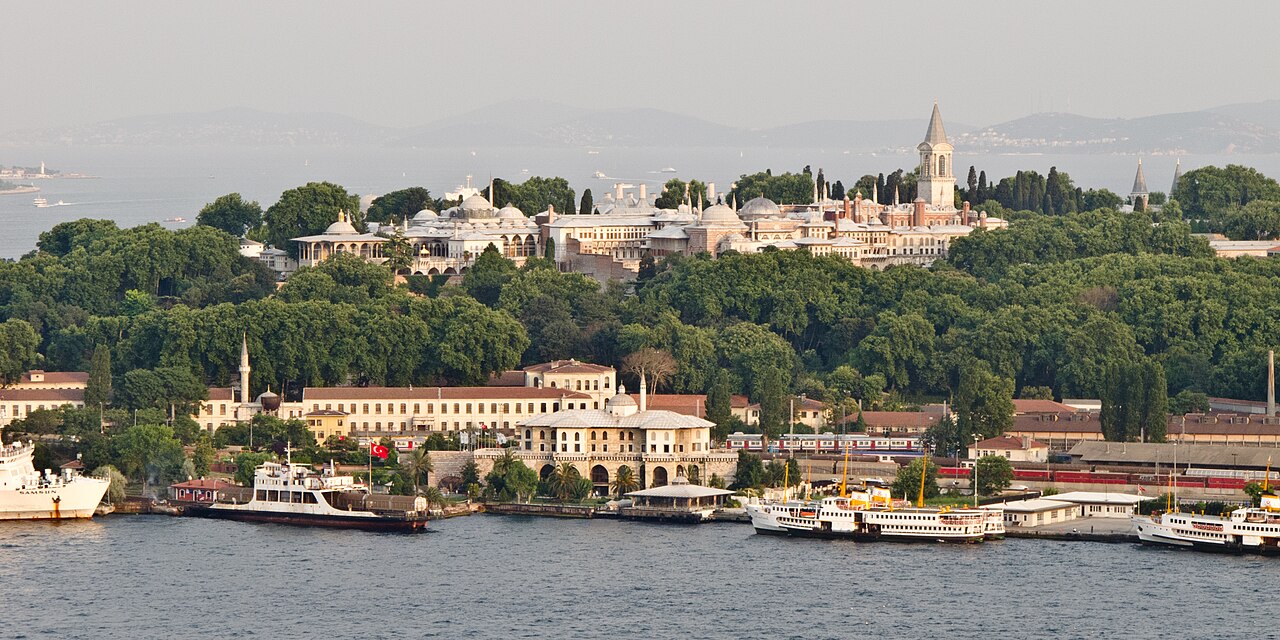
Topkapı Palace is the former administrative centre and primary residential compound of the Ottoman sultans, situated on the Seraglio Point — the peninsula where the ancient Greek city of Byzantium was founded, at the junction of the Golden Horn, the Bosphorus, and the Sea of Marmara. Built by Sultan Mehmed II, the conqueror of Constantinople, beginning around 1459 and formally occupied from approximately 1465, the palace served as the heart of the Ottoman Empire for nearly 400 years — from the reign of Mehmed II to 1856, when Sultan Abdülmecid I moved the court to the newly completed Dolmabahçe Palace on the European shore of the Bosphorus. In that period it housed the administration of an empire that at its peak stretched from Algeria to Azerbaijan, from the Crimea to Yemen, and from the gates of Vienna to the Persian Gulf.
The name Topkapı means "Cannon Gate" in Ottoman Turkish — it refers to a gate near the shoreline that was armed with artillery — and the name was not widely used for the palace until after it ceased to be a royal residence. During the centuries of Ottoman rule, Europeans referred to it as the Seraglio, a term derived from the Italian adaptation of the Turkish word for palace (saray). The palace is not a single building but an organic accumulation of structures added over four centuries by successive sultans — a city within a city, sprawling across roughly 70 hectares on the promontory, enclosed by high walls on three sides and by the water on the fourth.
At its population peak, Topkapı housed an estimated 4,000 people within its walls: the sultan and his immediate family, his wives and concubines in the Harem, hundreds of pages and apprentices in the palace school, the Janissary guard, administrators, scribes, cooks, gardeners, and thousands of black and white eunuchs who managed the internal organisation of the household. The palace had its own bakeries, stables, armoury, treasury, hospital, mosques, and schools. It functioned as a self-contained organism, deliberately sealed from the city around it, with access at each level of the hierarchy requiring permission that became progressively more restricted as one penetrated deeper into the compound.
The four courtyards
The organisational logic of Topkapı is spatial and hierarchical: the palace is structured around four sequential courtyards, each more restricted and more sacred than the last. This progression from public to private, from the accessible to the inviolate, is one of the most consistently maintained spatial principles in the palace's long history.
The First Courtyard (the Court of the Janissaries) was effectively public space: the great gate of the palace, the Bab-ı Hümayun (Imperial Gate), opened onto the city, and the courtyard inside could be crossed by Ottoman subjects on legitimate business, petitioners seeking justice, and merchants supplying the palace. The church of Hagia Eirene — a Byzantine basilica that Mehmed II chose not to convert to a mosque — stands in the First Courtyard, one of the only Byzantine churches in Istanbul to have survived without conversion.
The Second Courtyard, entered through the Bab-üs Selam (Gate of Salutation), was the administrative heart of the empire. The Divan (Imperial Council chamber) stands here, where the Grand Vizier and the council of ministers met four times weekly to govern the empire — with the sultan occasionally observing the proceedings from behind a latticed window without being seen, an architectural arrangement that embodied the Ottoman doctrine of imperial remoteness. The palace kitchens, which fed thousands daily, also border the Second Courtyard and now house one of the world's great collections of Chinese celadon and Ottoman ceramic ware.
The Third Courtyard, entered through the Bab-üs Saade (Gate of Felicity), was the sultan's private domain. Only those with specific imperial permission — senior officials on formal occasions, the pages of the palace school, the Harem household — could enter. The Throne Room (Arz Odası) stands just inside the gate, where the sultan received formal audiences and foreign ambassadors. The Enderun Library, built by Ahmed III in 1719, is one of the most beautiful interiors in the palace. The Hazine — the Imperial Treasury — occupies a series of rooms in this courtyard and holds the palace's most extraordinary objects: the Topkapı Dagger (with three large emeralds set in the hilt and a concealed watch in the pommel), the Spoonmaker's Diamond (86 carats, the fifth-largest cut diamond in the world), the Throne of Sultan Ahmed I (encrusted with approximately 25,000 pieces of gold, silver, and gemstones), and the Kasıkçı Elması.
The Fourth Courtyard was a collection of garden terraces and pleasure pavilions overlooking the water on three sides: the Mecidiye Kiosk, the Baghdad Kiosk (built to commemorate the 1638 conquest of Baghdad), and the Revan Kiosk. These pavilions, inlaid with Iznik tiles and carved woodwork, represent the most intimate and domestic face of the palace — spaces of retreat rather than ceremony.
The Harem
The Harem — literally "forbidden" in Arabic — was the private quarters of the sultan's household: his mother (the Valide Sultan, the most powerful woman in the empire), his wives (up to four under Islamic law), his concubines (cariye), his unmarried daughters, and his sons before they came of age. The Harem at Topkapı grew to over 400 rooms, built and rebuilt over several centuries in a labyrinthine accumulation that even its inhabitants navigated with difficulty. It was managed entirely by black eunuchs (the Kızlar Ağası or Chief Black Eunuch was one of the most powerful figures in the empire), who controlled all access to and from the Harem and served as intermediaries between the outside world and the secluded household within.
The popular Western imagination of the Harem — a space of luxury, intrigue, and pleasure — has a basis in reality but vastly overstates both the sensuality and understates the political significance. The Valide Sultan wielded enormous power during the so-called "Sultanate of Women" (approximately 1533–1651), a period when the mothers and wives of successive sultans effectively governed the empire through their influence over weak or young rulers. Kösem Sultan, Valide Sultan to two sultans and regent for a third, was for several decades the most powerful individual in the Ottoman Empire, managing grand viziers, orchestrating military appointments, and building political alliances through a network that extended from the Harem outward to the entire imperial administration. She was strangled in 1651 in a palace coup organised by her rival daughter-in-law — a reminder that Harem politics, conducted in close quarters with enormous stakes, was never merely decorative.
The Sacred Relics
The Sacred Relics Chamber (Hırka-i Saadet Dairesi) in the Third Courtyard houses the collection of Islamic relics assembled by the Ottoman sultans after Selim I's conquest of Egypt in 1517 and the transfer of the Caliphate to the Ottoman house. The collection includes items attributed to the Prophet Muhammad: the Mantle of the Prophet (Hırka-i Saadet), his sword, his bow, a tooth, a hair of his beard, his footprint preserved in stone, and a letter in his handwriting. The Sacred Relics Chamber was treated as a space of profound sanctity: Quranic reciters chanted continuously within it, day and night, without interruption, from the time the relics were installed until 1924 — a practice maintained for over 400 years. The chamber remains among the most visited parts of the museum today.
Museum and UNESCO status
After the Ottoman court moved to Dolmabahçe in 1856, Topkapı fell into gradual disuse, maintained by a skeleton staff and used for storage. The Republic of Turkey, under Atatürk, converted it into a public museum in 1924, one of the first acts of cultural nationalisation in the new republic. The palace receives approximately 3.5 million visitors per year, making it the most visited museum in Turkey and one of the most visited in the world. Topkapı Palace was inscribed as part of the UNESCO World Heritage Site of Historic Areas of Istanbul in 1985. The inscription covers the historic peninsula as a whole — including Hagia Sophia, the Blue Mosque, the Hippodrome, the Süleymaniye Mosque, and the land walls — recognising the exceptional concentration of monuments from the Byzantine, Ottoman, and Roman periods in a single urban area.
Think you can place this building on the map?
Play Building Guessr