What it is
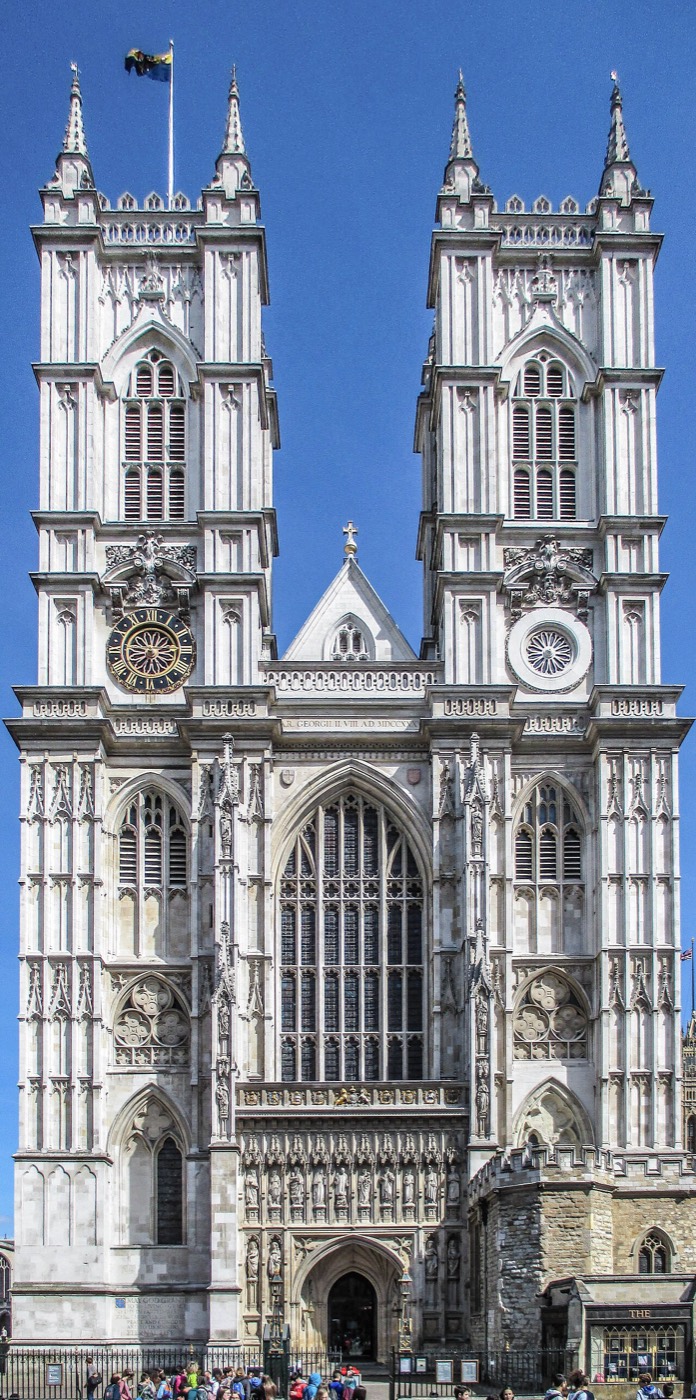
Westminster Abbey — formally the Collegiate Church of Saint Peter at Westminster — has occupied its site on Thorney Island at the bend of the Thames in London since at least the mid-eleventh century. Edward the Confessor consecrated a Romanesque church on the site in 1065, just days before his death, and was buried there. William the Conqueror, who arrived in England the following year, had himself crowned at Westminster in December 1066 — establishing a precedent that has been followed, with only two exceptions (Edward V and Edward VIII), by every subsequent British monarch. The current Gothic building was begun in 1245 by Henry III, who desired a church that would rival the great Gothic cathedrals of France — specifically Reims and Sainte-Chapelle in Paris — as a suitable setting for the shrine of Edward the Confessor and as a royal burial church. Henry's reconstruction proceeded eastward from the existing church; the nave was continued and completed only in the fifteenth century. The western towers, with their immediately recognizable twin pinnacled tops, were designed by Nicholas Hawksmoor and added between 1722 and 1745.
Westminster Abbey is at once a functioning church, a major tourist destination, a national memorial, and an active repository of nearly 1,000 years of English and British history. The abbey has hosted every royal coronation since 1066, the funerals and burials of monarchs, the weddings of more than a dozen members of the royal family including those of the current King Charles III (then Prince of Wales) in 1981 and Prince William in 2011, and the commemorative services that mark major national events. More than 3,300 people are buried or commemorated within the building, including seventeen monarchs and a remarkably diverse group of cultural and scientific figures — from Geoffrey Chaucer (who was buried here in 1400, the first occupant of what became Poets' Corner) to Charles Darwin, Isaac Newton, Stephen Hawking, and Charles Dickens.
Architectural significance
Henry III's rebuilt church introduced the French Gothic style to England more fully than any previous building — the height of the nave at 31 meters (the tallest Gothic nave in England), the use of flying buttresses visible on the exterior, the apsidal east end with a ring of radiating chapels following the French cathedral plan, and the delicate stone tracery of the windows all reflect the French cathedrals Henry admired and wanted to emulate. Yet the building is not simply a French import: English Gothic sensibility shaped the construction throughout, particularly in the emphasis on horizontal surface decoration and the use of dark Purbeck marble for shafts and column capitals, which creates a distinctive color contrast with the pale Caen stone of the structural elements — a combination characteristic of English Gothic but rare in France.
The Henry VII Lady Chapel, added to the east end of the church between 1503 and 1519, is considered the finest example of Perpendicular Gothic fan vaulting in England and one of the most extraordinary interior spaces in European Gothic architecture. The fan vault — a uniquely English Gothic form in which ribs radiate from a central point in a conical fan pattern, creating a surface that reads like lace in stone — here reaches its maximum complexity and refinement, with pendants hanging from the vault's underside and the whole surface covered in carved heraldic badges and decorative carving. The chapel was designed as the burial chapel and chantry of Henry VII, the first Tudor monarch, and his effigy by Pietro Torrigiano (who had previously broken Michelangelo's nose in a brawl in Florence) stands on the tomb at the chapel's center.
Key features
- Gothic nave: At 31 meters, the tallest Gothic nave in England, with narrow proportions that read as more French in character than most English Gothic cathedrals; the nave was constructed over more than a century but maintains remarkable stylistic consistency.
- Henry VII Lady Chapel: The Perpendicular Gothic fan vault, with its lace-like surface of stone tracery and hanging pendants, is the culminating achievement of English Gothic vaulting; the bronze effigies of Henry VII and his queen Elizabeth of York by Pietro Torrigiano occupy the central tomb.
- Twin western towers (Hawksmoor, 1722–1745): Nicholas Hawksmoor's Gothic Revival towers, designed more than two centuries after the main body of the church, are so well integrated with the existing fabric that most visitors assume they are medieval; they create the building's most recognizable silhouette.
- Cosmati pavement (1268): The sanctuary floor around the high altar is covered in a Cosmati pavement — intricate geometric inlay in marble, porphyry, glass, and gilded metal — imported from Rome in 1268; it is one of the finest Cosmati works outside Italy and was commissioned by Henry III specifically to rival the floors of the great Roman basilicas.
- Poets' Corner: The south transept has been, since the burial of Geoffrey Chaucer in 1400, the traditional location for commemorating major British literary figures; the floor and walls are thick with memorial tablets and monuments to writers including Shakespeare, Milton, Keats, Austen, Dickens, and T.S. Eliot.
- Chapter House (1255): The octagonal chapter house, with its original medieval floor tiles (the largest collection of medieval floor tiles in England), its ring of slender columns supporting the vault, and its large windows, was used by the medieval House of Commons as its meeting chamber.
Preservation status
Westminster Abbey is an active working church; it is not a cathedral (it has no bishop) but a Royal Peculiar — a church under the direct jurisdiction of the sovereign rather than any bishop or archbishop. As such it operates under different rules from parish or cathedral churches and is not subject to the faculty jurisdiction of the Church of England. Ongoing conservation of the exterior stonework is a perpetual challenge: London's historically poor air quality accelerated the decay of the Caen limestone used in the medieval construction, and the stone conservation program — which has been running continuously since the 1970s — involves cleaning and consolidation of the existing stone as well as replacement of badly deteriorated elements. The Abbey is not independently a UNESCO World Heritage Site but is listed as part of the Palace of Westminster and Westminster Abbey and Saint Margaret's Church World Heritage Site (1987).
Think you can place this building on the map?
Play Building Guessr