Architecture in Australia
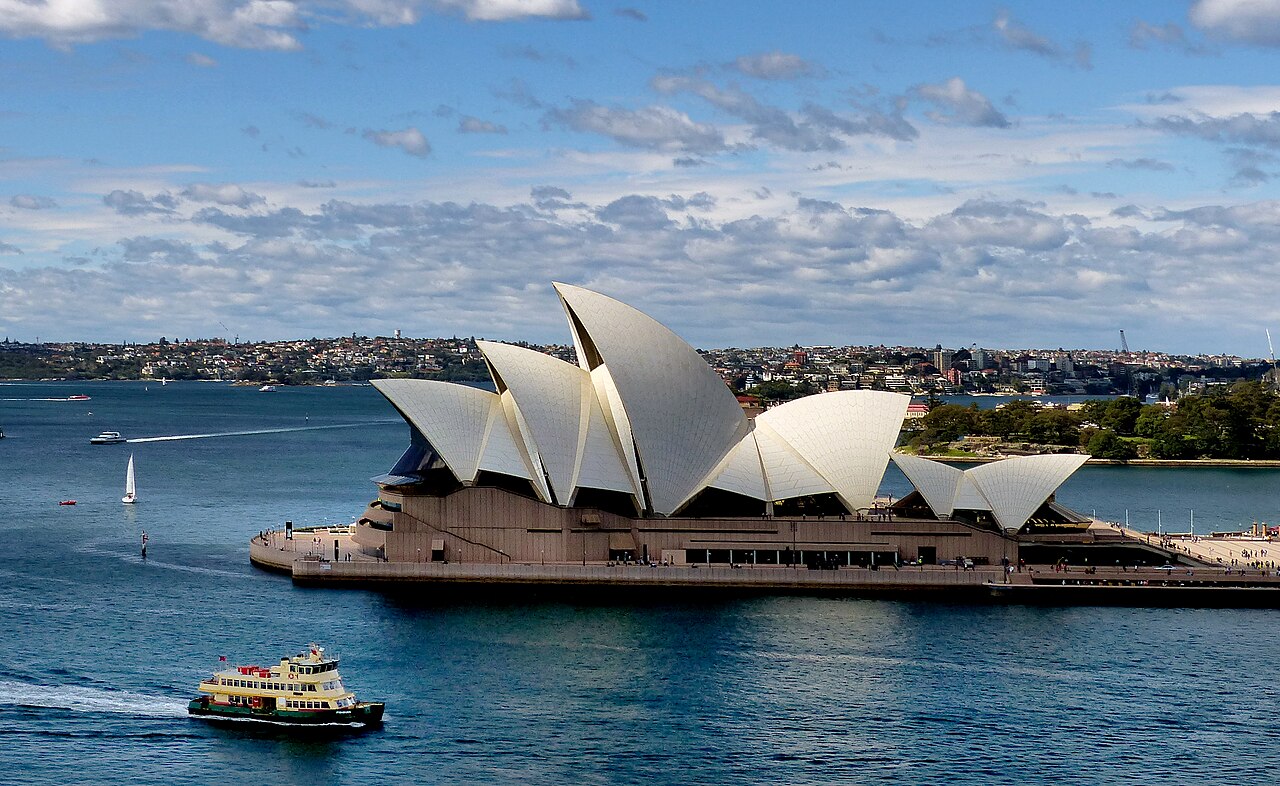
Australia's architectural history encompasses 60,000 years of Aboriginal relationship with landscape — including stone arrangements, scarred trees, rock art sites, and a profound understanding of Country as the built environment itself — followed by the British colonial imposition of Georgian and Victorian architecture in coastal cities, and a 20th century that produced both suburban sprawl and some genuinely significant works of Modernism. The Sydney Opera House is the most recognisable building in the southern hemisphere and among the most studied structural achievements of the 20th century. Melbourne's Victorian-era streetscapes rival those of any British colonial city, while Canberra — designed from scratch by Walter Burley Griffin after a 1912 international design competition — is one of the few capital cities in the world designed entirely by a single master plan.
Notable Buildings
-
Expressionist
Jørn Utzon's 1973 building resolved the shell roof problem by treating each shell as a segment of a single sphere — a geometric breakthrough that made fabrication possible for the first time. The building sits on a headland in Sydney Harbour; its relationship to water, sky, and the harbour bridge defines the most important urban moment in Australian civic design.
-
Victorian / Gothic Revival
Royal Exhibition Building, Melbourne
The first building in Australia to be listed as a UNESCO World Heritage Site (2004), built for the 1880 Melbourne International Exhibition. Its Great Hall under a central dome was the venue for the opening of the first Australian Parliament in 1901. It remains in continuous use as an exhibition space.
-
Modernist Planned
Parliament House, Canberra
Romaldo Giurgola's 1988 Parliament House is buried under a grassed hilltop — the building as landscape, topped by a flagpole-spire that can be seen from across the city. The axial relationship between Parliament House, Old Parliament House (1927), and the Australian War Memorial on the opposite hill of Anzac Parade is the spine of Burley Griffin's city plan.
-
Aboriginal Cultural
Uluru (Ayers Rock)
The 340-metre sandstone monolith sacred to the Anangu people is not a building but a cultural site of the first order — a living cultural landscape with hundreds of associated sites, stories, and art. It was returned to Anangu ownership in 1985 and climbing was permanently banned in 2019. The relationship between Uluru and the built environment is the central question of Australian architecture: how does design engage with a landscape already deeply inhabited culturally?
-
Colonial / Heritage
The Rocks, Sydney
The oldest surviving area of European settlement in Australia, dating from 1788. The sandstone warehouses, cottages, and pubs of The Rocks represent the vernacular architecture of early colonial Sydney and are now a preserved heritage precinct alongside the northern pylon of the Sydney Harbour Bridge.
-
Contemporary
National Museum of Australia, Canberra
Ashton Raggatt McDougall's deconstructivist museum (2001) is one of the most formally radical public buildings in Australia: its plan is a knot — literally — and its facades incorporate distorted quotations from other buildings including the Jewish Museum Berlin. Loved and hated in equal measure, it represents the most ambitious architectural statement in Canberra since Parliament House.
Architectural Character
Australian architecture has been shaped by the tension between the imported and the indigenous. British colonial building transplanted Georgian and Victorian typologies to a climate and landscape for which they were not designed: the addition of the verandah — the shaded perimeter that wraps a building, standard in Australian residential architecture since the 19th century — was one of the first local adaptations. The Federation style (1890–1915) developed a distinctly Australian residential architecture: red brick, terracotta tile, decorated timber fretwork, and large verandahs responding to the suburban block and the Australian climate.
The modernist period produced Robin Boyd's critique of "Austerica" — the uncritical adoption of American commercial modernism — and a search for an architecture appropriate to Australian conditions. Contemporary Australian architecture has engaged increasingly with questions of Indigenous relationship to Country: who has the right to shape landscape that is already profoundly shaped, by a 60,000-year culture that built without permanent structures but inhabited space with extraordinary depth?
Test your knowledge of Oceanian and African landmarks.
Play Building Guessr