Architecture in China
China has one of the world's oldest continuous architectural traditions, shaped by Confucian cosmology, the demands of an imperial bureaucracy, and climatic conditions ranging from subarctic to subtropical. The wooden post-and-beam frame — the dominant structural system for over 3,000 years — produced a remarkably consistent architectural language across the vast country: curved roofs with upturned eaves in glazed tile, symmetrical courtyard arrangements (siheyuan), and hierarchical colour coding (yellow reserved for the emperor). The 20th century brought the brutal discontinuity of the Cultural Revolution, which destroyed thousands of historic buildings, followed by one of the most rapid urbanisation programmes in human history: between 1990 and 2020, China added more urban floor area than the entire existing building stock of the United States.
Notable Buildings
-
Imperial Chinese
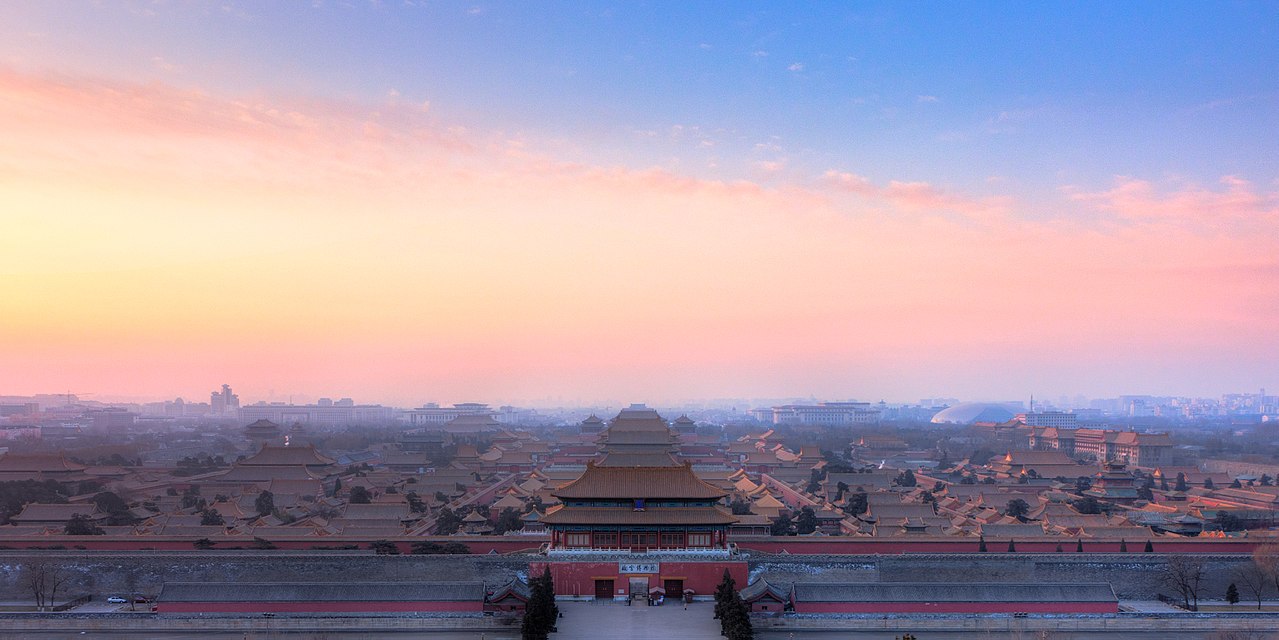
The palace complex of the Ming and Qing dynasties (1420–1912) contains 980 buildings within a 72-hectare walled enclosure. Yellow glazed tiles signal imperial status; the south-facing orientation and axial sequence of courtyards embody Confucian principles of hierarchical order.
-
Military
Not one wall but many — built, rebuilt, and connected by successive dynasties over 2,000 years. The Ming dynasty sections (14th–17th c), constructed in brick and stone with watchtowers at regular intervals, are what most visitors see. Total length of all sections combined: approximately 21,196 km.
-
Imperial
The ritual complex where the Emperor of China performed annual ceremonies to pray for good harvests (1420). The circular Hall of Prayer for Good Harvests — triple-eaved, 38 metres high, built on a triple marble terrace — sits on a square base: the circle of heaven and square of earth made architectural.
-
Tibetan
The winter residence of the Dalai Lamas, built on Red Hill above Lhasa at 3,700 metres altitude. The current structure (1645–1694) has 13 storeys, 1,000 rooms, 10,000 shrines, and approximately 200,000 statues. Since the 14th Dalai Lama's exile in 1959, it has been a museum.
-
Contemporary
Bird's Nest Stadium, Beijing
Herzog & de Meuron's National Stadium for the 2008 Olympics takes its nickname from the interlocking steel lattice of its exterior structure. The 91,000-seat oval bowl was designed so that the structural steel — a three-dimensional space frame — is simultaneously the architectural expression.
-
Contemporary
CCTV Headquarters, Beijing
Rem Koolhaas/OMA's 2012 headquarters for China Central Television consists of two leaning towers connected at the top and bottom into a continuous loop — a closed structural ring that redirects gravity loads in unconventional patterns. It challenged the typology of the skyscraper as a vertical extrusion.
-
Imperial
Summer Palace, Beijing
The imperial garden retreat enlarged by the Qing emperor Qianlong (18th c) and rebuilt by the Dowager Empress Cixi with funds intended for the navy. Kunming Lake (excavated by hand, the soil piling into Longevity Hill), the Long Corridor (728 metres of painted covered walkway), and the Marble Boat are its centrepieces.
Architectural Character
Chinese architecture is among the most internally consistent in history — the basic principles of wooden frame construction, courtyard organisation, and symbolic orientation persisted largely unchanged from the Zhou dynasty to the 20th century. The key spatial concept is the courtyard (yuan): buildings are not objects in landscape but walls around voids, with the interior outdoor space as the primary social realm. This system scales from the single-family siheyuan of Beijing's hutong lanes to the nested courtyards of the Forbidden City.
Symbolic colour and material conventions were rigorously maintained: yellow tiles for the emperor, green for princes, grey for commoners; the number nine (most yang) appearing in the Forbidden City's 9×9 gate stud arrangements. The 20th century brought radical disruption — the May Fourth Movement rejected traditional culture, the Cultural Revolution destroyed physical heritage, and post-1978 urbanisation replaced historic fabric at unprecedented speed, raising urgent questions about what survives and what has been lost.
Test your knowledge of Asian landmarks.
Play Building Guessr