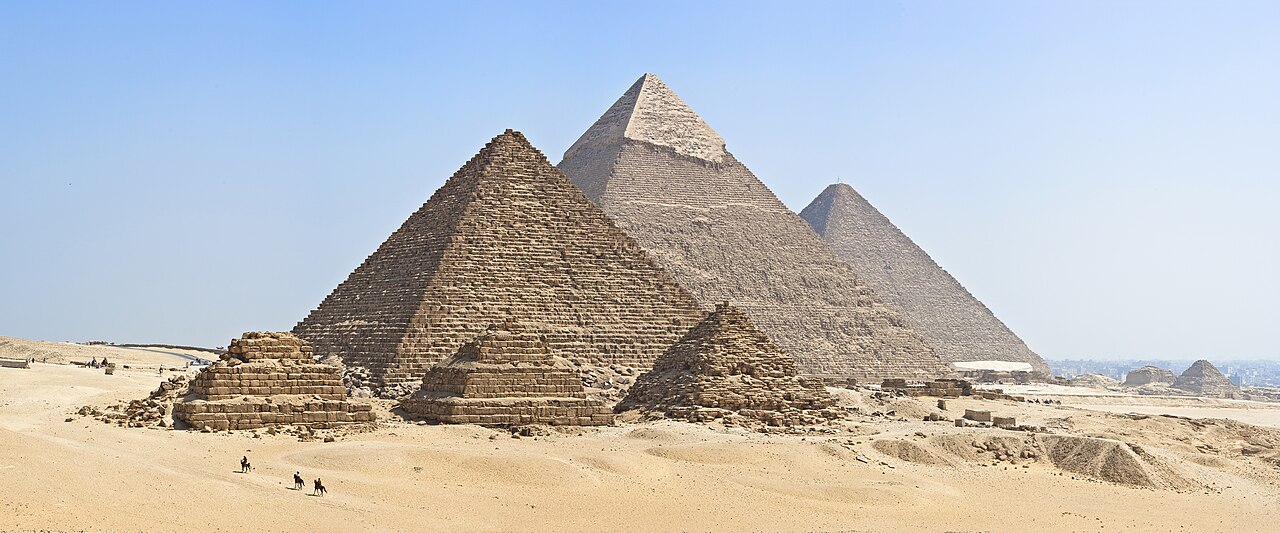
Architecture in Egypt
Egypt's architectural history begins earlier than almost any other on earth. The stepped pyramid of Djoser at Saqqara (c.2650 BCE) is the oldest large-scale dressed-stone structure in the world; the Great Pyramid of Giza (c.2560 BCE) was the tallest man-made structure for nearly 4,000 years. This extraordinary precedence gave Egyptian architecture a quality of primordial weight and permanence — the column derived from the papyrus bundle, the pylon gateway, the hypostyle hall of columns, and the obelisk were all developed in Egypt and spread across the Mediterranean and beyond. The Islamic conquest (641 CE) added a layer of mosque, madrasa, and Fatimid architecture that makes Cairo's historic core one of the densest accumulations of medieval Islamic architecture in the world.
Notable Buildings
-
Ancient Egyptian
The only surviving original Wonder of the Ancient World (c.2560 BCE). Built for Pharaoh Khufu, the pyramid originally reached 146.5 metres — the world height record until Lincoln Cathedral (c.1311) finally surpassed it after nearly 4,000 years. Approximately 2.3 million blocks averaging 2.5 tonnes, quarried at Tura and Aswan, fitted with joints measured in fractions of a millimetre.
-
Ancient Egyptian
Luxor Temple
The temple complex at the centre of the ancient city of Thebes (c.1400 BCE), built over several reigns. An avenue of sphinxes connecting it to Karnak (3 km) has been partially excavated. The temple was later enclosed within a Roman military camp; a mosque built inside the courtyard is still in use, gradually elevated above the original floor level by accumulated sediment.
-
Ancient Egyptian
Karnak Temple Complex
The largest ancient religious site in the world, built and modified over 2,000 years by successive pharaohs. The Hypostyle Hall — 134 sandstone columns up to 23 metres high arranged in 16 rows, covering 5,000 square metres — is the most overwhelming interior space in ancient architecture.
-
Ancient Egyptian
Abu Simbel
Two rock-cut temples of Ramesses II (c.1264 BCE), relocated 64 metres above their original position (1964–1968) when the Aswan High Dam threatened to submerge them — one of the greatest engineering operations in the history of conservation. The temples were originally aligned so that twice a year, sunlight penetrates 60 metres into the inner sanctuary to illuminate three of the four seated statues.
-
Islamic
Ibn Tulun Mosque, Cairo
The oldest intact mosque in Egypt (876 CE), built by Ahmad ibn Tulun in the unusual Abbasid style of brick spiral minaret — the only example in Cairo. Its vast open courtyard and arcaded cloisters are almost unaltered from their original form, making it the best-preserved early Islamic mosque in North Africa.
-
Modern
Bibliotheca Alexandrina
Snøhetta's 2002 library on the Mediterranean coast of Alexandria is designed as a disc tilted toward the sea, its exterior wall of Aswan granite inscribed with letters from 120 world scripts. Its capacity of 8 million books and its position on the site of the ancient Library of Alexandria make it one of the most symbolically weighted buildings of the 21st century.
Architectural Character
Egyptian architecture is defined by permanence as a theological principle. The pharaoh's tomb was not merely a burial place but a machine for resurrection: its orientation (east-west, following the sun), its alignment with stars, its offering chambers and false doors for the passage of the ka (spirit), and its massive stone construction (to last into eternity) were all components of a theological programme. The colossal scale — the Great Pyramid, the Ramesseum, the Karnak Hypostyle Hall — was also theological: the pharaoh's divine authority made visible in stone.
Egyptian columnar architecture developed forms derived from nature — the papyrus bundle, the lotus, the palm — that influenced Greek column design (whether directly or by parallel development remains debated). The Islamic architecture that overlaid this in the 7th century CE was at first Arab in character but gradually absorbed Egyptian craft traditions, producing the distinctive Mamluk style of decorative stonework that defines Cairo's historic mosques.
Test your knowledge of African landmarks.
Play Building Guessr