Architecture in Germany
Germany's architectural history is inseparable from its political fragmentation and eventual reunification. Before 1871 there was no German state, only hundreds of principalities, free cities, and kingdoms — each with its own court architecture, cathedral building programme, and civic tradition. This produced an extraordinary diversity: Romanesque abbeys along the Rhine, Gothic cathedrals competing for height, Baroque palaces competing with Versailles for grandeur, and the austere Prussian Neoclassicism of Karl Friedrich Schinkel's Berlin. The 20th century brought the Bauhaus — the most influential design school in history, founded by Walter Gropius in Weimar in 1919 — followed by the catastrophe of National Socialist architecture, the postwar division and reconstruction of destroyed cities, and the reunification architecture of Berlin that produced some of the most politically charged buildings of the late 20th century.
Notable Buildings
-
Romanesque Revival
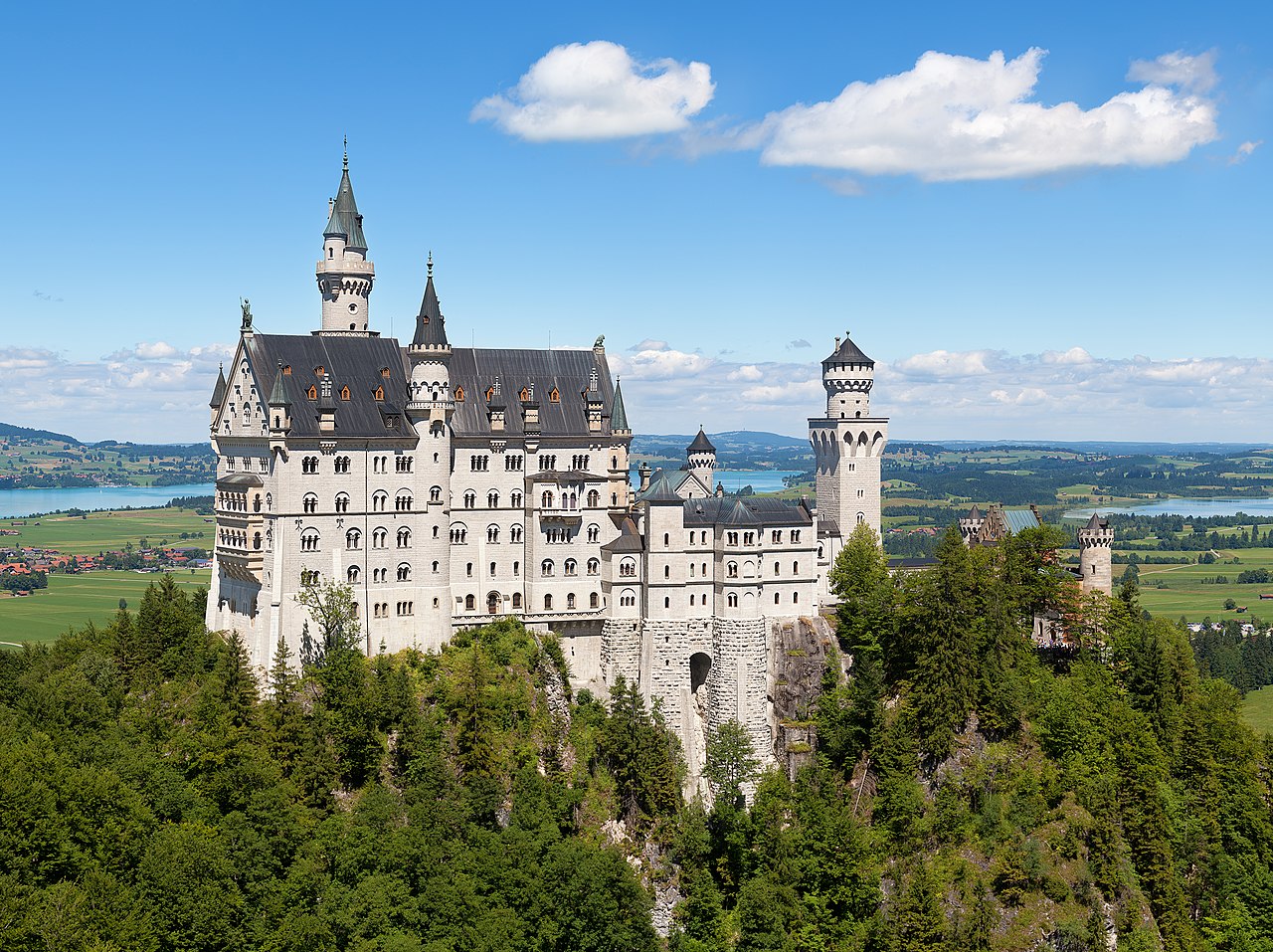
Ludwig II of Bavaria's 19th-century romantic fantasy, built more as a theatrical stage set than a functional fortress. Completed in 1886, it inspired Walt Disney's Sleeping Beauty Castle and receives 1.3 million visitors per year. Ludwig died before seeing it completed; the castle was opened to the public just six weeks after his death.
-
High Gothic
Begun in 1248 and not completed until 1880 — 632 years of construction, making it the longest continuously built Gothic structure. Its twin spires at 157 metres were the tallest man-made structures in the world from 1880 to 1884. The cathedral received 14 direct bomb hits in World War II but survived structurally; the surrounding city was nearly flattened.
-
Neoclassical
Carl Gotthard Langhans's Doric gateway (1791), modelled on the Propylaea in Athens. During the Cold War it stood in no-man's land between East and West Berlin, becoming a symbol of division. When the Wall fell in November 1989, the first jubilant crowds converged here — and it has been a symbol of reunification ever since.
-
Bauhaus
Bauhaus Dessau
Walter Gropius's 1926 building for the Bauhaus school is a manifesto in built form: flat roof, glass curtain walls on the workshop wing, primary colours, and no historicist ornament of any kind. It is the canonical example of early Modernist architecture and a UNESCO World Heritage Site, studied by architecture students worldwide.
-
Neo-Gothic / Contemporary
Reichstag with Foster's Dome, Berlin
The 1894 parliamentary building was gutted by fire in 1933 and left a ruin through much of the Cold War. Norman Foster's 1999 renovation added a glass dome open to the public, with a mirrored cone that channels daylight into the debating chamber below — a deliberate statement about transparent, accessible democracy.
-
Baroque / Rococo
Sanssouci Palace, Potsdam
Frederick the Great's summer retreat (1747), designed by Georg Wenzeslaus von Knobelsdorff in Rococo style. The name means "without worry" in French. The terraced vine-covered hillside and intimate scale contrast sharply with the grandiosity of most royal residences of the period — Frederick wanted a retreat, not another Versailles.
-
Romanesque
Speyer Cathedral
One of the largest Romanesque buildings in the world, begun in 1030 under Emperor Conrad II and expanded under Henry IV. The crypt contains the tombs of eight Holy Roman Emperors and four queens. Its four towers and two domes define the Rhenish Romanesque style that influenced church architecture across Central Europe.
Architectural Character
Germany's architecture reflects the country's late national unification and its role as a cultural crossroads between northern, southern, and eastern Europe. Romanesque building (10th–12th c) flourished under the Holy Roman Emperors along the Rhine — at Speyer, Worms, and Mainz — in large, austere basilicas with multiple towers, each tower marking a different liturgical function. Gothic arrived from France and was pursued to structural extremes: Cologne Cathedral's builders aimed to outdo every previous Gothic structure in height, vault span, and window area, a competition that ultimately spanned six centuries.
The Baroque flourished in the Catholic south and the Protestant north equally, though in different registers. The pilgrimage churches of Bavaria — the Wieskirche, the Vierzehnheiligen — achieve an exuberance of decoration that rivals anything in Rome. The Prussian palace architecture of Berlin and Potsdam, by contrast, favours a cooler Rococo refinement under French cultural influence. The 20th century gave Germany the Bauhaus and the defining responsibility of rebuilding cities twice destroyed — producing both prefabricated mass housing at enormous scale and the self-consciously memorial architecture of reunified Berlin, where buildings by Daniel Libeskind, Rem Koolhaas, and Zaha Hadid grapple with the weight of 20th-century history in brick, steel, and glass.
Test your knowledge of European landmarks in the game.
Play Building Guessr