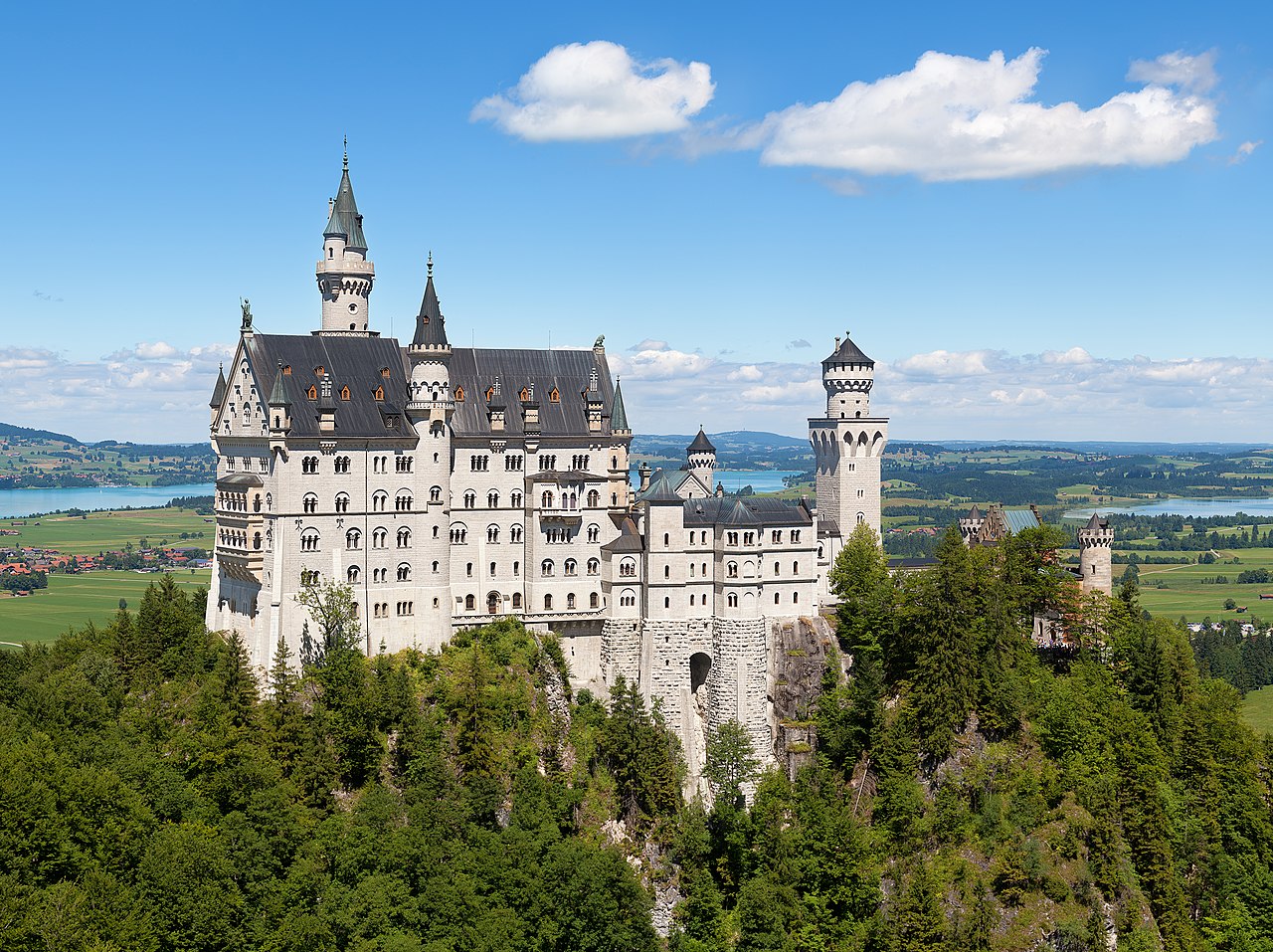
What it is
Neuschwanstein Castle is one of the most visited historic buildings in Europe and one of the most recognizable structures in the world — yet it is neither ancient nor functional as a castle. It was built between 1869 and 1886 for King Ludwig II of Bavaria, a monarch who was more interested in opera, mythology, and solitary grandeur than in warfare or administration. Ludwig conceived Neuschwanstein not as a defensive fortification but as a personal refuge — a theatrical stage set for his private world, built around his deep devotion to the operas of Richard Wagner. The design was developed by theatrical stage designer Christian Jank, who produced the visual concept, with court architect Eduard Riedel translating those theatrical sketches into working construction drawings. The result is a building that began as a stage set and was then built in stone, which explains much of its visual character: it is dramatically composed for the viewer on the valley floor below, with its towers and silhouette arranged for maximum picturesque effect at a distance.
Construction proceeded slowly over seventeen years, employing hundreds of workers and consuming enormous sums from the Bavarian treasury. By 1886 only about fifteen of the planned rooms had been completed and furnished. On June 10, 1886, a medical commission declared Ludwig mentally incompetent, and he was removed from power. Three days later he was found dead in the Starnberger See under circumstances that remain disputed — officially ruled a suicide by drowning, but the details have never been fully explained. Ludwig had lived in Neuschwanstein for exactly six weeks before his death. In a decision that would prove extraordinarily consequential for Bavarian tourism, the castle opened to the public just seven weeks after Ludwig's death, on August 1, 1886. It has been a major tourist destination ever since, and now receives approximately 1.4 million visitors per year.
Architectural significance
Neuschwanstein is a key exemplar of Historicism — the nineteenth-century architectural movement that borrowed forms from earlier historical periods not for functional reasons but for ideological, romantic, or nationalistic ones. In the case of Neuschwanstein, the Romanesque forms (rounded arches, heavy towers, corbelled battlements, thick ashlar walls) were chosen by Ludwig to evoke the world of medieval German legend, specifically the Arthurian and Norse mythologies that Wagner dramatized in his operas. This was not a building for warriors or feudal administration; it was a building for a man who wished to inhabit the imaginary world of Lohengrin and Parsifal. The contradiction between the medieval exterior and the modern interior is absolute and intentional: inside the Romanesque stone shell, Neuschwanstein was fitted with electric lighting (remarkable for 1880s construction), central heating delivered through underfloor ducts, flush toilets, and running hot and cold water throughout. Ludwig demanded nineteenth-century comfort inside a twelfth-century fantasy.
The building's most consequential cultural legacy is its role in establishing the popular image of the "fairy-tale castle." When Walt Disney's animators sought a visual model for the castle in the 1959 film Sleeping Beauty, they used Neuschwanstein as a direct reference — and the Disney version was in turn used as the basis for Disneyland's Sleeping Beauty Castle in Anaheim, and subsequently for similar structures at Disney parks worldwide. This means that the globally dominant mental image of what a medieval castle looks like derives not from any actual medieval fortification but from a nineteenth-century theatrical fantasy built by an eccentric Bavarian king. Actual medieval castles are generally far more utilitarian and less photogenic than the Neuschwanstein archetype suggests, but the pop-culture image has become so powerful that it shapes expectations even among architectural students and historians.
Key features
- White limestone ashlar walls: The exterior is clad in Jurassic limestone from local Bavarian quarries, giving the building its distinctive pale ivory-white appearance — very different from the rough stone of actual medieval fortifications and chosen specifically for its visual delicacy at a distance.
- Romanesque towers and arched windows: The towers use rounded Romanesque arches at their window and arcade openings throughout, reinforcing the medieval evocation. The tallest tower rises 65 meters.
- Dramatic mountain site: The castle is positioned on a spur above a gorge at approximately 960 meters elevation, with the Marienbrücke (Mary's Bridge) spanning the gorge below, providing the most famous panoramic view of the castle. The site was chosen by Ludwig specifically for its theatrical picturesqueness.
- Throne room with Byzantine mosaic floor: One of the grandest completed interior spaces, designed as a two-story Byzantine basilica with a mosaic floor depicting animals and plants, and an apse where a throne was intended to stand. Ludwig died before the throne was installed; the throne base and dais exist but the throne itself was never made.
- Singer's Hall (Sängersaal): Occupying the entire fourth floor of the main building, the Singer's Hall is dedicated to the Parsifal legend and features a painted ceiling and wall murals depicting scenes from Wolfram von Eschenbach's medieval poem. The hall was intended for private Wagner opera performances; no performance was ever held there during Ludwig's lifetime.
- Unrealized courtyards and wings: Only the first and second courtyards were completed. The original plans included a third and fourth courtyard and additional wings that would have substantially expanded the complex. These were never built, and the castle remains unfinished according to Ludwig's original vision.
- Modern infrastructure inside medieval shell: Electric chandeliers powered by a dynamo in the basement, central heating, hot and cold running water in all rooms, and flush toilets — all installed during construction in the 1880s, making Neuschwanstein technologically more advanced than most contemporary buildings despite its medieval appearance.
Preservation status
Neuschwanstein is in good structural condition and is managed by the Bavarian Palace Department (Bayerische Schlösserverwaltung) as a historic property. Structural repairs and facade conservation work have been ongoing over the decades since the castle opened to the public. The white limestone exterior requires periodic cleaning and stabilization to address weathering and biological growth. Interior conservation focuses on the elaborate murals, mosaics, and furnishings in the completed rooms, which are vulnerable to humidity and light exposure from visitor traffic.
The 1.4 million annual visitors create significant management challenges. Timed-entry tickets are required, and visitor numbers in the completed rooms are controlled to limit humidity and physical wear. The castle's global fame — substantially amplified by its association with Disney — means that peak-season wait times for tours can be several hours even with advance booking. Bavaria has no plans to limit visitor numbers dramatically, as the castle is a central part of the regional tourism economy. Ongoing structural repairs to the gorge and the access routes have periodically affected visitor access to the most famous viewpoints.
Think you can place this building on the map?
Play Building Guessr