Architecture in India
India's architectural history spans more than 4,500 years, from the planned cities of the Indus Valley Civilisation to the contemporary skylines of Mumbai and Bengaluru. The subcontinent has been shaped by successive civilisations — Mauryan, Gupta, Chola, Rajput, Delhi Sultanate, Vijayanagara, Mughal, and British colonial — each leaving a distinct architectural signature. Hindu temple architecture, which developed the Nagara (north Indian) and Dravidian (south Indian) styles from the 5th century CE onwards, is among the most elaborate and symbolically dense in the world: towers (shikharas and gopurams) covered in sculpted figures represent the sacred mountain at the centre of the cosmos. The Mughal emperors, descendants of Central Asian rulers with Persian cultural inheritance, created the most refined Islamic architecture outside the Middle East.
Notable Buildings
-
Mughal
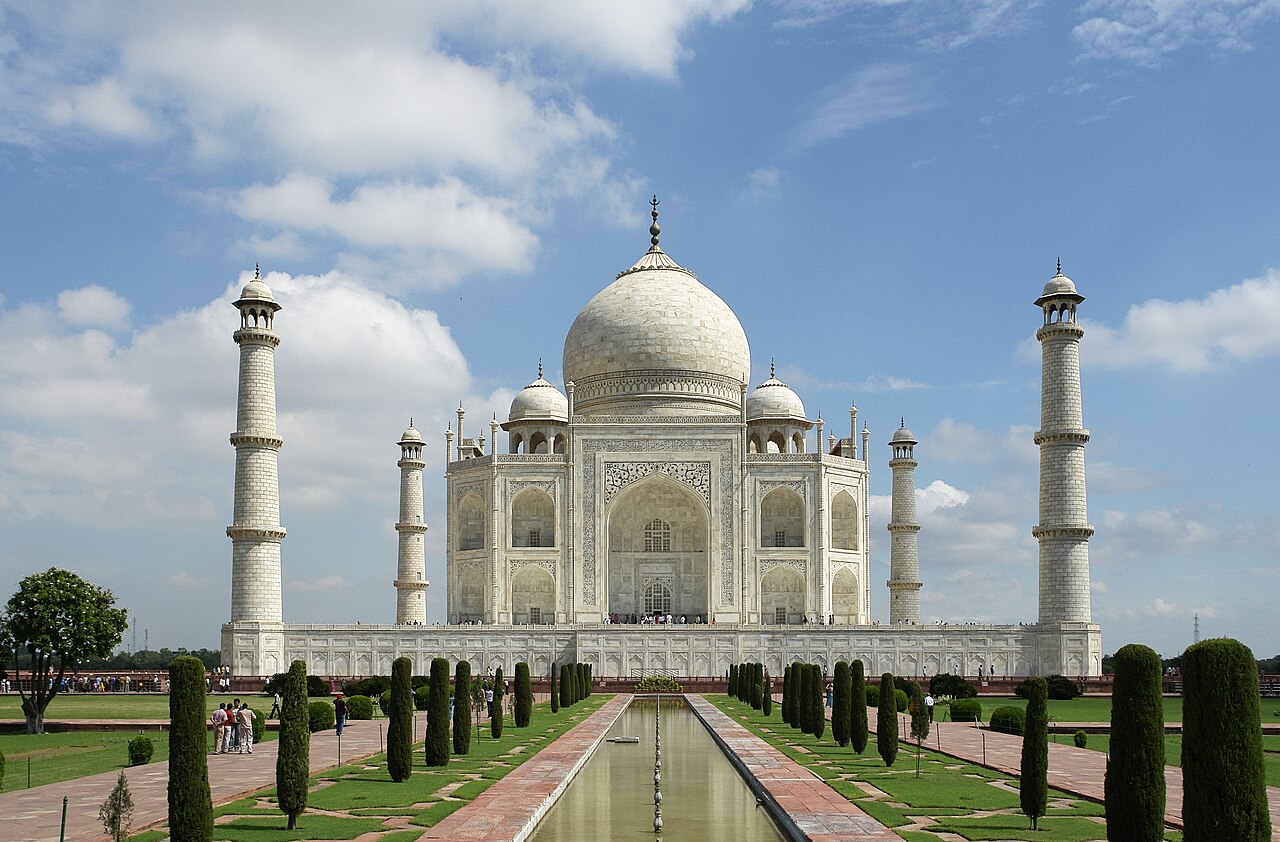
The mausoleum built by Shah Jahan for his wife Mumtaz Mahal (1632–1643) is the supreme expression of Mughal architecture: perfect bilateral symmetry, white Makrana marble that changes colour through the day, a chaharbagh paradise garden, and four minarets designed to fall outward in an earthquake.
-
Mughal
Red Fort, Delhi
Shah Jahan's walled palace-fortress on the Yamuna river (1639–1648) takes its name from the red Agra sandstone of its curtain walls. The Diwan-i-Khas (Hall of Private Audience) once housed the Peacock Throne; the fort is now the site of India's Independence Day address.
-
Early Mughal
Humayun's Tomb, Delhi
The tomb of the Mughal emperor Humayun (1570) was the first garden-tomb in the Indian subcontinent and a direct prototype for the Taj Mahal. Its double dome — an outer shell visible from a distance, an inner shell at a habitable scale — became standard in subsequent Mughal mausolea.
-
Indo-Islamic
Qutb Minar, Delhi
The 72.5-metre minaret built in 1193 by Qutb ud-Din Aibak is the tallest brick minaret in the world and the earliest surviving example of Indo-Islamic architecture. The surrounding Qutb complex includes the Iron Pillar of Delhi — a 7-metre iron column that has not corroded despite 1,600 years of exposure.
-
Dravidian
Meenakshi Temple, Madurai
The temple complex dedicated to the goddess Meenakshi has 14 gopurams (gateway towers), the tallest at 52 metres, covered with approximately 33,000 sculpted figures painted in bright colours. The complex covers 6 hectares and is the centrepiece of Madurai's urban fabric.
-
Mughal
Fatehpur Sikri
The short-lived Mughal capital built by Akbar between 1571 and 1585, abandoned when its water supply failed. The complex — mosque, palace, audience halls, and royal quarters — is one of the best-preserved examples of Mughal architecture and demonstrates the fusion of Hindu and Islamic design vocabularies.
-
Modernist
Lotus Temple, Delhi
Fariborz Sahba's Bahá'í House of Worship (1986) consists of 27 free-standing white marble-clad petals arranged in three rows around a 40-metre central hall. Open to worshippers of all religions, it receives over 4 million visitors annually.
-
Colonial / Contemporary
Parliament House, New Delhi
Edwin Lutyens and Herbert Baker's 1927 circular colonnaded building in the colonial capital they designed from scratch. The circular plan — 560 metres in circumference — contains three semicircular legislative chambers and a central library. A new triangular Parliament building, designed by Bimal Patel, opened in 2023 alongside it.
Architectural Character
Indian architecture is shaped by the concept of the sacred mountain. In the Nagara tradition of north India, the temple's tower (shikhara) represents Mount Meru, the cosmic axis; every element of the building's plan and elevation is derived from symbolic geometry (vastu shastra). In the Dravidian tradition of south India, the gopuram — the monumental gateway tower — assumes greater importance than the inner shrine, creating a sequence of increasingly sacred spaces.
Mughal architecture brought the Persian garden, the iwan (vaulted portal), and the double dome into contact with Indian craftsmanship in stone-carving, inlay, and geometry, producing a synthesis of remarkable refinement. British colonial architecture in India produced its own hybrid: Lutyens's New Delhi combined Mughal, Rajput, and Classical elements into a new imperial grammar, while the Indo-Saracenic style mixed Gothic spires with Mughal domes in railway stations and universities across the country.
Test your knowledge of Asian landmarks.
Play Building Guessr