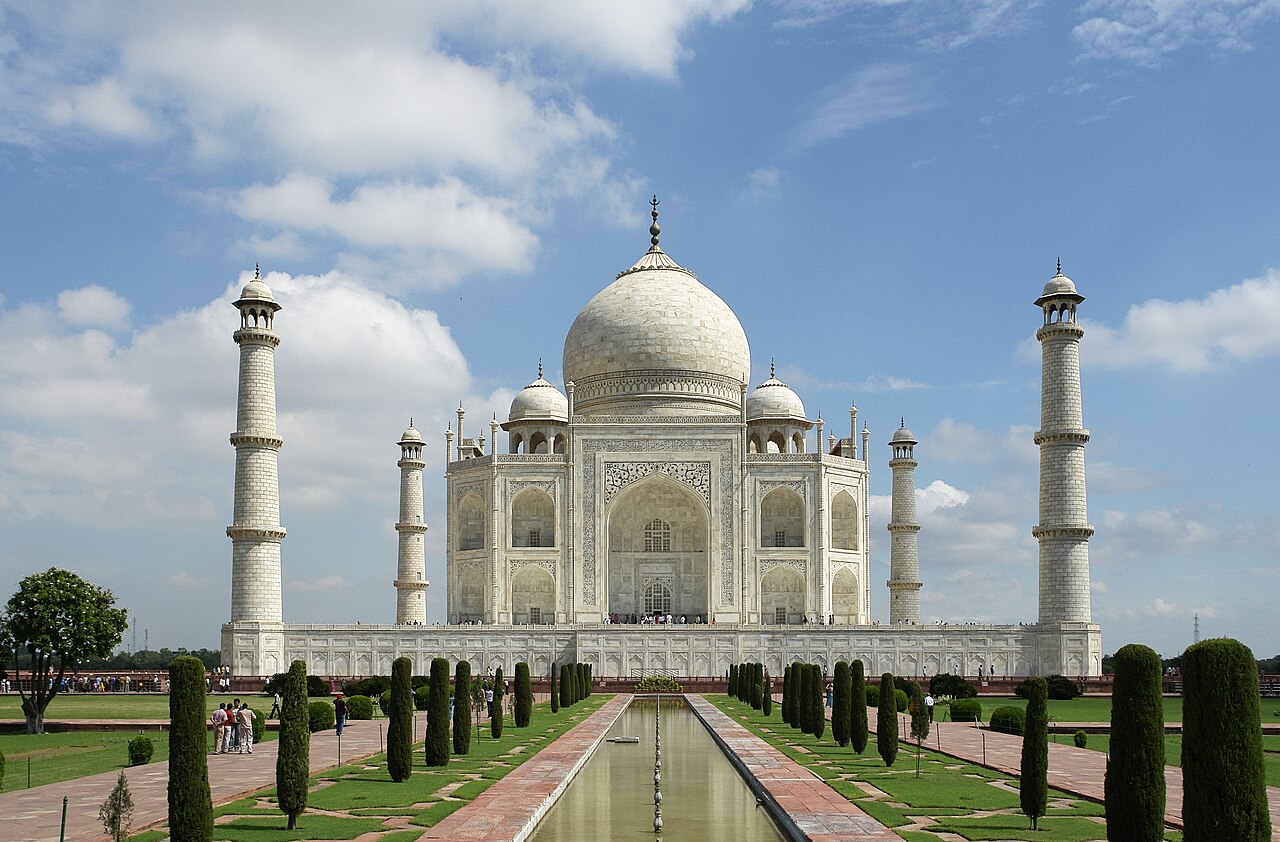
What it is
The Taj Mahal is a mausoleum commissioned by the Mughal emperor Shah Jahan to house the tomb of his third and most beloved wife, Arjumand Banu Begum — known by her honorific title Mumtaz Mahal, meaning "Chosen One of the Palace." Mumtaz Mahal died in 1631 during the birth of their fourteenth child, and Shah Jahan, reportedly inconsolable, resolved to build her the most magnificent tomb the world had ever seen. Construction began almost immediately, around 1632, and continued for twenty-two years, finally reaching completion in 1643. The main tomb structure was finished by about 1648, with the surrounding gardens, mosque, guest house, and outer courts completed in the years that followed.
The scale of the undertaking was staggering even by imperial standards. Over 20,000 artisans, craftsmen, and laborers were brought to Agra from across the Mughal empire and beyond — from Persia, Ottoman Turkey, Central Asia, and the Indian subcontinent itself. The chief architect is generally identified as Ustad Ahmad Lahauri, a Persian-born designer working in the Mughal court tradition. Precious and semi-precious stones were sourced from across Asia: turquoise from Tibet, lapis lazuli from Afghanistan, carnelian from Arabia, jade from China, and jasper from the Punjab. The total cost of construction, estimated at 32 million rupees in contemporary terms, is thought to have consumed roughly half of the Mughal state's annual treasury revenue during the years of construction. Shah Jahan himself is buried beside Mumtaz Mahal; after being deposed by his son Aurangzeb in 1658, he spent the remaining years of his life under house arrest in the Agra Fort, reportedly with a view of the Taj across the river.
Architectural significance
The Taj Mahal's most immediately recognizable quality is its perfect bilateral symmetry — or near-perfect, depending on what you include in the accounting. The main tomb, its four minarets, the reflecting pool, the garden axes, and the flanking mosque and guest house buildings are all arranged with mirror-image precision on two perpendicular axes. This symmetry is an expression of a Mughal aesthetic ideal rooted in both Persian garden design and Islamic geometric principles. The chaharbagh — the four-part paradise garden divided by water channels representing the four rivers of Islamic paradise — is one of the most fully realized examples of this garden type in existence. The central reflecting pool, positioned between the gatehouse and the tomb, is designed at the precise distance needed for the dome to be reflected in full in the still water surface: the iconic photograph that most people associate with the building is not accidental but was carefully engineered into the original design.
The white Makrana marble of the tomb is chosen and positioned with deliberate optical awareness. The material appears to change color across the day: blue-grey at pre-dawn, softly luminous at sunrise, white at noon, golden-pink at sunset, and silver under moonlight. This effect results from the marble's crystalline structure catching and scattering light at different angles, and it was understood and valued by the Mughal court as an expression of divine changeability — the tomb alive with the light of God at different hours. The four minarets flanking the tomb platform carry a subtle but famous optical correction: each minaret leans slightly outward from the platform, so that in the event of an earthquake, they would fall away from the tomb rather than onto it. The lean is small enough to be imperceptible to a casual observer, visible only when measured against a plumb line — a detail of structural thinking embedded invisibly in an apparently purely aesthetic composition.
Key features
- White marble dome: The central onion dome rises 73 meters from the base of the platform to the finial. It sits on an octagonal drum decorated with blind arches and is surrounded by four smaller chattri (kiosk) domes at the corners of the plinth, providing visual balance at lower eye levels.
- Four independent minarets: Each minaret is 40 meters tall and constructed as a structurally separate element from the main tomb — they are not load-bearing parts of the central structure. Each leans slightly outward, designed to fall away from the tomb in a seismic event.
- Chaharbagh garden: The formal paradise garden is divided into four quadrants by raised marble water channels, with the central reflecting pool as the focal point. Originally planted with cypress trees and fruit trees symbolizing life and death respectively, the current planting dates largely from later restoration work.
- Red sandstone mosque and guest house: Two matching red sandstone buildings flank the white marble tomb on the east and west sides of the plinth. The western building is a functioning mosque; the eastern is a jawab (literally "answer") — a guest house built solely to maintain the symmetry of the composition, since Islamic law required a mosque to face Mecca and therefore could not be duplicated on the opposite side.
- Pietra dura inlay work: The interior and exterior surfaces of the tomb are decorated with elaborate floral and geometric patterns inlaid in semi-precious stones — a technique called parchin kari in Persian, or pietra dura in Italian. The craftsmanship, including flowers with dozens of individual stone pieces per bloom, is among the finest surviving examples of the technique anywhere in the world.
- Calligraphic bands: Quranic inscriptions in black marble inlay run along the arches and portals of the main tomb, composed by the calligrapher Amanat Khan, whose name is inscribed at the base of the main arch — a rare instance of an artisan signing their work on a Mughal imperial commission.
Preservation status
The Taj Mahal is standing but subject to ongoing environmental pressures. The most serious long-term threat has been air pollution from industrial activity in and around Agra, which has caused a gradual yellowing of the white Makrana marble. Sulfur dioxide and nitrogen dioxide from vehicle exhaust and nearby foundries react with the marble surface to form gypsum, a yellowing compound. The Indian government has implemented vehicle restrictions in the immediate vicinity and has established green buffer zones around the complex. Periodic cleaning of the marble using multani mitti clay poultices — a traditional cleaning method — is carried out by the Archaeological Survey of India. Insect damage from the Yamuna River, particularly from midges that leave deposits on the marble, has also been an issue.
The Taj Mahal was designated a UNESCO World Heritage Site in 1983. Visitor numbers, which reached approximately 7 to 8 million annually before the COVID-19 pandemic, have returned and created crowd management challenges. Timed entry systems and caps on daily visitor numbers have been implemented at various points. The wooden foundations of the tomb, which rest on timber pilings above the clay soil of the Yamuna floodplain, have raised engineering concerns about long-term stability as the river level and groundwater table change. Monitoring programs are in place but the long-term structural implications remain an active area of conservation concern.
Think you can place this building on the map?
Play Building Guessr