Architecture in Italy
Italy's built environment spans 2,500 years of Western architectural history with unmatched density. Roman engineering — the arch, the concrete vault, the dome — still stands across the peninsula in amphitheatres, temples, and bath complexes. The Renaissance, which began in Florence in the early 15th century and reinvented Classical forms for a Christian culture, produced some of the most studied buildings in the world. Baroque Rome layered theatrical plazas and curved facades over the ancient street pattern. Venice evolved its own maritime Gothic, influenced by Byzantine and Islamic trading partners, while Milan absorbed northern European influences. Italy today is simultaneously a living city and an open-air museum: Romans park their scooters next to the Pantheon; Florentines walk past Brunelleschi's dome every morning on their way to work. The concentration of architectural masterworks per square kilometre is unequalled anywhere on earth.
Notable Buildings
-
Roman Imperial
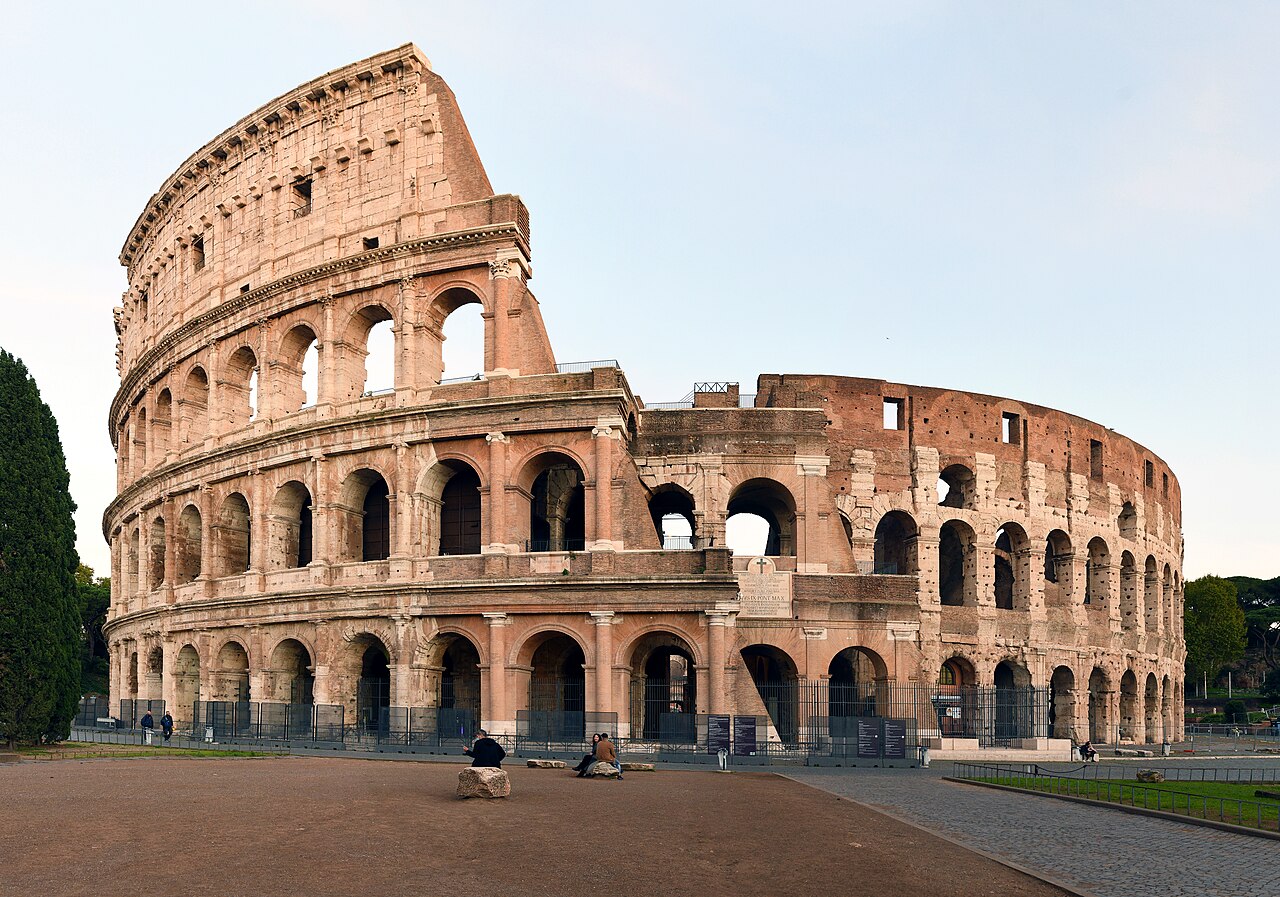
The Flavian Amphitheatre, opened in 80 CE. Its system of vaulted corridors (vomitoria) allowed 50,000 to 80,000 spectators to fill and evacuate in minutes. The tiered facade introduced a different Classical order on each level — Doric, Ionic, Corinthian — providing an architectural education in a single glance.
-
Italian Gothic / Renaissance
Filippo Brunelleschi's dome (completed 1436) was the largest masonry dome built since the Pantheon and remained the largest in the world for centuries. It was built without temporary wooden centering — a feat that had been considered structurally impossible — using a double-shell design and a herringbone brick pattern that locks each course in place.
-
Roman Imperial
Hadrian's rebuilt temple (c.125 CE) has an unreinforced concrete dome 43.3 metres in diameter — still the largest in the world after two millennia. The only light source is the 9-metre oculus at the apex. Converted to a church in 609 CE, which saved it from the systematic spoliation that dismantled most Roman monuments.
-
Romanesque
The campanile of Pisa Cathedral has leaned since construction began in 1173, due to soft subsoil on the south side. The lean was reduced from 5.5° to 3.97° during stabilisation works in the 1990s. Galileo reportedly used it for his falling-body experiments, though this may be apocryphal.
-
Renaissance / Baroque
The world's largest church by interior volume. Bramante, Raphael, Michelangelo (the dome), della Porta, Maderno, and Bernini all contributed across 120 years of construction (1506–1626). Michelangelo's dome set the template for cathedral domes worldwide, from St Paul's London to the US Capitol.
-
Baroque
Trevi Fountain
The terminus of the ancient Aqua Virgo aqueduct, rebuilt in Baroque grandeur by Nicola Salvi and completed in 1762. At 26 metres high and 49 metres wide, it is the largest Baroque fountain in Rome. The coin-throwing tradition — one coin to return to Rome, two to fall in love — generates significant charitable revenue annually.
-
Gothic / Renaissance
Doge's Palace, Venice
The seat of Venetian government for centuries. Its distinctive pattern — heavy arcaded Gothic upper floors sitting on lighter ground-floor colonnades — is the structural inverse of conventional building logic, designed to make the palace appear to float above the lagoon. The interior contains paintings by Tintoretto and Veronese in rooms of extraordinary opulence.
-
Roman
A Roman city preserved under volcanic ash from the 79 CE eruption of Vesuvius. About two-thirds of the 66-hectare site has been excavated, revealing intact bakeries, baths, brothels, and villas with vivid frescoes — an irreplaceable snapshot of Roman urban life at a specific moment in time.
Architectural Character
Italy is the country where the Western architectural tradition was repeatedly reinvented. Roman engineering established the principles of large-scale public construction — arches, concrete vaulting, underfloor heating — that remained influential for 2,000 years. The Romans were the first to use concrete systematically as a structural material, allowing them to build domes, barrel vaults, and groin vaults at a scale that timber-framed or post-and-lintel construction could not approach. The Pantheon, the Colosseum, and the Baths of Caracalla are exercises in structural ambition that had no precedent and no successor for over a millennium.
The Renaissance recovered Classical proportions and applied them to a Christian building programme, producing Florence Cathedral, St Peter's Basilica, and hundreds of palaces and villas across the peninsula. The key insight of Renaissance architects — Brunelleschi, Alberti, Bramante, Palladio — was that the proportions of ancient Rome were not arbitrary but reflected mathematical principles that could be studied, codified, and reapplied. Palladio's Four Books of Architecture became the most influential architectural treatise ever written, shaping building across Europe and North America for two centuries.
The Baroque, centred in Rome under papal patronage, introduced dramatic spatial sequences, curved facades, and theatrical lighting effects. Bernini's St Peter's Square, his Baldacchino inside the basilica, and his transformation of the Roman church interior into an experience of overwhelming grandeur defined the Catholic Baroque response to the Protestant Reformation. Northern Italy — Venice, Milan, Turin — absorbed Gothic and northern European influences, developing regional variants that produced a distinct aesthetic quite different from Roman classicism.
Test your knowledge of European landmarks in the game.
Play Building Guessr