What it is
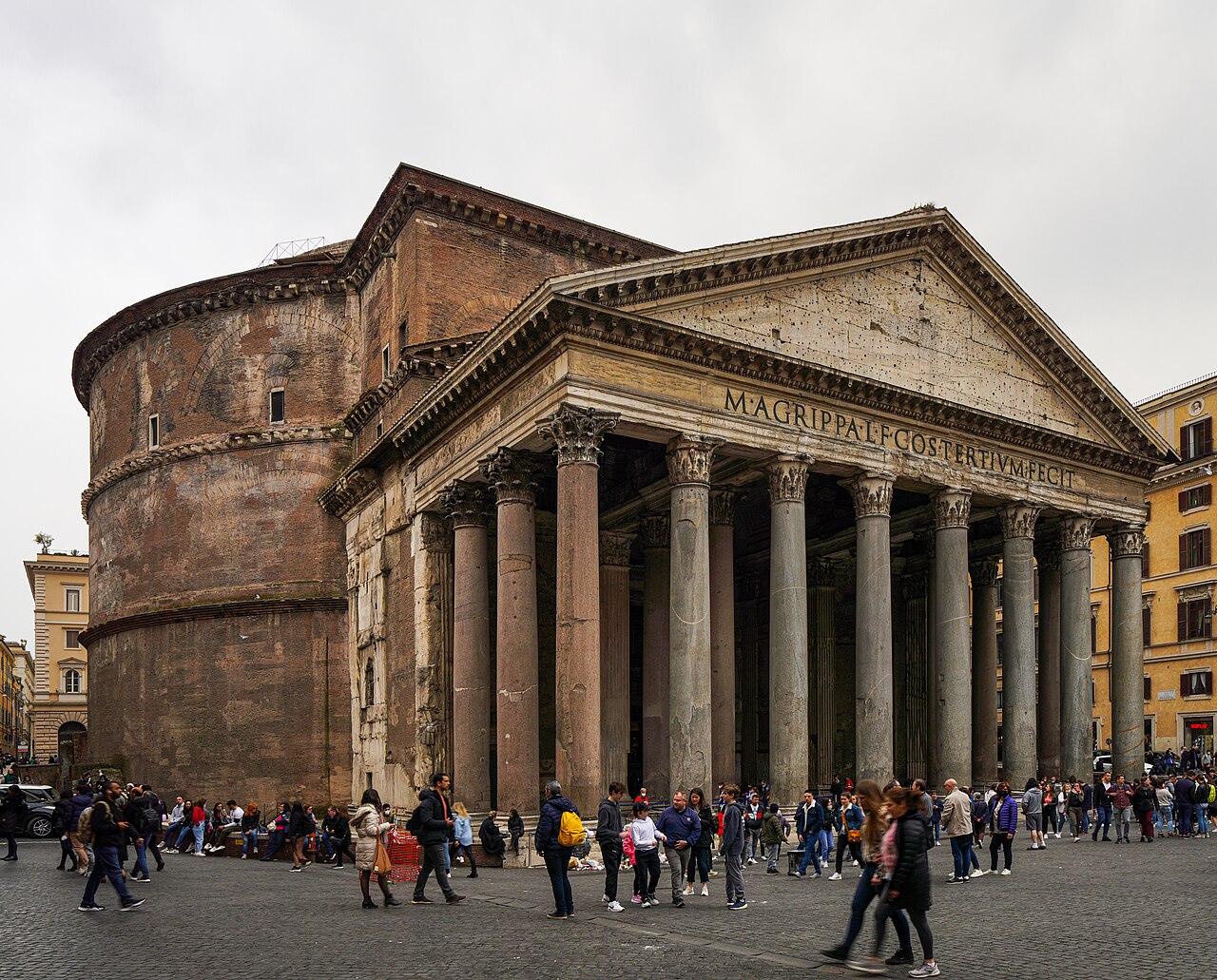
The Pantheon is a former Roman temple in the centre of Rome, now functioning as a church dedicated to Santa Maria ad Martyres, and one of the best-preserved buildings from the ancient world. Its name, derived from Greek, means "temple of all the gods," though its precise religious function in Roman times remains debated. The building we see today was commissioned by the Emperor Hadrian, who rebuilt an earlier temple originally constructed by Marcus Agrippa in 27 BCE. Hadrian's rebuilding, completed around 125 CE, preserved — or reinstated — Agrippa's original dedicatory inscription on the portico: "M.AGRIPPA.L.F.COS.TERTIVM.FECIT" (Marcus Agrippa, son of Lucius, consul for the third time, built this). The inscription led later historians to mistakenly attribute the building to Agrippa rather than Hadrian for many centuries.
What makes the Pantheon extraordinary is its dome: 43.3 metres in diameter, the largest unreinforced concrete dome ever built, and one that remained unmatched in size for 1,300 years until Brunelleschi completed the dome of Florence Cathedral in 1436. The interior space is a perfect geometric statement: the diameter of the dome equals the height from the floor to the oculus, meaning that a perfect sphere would fit exactly within the building. This is not coincidence but deliberate design — a mathematical ideal that the Romans understood as a symbol of cosmic perfection. The Pantheon was converted to a Christian church by Pope Boniface IV in 609 CE, a conversion that almost certainly saved it from the systematic quarrying and spoliation that stripped most other Roman monuments of their marble, bronze, and stonework over the following centuries.
Architectural significance
The Pantheon's dome is the central achievement of Roman structural engineering. It is built of unreinforced opus caementicium — Roman concrete, a mixture of volcanic pozzolana, lime, and aggregate — without any steel reinforcement, and it has stood without major structural repair for nearly 1,900 years. The achievement is partly the result of a sophisticated understanding of materials: the aggregate in the dome changes as it rises, from heavy basalt and brick near the base, through tufa and lighter stone in the middle courses, to pumice — the lightest available aggregate — near the top. This graduated lightening of the concrete reduces the dome's self-weight in the areas where the outward-thrusting forces are greatest, allowing the structure to remain stable without the buttressing that Gothic builders would later require for their stone vaults.
The dome's inner surface is divided into five rings of 28 coffers — recessed square panels — that decrease in size as they approach the apex. The coffers serve both aesthetic and structural purposes: aesthetically, they create the visual impression of the dome receding into depth, their diminishing perspective enhancing the sense of height; structurally, they reduce the dead weight of the concrete by approximately 5,000 tonnes compared with a solid shell of the same outer dimensions. At the dome's apex, the 8.7-metre open oculus is the only natural light source in the building. The oculus is not covered: it lets in rain, which drains through slightly convex paving stones to hidden drainage channels beneath the floor. The column of light from the oculus moves slowly across the interior as the sun tracks across the sky — a dynamic, living element in an otherwise static space, understood in Roman times as a connection between the temple interior and the heavens above.
Key features
- The oculus: The 8.7-metre circular opening at the dome's apex is the building's only source of natural light and ventilation. It creates a moving column of light that traces a path across the walls and floor as the sun moves, and it admits rain, which falls on the slightly domed floor and drains through imperceptible openings. On 21 April — the traditional founding date of Rome — the midday sun shines directly through the oculus onto the threshold of the main door.
- Perfect geometric proportions: The interior is a cylinder surmounted by a hemisphere: the diameter equals the height from floor to oculus, approximately 43.3 metres. A sphere of that diameter would fit precisely inside the building. This proportion — the cube, the sphere, and the cylinder in harmonic relationship — became one of the foundational references for Renaissance architectural theory.
- The portico and inscription: The Pantheon's entrance portico has 16 monolithic granite columns, each 12 metres tall and weighing approximately 60 tonnes, quarried in Egypt and shipped to Rome. The pediment above carries the famous inscription attributing the building to Agrippa, a deliberate act of self-effacement unusual for an emperor of Hadrian's ambition.
- Tombs of the illustrious: The church contains the tombs of the painter Raphael (died 1520), who requested burial there, and of two Kings of Italy — Vittorio Emanuele II (died 1878) and Umberto I (died 1900). Raphael's tomb, inscribed with a famous epitaph by Cardinal Pietro Bembo, has been a site of pilgrimage for artists since the Renaissance.
- Concrete composition: Analysis of the Pantheon's concrete shows that Roman builders used different aggregate mixes at different heights: travertine and basalt at the base and walls, brick in the rotunda walls, tufa and brick in the middle dome sections, and pure pumice near the oculus. This deliberate material grading demonstrates a sophisticated intuitive understanding of structural behaviour that was not formally theorised until the 20th century.
Construction and history
Agrippa's original Pantheon of 27 BCE was damaged by fire in 80 CE and rebuilt by the Emperor Domitian, then struck by lightning and severely damaged again in 110 CE. Hadrian's complete rebuilding, which produced the structure we see today, is generally dated to between 118 and 125 CE, though some scholars place completion later in Hadrian's reign. The precise architects are not recorded; Hadrian himself is known to have taken a keen interest in architectural design. The dome required a temporary wooden centering — a scaffolding framework — of extraordinary size; how the Romans constructed and subsequently removed this centering without leaving evidence of attachment points remains a subject of engineering speculation.
After the conversion to a church in 609 CE, the Pantheon remained in active use and relatively good repair through the medieval period, though it was not without depredation: Pope Urban VIII (Barberini) authorised the stripping of the bronze coffers from the portico ceiling, said to have yielded approximately 200,000 pounds of bronze, which Bernini used partly for the baldachin over St Peter's tomb at the Vatican and partly for cannons at Castel Sant'Angelo. The act prompted the Roman satirist to coin the phrase "Quod non fecerunt barbari, fecerunt Barberini" — what the barbarians did not do, the Barberini did. Despite this and other losses, the Pantheon is the most complete Roman building in existence.
Preservation and status
The Pantheon is a functioning Catholic church administered by the Diocese of Rome, and admission fees (introduced in 2023) fund its maintenance. The dome's concrete, though nearly two millennia old, is structurally sound; ongoing monitoring detects no significant movement or cracking. The main conservation challenges are the very high volume of visitors — over six million annually — and environmental degradation from vehicle pollution in the dense urban context of the historic centre. The Pantheon is not individually listed as a UNESCO World Heritage Site, but it falls within the Historic Centre of Rome, which received World Heritage designation in 1980.
Think you can place this building on the map?
Play Building Guessr