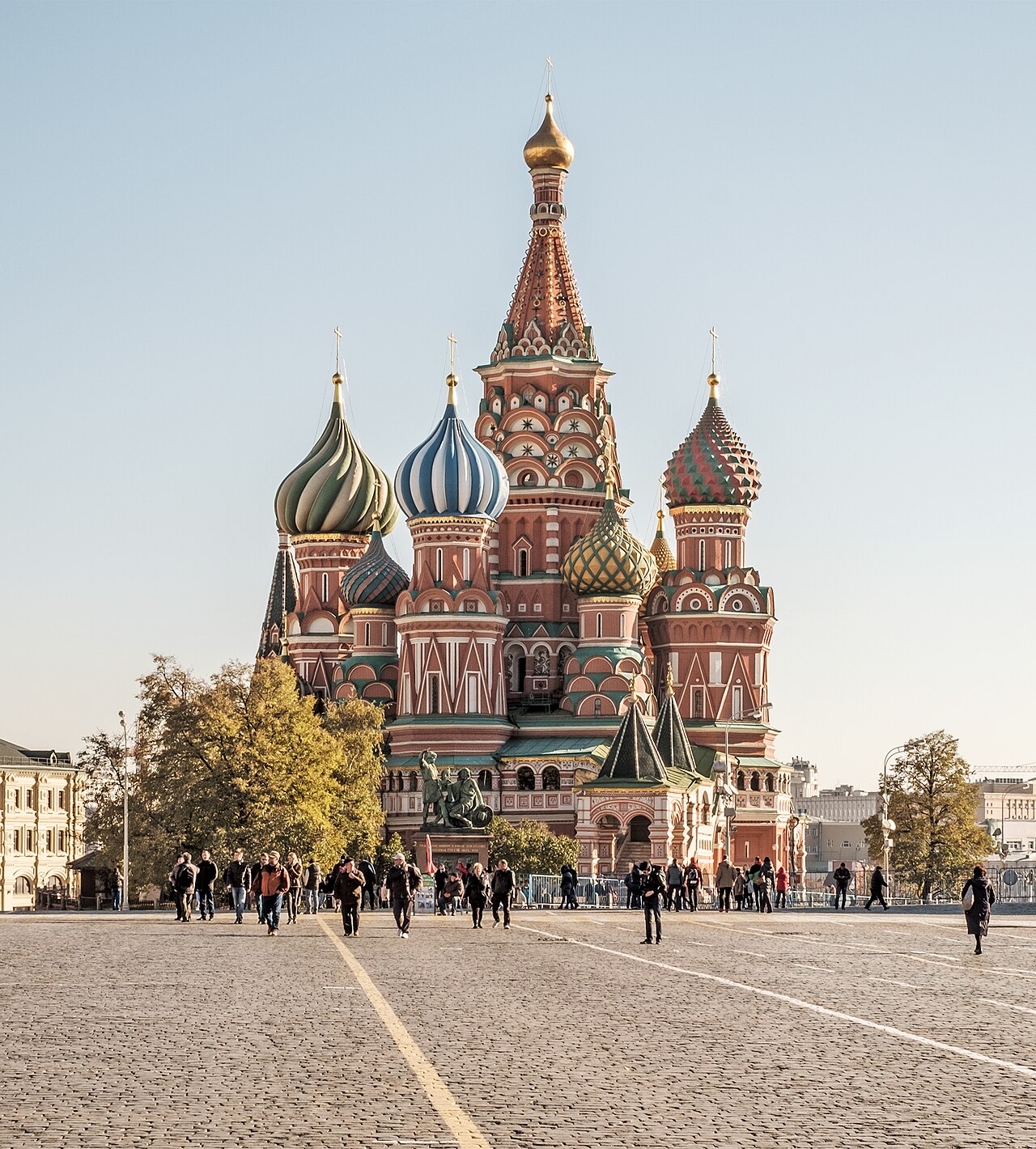
Architecture in Russia
Russian architecture is one of the most dramatic in the world, shaped by the country's Byzantine inheritance, its long partial isolation from Western Europe, the ambitions of successive Tsars, and the radical break of the Soviet experiment. Byzantine Christianity arrived from Constantinople in the 10th century and established the onion-domed Orthodox church as Russia's primary architectural form — a tradition so deeply embedded that it persisted through centuries of Westernisation. Peter the Great forcibly modernised Russian culture and architecture from 1700, importing Dutch and Italian Baroque architects to build St Petersburg as a European capital on swampy northern ground. The Soviet Union then produced Constructivism — one of the most radical architectural movements of the 20th century — and then Stalinist neoclassicism — one of its most bombastic — before settling into prefabricated mass housing that shaped the lives of hundreds of millions of people across the USSR.
Notable Buildings
-
Russian Orthodox
Ivan the Terrible's commemorative church on Red Square (1560), comprising nine separate chapels united under one roof and topped with eight differently patterned onion domes surrounding a central tent-roof tower. It has no precedent in any earlier architectural tradition and remains instantly recognisable worldwide as the symbol of Moscow.
-
Imperial
Kremlin Ensemble, Moscow
The triangular walled complex on the Moscow River contains five palaces, four cathedrals, and numerous government buildings accumulated over five centuries. The Cathedral of the Assumption (1479) was the coronation church of Russian Tsars; the Grand Kremlin Palace (1849) is a vast neo-Russian Baroque fantasy commissioned by Nicholas I.
-
Russian Baroque
Winter Palace (State Hermitage), St Petersburg
Bartolomeo Rastrelli's palace for Empress Elizabeth (completed 1762) is one of the largest Baroque buildings in the world. Its 1,057 rooms, 1,786 doors, 1,945 windows, and 117 staircases house the State Hermitage Museum — one of the largest and oldest art museums in the world, with a collection of over 3 million items.
-
Russian Revival
Church on the Spilled Blood, St Petersburg
Built on the spot where Tsar Alexander II was assassinated in 1881, in a deliberate neo-Russian style that consciously referenced St Basil's. The interior is entirely covered in mosaics totalling 7,500 square metres — the largest mosaic programme in Russia, depicting New Testament scenes in a jewelled Byzantine palette.
-
Baroque
Peterhof Palace
Peter the Great's "Russian Versailles" (begun 1714) on the Gulf of Finland. Its cascade of 64 fountains, 142 water jets, and 255 gilded statues all operate entirely without pumping machinery — fed by gravity from elevated reservoirs 22 kilometres away, an engineering achievement that Peter himself supervised.
-
Soviet Constructivism
Narkomfin Building, Moscow
Moisei Ginzburg's 1930 collective housing block was the built manifesto of Soviet social Constructivism — communal laundry, kitchen, and crèche on separate floors to liberate residents from domestic labour. Restored in recent years after decades of neglect, it is studied worldwide as a key text in the history of the Modern Movement.
-
Stalinist
Seven Sisters, Moscow
Seven skyscrapers built between 1947 and 1953 under Stalin's direct instructions, designed by different architects but sharing a silhouette of wedding-cake setbacks and a central spire. They redefined Moscow's skyline and influenced the architecture of Soviet satellite states across Eastern Europe, from Warsaw to Bucharest to Riga.
Architectural Character
Russia's architectural history is shaped by dramatic ruptures more than organic continuities. Byzantine Orthodoxy established the onion dome and the centralised church plan as the primary architectural form; the Mongol invasion of the 13th century interrupted development for two centuries. Ivan III imported Italian architects — including the Milanese Aristotele Fioravanti — to rebuild the Moscow Kremlin in the late 15th century, beginning a long tradition of importing Western expertise and adapting it to Russian conditions and the Orthodox liturgical programme.
Peter the Great's Westernisation produced St Petersburg's Baroque canal-side palaces — a European capital built from nothing on swampy northern ground in less than a century. Empress Elizabeth's court architect Bartolomeo Rastrelli gave the city its characteristic turquoise-and-white winter-palace Baroque; Catherine the Great then pivoted to Neoclassicism, importing Scottish architect Charles Cameron to build the Cameron Gallery at Tsarskoye Selo. The contrast between the two impulses — Russian splendour and European refinement — runs through Russian architecture up to the Revolution.
The Soviet period is architecturally one of the most radical in human history. Constructivism (1917–1932) proposed an entirely new architecture for a new socialist society, with spatial programmes designed to transform daily life — workers' clubs, communal houses, agricultural collective facilities, and propaganda towers. Stalinist Classicism (1932–1955) then reversed this, reasserting monumental grandeur in the Seven Sisters and the Moscow Metro. Khrushchev's mass housing programme (1955–1991) built more square metres of habitation than any previous civilisation, defining the lives of the Soviet urban population in identical concrete prefabricated apartments.
Test your knowledge of European landmarks in the game.
Play Building Guessr