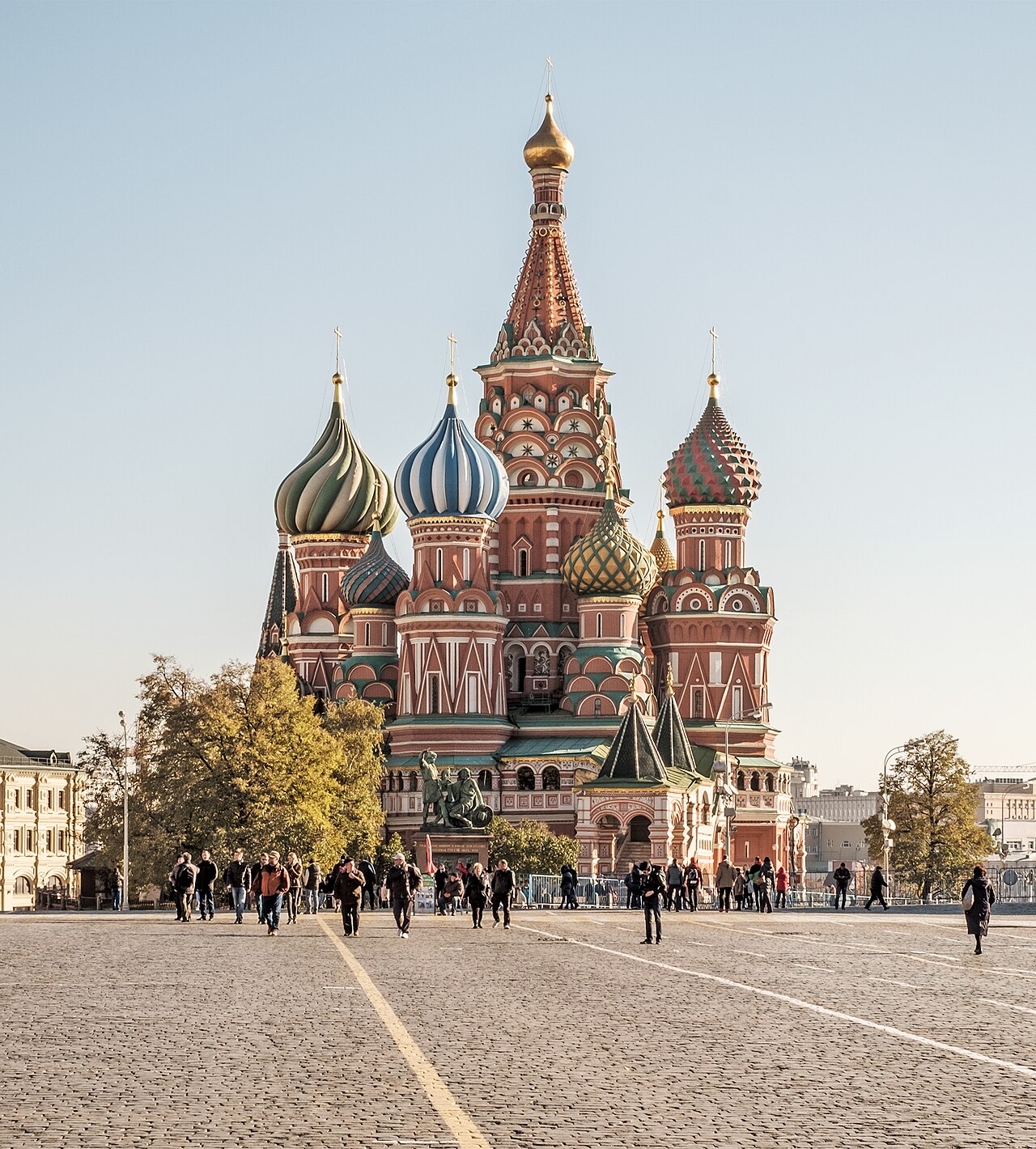
What it is
The building's official name is the Cathedral of the Intercession of the Most Holy Theotokos on the Moat, or the Pokrovsky Cathedral, but it is universally known as St. Basil's Cathedral after Vasily the Blessed — a holy fool venerated in Moscow who was buried at the site and whose remains were later incorporated into a chapel added at the building's northeastern corner. Ivan the Terrible commissioned the cathedral to commemorate the Russian conquest of the Khanate of Kazan in 1552, specifically the assault on Kazan that fell on the Feast of the Intercession of the Theotokos on 1 October 1552. Construction began in 1555 and was completed in 1561, directed by the architects Postnik Yakovlev and Barma — possibly the same person referred to by two names. The building stands at the southern end of Red Square, directly in front of the Kremlin, in the most symbolically charged position in the Russian capital.
A legend — almost certainly false, but irresistible — holds that Ivan the Terrible had the architects blinded after the building's completion to prevent them from ever creating anything comparable. There is no documentary evidence for this, and Postnik Yakovlev is recorded as working on other projects after 1561. The legend tells us more about how later generations perceived Ivan IV than it does about the cathedral's actual history. What the building's history does record is that it narrowly survived Napoleon's retreat from Moscow in 1812 (Napoleon is said to have ordered it demolished, but his engineers reportedly could not figure out how to do it), and again survived Stalin's urban renewal of Red Square in the 1930s, when the architect Kaganovich reportedly demonstrated to Stalin how the cathedral could be removed to improve the flow of military parades — Stalin, having considered the model, said to put it back.
Architectural significance
The most remarkable thing about St. Basil's Cathedral is that it has no clear precedent. The building consists of nine chapels raised on a single podium: eight chapels arranged around a central ninth, each capped with a dome entirely different in pattern from the others. The eight surrounding domes display geometric patterns drawn from Russian folk art, Ottoman textile decoration, and the architect's own invention: scaled, faceted, spiral, chevron, lattice, ribbed, and twisted forms, all executed in ceramic tile and painted plasterwork. No two are the same, and the accumulation of individually distinct elements into a single visual composition reads as extraordinary abundance rather than chaotic disorder. This is because each dome is consistent with its own logic — the complexity is controlled, not random. In the Western architectural tradition, buildings achieve unity through the repetition of elements; St. Basil's achieves it through contrast and accumulation.
The building also illustrates how color functions differently in Russian Orthodox architecture than in the Western tradition. The original St. Basil's was predominantly white with gold domes, which was conventional for Orthodox churches. The brilliant polychrome paint scheme familiar today — reds, greens, blues, yellows arranged in geometric patterns across every surface — dates from the seventeenth century and represents a deliberate decision to make the building maximally festive. The shift from white to polychrome is partly a function of changing taste and partly a reflection of the building's symbolic role: standing at the threshold of Red Square, it was expected to perform, to announce the power and richness of the Tsardom of Russia to everyone approaching the Kremlin from the south.
Key features
- Nine chapels on a single podium: Eight chapels surround the central ninth in a composition that is neither fully centralized nor fully axial, creating a building that reads differently from every angle and rewards walking around it.
- Eight uniquely patterned onion domes: Each of the eight surrounding domes has a completely different geometric surface pattern — including scale, facet, spiral, chevron, and lattice forms — executed in ceramic tile, making each dome visually distinct while all belong to a coherent family of forms.
- Polychrome painted exterior: The current riot of color dates from the seventeenth century; the original sixteenth-century scheme was predominantly white with gold domes, and documentary records show several intermediate color schemes in between.
- Central tent-roofed tower: The central chapel is capped not with a dome but with a tall octagonal tent roof rising 47 meters above the podium — a form derived from Russian wooden church architecture and the dominant element of the building's silhouette when seen from a distance.
- Red Square position: The building sits at the southern end of Red Square, on axis with the Kremlin's Spasskaya Tower gate, making it the visual termination of the square's most important processional route.
- Chapel of St. Basil: The chapel housing the relics of Vasily the Blessed, added in 1588 at the northeastern corner of the main structure, has its own small onion dome and was the origin of the building's popular name.
Preservation status
St. Basil's Cathedral was nationalized in 1923 during the Soviet period; religious services were discontinued, and the building has since functioned as a branch of the State Historical Museum. It is part of the Moscow Kremlin and Red Square UNESCO World Heritage Site (1990). The building is in sound structural condition and receives approximately 500,000 visitors per year, which is modest by the standards of major European monuments. The onion domes, which are clad in ceramic tile and painted metal, require periodic maintenance and repainting; the most recent major restoration of the exterior polychrome decoration was undertaken in the 1990s.
The cathedral exists in an unusual institutional position — a working museum housed in an active religious building whose legal status has been complicated since the post-Soviet Russian government returned many church properties to the Russian Orthodox Church. Discussions about returning St. Basil's to religious use have been reported periodically but have not resulted in a change of status. The building's role as one of the most recognizable symbols of Russia means that decisions about its use carry political weight far beyond the question of its physical conservation.
Think you can place this building on the map?
Play Building Guessr