Architecture in Spain
Spain's architecture is one of the most culturally layered in Europe. Eight centuries of Islamic rule in southern Iberia produced the Moorish palaces, mosques, and decorative systems of al-Andalus — then the Reconquista superimposed Gothic cathedrals and Renaissance palaces on the same cities, sometimes within the same walls. The Great Mosque of Córdoba had a cathedral built inside it; the Alhambra gained a Renaissance palace in its courtyard. The Habsburg empire imported Italian Renaissance forms while the Bourbon dynasty brought French Baroque influences. The 19th century produced the singular flowering of Catalan Modernisme, centred on Antoni Gaudí and Barcelona, a style with no close parallel anywhere else in Europe. Contemporary Spain has become a laboratory for ambitious contemporary architecture, from Frank Gehry's titanium Guggenheim in Bilbao to the parametric curves of Santiago Calatrava and Zaha Hadid.
Notable Buildings
-
Catalan Modernisme
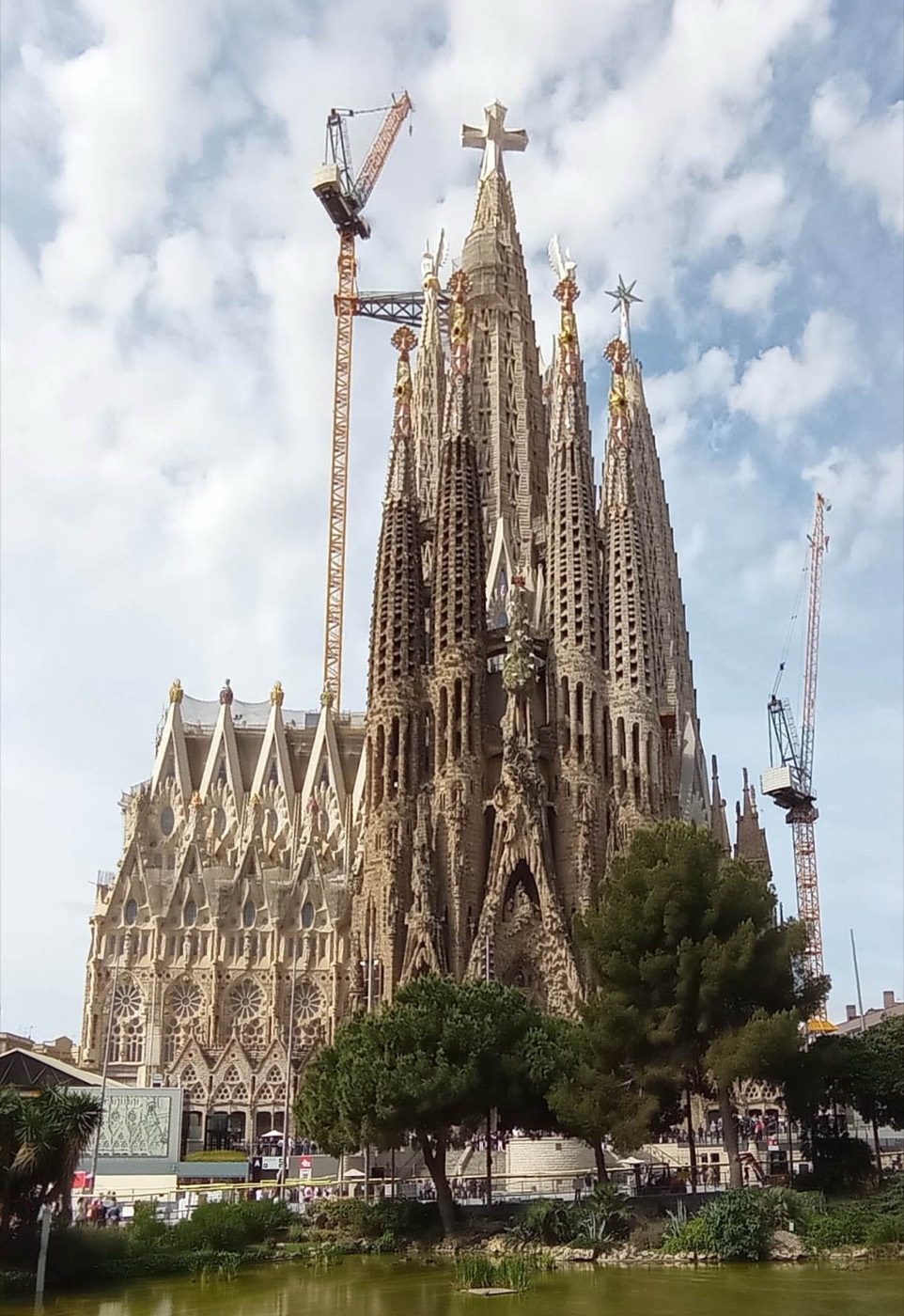
Gaudí's basilica has been under construction since 1882 and is projected to be structurally complete around 2026. It is the most visited building in Spain. The structure uses a branching hyperboloid column system that Gaudí derived from studying trees — each column splits as it rises, distributing loads like a forest canopy.
-
Catalan Modernisme
Gaudí's 1906 remodel of a Barcelona apartment block. The dragon-back roof, skull-shaped balcony railings, and aquarium-blue light well make it one of the most inventive building interiors in Europe. Every surface curves; there are no right angles in the principal rooms.
-
Nasrid / Islamic
The Nasrid palace complex in Granada, completed in the 14th century, is the finest surviving example of Moorish architecture in Spain. The Court of Lions, muqarnas ceilings, and the use of water as a reflective architectural element flowing through every space are its defining features.
-
Deconstructivism
Frank Gehry's titanium-clad museum (1997) is credited with transforming Bilbao's economy through tourism — the "Bilbao Effect." Its computer-generated curves were only possible using aerospace design software (CATIA), originally developed for the French Mirage fighter jet.
-
Medieval / Mudéjar
A fairytale castle on a rocky promontory above the confluence of two rivers, said to have inspired Walt Disney's Sleeping Beauty Castle. It has served as a royal palace, state prison, artillery college, and military academy over its 900-year history — each use leaving its mark on the fabric of the building.
-
Islamic
Mezquita, Córdoba
The Great Mosque of Córdoba (785–987 CE) is one of the most accomplished buildings in the Islamic world. Its forest of 856 columns with bicoloured arches — alternating red brick and white stone — creates an almost infinite interior space. A cathedral was built within it after the Reconquista, its Gothic choir cutting through the forest of columns.
-
Gothic
Toledo Cathedral
One of the great Gothic cathedrals of Spain, begun in 1226 on the site of a Visigothic church that had served as a mosque. The Transparente — a 1732 Baroque altarpiece with a skylight cut through the Gothic vault above it — is one of the most dramatic spatial interventions in any cathedral in the world.
-
Romanesque / Gothic
Santiago de Compostela Cathedral
The endpoint of the Camino de Santiago pilgrimage routes. The Romanesque structure (11th–13th century) was given a spectacular Baroque west facade, the Obradoiro, in the 18th century. The Pórtico de la Gloria (1188), carved by Master Mateo, is among the masterworks of Romanesque sculpture.
Architectural Character
Spanish architecture cannot be understood without the concept of convivencia — the centuries-long coexistence and collision of Christian, Islamic, and Jewish cultures on the Iberian peninsula. Islamic builders introduced the horseshoe arch, the muqarnas (honeycomb) vault, geometric tilework (azulejos), and sophisticated water management systems. The Reconquista produced hybrid Mudéjar buildings — Islamic craftsmanship in the service of Christian patrons — creating a uniquely Iberian synthesis found nowhere else in Europe.
The 16th century brought the austere Plateresque and then the severely rational Herrerian style under the Habsburgs, best exemplified by the Escorial near Madrid — a palace, monastery, and royal mausoleum of almost oppressive sobriety. Catalan Modernisme, which flowered between roughly 1880 and 1930, was a sui generis movement — organic, structural, deeply Catholic, and intensely regional. Gaudí alone produced a body of work that has no parallel in any architectural tradition: the Sagrada Família, the Casa Batlló, the Casa Milà, the Colònia Güell crypt, and the Park Güell are each unlike anything built before or since.
Contemporary Spain has embraced globally significant contemporary architecture with unusual confidence, producing some of the most photographed buildings of the past 30 years. The Guggenheim Bilbao is widely credited with demonstrating that a single ambitious building could transform a city's identity and economy — a claim, the "Bilbao Effect," that has been repeated and contested in dozens of cities worldwide since 1997.
Test your knowledge of European landmarks in the game.
Play Building Guessr