Architecture in Turkey
Turkey occupies a unique architectural position as the meeting point of European and Asian traditions, of Christianity and Islam, of the Classical Mediterranean world and the Islamic Middle East. Istanbul alone contains the greatest concentration of imperial architecture in the world after Rome: Roman aqueducts and hippodromes, the Byzantine churches of Justinian's empire, the Ottoman mosques and palaces of Süleyman the Magnificent and his successors, and 19th-century European-style banks and train stations. The Anatolian interior adds Hittite and Phrygian ruins, Hellenistic cities (Ephesus, Pergamon, Miletus), Byzantine cave churches (Cappadocia), and Seljuk caravanserais along the Silk Road. Contemporary Turkey has built extensively, but the pressure of urban development has threatened the integrity of historic Istanbul — a UNESCO World Heritage Site since 1985.
Notable Buildings
-
Byzantine
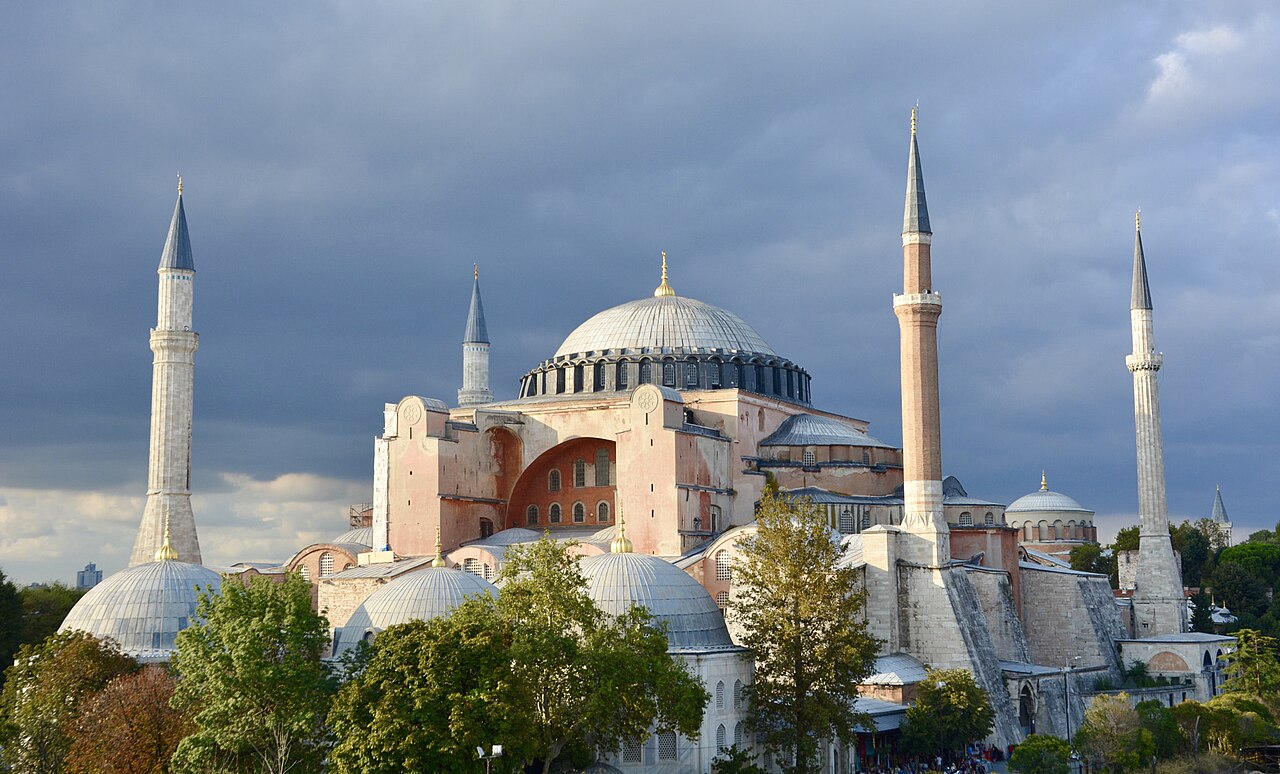
Justinian's cathedral (537 CE) introduced the pendentive — a spherical triangle that transfers the weight of a circular dome to four square piers — creating an interior of extraordinary lightness and scale. Converted to a mosque in 1453, a museum in 1934, and back to a mosque in 2020.
-
Ottoman Classical
The only mosque in Istanbul with six minarets (1616), built by Ahmed I and designed by Sedefkâr Mehmed Ağa, a student of the master architect Sinan. Its interior is lined with over 20,000 İznik tiles predominantly in blue, giving it its popular name.
-
Ottoman
The administrative centre of the Ottoman Empire for 400 years (1465–1856). Its four successively more private courtyards, the harem of 300 rooms, and the treasury (containing the Topkapi Dagger and the 86-carat Spoonmaker's Diamond) are now a museum with over 3 million visitors annually.
-
Ottoman Classical
Süleymaniye Mosque
Mimar Sinan's masterwork (1557), built for Süleyman the Magnificent. The central dome (approximately 47 metres high, 27 metres diameter) is supported by four semi-domes, creating a spacious interior that Sinan considered his most satisfying structural solution. The surrounding complex includes a hospital, madrasa, library, and Sinan's own tomb.
-
Roman / Hellenistic
Ephesus
One of the best-preserved ancient Greek cities on the Mediterranean coast, including the Temple of Artemis (one of the Seven Wonders), the Library of Celsus (a two-storey Roman library facade), the Great Theatre (capacity 25,000), and the Terrace Houses with intact mosaic floors.
-
Byzantine
Cave Churches of Cappadocia
Thousands of rock-cut churches, monasteries, and underground cities carved from the soft volcanic tuff of central Anatolia between the 4th and 11th centuries. The Göreme Open Air Museum contains the highest concentration, with fresco cycles ranging from crude early Christianity to late Byzantine refinement.
-
Ottoman
Dolmabahçe Palace, Istanbul
The Westernised palace built by the reforming Tanzimat sultans on the Bosphorus (1856) deliberately echoes European Baroque — 285 rooms, 44 halls, 6 galleries, and a crystal staircase — signalling the Ottoman Empire's aspiration to European recognition. Atatürk died here in 1938.
Architectural Character
Turkey's built environment is defined by the creative tension between its Byzantine and Ottoman inheritances. Byzantine architecture (4th–15th c) achieved its peak in the centralised domed church — Hagia Sophia, the Church of the Holy Apostles (destroyed), the Chora church with its mosaic cycles — a structural and spatial tradition that was absorbed wholesale by Ottoman architecture after the conquest of Constantinople in 1453.
The Ottoman architects, under the direction of court architects culminating in Mimar Sinan, developed the centralised domed mosque into an architectural form of great sophistication — progressively lightening the walls and multiplying the semi-domes that transfer the dome's thrust, until the interior volume became a single unified space flooded with light from dozens of windows. The classical Ottoman mosque — Sinan's Selimiye in Edirne is the supreme example — represents one of the great solutions to the problem of large-scale interior space in the history of architecture.
Test your knowledge of Asian and Middle Eastern landmarks.
Play Building Guessr