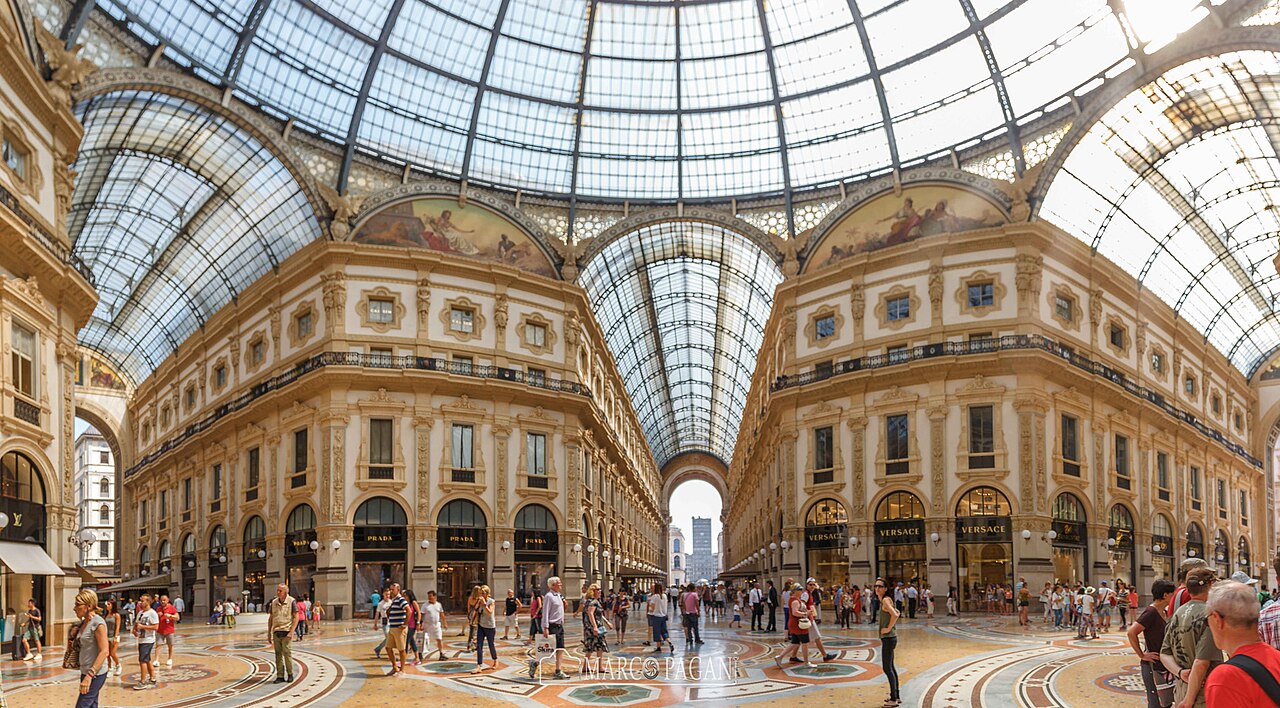
The covered market is one of the oldest and most universal building types. Wherever trade happens in a climate with rain or extreme sun, architecture finds ways to protect it. The problem is simple: buyers and sellers need to gather in the same place, they need to examine and handle goods, and they need to do this in weather that does not cooperate. The architectural solutions to this problem have varied by culture, climate, and available technology across four thousand years of urban history, but they share a common spatial logic: a sheltered passage or hall that concentrates trade, provides protection from the elements, and creates a distinct zone within the city where the rules of commerce apply. From the Grand Bazaar of Istanbul to the Galleria Vittorio Emanuele II in Milan, the covered market is where architecture and economics meet.
The bazaar: a city within a city
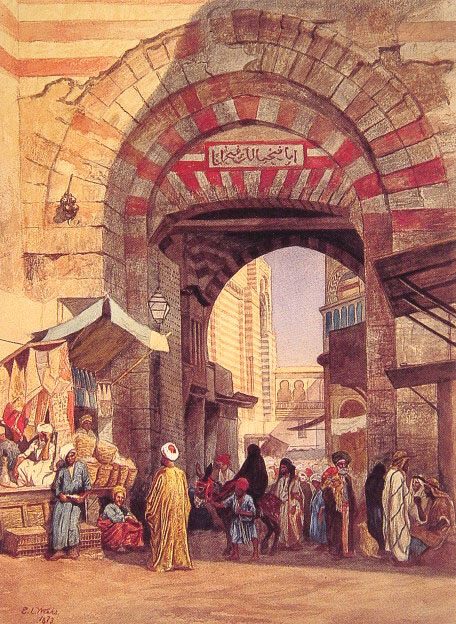
The Islamic bazaar — known variously as bazaar, souq, or çarşı depending on the language and region — represents the most fully developed expression of the covered commercial district as urban form. Where a European market might be a single building or a square, the Islamic bazaar is typically a district of interconnected covered streets, specialized by trade: one street for goldsmiths, another for spice merchants, another for cloth dealers, another for coppersmiths. The sound and smell change as you move from one section to another; the spatial character is that of a network rather than a single hall.
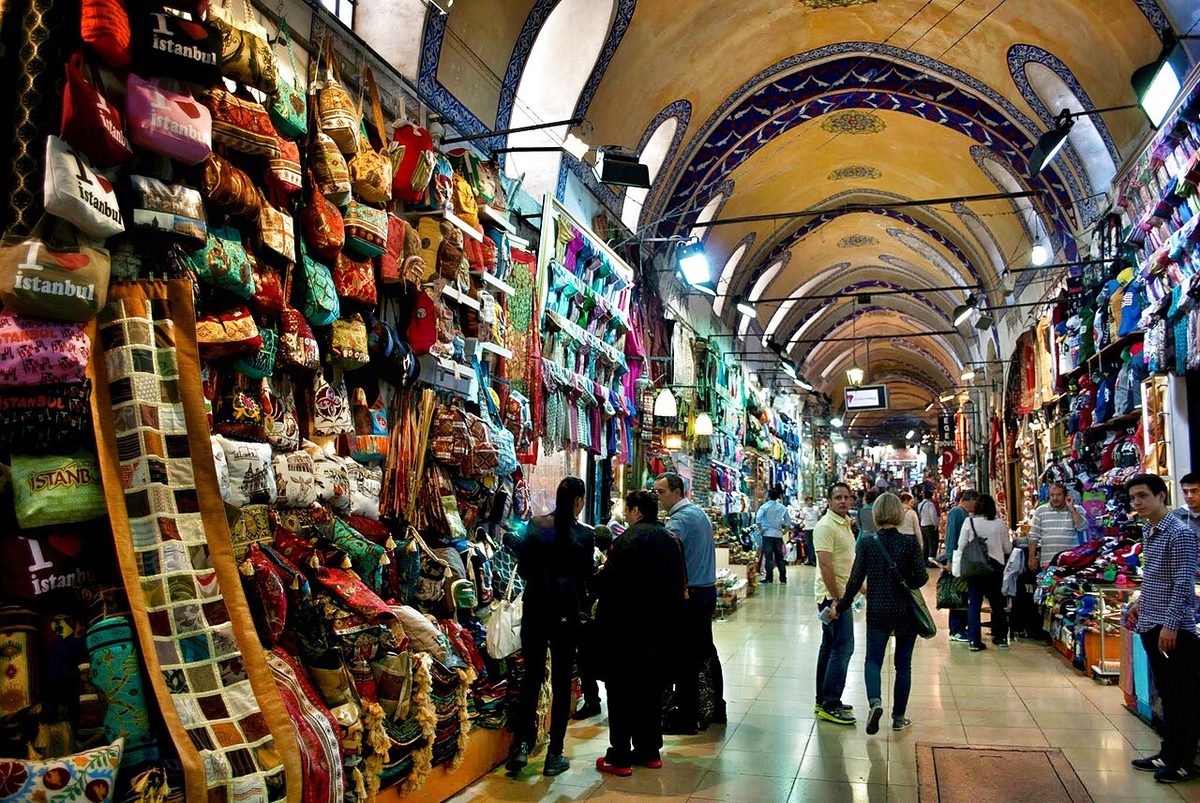
The fundamental unit of the bazaar is the covered street (bazaar khan or simply bazaar): a narrow passage between two rows of small shops, roofed with a masonry vault pierced by small openings that admit shafts of light. These openings — oculi, or small domed skylights called shashahs — serve a dual purpose: they admit daylight into what would otherwise be a dark tunnel, and they allow hot air to rise and escape, creating a natural ventilation system that keeps the bazaar cooler than the street outside even in extreme heat. The masonry construction — thick stone or brick walls, heavy vaults — provides thermal mass that resists both the summer heat and the winter cold, maintaining a relatively stable interior temperature year-round. This is vernacular passive cooling: architecture solving a climate problem without mechanical systems, using only geometry and mass.
The caravanserai and han are the larger institutional elements of the bazaar system. The caravanserai is a way-station on the trade route: a courtyard building providing shelter for merchants, their animals, and their goods, typically at a day's journey from the next caravanserai along a major road. The han is the urban equivalent, providing warehouse storage, accommodation, and sometimes workshops for merchants operating in a particular city. The bedesten — a covered, lockable hall for the storage and sale of the most valuable goods (jewelry, textiles, metalwork) — is the innermost, most secure element of the bazaar, typically located at its geographic center and distinguished by heavier construction and more elaborate architectural treatment than the surrounding covered streets.
The Grand Bazaar of Istanbul (Kapalıçarşı, or Covered Bazaar) is the most complete and most visited example of the fully developed Ottoman bazaar. It was established immediately after the Ottoman conquest of Constantinople in 1453 and has been continuously in operation since then, making it one of the oldest covered markets in the world still functioning in its original purpose. The bazaar now covers approximately 30,000 square meters, contains over 4,000 shops, and is organized around two bedestens — the Iç Bedesten (Old Bazaar) and the Sandal Bedesteni — with a network of covered streets radiating outward. The bazaar is not a single designed object but an accumulated urban structure that has grown, been damaged by fire and earthquake, and been rebuilt repeatedly over five and a half centuries, retaining the same spatial logic — covered streets, specialized trade districts, secure central storage — throughout.
The Roman forum and medieval market hall
The ancient Roman city had its own solution to the problem of protected trade. The macellum was a covered market building, typically organized around a central colonnaded courtyard with shops arranged on the perimeter and a circular or octagonal central structure (the tholos) used for the sale of fish or meat. The macellum was a standard element of Roman urban planning, appearing in cities across the empire from Britain to North Africa. It provided protection from weather, concentrated the food trade in a single location that could be regulated and taxed, and gave the commercial zone architectural dignity — the same stone columns and tiled roofs that characterized the forum and the basilica were applied to the market.
The Roman basilica was not originally a church — the word means a large hypostyle hall, and the building type was used for commerce, law courts, and public assembly. The basilica plan — a wide central nave flanked by lower side aisles, lit by clerestory windows above the nave roof — was well suited to covered market use and was adapted for this purpose in many medieval European cities. The medieval market hall, as it developed in northern Europe from the 12th century onward, typically took the form of a large rectangular hall with an open ground floor (for market stalls) and an upper floor (for storage or administrative uses), built of timber or stone depending on local resources. The cloth halls of Flemish and English towns — Bruges, Ghent, Ypres, Leeds — are the grandest surviving examples: enormous masonry buildings whose scale reflects the commercial importance of the wool and cloth trade in medieval northern Europe.
The 19th-century shopping arcade
The shopping arcade as a distinct building type was a 19th-century invention, and its invention was made possible by two technical developments: plate glass (which allowed large, transparent shop windows) and cast iron (which could span wide openings without the massive masonry required by traditional construction). The combination of these two materials with the barrel-vaulted glass roof produced a building type that was at once sheltered street, luxury retail environment, and urban spectacle.
The earliest and most influential arcades were built in Paris in the first decades of the 19th century. The Galerie Vivienne (1823) and the Galerie Colbert (also 1823) are among the best-preserved: narrow passages with mosaic tile floors, iron-framed glass roofs that admit natural light, and shops on both sides whose large plate-glass windows display goods in a manner impossible in a conventional street shop. The arcade solved several urban problems simultaneously: it provided a weather-protected pedestrian route through the dense urban fabric of central Paris; it created a prestigious retail environment where luxury goods could be displayed and sold in conditions of cleanliness and protection; and it generated income for the investors who developed the land between two streets into a roofed passage.
Walter Benjamin, in his unfinished Arcades Project, described the 19th-century Paris arcades as the ur-form of consumer capitalism: spaces where the fantasy of commodity display was first fully developed, where the act of looking at goods for sale became a form of entertainment in itself, detached from the practical necessity of purchase. The arcade pedestrian does not need to buy anything; the pleasure is in the looking, in the display, in the social theater of seeing and being seen in a prestigious commercial environment. This logic — shopping as leisure, as spectacle, as identity performance — is so familiar in contemporary retail that it is difficult to recover the sense in which it was genuinely new in 1820.
The Burlington Arcade in London (1819) is the oldest surviving shopping arcade in England and one of the oldest in the world. Its distinctive feature is the presence of the Beadles — uniformed guards employed by the arcade to maintain standards of behavior — who have been a continuous institution since the arcade opened. Running, singing, whistling, and carrying open umbrellas have all been prohibited in the arcade at various times; the Beadles embody the idea that a luxury retail environment requires not just architectural shelter but social regulation. The Burlington Arcade is a private street, a piece of urban infrastructure that operates under its own rules within the public city.
The covered market hall
Alongside the luxury shopping arcade, the 19th century produced a parallel building type: the large-scale covered market hall for wholesale and retail food trade. Where the arcade served the middle class and wealthy with luxury goods, the market hall served the general population with fresh food, fish, and meat. The architectural ambitions were different — the market hall was civic rather than commercial in character, a piece of public infrastructure rather than a private investment — but the technical solutions were similar: iron structure, glass roof, natural top-light, large unobstructed interior space.
Billingsgate Fish Market in London (Sir Horace Jones, 1875) is one of the most important surviving examples of the Victorian market hall in England. The building has a cast-iron structure supporting a glass and slate roof, with an upper fish market hall that could accommodate hundreds of traders. It operated as a working fish market until 1982, when the trade relocated to a new site in Docklands; the building is now used as a financial events venue, and its iron structure and market hall proportions remain intact. Les Halles in Paris (Victor Baltard, begun 1853) was the most celebrated example of the type — twelve iron-and-glass pavilions covering the central market of Paris — but was demolished in 1971 in one of the most controversial acts of architectural destruction in modern France, replaced by a subterranean shopping center that has never achieved the urban vitality of the original.
The Bon Marché in Paris (1852, with major extensions by Louis-Charles Boileau and Gustave Eiffel in the 1870s) represents the next evolutionary step: the department store, which internalized the entire retail environment within a single building organized around a central atrium. The Bon Marché was the first true department store in the world — a self-contained shopping universe organized by departments, with fixed prices (rather than negotiation), a returns policy, and a philosophy of bringing all goods under one roof. Émile Zola visited it researching his novel Au Bonheur des Dames (1883) and described it as a cathedral of commerce: the iron and glass atrium, the cascading escalators, the departments as chapels in the arms of the plan, the crowds of shoppers as a kind of congregation.
Modern market revivals
The late 20th and early 21st centuries saw a significant revival of interest in covered market buildings, partly as a reaction against the out-of-town shopping center and the enclosed mall, and partly as a response to the growing interest in fresh, local, and artisanal food. Markets like Borough Market in London — originally a medieval market, revived and expanded in the 1990s and 2000s into a major food destination under a Victorian railway viaduct — represent a hybrid: a traditional market form given a new cultural identity as a premium food destination. The railway arches provide the shelter that a glass roof once provided in the 19th-century arcade; the iron structure of the Victorian railway infrastructure doubles as the market's ceiling.
Torvehallerne in Copenhagen (2011, Lundhagem and Arkitema) is a purpose-built contemporary covered market: two glass-and-steel pavilions on Israels Plads, providing a sheltered environment for food stalls and specialty retailers. The design is deliberately transparent — the glass walls dissolve the boundary between inside and outside — and the two pavilions are separated by an open plaza, so that the market also works as an outdoor space in summer. Torvehallerne has been widely cited as a model for how a contemporary covered market can be designed for a northern European climate without either replicating Victorian historicism or abandoning the quality of the enclosed environment.
Regional Variations
The Middle Eastern and South Asian bazaar tradition continues in cities that have not been extensively rebuilt by Western-style urban planning. The bazaars of Isfahan, Tehran, Aleppo (before its partial destruction in the Syrian civil war), and Marrakech preserve the spatial logic of covered streets, specialized trade districts, and thermal mass construction that characterized the Islamic market from the medieval period onward. These are not tourist attractions but working commercial districts — though tourism has superimposed a second economy on top of the original trade in many cities. The bazaar of Isfahan, connecting the Maidan Imam (Royal Square) with the Friday Mosque and the residential neighborhoods to the north, is approximately 3 kilometers long and is still in daily use by local residents for ordinary shopping as well as by tourists for craft goods.
The northern European covered market hall tradition is most fully preserved in the Netherlands, Belgium, and Britain. Rotterdam's Markthal (MVRDV, 2014) is a spectacular recent addition to this tradition: a horseshoe-shaped residential and commercial building whose interior surface is covered with a vast mural of fruit, vegetables, and flowers, creating a contemporary equivalent of the decorated interior that the Victorian market hall achieved through iron structure and glass light. The building is entirely new in its technology and its program — apartments above the market, rather than storage or offices — but it is recognizably in the tradition of the large-scale covered market hall as civic institution.
In North America, the covered market tradition took a different form. The great Victorian market halls — Quincy Market in Boston (1826), Reading Terminal Market in Philadelphia (1893), Pike Place Market in Seattle (1907) — survived the 20th century largely by accident: their demolition was proposed and opposed at various times, and they survived because communities organized to save them. They are now among the most-visited public spaces in their respective cities, functioning simultaneously as working food markets and as tourist destinations, a dual function that creates tension between the two constituencies but has generally kept the buildings alive and economically viable in ways that purely historical preservation might not have achieved.
The Italian galleria — the grandest expression of the 19th-century covered arcade — is a specifically Italian building type, produced by the ambitions of the newly unified Italian state and the wealth of its industrial cities. The gallerias of Milan, Naples, Turin, and Genoa are typically organized on a cruciform plan (two intersecting arcades) with a glass dome at the crossing, creating a spatial climax at the point of intersection. This plan is derived from the basilica tradition — the crossing of nave and transept — and applies it to a secular commercial program. The effect is monumental in a way that the linear French arcade is not: the galleria reads as a public building, comparable in ambition if not in function to a railway station or a government palace.
Key Identifiers: Markets, Bazaars, and Arcades
- Barrel-vaulted glass roof — a curved glass ceiling spanning the width of the passage or hall, admitting natural light from above while providing weather protection
- Iron or steel column arcade — a regular rhythm of slender metal columns supporting the roof structure, distinguishing 19th-century iron-and-glass construction from masonry market halls
- Bilateral plan — retail units or market stalls arranged symmetrically on both sides of a central passage, with the circulation in the center and the goods on the edges
- Natural top-light — light entering from above (through glass roof, oculi, or domed skylights) rather than from side windows; the defining spatial characteristic of the covered market type
- Mosaic or patterned tile floor — a common finish in both the 19th-century arcade and the Islamic bazaar, durable underfoot and visually distinctive
- Domed crossing — in cruciform gallerias, the glass dome at the intersection of the two arcades marks the center of the building and provides the spatial climax
- Covered street rather than room — the spatial experience is that of an interior street, with the character of an outdoor market translated into an enclosed environment
- Masonry vault with light oculi — in Islamic bazaars, the vaulted masonry roof with small circular openings admitting shafts of light is the distinctive overhead treatment
A Closer Look: Galleria Vittorio Emanuele II, Milan
The Galleria Vittorio Emanuele II in Milan (Giuseppe Mengoni, begun 1865, inaugurated 1877) is the most monumental surviving example of the 19th-century covered arcade, and one of the most spectacular interior spaces in Europe. It was conceived as part of a comprehensive urban improvement of central Milan: a covered pedestrian connection between the Piazza del Duomo and the Piazza della Scala, running through the center of the block that separated the two great public spaces. The project was commissioned by the newly unified Italian state and named for Victor Emmanuel II, the first king of unified Italy; the Galleria was intended not merely as a commercial building but as a monument to the new nation.
The plan is cruciform: two glazed arcades intersect at right angles at the center of the block, with shops and restaurants on both levels (ground floor and mezzanine) along both arms. At the crossing, a glass-and-iron dome rises approximately 47 meters above the floor — the highest point of the building and the spatial climax of the crossing. The arms of the arcade are barrel-vaulted in glass and iron, with the vault spring from an elaborate iron cornice that runs along both walls at the mezzanine level. The facades of the buildings flanking the arcade are treated in a rich Renaissance Revival style — stone pilasters, carved ornament, round-headed windows — that gives the interior the character of an outdoor street rather than an enclosed hall. The effect is of a grand urban boulevard that has been roofed over without otherwise being changed.
The floor of the Galleria at the center of the crossing contains one of its most famous features: a circular mosaic of the bull of Turin, symbol of the city, whose testicles are a traditional good-luck charm. The tradition of grinding one's heel into this spot while making a wish is now so firmly established that the mosaic has been replaced multiple times as it wears through. This small ritual is characteristic of the Galleria's peculiar status: it is simultaneously a luxury retail and restaurant environment — Prada, Gucci, Louis Vuitton, and the oldest restaurant in Milan are among the tenants — and a genuinely public space where ordinary Milanese come to meet, drink coffee, and walk through on their way from the Duomo to La Scala. The combination of commercial luxury and civic openness is exactly what the 19th-century covered arcade aspired to, and the Galleria achieves it more completely than almost any other building of its type.
Spotting It in Building Guessr
Covered market buildings and arcades are distinctive in the game because their spatial logic — the bilateral passage, the glass roof, the iron structure — produces images that are immediately recognizable even without external architectural cues. An interior photograph looking down a barrel-vaulted glass passage flanked by shops is almost certainly a 19th-century shopping arcade; the iron columns, the curved glass overhead, and the mosaic or tile floor are all strong identifiers. The cruciform plan with a domed crossing is specific to the Italian galleria tradition: if you see a glass dome visible above the intersection of two glazed passages, you are almost certainly looking at a galleria in an Italian or Italian-influenced city.
Islamic bazaar photographs are equally distinctive but in a completely different register: the masonry vault with small circular light openings, the narrow passage with shops on both sides opening directly onto the street, the absence of iron structure or plate glass, and the warm stone or brick materials all signal the bazaar type. The geographic context provided by visible signs, dress, and street life will usually confirm the identification. The Victorian market hall — iron structure, glass roof, but a wide hall rather than a narrow passage — appears in photographs as a large open space with a regular rhythm of iron columns and a glass ceiling, typically with stall furniture and market activity below. The functional difference from the arcade is in the program (wholesale food rather than luxury retail) and the spatial type (hall rather than passage), but the structural logic is similar.
Spot market buildings and arcades in the Commercial and Civic filters.
Play Building GuessrSources & further reading
Reference material this page draws on, and where to read further. External links open third-party sites.
- Marketplace · Wikipedia
- Bazaar · Wikipedia
- Grand Bazaar, Istanbul · Wikipedia
- Arcade (architecture) · Wikipedia
- Galleria Vittorio Emanuele II · Wikipedia
- Bazaar · Wikipedia