The dome that changed everything
The Renaissance in architecture begins with a specific engineering achievement: Filippo Brunelleschi's dome over the Cathedral of Santa Maria del Fiore in Florence, completed in 1436. The dome had been a problem for over a century — the cathedral was designed with a crossing octagon so large that no one knew how to roof it. The traditional method of Gothic construction required a timber centering, a massive temporary wooden framework to support the masonry dome while it was being built, then removed after completion. The Florence dome was too large for centering to be practical. Brunelleschi solved the problem through a combination of structural invention and geometric precision: a double-shell dome whose inner brick courses were laid in a herringbone pattern that allowed each ring of bricks to lock together without needing temporary support, progressively closing toward the apex without ever requiring a traditional framework.
The structural achievement is extraordinary. The dome rises 114 meters above the floor of the cathedral, spans 45 meters, and was built without steel reinforcement. But the architectural significance is perhaps even greater. The dome is the first large dome built in Europe since the Pantheon in Rome, built over 1,300 years earlier. It demonstrated that the structural knowledge of the Roman world could be recovered and surpassed — that the medieval period had been not a natural evolution but an interruption, and that the ancient traditions could be reactivated. This is the founding idea of the Renaissance.
The word itself — Renaissance, rebirth — is central to understanding the architecture. This was not an attempt to build new kinds of buildings for new needs. It was a conscious program of recovery: recovering the vocabulary, the proportional systems, and the philosophical ideas of Greek and Roman antiquity, which humanist scholars were simultaneously recovering from manuscripts, ruins, and inscriptions. Architecture was one front of a larger intellectual campaign to reconnect with the world before what Renaissance humanists called the "dark ages."
Brunelleschi and the grammar of the new style
Brunelleschi was not only the greatest engineer of his age; he was the inventor of Renaissance architectural language. His buildings in Florence — the Ospedale degli Innocenti (begun 1419), the Old Sacristy of San Lorenzo (1421–28), the Pazzi Chapel (begun c. 1429), and the basilicas of San Lorenzo and Santo Spirito — established the visual vocabulary that defined Renaissance architecture for the next two centuries.
The key elements of the Brunelleschi grammar are few, precise, and endlessly combinable. Round arches replace the pointed Gothic arch everywhere — in colonnades, in windows, in vaults. The round arch is the fundamental signal of Renaissance affiliation; its use declares allegiance to Rome rather than to the medieval tradition. Pilasters — flat pillar-forms embedded in a wall surface — articulate the wall with the vertical rhythm of columns without the structural implications: they divide the facade into a system of bays whose proportions are controlled. Pietra serena (a grey-blue Florentine sandstone) provides the structural articulation — arches, pilasters, cornices — against whitewashed plaster walls, creating a precise linear graphic quality in which the geometry of every element is exactly legible. Rational proportion controls everything: the ratios of height to width, span to column diameter, cornice height to wall height, are all governed by a system of simple whole-number relationships derived from Vitruvius and from the study of Roman ruins.
The Ospedale degli Innocenti, Florence's orphanage, demonstrates all these principles in its nine-bay loggia: round arches spring from slender Corinthian columns in a colonnade of perfect regularity, each bay a square, each arch semicircular, the pilasters behind the columns continuing the vertical rhythm into the wall. The simplicity is deceptive — every element is the product of precise mathematical control. This is the Brunelleschian ideal: architecture as applied mathematics, where the beauty of the building is the beauty of its underlying proportional system made visible.
Leon Battista Alberti and the theoretical foundation
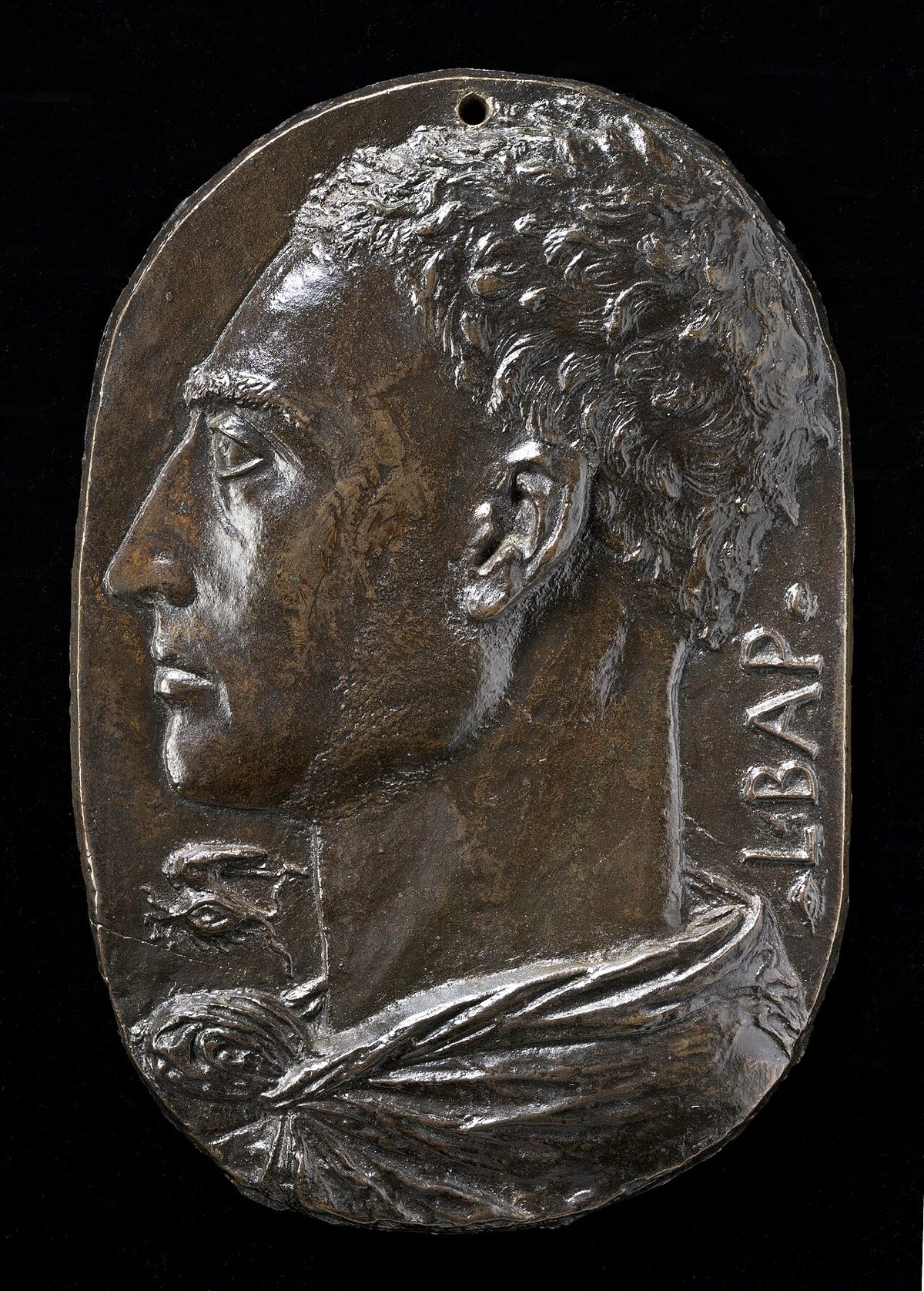
Leon Battista Alberti (1404–1472) was the theorist of the Renaissance, the figure who gave the movement its intellectual foundations and its aspirations. Where Brunelleschi was primarily an engineer and builder, Alberti was a scholar, writer, painter, musician, and architect who approached building as one branch of a comprehensive humanist project. His treatise De re aedificatoria (On the Art of Building, written c. 1450, published 1485) was the first comprehensive architectural treatise since Vitruvius and the founding text of Western architectural theory.
Alberti's treatise restated Vitruvian principles — firmitas, utilitas, venustas (strength, utility, beauty) — and elaborated a complete system for designing buildings of every type: temples, palaces, civic buildings, bridges, harbors. Crucially, it argued that beauty in architecture was not a matter of decoration but of proportion: a building was beautiful when its parts were in the correct mathematical relationships to each other and to the whole, relationships that mirrored the harmonic intervals of music and the proportions of the human body. This idea — that architectural beauty is mathematical, not ornamental — became the central doctrine of the classical tradition and shaped Western architecture until the 20th century.
Alberti's buildings applied his theories to real facades and real structures, not always without difficulty. The Malatesta Temple in Rimini (c. 1450) — a Gothic church clad in a new Roman marble exterior — wrapped an existing medieval building in a classical shell of Roman triumphal-arch motifs, creating an extraordinarily powerful facade that is as much conceptual art as architecture. The Church of Sant'Andrea in Mantua (begun 1472) — the building that Alberti considered his masterpiece — used the Roman triumphal arch as both the exterior entrance motif and the interior structural system, a move of great ingenuity that tied facade and interior into a single unified composition. And the Palazzo Rucellai in Florence (c. 1446–51) — discussed in detail below — applied the classical orders to a domestic facade for the first time in the Renaissance.
High Renaissance: Bramante and the move to Rome
The Early Renaissance was a Florentine affair. The High Renaissance — roughly the first quarter of the 16th century — moved to Rome, drawn by papal patronage and the presence of the ancient ruins. The central figure of the High Renaissance in architecture is Donato Bramante (1444–1514), a painter turned architect who arrived in Rome in 1499 and immediately grasped what the city's ruins represented: not merely sources of decorative vocabulary but evidence of a structural and spatial ambition that no medieval or Early Renaissance building had approached.
Bramante's Tempietto at San Pietro in Montorio, Rome (1502), is the purest realization of Renaissance architectural ideals: a tiny round temple-like structure, peristyled with Doric columns, set on a stepped podium on the supposed site of St. Peter's martyrdom. Every element is derived from Roman precedent — the Doric order, the circular colonnade, the drum and dome — but the synthesis is entirely original. The Tempietto demonstrates that classical architecture is not simply a matter of borrowing elements but of understanding the principles that govern their use and recombining them with confidence. Bramante's building is smaller than most garden gazebos, but it possesses a completeness and authority that makes it one of the most studied buildings in the Western tradition.
Pope Julius II appointed Bramante the architect of the new St. Peter's Basilica in 1505, the most ambitious architectural commission of the Renaissance and the project that would define Roman architecture for over a century. Bramante's plan — a Greek cross with four equal arms and a central dome — was the most ambitious application of centralized Renaissance ideals to a major church, treating the symbolic center of Christianity as a pure geometrical form. Bramante died in 1514 with the foundations barely begun; the building would not be completed until 1626 after designs by Sangallo, Michelangelo, Maderno, and Bernini had each transformed it. But the central crossing dome, as realized by Michelangelo, remains the most influential single architectural element of the Renaissance and the model for domed structures worldwide — the US Capitol, St. Paul's Cathedral, the Pantheon in Paris — for four centuries.
Spread to France, England, and the Low Countries
Renaissance architecture spread northward through different mechanisms in different countries. In France, the Valois kings brought Italian architects and craftsmen with them after their Italian military campaigns; the Chateau de Chambord (begun 1519) demonstrates the hybrid result — a fundamentally medieval castle plan overlaid with Italian Renaissance ornamental vocabulary in a combination that is distinctly French rather than either tradition pure. The French had a taste for profuse roofscape ornament — dormers, chimneys, turrets — that Italian classicism would have found excessive, and the Franco-Italian hybrid of the 16th century reflects this national preference.
England was slower to absorb Renaissance ideas, and the English Renaissance has a particular character. Inigo Jones (1573–1652) was the first English architect to fully internalize Italian Renaissance principles — not the Franco-Italian hybrid of early Tudor decoration, but the disciplined Palladian classicism of Andrea Palladio's Veneto villas. Jones's Queen's House at Greenwich (1616–35) and the Banqueting House in Whitehall (1619–22) are exact transplants of northern Italian Renaissance architecture to English soil — buildings of absolute classical regularity that must have appeared as alien to their contemporaries as Mies van der Rohe's glass-and-steel boxes appeared to post-war Americans. Both buildings were pivotal in establishing the English Baroque and the Palladian revival of the 18th century.
In the Low Countries and Germany, Renaissance architecture arrived through pattern books and the mediation of Flemish architects who adapted Italian ornamental vocabulary to local building traditions. The result was a Northern Renaissance style characterized by stepped and scrolled gables, elaborate window surrounds, and ornament that mixes classical motifs with local craft traditions. The Town Hall of Antwerp (1561–65) is a key example of this transitional Flemish style.
Regional Variations
Italian Renaissance architecture is not a single style but a family of regional approaches united by the commitment to classical vocabulary and proportion. Florentine Renaissance — the style of Brunelleschi and Alberti — is characterized by its restraint and precision: pietra serena structural elements against white plaster, round arches of exact proportional relationships, a deliberate avoidance of excessive ornament. The Florentine palazzo is the definitive expression of this approach: three stories of rusticated stone (the rustication growing finer at each level as the building rises), regular round-arched windows, a heavy projecting cornice, a plan organized around a central cortile with an arcaded ground floor. The Palazzo Medici Riccardi (Michelozzo, begun 1444) and the Palazzo Strozzi (begun 1489) are the canonical examples — buildings of enormous presence achieved through mass and proportion rather than ornament.
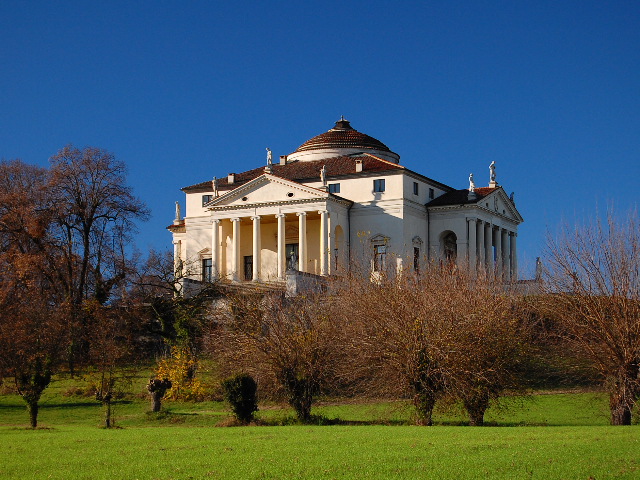
Venetian Renaissance developed along different lines, partly because Venice is Venice: a city built on water, with its own traditions of Byzantine and Gothic ornament and its own relationship to trade, color, and light. The great Venetian architect Jacopo Sansovino (1486–1570) brought Roman High Renaissance vocabulary to the city in buildings of extraordinary richness — the Biblioteca Nazionale Marciana (begun 1537), facing the Doge's Palace, uses the Roman triumphal arch system in a two-story facade of great spatial depth and ornamental richness that mediates elegantly between the classical rigor of Rome and the Gothic and Byzantine richness of Venice. Andrea Palladio (1508–1580), working in Vicenza and the Veneto, created a variant of the High Renaissance style that was simultaneously the most rigorous application of Vitruvian principles and the most widely influential: his villas — Villa Rotonda, Villa Barbaro, Villa Foscari — established a domestic architecture of symmetrical facades with temple-front porticoes that became the model for country houses throughout England, Ireland, and America.
The Spanish Renaissance — known as Plateresque in its early phase — retained a Gothic structural tradition while applying Italian Renaissance ornamental vocabulary to facades with an exuberance that Italian architects would have found excessive. The name comes from platero (silversmith): the carved stone detail is so fine and so dense that it resembles metalwork rather than masonry. The facade of the University of Salamanca (c. 1515–30) is the canonical example, its surface covered with a dense carpet of carved medallions, heraldic devices, figures, and foliage organized in panels that have no structural relationship to the building behind them. Later Spanish Renaissance — the Herrerian style, named after Juan de Herrera, architect of El Escorial (begun 1563) — swung to the opposite extreme: a style of almost brutal severity, bare stone, unornamental facades, flat surfaces broken only by the geometric rhythm of windows and the profile of the slate roofs. El Escorial, the palace-monastery of Philip II, is the most extreme example: a building of 300,000 square meters of floor area, housing a palace, a monastery, a basilica, a library, and a royal mausoleum, all in a language of such disciplined austerity that it has been described as the first modern building.
Northern European Renaissance architecture — in Germany, the Low Countries, England, and Scandinavia — developed through the mediation of pattern books rather than direct contact with Italian buildings or architects. This produced a characteristic hybrid: classical ornamental vocabulary (pilasters, columns, entablatures, rustication, classical pediments) applied to building types and structural traditions that remained fundamentally Gothic or medieval. The stepped and scrolled gable — an ornamental top edge to a building facade created by stepping the masonry up in stages, each step decorated with scrolls, pilasters, and obelisks — is the most characteristic element of Northern European Renaissance. It appears on guild halls, town halls, merchant houses, and churches across the Netherlands, northern Germany, Denmark, and England from roughly 1550 to 1650, creating a distinctive regional style that is recognizably classicizing without being Italian.
Key Identifiers: Renaissance Architecture
- Round arches: the semicircular arch, derived from Roman architecture, replaces the pointed Gothic arch in colonnades, windows, vaults, and doorways — the single most reliable identifier of Renaissance affiliation
- Pilasters: flat, rectangular pillar-forms embedded in a wall surface, articulating the facade with the vertical rhythm of columns without projecting from the wall — characteristically used in superimposed orders (Doric below, Ionic above, Corinthian at the top)
- Rusticated base: the ground story built of large, rough-faced stone blocks with deeply recessed joints, creating a visual base of solidity and weight that lightens as the building rises through more refined masonry at upper levels
- Piano nobile: the principal floor, raised above a basement or ground level, with the tallest and most elaborately fenestrated windows — the visual center of gravity of the facade
- Loggia: an open arcaded gallery at ground or piano nobile level, giving covered outdoor space while maintaining the classical arcade rhythm on the exterior
- Balustrade: a parapet formed of closely spaced balusters (vase-shaped turned-stone or stucco uprights) supporting a handrail, used at roof level, on staircases, and on balcony edges
- Coffered ceiling: a ceiling decorated with a grid of sunken panels (coffers), derived from the Pantheon and other Roman vaulted structures — used on flat timber ceilings as well as stone vaults
- Bilateral symmetry: the facade divided by a central axis with identical elements on each side — a fundamental Vitruvian principle that distinguishes Renaissance design from medieval asymmetry
- Vitruvian proportions: the height, width, and depth of all major elements governed by simple whole-number ratios — 1:1, 1:2, 2:3 — creating a visual harmony derived from the proportional system of the human body
- Temple-front portico: in High Renaissance and Palladian work, a full-height classical temple facade — pediment, columns, entablature — applied to the entrance of a church or villa, signaling the sacred or civic importance of the building
A Closer Look: Palazzo Rucellai, Florence
The Palazzo Rucellai in Florence (Leon Battista Alberti, c. 1446–51) is the building that solved one of the fundamental problems of Renaissance domestic architecture: how to apply the classical orders — developed for columns and temples — to the flat wall of a private palace facade. It was the first time in the Renaissance that this had been done, and Alberti's solution was elegant enough to become the template for classical palace facades for five centuries.
The problem was this: the classical orders (Doric, Ionic, Corinthian) are systems for designing columns, capitals, entablatures, and the proportional relationships between them. They were developed for free-standing colonnaded structures — temples and basilicas — where columns actually support the roof. A palace does not have columns on its facade; it has a solid wall with windows. How do you apply the vocabulary of a columnar system to a non-columnar wall? Alberti's answer was pilasters — the flat, engaged half-columns embedded in the wall surface — and a careful system of entablatures that divide the three stories of the facade horizontally, each story using a different order as the Roman Colosseum does (Doric below, Ionic above, Corinthian at the top), creating a vertical hierarchy of ornamental richness that mirrors the structural logic of the classical temple without requiring actual columns.
The result is a facade of great precision and elegance: eight bays of pilastered wall, each bay a round-arched window framed by flat pilasters, the whole divided into three horizontal zones by entablatures whose profiles are exact reproductions of classical Roman moldings. Every detail is derived from study of ancient Roman buildings — Alberti was one of the great antiquarian scholars of his generation and had measured Roman ruins extensively. But the synthesis is entirely original. No Roman building looks like the Palazzo Rucellai; the building is not a copy of antiquity but a new classical language invented from ancient principles. This distinction — between copying and creating from classical principles — is the defining achievement of Renaissance architecture and the source of its enduring influence.
The Palazzo Rucellai had immediate influence. The Rucellai family were one of the great merchant dynasties of Florence, and their palace was widely visited and discussed. Within a generation, virtually every major Florentine palace was using pilasters and superimposed orders on its facade. By the end of the 15th century, the vocabulary had spread to Rome, then to Venice, then progressively northward across Europe. The combination of pilasters, entablatures, round-arched windows, and rusticated base that Alberti invented at the Palazzo Rucellai became so standard that it effectively defines what a classical building looks like to the present day.
Spotting It in Building Guessr
Renaissance buildings are identifiable primarily by their combination of classical vocabulary and formal restraint — they use columns, pilasters, round arches, and pediments, but in a measured, proportional way that is calmer and less dramatic than the Baroque. The single most reliable signal is the round arch: if a building uses semicircular arches for its windows, colonnades, and arcades, and is organized with a clear horizontal hierarchy (rusticated base, piano nobile, attic story), it is almost certainly Renaissance in origin or influence. The absence of Gothic pointed arches and the absence of Baroque curves together narrow the identification considerably.
Geography and building type matter greatly. In Italy — especially Florence, Venice, Mantua, and Urbino — palaces with pilastered facades, rusticated bases, and projecting cornices are likely 15th or early 16th century. In Rome, centrally planned churches with drum-and-dome compositions are likely High Renaissance (c. 1500–1600). In England, buildings with absolutely symmetrical facades, large sash windows, and classical porticoes — particularly country houses — are likely Palladian (17th–18th century), which is a direct descendant of Venetian High Renaissance. The Era filter set to 1400–1600 combined with the Style filter for Renaissance will surface the core examples in Building Guessr.
Can you distinguish a Renaissance palazzo from its Baroque neighbor? The proportions tell the story.
Play Building GuessrFurther Reading
Sources & further reading
Reference material this page draws on, and where to read further. External links open third-party sites.
- Renaissance architecture · Wikipedia
- Filippo Brunelleschi · Wikipedia
- Leon Battista Alberti · Wikipedia
- Andrea Palladio · Wikipedia
- Donato Bramante · Wikipedia
- Florence Cathedral · Wikipedia