The building type that invented itself
The railway station is the building type that most purely expresses the 19th century. No other structure so completely embodies the age that produced it: a structure that had no historical precedent, that demanded new materials and new engineering techniques to exist at all, that was simultaneously a utilitarian machine for the movement of people and goods and one of the most grandly public buildings of its era, and that served as the literal gateway to modernity for hundreds of millions of travelers who passed through it on their first experience of the railway age.
Before the 1830s, there were no railway stations. There was no need for them. The design problem was entirely new: how do you build a structure that can shelter multiple long-distance trains and their passengers simultaneously, provide for the sale of tickets and the storage of luggage, accommodate the departure and arrival of trains on a continuous schedule, and announce to the approaching traveler the civic importance of the town or city that the railway has now connected to the national network? No existing building type answered these questions. The station had to be invented from scratch, and the process of inventing it — over roughly sixty years from the 1830s to the 1890s — produced some of the most technically ambitious and spatially spectacular structures of the 19th century.
The fundamental design problem of the station is actually two separate problems, which were typically solved by two separate structures in the same complex: the shed and the head house. The shed is the engineering problem: a long-span roof structure covering the tracks and platforms, spanning distances of 60, 80, or even 100 meters or more to allow trains to enter, stop, and depart without the passengers having to go outdoors. The head house — also called the station building, the terminus block, or the facade building — is the civic and commercial problem: the public face of the railway company, housing ticketing, waiting rooms, restaurants, luggage storage, and often hotels, and announcing the station's presence to the city through an architecture of appropriate grandeur. The relationship between these two elements — the vast industrial shed behind, the grand classical facade in front — is the compositional challenge that station architects solved in different ways across the 19th and 20th centuries.
The engineering problem: spanning the tracks
The train shed required spans that masonry construction could not achieve without an entirely new structural material. Stone can span perhaps 12–15 meters in an arch before the forces become unmanageable; timber in its natural form can span somewhat further but is limited by the available lengths of timber members; wrought iron, and later steel, can span as far as the engineer's confidence in his calculations allows. The development of the great railway shed is inseparable from the development of structural iron and steel engineering in the 19th century.
The first major train sheds used wrought iron in arched trusses — curved structural frames assembled from many smaller elements — to span widths that would have been impossible with any earlier material. Paddington Station in London (Isambard Kingdom Brunel, with architect Matthew Digby Wyatt, 1854) has three parallel arched spans of 31, 21, and 21 meters, covered in glass between the iron ribs — a train shed of great elegance that uses the material and structural logic of the greenhouse or the Crystal Palace applied to a major urban railway station. Brunel was simultaneously building the Great Western Railway's tracks and bridges, and his shed at Paddington was conceived as a piece of the same engineering enterprise: a structure optimized for its function rather than historicized to look like something else.
The great period of span records came in the 1860s to 1880s, as both iron production and structural engineering theory advanced simultaneously. St. Pancras Station in London (William Henry Barlow, 1868) established a new world record for single-span iron arch construction at its completion: a single barrel vault 74 meters wide and 210 meters long, rising 30 meters at its crown, carried on a row of cast-iron columns at platform level above which wrought-iron arched ribs spring in a continuous curve to the ridge. From inside, the effect is extraordinary: a single vast space of light and air, the arched ribs overhead like the ribcage of some enormous creature, the platforms and tracks spreading out below. The structural ingenuity is equally remarkable: the horizontal thrust of the great arch is resisted not by external buttresses but by the floor structure itself — the platforms are carried on a grid of iron girders braced against the arch bases, making the entire platform floor a continuous horizontal tension member.
Philadelphia's Reading Terminal (1893) and Frankfurt's Hauptbahnhof (1888) pushed the span further: the Frankfurt shed uses three parallel spans of 56 meters each, a total clear width of 170 meters, covered in glass and iron to create what was at the time the largest station in the world by shed area. The competitive dimension of shed engineering in the late 19th century was not incidental: railway companies were in direct competition for passengers, and the impressiveness of the station shed was a direct advertisement for the line and its investment in the passenger experience.
The civic problem: the head house and the Beaux-Arts station
While engineers were competing to span the longest single vault, architects were wrestling with the problem of what the public face of the railway station should look like. The shed solved the engineering problem; the head house had to solve the civic, commercial, and symbolic problem. What architectural language was appropriate for an institution that was simultaneously a public utility, a commercial enterprise, and the primary point of entry for the city?
The answer that the 19th century eventually settled on was: the grandest possible version of whatever historical style was currently fashionable for civic buildings. The result, particularly in the United States and France from about 1870 onward, was the Beaux-Arts station — a building of monumental scale, Roman or Renaissance classical inspiration, and lavish stone ornament, designed to communicate permanence, civic importance, and the transformative power of the railway connection through the most authoritative architectural language available.
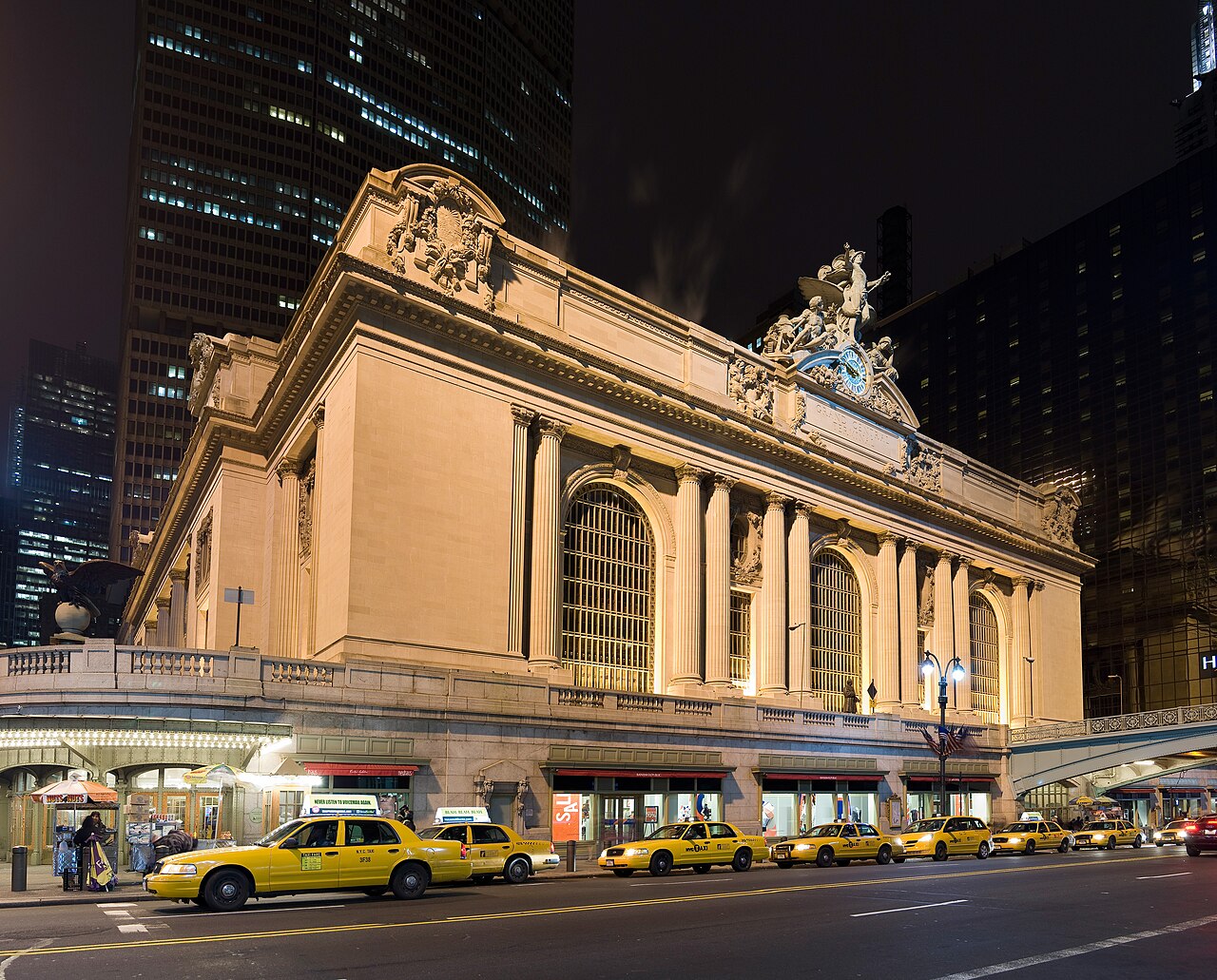
Grand Central Terminal in New York (Reed and Stem, Warren and Wetmore, 1903–13) is the definitive Beaux-Arts station, examined in detail below. Washington Union Station (Daniel Burnham, 1908) applies the same vocabulary — Roman triumphal arch entrance, barrel-vaulted main hall, coffered ceilings, white stone — to the capital of the United States with an explicitly civic purpose: the station is conceived as a gateway to the national capital, and its architecture communicates permanence, authority, and national pride in the same register as the Capitol building it faces. Pennsylvania Station in New York (McKim, Mead and White, 1910) went even further: its main waiting room, modeled on the tepidarium of the Baths of Caracalla in Rome, was the largest interior space in New York City and one of the grandest public interiors in the world. The steel-and-glass train shed behind it spanned eleven tracks and covered an area larger than Madison Square Garden. The demolition of Pennsylvania Station in 1963 to make way for the current Madison Square Garden was one of the most destructive acts of urban redevelopment in American history, and it directly catalyzed the preservation movement that produced New York City's Landmarks Preservation Commission.
In Europe, the Beaux-Arts formula was more varied. French stations — the Gare de Lyon, the Gare du Nord, the Gare de l'Est in Paris — tend toward a style of grand Second Empire classicism: high mansard roofs, elaborate stone facades with arched windows, clock towers, and sculptural allegories of the cities or regions served. The Gare du Nord (Jakob Ignaz Hittorff, 1864) has 23 statues representing the cities of northern France and Europe on its facade — an explicit statement that the railway is not merely transportation but a network connecting the civilization of Europe. German stations of the same period tend toward a more restrained historicism — the Romanesque Revival was a particular German favorite, producing stations whose brick-and-stone facades with round-arched windows and solid towers look simultaneously ancient and authoritative.
Early stations: King's Cross and Paddington
King's Cross Station in London (Lewis Cubitt, 1851–52) is the most architecturally honest of the early great stations: a building whose facade is a direct expression of the two sheds behind it. The main facade consists of two large round-arched windows — one for the departure shed, one for the arrival shed — flanked by an Italianate clock tower. There is no applied ornament, no classical columns, no historical dressing: the facade says, precisely, what is behind it, using the round arch form (borrowed from Roman engineering rather than classical ornament) to express the vaulted sheds in the clearest possible way. King's Cross is the opposite of the Beaux-Arts approach: rather than hiding the industrial shed behind a grand civic facade, Cubitt made the shed itself the facade. John Betjeman, the poet laureate and architectural campaigner, called it "the most beautiful station in the world," and the claim is not absurd.
Paddington Station (Brunel and Wyatt, 1854) takes a middle position: the shed is the dominant experience inside, but the head house — a separate hotel building facing Praed Street, designed by Philip Hardwick in a French Renaissance style — provides the civic face toward the city. This separation of the engineering and the civic functions into two distinct buildings — shed behind, hotel and booking hall in front — was a common approach in British stations of the Victorian era, and produces a characteristic composition that can be identified from the exterior: a relatively plain or modest booking-hall building facing the street, with the ridge of the great shed visible above and behind it.
European station types: the German Hauptbahnhof, the French terminus, the Italian shed
German railway station architecture developed a characteristic formal type — the Hauptbahnhof (main station) — that is distinctive in its urban relationship and its architectural vocabulary. German stations of the 19th century tend to be large, stone-built, and symmetrical, with a monumental central portal flanked by wings and often a prominent clock tower or towers. The planning relationship with the city was frequently more deliberate than in Britain: German planners often placed the Hauptbahnhof at the end of a major urban axis, creating a formal visual relationship between the station facade and the city's main boulevard, so that the station became the terminal point of the urban sequence rather than simply occupying the first available site near the track entry point.
The Frankfurt Hauptbahnhof (1888) is the most impressive of the German Victorian stations: a Romanesque Revival facade of great weight and mass, three central arched portals flanked by towers, the entire composition expressing the permanence and civic authority of the railway. The three shed spans behind it — 56 meters each, the largest station shed in the world at their completion — create a back-of-house industrial reality that is entirely concealed from the street. The contrast between the monumental stone facade and the iron-and-glass industrial structure behind it is the essential tension of the 19th-century station, nowhere more dramatically expressed than here.
French stations — particularly the Parisian termini — developed a characteristic form: the facade pignon (gable facade), where the end wall of the single-span train shed forms the primary public face of the station. The Gare de l'Est (1849, expanded 1931) and the Gare Saint-Lazare are organized on this principle: a single large arched window or rose window in the gable end of the train shed is the central feature of the facade, flanked by the subsidiary buildings of the ticketing hall and station facilities. This arrangement is more honest about the relationship between the shed and the facade than the German approach of hiding the shed behind a separate facade building.
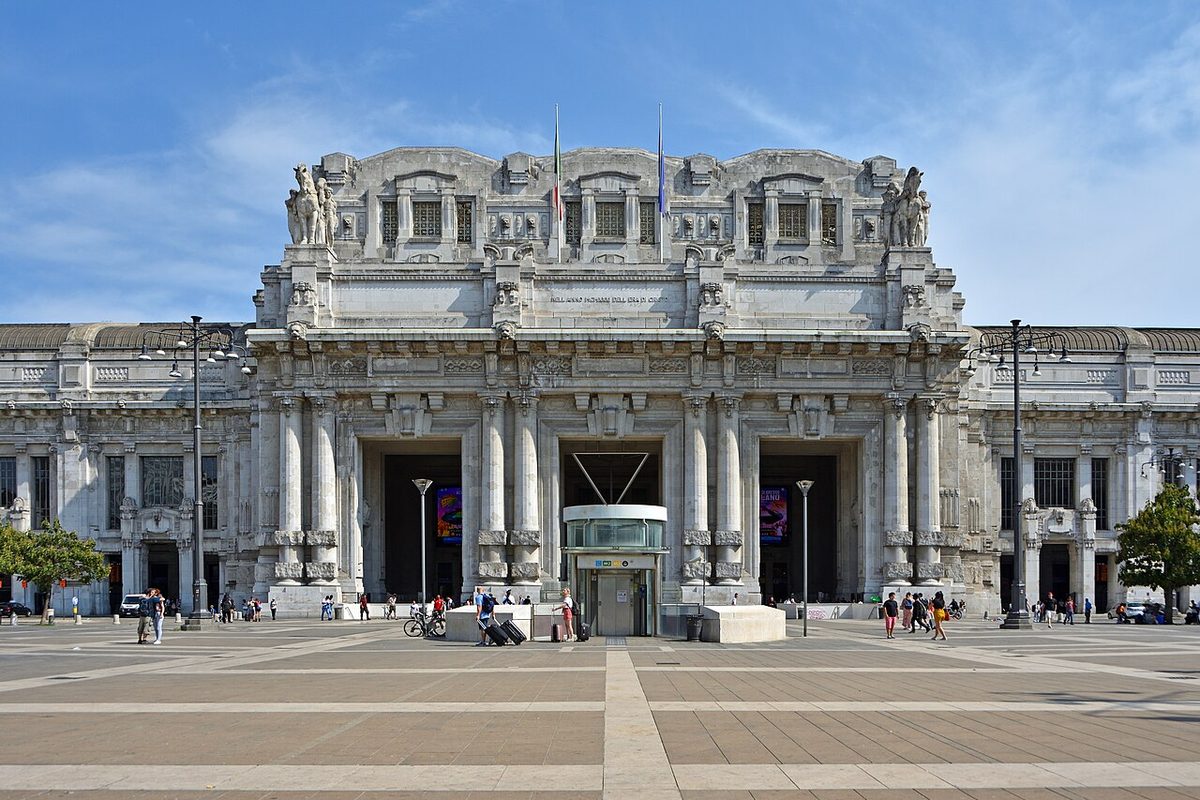
Italian stations of the late 19th and early 20th centuries produced some of the most spectacular glass-and-iron sheds in Europe. Milano Centrale (Ulisse Stacchini, 1906–31) combines a monumental Art Deco facade of extraordinary scale — 36 meters high, 207 meters wide, covered in carved stone ornament — with a series of vast glass-and-iron barrel vaults behind it, each spanning 70 meters. The facade and the shed are conceived as a unified composition: the arched profiles of the shed vaults are visible above the roofline of the facade building, tying the engineering and the civic architecture together. Milano Centrale was built under Mussolini and its scale and rhetoric are explicitly Fascist — the architecture of power applied to transportation infrastructure — but the station is also, despite this, one of the great architectural experiences in Italy: a building whose scale and spatial ambition are genuinely overwhelming.
The 20th-century decline and the Penn Station catastrophe
The mid-20th century was disastrous for railway stations in North America and, to a lesser degree, in Europe. The automobile and the airplane eroded railway traffic from the 1950s onward, and the grand stations of the 19th and early 20th centuries — built to handle passenger volumes that the declining railways could no longer sustain — became financial burdens. The revenue from railway operations was insufficient to maintain large station buildings, and the land on which stations stood — often central urban land of high value — was increasingly attractive to developers for commercial development.
The demolition of Pennsylvania Station in New York (1963–66) was the most consequential of these losses. Penn Station had been financed by the Pennsylvania Railroad, which by the 1950s was losing money and needed to generate revenue from its land holdings. The railroad sold the air rights above the station site to Madison Square Garden Corporation in 1962, and demolition began in 1963. The main waiting room — modeled on the Baths of Caracalla, 180 meters long, 55 meters wide, 45 meters high, one of the greatest public interiors in the Western hemisphere — was demolished in less than two years. "We will probably be judged not by the monuments we build but by those we have destroyed," wrote the architectural critic Ada Louise Huxtable in the New York Times in 1963. The loss of Penn Station directly caused the passage of the New York City Landmarks Preservation Law in 1965, which has since protected hundreds of significant buildings including Grand Central Terminal from a similar fate.
The period from roughly 1950 to 1975 also produced a generation of station replacements that have not aged well. New rail stations of the postwar era were typically designed in an International Style of glass and concrete that was efficient and inexpensive but lacked the spatial generosity and civic ambition of their predecessors. Washington's Union Station was converted to a visitor center and national museum in the 1970s (a use that undermined its railway function) before being restored as a working station in the 1980s. London's Euston Station lost its original Greek Revival propylaea (the "Euston Arch," a massive stone gateway built in 1838) in 1962, demolished to allow station rebuilding that produced one of the most disliked station environments in Britain. The loss of the Euston Arch, like the loss of Penn Station, became a defining moment in the British preservation movement.
Station revival: Calatrava, St. Pancras, and the high-speed rail era
From the 1980s onward, the railway station underwent a remarkable rehabilitation — both literally, as many historic stations were restored, and symbolically, as high-speed rail became the dominant form of intercity travel in Europe and Asia. The restoration of St. Pancras International in London — completed in 2007 as the terminus for Eurostar services through the Channel Tunnel — is the most spectacular example of the restoration approach: Barlow's great iron arch shed, which had been threatened with demolition in the 1960s before being listed as a heritage building through campaigning by John Betjeman, was cleaned, re-glazed, and opened as a combined railway concourse, shopping center, and public space. The adjacent Midland Grand Hotel (Sir George Gilbert Scott, 1873) — a Victorian Gothic extravaganza of red brick, carved stone, and pointed arches — was restored and reopened as a hotel in 2011. The combined complex is now one of the most visited and celebrated buildings in London, a complete reversal of its status in the 1960s when it was widely described as a hideous relic of Victorian excess.
Santiago Calatrava's railway stations of the 1990s and 2000s represent the most distinctive architectural contribution to the station revival: buildings whose structural expressionism — white concrete bones, soaring arched roofs, wings and fins that extend beyond structural necessity into pure formal gesture — creates interiors of unusual spatial drama that recall the great glass-and-iron sheds of the 19th century while being entirely of their own moment. The Liège-Guillemins station in Belgium (2009) is the most admired: a single arched roof of white steel and glass spanning the entire width of the station and the track area, its profile a shallow pointed arch of great elegance, the entire structure rising 35 meters above the platforms. The station is experienced as a single vast covered outdoor space rather than an enclosed building — the light and the view through the glass roof change constantly through the day, creating an atmosphere that is dynamic rather than static. Calatrava's Valencia Estacion del Norte renovation and his stations for the Swiss Federal Railways in Zurich and elsewhere demonstrate the same formal vocabulary applied to different scales and contexts.
Rotterdam Centraal (Benthem Crouwel Architects, 2014) takes a different approach: a station building of angular contemporary form — sloping facades of stainless steel and glass, a roof canopy that extends over the station forecourt, an interior organized as a fluid public space — that is explicitly not historical, not classical, and not Calatravan, but entirely contemporary in its materials and formal logic. It is the best contemporary large station in Europe outside of the high-speed rail termini in Japan and China, where the scale and ambition of new station construction in the 21st century has returned to something approaching the ambition of the 19th century.
Regional Variations
The railway station, as a building type, is intrinsically international — railways spread globally in the 19th century and produced stations in every country on every continent — but regional variations in the architecture of stations are as significant as the universal features that connect them. British railway stations are distinguished by their variety: the British railway system was built by a large number of competing private companies, each with its own architectural preferences and its own traditions. The Great Western Railway's stations, designed under Brunel's direction, tend toward the Italianate: shallow-pitched roofs with broad overhanging eaves, round-arched windows, and a warm domestic character that contrasts with the industrial engineering of the track infrastructure. The Midland Railway's stations, by contrast, are in the Victorian Gothic that George Gilbert Scott applied to St. Pancras: red brick, pointed arches, and an ecclesiastical richness of ornamental detail. The London and North Western Railway favored a Jacobean or Tudor Revival manner. These company-specific traditions mean that knowledgeable travelers could identify their railway company from the station architecture without any signage.
American railway stations followed the Beaux-Arts template with particular consistency in the major terminus cities — New York, Chicago, Washington, Los Angeles, Kansas City — while smaller junction towns and intermediate stations varied widely. The characteristic small-town American station — a single-story frame building with a broad overhanging roof, a covered platform, and a distinctive bay window for the stationmaster's office overlooking the tracks — is an architectural type as recognizable and specific as the Queen Anne or the Craftsman bungalow, and it survives in considerable numbers across the Midwest and Mountain West. Many of these small stations were built from standard company plans, making them recognizable as products of a specific railroad regardless of their town or state.
Japanese railway station architecture has developed in two distinct directions since the Meiji period. The historic stations of the late 19th and early 20th century — Tokyo Station (Kingo Tatsuno, 1914) is the most famous — applied European Beaux-Arts and Renaissance vocabularies to Japanese conditions: a long brick facade of Dutch Renaissance character, with two symmetrical brick towers flanking the central entrance, that was the most ambitious European-style building in Japan at its completion. The postwar and contemporary Japanese station is a very different thing: a multi-level commercial complex organized around rail interchange, integrating railway, subway, and bus terminals with department stores, restaurants, hotels, and public space in a density of program and a complexity of circulation that has no Western equivalent. The Osaka Umeda and Shinjuku station complexes in Tokyo are the most extreme examples: buildings with hundreds of exits serving tens of millions of passengers per day, their internal geography so complex that navigation aids and specialist smartphone apps are provided as a matter of course.
In India, the railway station is one of the most important civic building types, both because the British colonial railway system produced some of the grandest Victorian stations outside Europe — Chhatrapati Shivaji Maharaj Terminus in Mumbai (Frederick William Stevens, 1888), a Victorian Gothic masterpiece now a UNESCO World Heritage Site, is the canonical example — and because railway travel remains the primary mode of long-distance travel for the majority of the Indian population. Indian stations are typically large, dense, and intensely social: places where travelers may wait for many hours or days, where food vendors, porters, ticket agents, and sleeping passengers coexist in a managed intensity of use that European stations, designed for a more time-efficient passenger flow, do not accommodate. The architecture of the major Indian stations reflects this: waiting halls of great size, covered platforms of considerable length, and a spatial generosity that anticipates extended occupation rather than rapid passage.
Key Identifiers: Railway Station Architecture
- Large arched glass-and-iron train shed: the defining engineering element — a long-span barrel vault or series of parallel arches in iron or steel, filled with glass, covering the tracks and platforms; no other building type uses this combination of elements at this scale
- Classical head house facade: a grand stone or brick facade in a historical style (Beaux-Arts, Renaissance, Romanesque, Gothic Revival) facing the city, often entirely different in character from the industrial shed behind it
- Clock tower: a prominent clock visible from the city approaches, confirming the station's role as a time-keeping institution and a civic landmark — clocks on station facades and towers are among the most recognizable features of 19th-century station design
- Grand booking hall or concourse: a large public interior for ticketing and passenger flow, often the most spatially impressive element of the station — coffered ceilings, marble floors, and monumental arched windows are characteristic features
- Barrel vault over the main hall: in stations without a separate booking hall, the main public space is often covered with a glass barrel vault — a smaller-scale version of the train shed roof applied to the public interior
- Terminus vs. through station plan: terminus stations (where trains reverse direction) have a characteristic arrangement — tracks running into a head house in a dead-end configuration; through stations have platforms on both sides and no head house directly facing the tracks
- Paired entrance arches: in Beaux-Arts stations, the main facade frequently uses paired arched openings — for arrivals and departures — flanked by ornamental towers, creating a triumphal arch compositional logic
- Platform canopy: the covered platform — a slender iron structure supporting a glass or corrugated-iron roof over the platform but not the tracks — is a standard feature of medium-sized stations that could not justify a full iron shed
A Closer Look: Grand Central Terminal, New York
Grand Central Terminal in New York City (Reed and Stem, Warren and Wetmore, completed 1913) is the most celebrated railway station in the world and one of the most visited buildings in the United States. Unlike Penn Station, which was demolished, Grand Central survived — through a combination of its own architectural quality, the advocacy of Jackie Kennedy and the Municipal Art Society in the 1970s, and a landmark Supreme Court ruling (Penn Central Transportation Co. v. New York City, 1978) that established the constitutionality of New York City's landmarks law. The station's survival and continued use as a working commuter rail terminal, public market, and tourist destination makes it the best existing demonstration of what the great Beaux-Arts stations intended to be.
The genius of Grand Central's planning is its management of levels. The station is organized on three levels: the main concourse level, the lower concourse, and the train platforms below both. These levels are connected by a system of ramps — not stairs — that allow the continuous flow of large crowds in both directions simultaneously. The ramp is a piece of transportation engineering: it is faster to negotiate than stairs for most people, it can handle larger crowds per unit of width, and it allows passengers to maintain a steady walking pace rather than stopping and starting at each step. The ramps at Grand Central are wide, gently sloping, and paneled in cream-colored Tennessee marble — beautiful ramps that are also perfectly functional ramps, the two qualities inseparable.
The main concourse — 76 meters long, 37 meters wide, and 38 meters tall — is the heart of the station and one of the great public spaces in American architecture. Its barrel-vaulted ceiling, painted with a representation of the winter sky constellations in gold on a cerulean blue ground, defines the space as something more than a transportation facility: it is a public room of genuine grandeur, a room that tells travelers that they are in one of the great cities of the world and that the infrastructure of that city was designed with care for the experience of its users. The celestial ceiling — based on a medieval manuscript illumination of the Mediterranean constellations — was repainted in 1944 and restored to its original colors (which had turned black from cigarette smoke over decades) in 1998. Three vast arched windows at the south end of the concourse, 23 meters tall, admit light that changes with the season and the hour of day, making the room never the same twice.
Grand Central is also a masterpiece of urban infrastructure integration. The terminal sits at the intersection of Park Avenue and 42nd Street in Midtown Manhattan, and the building is organized so that the surrounding streets remain passable: Park Avenue passes through the building via a viaduct that loops around the station's perimeter, connecting the blocks to the north and south without interruption. The station is the terminus not only of the Metro-North commuter rail system but of a subsurface pedestrian network that connects to dozens of surrounding office buildings, hotels, and subway stations without requiring passengers to go above ground. On a cold or wet day, it is possible to travel from multiple Midtown office buildings to the station platform entirely underground — a convenience that is entirely invisible to most users and that represents an extraordinary level of urban planning investment.
Spotting It in Building Guessr
Railway stations are among the most identifiable building types in Building Guessr because their combination of features — the large arched glass-and-iron shed roof, the classical head house facade, the clock tower, the grand booking hall — is almost never found in any other building type at this scale. The train shed roof is the single most distinctive element: a curved or pointed barrel vault in iron and glass, spanning 50–100 meters, rising above surrounding buildings, is immediately recognizable as a station shed even in a photograph that does not show the full building. If you can see a large glass-and-iron arch structure in a photograph, it is almost certainly a station (or possibly a covered market or a greenhouse, but the scale and the track-level platforms visible at the base will confirm the identification).
The Era filter is highly useful for stations. The great glass-and-iron sheds were built between roughly 1850 and 1920 — the Industrial Age and early Modern period. Beaux-Arts station facades from the same period will have the classical ornament and grand hall interiors described above. Stations from the post-1950 period tend to have the restrained concrete-and-glass language of International Style modernism, or — in the case of the post-1990 revival stations — the structural expressionism of Calatrava or the angular contemporary forms of Rotterdam Centraal. A station building in pure International Style concrete is likely 1960–1980; a station in dramatic white structural steel and glass curves is likely 1990–2020. The country filter helps narrow further: British stations have distinctive Victorian brick and iron vocabulary; French stations have the Second Empire mansard and facade pignon type; German stations have Romanesque Revival stone and brick; American Beaux-Arts stations are enormous, marble-faced, and Roman in their formal vocabulary.
How quickly can you place a Beaux-Arts booking hall or a Victorian iron shed? The clock is ticking.
Play Building GuessrFurther Reading
Sources & further reading
Reference material this page draws on, and where to read further. External links open third-party sites.
- Train station · Wikipedia
- Grand Central Terminal · Wikipedia
- St Pancras railway station · Wikipedia
- Beaux-Arts architecture · Wikipedia
- Gare du Nord · Wikipedia
- Chhatrapati Shivaji Terminus · Wikipedia
- World Heritage listing: Chhatrapati Shivaji Terminus · UNESCO World Heritage Centre