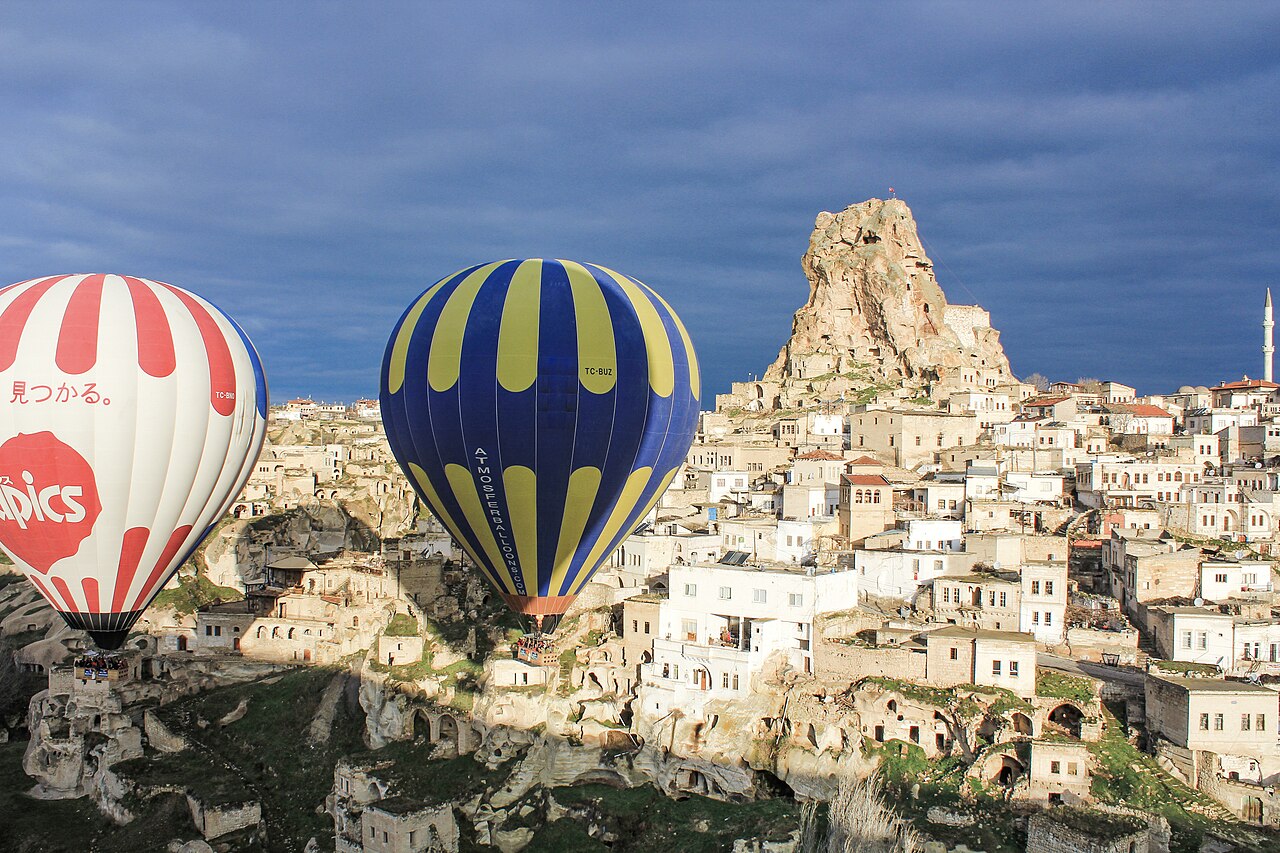
Building underground solves problems that surface architecture cannot: extreme temperature regulation, defense from attack, concealment, and the simple fact that in some landscapes, the best building material is already in place. Rock does not need to be quarried and transported; it is already where you want the building to be. You remove material rather than adding it. The result is a structure that in some cases has survived for thousands of years with minimal maintenance, because the geology itself is the building. Underground architecture is the oldest, most widespread, and most durable building tradition in human history — and it is undergoing a revival in contemporary design as architects grapple with the thermal efficiency and landscape sensitivity that subterranean construction makes possible.
Prehistoric and Ancient Cave Dwellings
The earliest human use of rock as architecture was not construction but modification: natural caves were adapted, their openings shaped, their interiors divided and decorated. The caves at Altamira in Spain and Lascaux in France, painted between 10,000 and 20,000 years ago, are not architecture in the designed sense — they are natural cavities used as ceremonial spaces. But the progression from using natural caves to carving new spaces in rock is a short conceptual step, and it was taken independently on every inhabited continent.
The Mesa Verde cliff dwellings in Colorado, built by the Ancestral Puebloans between approximately 600 and 1300 CE, are among the most dramatic examples of cliff-face architecture anywhere in the world. The dwellings are built not by digging into the cliff but by constructing stone buildings within natural alcoves eroded into the sandstone canyon walls. Cliff Palace, the largest of these complexes, contains 150 rooms and 23 kivas (ceremonial chambers) and housed an estimated 100 people at its peak. The alcove provides natural protection from weather, maintains a relatively stable internal temperature (the overhanging cliff blocks the high summer sun while allowing the low winter sun to penetrate), and makes the complex accessible only from below via handholds cut into the rock face — a natural defensive advantage. The result is a community of stone-built rooms that reads from the canyon floor as a series of golden stone facades set within a natural arch of overhanging rock, an effect so striking that the image has become one of the defining symbols of Native American architecture.
In the cliff-carved tradition of the American Southwest, the architecture is both natural (the alcove) and constructed (the stone buildings within it). In other traditions, the rock itself becomes all the walls, floors, and ceilings, with human intervention consisting entirely of removal: carving away the stone to create the spaces needed. This is rock-cut architecture, and it has been practiced from Ethiopia to India to Jordan with results of extraordinary sophistication.
The Cappadocia Cave Cities
The volcanic landscape of central Anatolia — modern Turkey — produced one of the most remarkable architectural traditions in the world. The tufa rock of Cappadocia, formed by ancient volcanic eruptions, is soft enough to carve with hand tools but hard enough to be structurally stable once exposed to air. Over millennia, the inhabitants of the region carved houses, churches, monasteries, and entire underground cities into this rock. The result is a landscape that looks, from above, like any other — rolling fields and scattered rock formations — but conceals, beneath it, an extraordinarily dense human habitation.
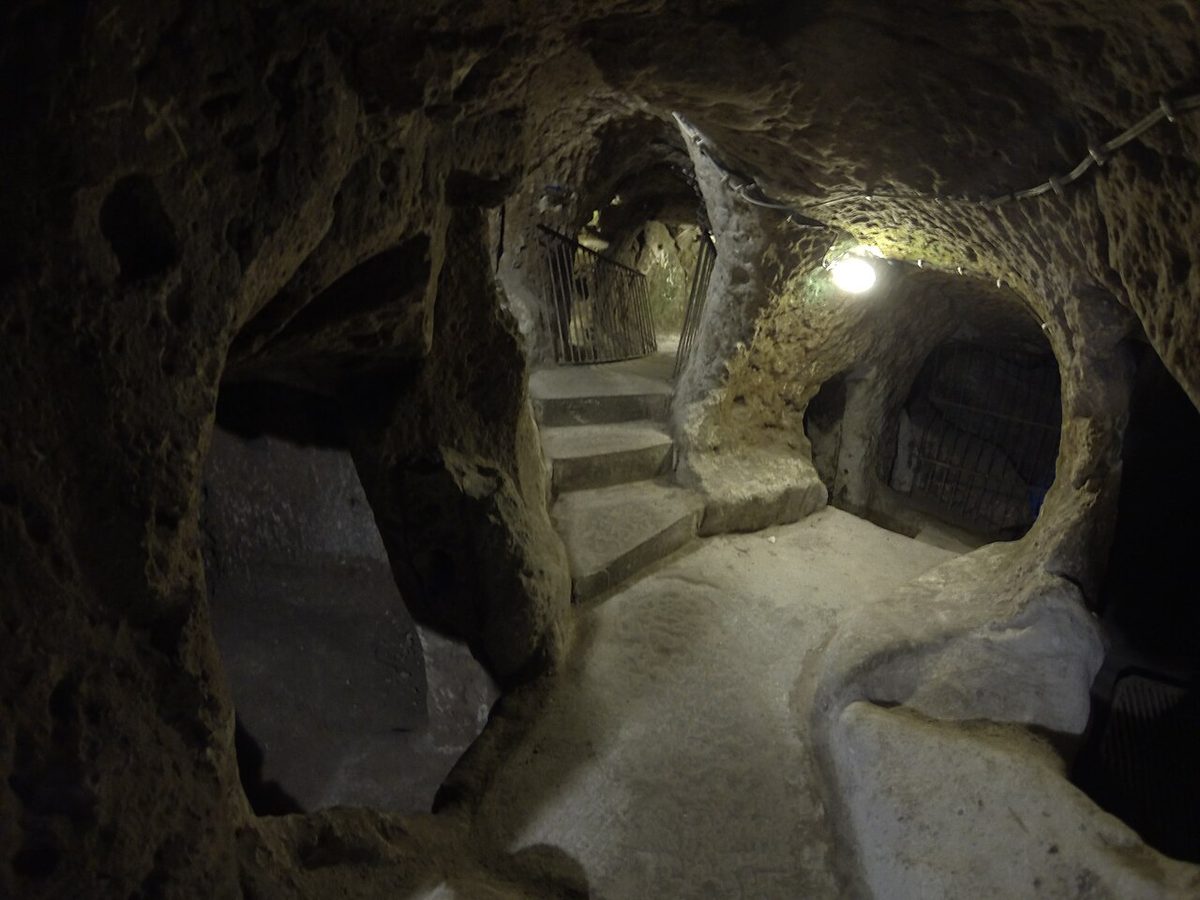
Derinkuyu is the deepest and most elaborate of the Cappadocian underground cities, discovered in 1963 and estimated to have housed up to 20,000 people at its maximum extent. The city descends 18 stories below the surface — approximately 85 meters — and contains stables, wine presses, oil presses, water wells, chapels, schools, and a large cruciform church on the seventh floor. The ventilation system is a network of shafts connecting all levels to the surface, some reaching 55 meters in depth. The city could be sealed from the inside using large circular stone doors (millstones) rolled across the passageways — each floor could be independently sealed, so even if attackers broke through the upper levels, they could not easily descend further. The city was connected to other underground settlements by kilometers of subterranean tunnels, creating an underground network that allowed the population to move between settlements without surfacing.
Derinkuyu was used primarily as a refuge during periods of invasion — by Persians, Arabs, and later Mongols and Ottomans. The population would descend with their livestock and supplies and remain underground for weeks or months at a time. The organization of the space reflects these requirements exactly: livestock on the upper levels (where the ceilings are highest and the smell can escape most easily), sleeping quarters and living spaces on the middle levels, stores and sacred spaces on the lower levels. The entire city is organized as a self-contained survival system, and its design sophistication — the ventilation engineering, the water management, the defensive sealing system — is equal to anything produced by surface architecture of the same period. It was not a crude hole in the ground but a planned urban environment that happened to be below ground.
Rock-Cut Architecture of the Ancient World
Petra, the Nabataean capital in southern Jordan, is the most visually spectacular example of rock-cut architecture in the world. The city was carved into rose-red sandstone canyon walls by the Nabataean people between the 4th century BCE and the 2nd century CE. The famous Treasury (Al-Khazneh) is not a building in any conventional sense: it is a facade carved into the cliff face, in full Hellenistic architectural style — columns, entablature, broken pediment, figural sculpture — with a chamber behind it that served as a royal tomb. The facade is approximately 40 meters tall and represents the most ambitious application of Hellenistic architectural vocabulary to a carved rock surface. It is simultaneously architecture and sculpture, produced entirely by subtraction rather than addition.
Petra contains hundreds of carved facades — tombs, temples, civic buildings — all cut from the canyon walls. The city also had built (freestanding) architecture in its central area, but the carved facades are what survive. They demonstrate that rock-cut architecture is not a primitive or makeshift alternative to construction — it is a deliberate choice, producing buildings of equal or greater durability than any freestanding equivalent, and with visual effects (the integration of architecture with geology, the use of natural rock color and texture as part of the design) that built construction cannot achieve. The Abu Simbel temples in Egypt (Ramesses II, c. 1264 BCE) are another expression of this: two enormous temples carved into a sandstone cliff face on the Nile, their facade featuring four seated colossi of Ramesses II at approximately 20 meters height. The temples are oriented so that twice a year — on Ramesses's birthday and coronation day — the rising sun penetrates the full length of the interior and illuminates the seated figures at the back of the innermost sanctuary.
The rock-hewn churches of Lalibela, Ethiopia (12th–13th centuries CE) represent the most architecturally complex rock-cut tradition: eleven churches carved entirely from the bedrock, not in cliff faces but below the ground surface, approached from below through trenches cut into the rock. The churches are freestanding in the sense that the rock around them has been cut away on all four sides and above, leaving the church as an isolated block still connected to the surrounding geology below. The interior is fully carved — columns, arches, vaulted ceilings, windows, decorative patterns — in the same rock. King Lalibela is said to have built the churches with divine assistance in 24 years. They are still active places of worship, receiving Orthodox Christian pilgrims, and the ceremonies conducted in them — with priests in elaborate vestments, in rock-cut chambers lit by candles — are among the most extraordinary living architectural experiences on earth.
Medieval and Early Modern Underground
The medieval period produced underground architecture in contexts of extraction, devotion, and necessity. The Wieliczka Salt Mine near Kraków, Poland, mined continuously from the 13th century, developed an underground culture of extraordinary richness: miners carved chapels, altars, statues, and eventually a full cathedral — St. Kinga's Chapel — from the salt rock over centuries. The chapel is 54 meters long and 12 meters high, with chandeliers carved from salt crystals, bas-relief scenes from the Bible carved into the walls, and a floor of compressed salt. It is an architectural space of genuine beauty, produced by miners working by candlelight over generations, in a material that has the reflective quality of stone but the slight translucency of alabaster. Wieliczka is a UNESCO World Heritage Site and the most visited tourist attraction in Poland.
The Paris catacombs are underground in a different way: not carved as architecture but adapted from limestone quarries that had been mined beneath Paris for centuries. When Parisian cemeteries became overcrowded in the late 18th century, the city transferred the remains of approximately six million people to the tunnels of the quarries, stacking the bones in neat patterns along the walls over several kilometers. The result is one of the most haunting spaces in architecture — not designed as a building at all, but functioning as one, a place of specific meaning and specific experience, shaped by the intersection of geology, history, and urban crisis.
20th-Century Military Underground
The 20th century produced the most ambitious underground architecture in history, driven by the combined imperatives of industrial warfare and nuclear threat. The Maginot Line, the French fortification system built along the German border between 1929 and 1936, was an interconnected system of underground forts, tunnels, and artillery casements extending for hundreds of kilometers. Each major fort (ouvrage) was essentially an underground city: barracks, magazines, kitchens, hospitals, power plants, rail connections, and gun emplacements all underground, with the fighting positions the only parts exposed at the surface. The largest ouvrages housed thousands of soldiers and were equipped with electric railways for internal transport. The Maginot Line was militarily circumvented in 1940 (the German advance went around it through Belgium) but was architecturally extraordinary — a demonstration of what military engineering could achieve underground at industrial scale.
The Cheyenne Mountain Complex in Colorado (completed 1966), built to house the North American Aerospace Defense Command (NORAD) during the Cold War, represents the nuclear-era extreme of military underground design. The complex is carved into 600 meters of solid granite and designed to withstand a near-miss nuclear strike. The buildings within the complex are free-standing steel structures on 1,319 enormous steel springs that isolate them from ground shock. Air, water, and power are entirely self-sufficient. The architecture is entirely functional — there is no pretense of aesthetic interest — but as an engineering achievement it is remarkable: a city designed for one specific extreme condition, built with total commitment to its program, and (unlike the Maginot Line) operationally successful in its purpose.
Contemporary Underground Architecture
Contemporary architects have returned to underground construction for reasons of thermal efficiency and landscape sensitivity rather than defense. A building partly or wholly below ground benefits from the thermal mass and stable temperature of the surrounding earth — in most climates, a few meters below the surface, the temperature stabilizes around the annual average air temperature, requiring far less heating and cooling than a surface building. Renzo Piano's Menil Collection in Houston (1987) uses this principle for its conservation storage vaults. The Getty Center in Los Angeles integrates significant underground parking and service areas below the hilltop campus to avoid visual impact on the landscape. The underground shopping districts of Montreal (RESO, 33 kilometers of interconnected tunnels linking 80 buildings) and Helsinki (a network beneath the city center connecting transport hubs, shopping, and civic facilities) demonstrate that underground can be a comfortable, commercially viable urban environment when well-designed and properly connected to the surface through daylight wells and atria. The Zollverein School of Management and Design in Essen (SANAA, 2006) uses a basement level that opens to a below-grade courtyard, demonstrating how careful design can make an underground space feel as open and light as a surface building.
Regional Variations
Rock-cut and underground architecture appears wherever the geology permits and the conditions demand it. In the Mediterranean, tufa — soft volcanic stone that hardens on exposure to air — was used for rock-cut tombs, cisterns, and dwellings from Etruria in Italy to Malta to Cappadocia. The Maltese hypogea, underground temple complexes dating to 3600–2500 BCE, are among the oldest underground architectural spaces in the world, carved into the soft limestone with antler picks before metal tools were available. The acoustic properties of the Ħal Saflieni Hypogeum in Malta — a deep resonant echo at specific sound frequencies — are believed to have been deliberately designed into the carved chambers, making it one of the earliest known examples of intentional acoustic design in architecture.
In China and the Loess Plateau of northern China, the yaodong — cave dwellings carved into the vertical faces of loess cliffs — have been occupied for millennia and remain inhabited by tens of millions of people today. The loess is soft enough to carve easily, thermally stable (warm in winter, cool in summer), and abundant. The resulting dwellings are fully functional homes with carved facades, windows, and sometimes multiple interconnected chambers behind. Contemporary versions incorporate ceramic tile and concrete detailing, and some have been renovated into boutique hotels. In Tunisia and Libya, troglodyte dwellings — underground homes carved into horizontal soft rock — have been similarly occupied for centuries and serve as a perfectly adapted response to a climate of extreme summer heat and cool winters.
In Central Asia and the Middle East, underground water-management systems — the Persian qanat, a horizontal tunnel dug into hillsides to intercept the water table — represent a different expression of underground engineering. A qanat can run for tens of kilometers, bringing water from highland aquifers to lowland settlements without pumping, using only gravity. The vertical shafts sunk at intervals to allow maintenance appear as strings of holes across the landscape, one of the most distinctive aerial signatures of inhabited arid landscapes. The qanat is an underground infrastructure that made entire regions habitable, as much an architectural achievement as any building above ground.
Iceland's lava tube caves, formed by volcanic eruption and available across the island's young volcanic landscape, have been used for shelter, storage, and occasional habitation. The Þórsmörk valley shelters formed in lava overhangs are the vernacular end of this tradition. At the other end, contemporary Icelandic designers have proposed deliberate use of lava tubes for large-scale storage and habitation in proposals that take the vernacular tradition into the 21st century.
Key Identifiers: Underground and Cave Architecture
- Absence of an external facade — the building IS the cliff or the ground surface; what you see from outside is the landscape itself with openings cut into it
- Carved rather than constructed surfaces — walls, ceilings, and floors that are the natural rock, smoothed or textured by carving rather than applied materials
- Skylight or light-well as the primary visible surface element for below-grade contemporary buildings — glazed apertures in the ground plane admitting daylight into spaces that are otherwise entirely below grade
- Rock texture visible on interior surfaces — the geology of the host rock apparent in color, grain, and occasionally in the fossils or mineral inclusions of the stone itself
- Doorway or entrance portal as the only designed surface element in cliff-face architecture — the facade is minimal because the building is behind it in the rock
- Multiple vertically stacked levels in underground city architecture — the spatial organization is vertical rather than horizontal, unlike most surface buildings
- Ventilation shafts appearing as surface features — circular or rectangular openings in the ground or cliff face that serve the circulation system of the underground spaces below
- Integration of structural and ornamental carving — columns, arches, and decorative details carved from the same continuous rock as the walls and ceilings, without joints or seams
A Closer Look: Derinkuyu, Cappadocia
Derinkuyu, in the Nevşehir province of central Turkey, is the deepest known underground city in the world — 18 stories below ground, extending approximately 85 meters into the volcanic tufa of the Cappadocian plateau. It was built by the ancient Phrygians, expanded by early Christians fleeing Roman and later Arab persecution, and used as a refuge intermittently from around the 8th century BCE through to the 14th century CE. It was rediscovered in 1963 when a local resident broke through a wall in his home and found a tunnel behind it. Subsequent excavation revealed a city of extraordinary complexity.
The engineering of Derinkuyu addresses every practical requirement of a long-term subterranean habitation. The ventilation system consists of approximately 52 shafts connecting all levels to the surface, the deepest reaching 55 meters, maintaining air quality for the estimated 20,000 inhabitants. Fresh water was supplied through wells drilled to the water table, with the deeper wells sealed from the upper levels and accessible only from the lowest floors — a defensive measure ensuring that even if the city were partially occupied by an enemy, the water supply could not be poisoned from above. The stables on the upper levels were positioned to allow animal waste to fall directly into collection chambers, keeping the living quarters on lower floors free from contamination. A massive stone door — essentially a millstone weighing several hundred kilograms — at the entrance to each level could be rolled into position to seal that level from below, with a small hole in the center that allowed a spear to be thrust through to repel any attempt to move the stone from the outside.
The architectural spaces of Derinkuyu are not merely functional tunnels. The church on the seventh level is a full cruciform plan with carved arches and a barrel-vaulted nave. The school on the third level has a large meeting room and smaller subsidiary rooms arranged around a central space. The wine presses are equipped with carved channels to direct juice into collection vessels. The oil presses are organized for efficient multiple-press operation. Every space is purpose-designed for its specific function, using the same vocabulary of carved tufa that produced the entire city. What is absent is any concern with exterior appearance — a building that is entirely underground has no facade, no relationship to streetscape, no concern with how it looks from outside. The architecture is entirely about interior experience, spatial organization, and functional performance. It is the purest expression possible of architecture as problem-solving rather than architecture as image-making.
Spotting It in Building Guessr
Underground and cave architecture is challenging in Building Guessr because the defining characteristic — being below ground — is often invisible in a standard exterior photograph. The key visual signals are what is absent rather than what is present. If you see a building facade that appears to be carved into a cliff face rather than built against it, with the surrounding rock continuous with the walls and ceiling of the space, you are almost certainly looking at rock-cut architecture. If the facade consists only of doorways and window openings cut into a vertical rock surface, with no applied wall material, columns, or cladding, it is rock-cut. The color of the rock — rose-red for Petra's sandstone, pale tufa for Cappadocia, dark basalt for some Ethiopian examples — helps narrow the location.
For contemporary underground architecture, the signal is typically a ground-level or below-grade glazed opening — a skylight or light-well — visible in a landscape that appears largely undisturbed. The roof may be a green roof, a paved plaza, or simply earth and grass, with the building visible only through its entrance portal and glazed ceiling openings. The combination of these surface-level clues with the knowledge that the building is primarily below grade is the identifying marker. Military bunkers and Cold War facilities are typically identifiable by their hardened concrete construction, blast doors, and embrasures (small horizontal openings in thick walls for weapons or observation), regardless of whether they are fully buried or semi-buried in earthworks.
Explore ancient and subterranean structures in the world heritage filter.
Play Building GuessrFurther Reading
Sources & further reading
Reference material this page draws on, and where to read further. External links open third-party sites.
- Cliff dwelling · Wikipedia
- Cappadocia · Wikipedia
- Derinkuyu underground city · Wikipedia
- Rock-cut architecture · Wikipedia
- Bunker · Wikipedia
- Petra · Wikipedia
- Matmata, Tunisia · Wikipedia
- World Heritage listing: Derinkuyu underground city · UNESCO World Heritage Centre
- World Heritage listing: Petra · UNESCO World Heritage Centre