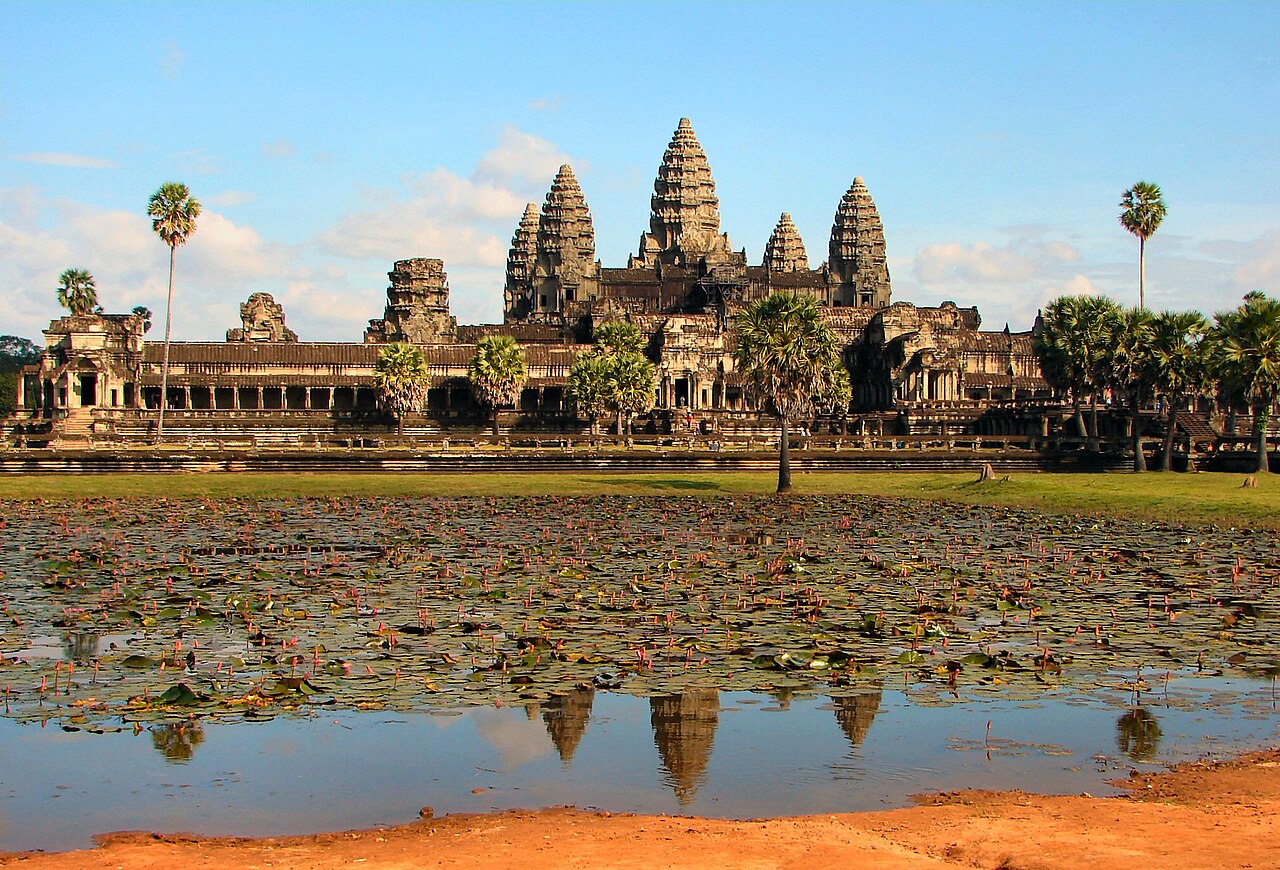
What it is
Angkor Wat is the world's largest religious monument by area, covering 162.6 hectares including its moat and approach causeway. It was built by the Khmer king Suryavarman II between approximately 1113 and 1150 CE as the state temple of the Khmer Empire and, most likely, as his funerary monument. The name means "Temple City" in Khmer — angkor (from Sanskrit nagara, city) and wat (temple). Originally dedicated to the Hindu god Vishnu, it was gradually converted to Theravada Buddhist use in the twelfth century and has been an active Buddhist temple continuously since then, making it the oldest operating religious site of its kind in Southeast Asia and one of the few major monuments in the world that has never been abandoned to ruin — though it was effectively unknown to the Western world until the French naturalist Henri Mouhot described it in 1860.
The temple sits within the broader archaeological complex of Angkor, the successive capitals of the Khmer Empire from the ninth to the fifteenth centuries, covering some 400 square kilometers in the jungle of northwestern Cambodia. Angkor Wat is the largest and best-preserved structure within this complex, but it is surrounded by hundreds of other temple ruins — including Angkor Thom, Bayon, Ta Prohm (famous for the trees growing through its stones), and Preah Khan — that together constitute the largest pre-industrial city complex ever discovered. At its height in the twelfth and thirteenth centuries, greater Angkor may have had a population of up to one million people, supported by an extraordinarily sophisticated hydraulic system of reservoirs (baray), canals, and rice paddies engineered across the flat Cambodian plain.
Architectural significance
Angkor Wat is the fullest expression of the temple-mountain form in Khmer architecture — a typology in which the temple represents Mount Meru, the cosmic axis mundi of Hindu and Buddhist cosmology, the home of the gods rising at the center of the universe. The five central towers represent the five peaks of Meru; the concentric enclosure walls represent the mountain ranges surrounding it; and the moat represents the cosmic ocean at the edge of the world. The entire complex is therefore not merely a building but a three-dimensional cosmological diagram, and its proportions, orientations, and spatial sequences were designed to enact a symbolic journey from the mundane world to the divine center. The approach along the 350-meter western causeway, flanked by naga balustrades (serpent railings), crossing the moat, passing through the western gopura (gateway tower), and gradually ascending through three increasingly elevated gallery levels to the central sanctuary is a choreographed spiritual procession as much as an architectural sequence.
The bas-relief galleries of Angkor Wat are among the greatest achievements of narrative carving in world architecture. At the lowest level of the temple, a continuous gallery 800 meters long — the longest bas-relief program in the world — encircles the entire structure with carved panels averaging 2 meters in height. The panels depict scenes from Hindu epic literature (the Mahabharata battle of Kurukshetra and the Churning of the Ocean of Milk) alongside historical scenes from Suryavarman II's military campaigns, and a detailed vision of heaven and hell with 37 heavens and 32 hells described with specificity worthy of architectural illustration. The carving technique — low relief with incised outline, executed in sandstone — achieves extraordinary compositional complexity with hundreds of figures in simultaneous narrative, a sculptural program that took an estimated 37 years to complete.
Key features
- Five central towers in quincunx: The defining silhouette of Angkor Wat — four corner towers and one central tower arranged in the quincunx (four corners plus center) pattern representing the five peaks of Mount Meru. The central tower rises 65 meters above ground level. The towers have distinctive lotus-bud profiles unique to Khmer architecture.
- Western entrance orientation: Angkor Wat faces west — the direction of the setting sun and in Hindu cosmology the direction associated with death and the ancestral realm — rather than the east-facing orientation of most Hindu temples. This is generally interpreted as indicating its funerary purpose as Suryavarman II's mausoleum.
- 190-meter-wide moat: The rectangular moat surrounding the temple complex measures 1,500 by 1,300 meters and is 190 meters wide — one of the largest temple moats in the world. It required the diversion of the Siem Reap River and served both ritual (as the cosmic ocean) and practical (as a water management feature in the Angkorian hydraulic system) purposes.
- 2-kilometer western approach causeway: The main approach axis is a 350-meter-long elevated stone causeway flanked by naga balustrades, connecting the western gopura to the main temple entrance across the moat. The causeway's width and length are calibrated to produce a precise visual alignment with the central tower at its midpoint.
- 800-meter continuous bas-relief gallery: The lowest level gallery circumscribing the entire temple is the longest continuous bas-relief in the world, depicting mythological battles, Suryavarman II's historical campaigns, and detailed cosmological scenes in a narrative program of extraordinary complexity.
- Cruciform gallery plan: The middle level of the temple is organized around a cruciform (cross-shaped) gallery system connecting the corner towers, creating a spatial grid that allows multiple simultaneous processional routes and views.
- Sandstone construction: The entire structure is built from sandstone blocks quarried at Phnom Kulen, approximately 25–35 kilometers away, transported by raft along canals dug specifically for the purpose — an infrastructure achievement requiring the same scale of organization as the temple itself.
Preservation status
Angkor Wat is in remarkably good structural condition for a building of its age, largely because it was never abandoned — continuous religious use meant continuous maintenance. The temple is managed by APSARA Authority (Authority for the Protection and Management of Angkor and the Region of Siem Reap), a Cambodian government body established in 1995. UNESCO World Heritage inscription came in 1992, at which point the site was in severe distress from the combined effects of the Khmer Rouge period (1975–1979), the subsequent civil war, and decades of neglect during which the global archaeological community had no access. Since the early 1990s, international conservation teams from France (EFEO), India, Japan, Germany, and the United States have conducted successive restoration programs, consolidating foundations, re-laying collapsed galleries, and treating the sandstone surface for biological growth (the green-black crust of cyanobacteria, lichens, and mosses is the primary ongoing deterioration agent).
The most acute current conservation issue is overtourism. Before the COVID-19 pandemic, Angkor received approximately 2.6 million visitors annually, concentrated primarily at Angkor Wat, where the foot traffic on sandstone surfaces and humidity from human breath were measurably accelerating stone deterioration. The pandemic-era collapse of tourism to near zero gave conservation teams an unusual opportunity to work without visitor pressure, but the economic dependence of the Siem Reap region on tourism revenue means that visitor access cannot simply be restricted. APSARA and UNESCO have been developing visitor management strategies, including timed entry, extended opening hours to spread crowds, and developing secondary sites within the Angkor complex to reduce concentration at the main temple.
Think you can place this building on the map?
Play Building Guessr