What it is
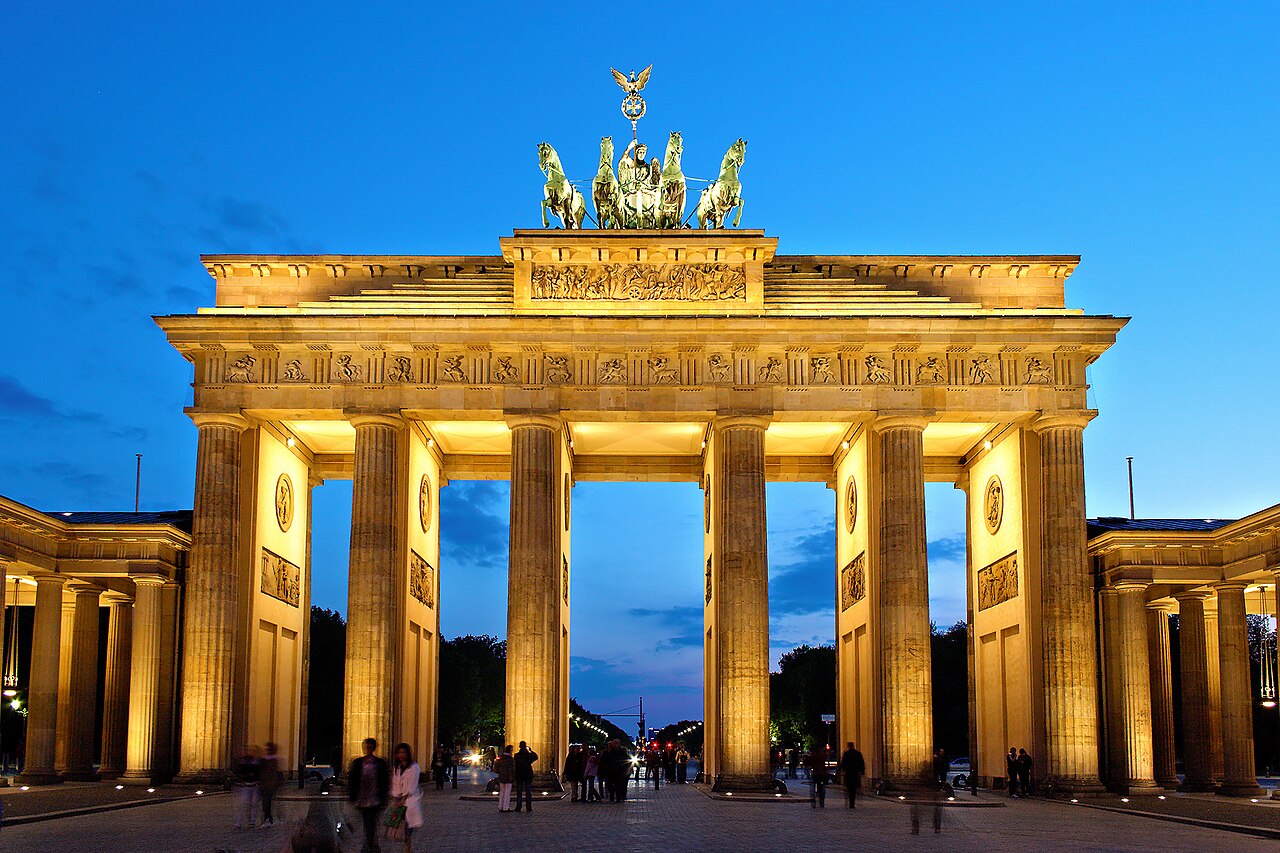
The Brandenburg Gate is a Neoclassical triumphal arch at the western end of Unter den Linden, Berlin's grand ceremonial boulevard, and the only surviving gate from Berlin's 18 original city wall gates. It was commissioned by King Friedrich Wilhelm II of Prussia as a symbol of peace and built between 1788 and 1791 to the designs of the architect Carl Gotthard Langhans. At 26 metres wide, 11 metres deep, and 26 metres tall to the top of the Quadriga sculpture, it is a substantial and imposing structure — though its fame in the modern era derives less from its dimensions than from the extraordinary density of political history accumulated around it in the 20th century.
The gate stands at the western entrance of Pariser Platz — a formal square laid out in the early 18th century — and marks the point where the royal road to Brandenburg, the old Prussian heartland, began. In the decades after its completion it became the symbolic gateway to Berlin, the point through which triumphal processions entered the city and through which monarchs, conquerors, and later liberators passed. Napoleon rode through it in 1806. Allied forces marched through it in 1945. Reagan stood before it in 1987 and demanded Gorbachev tear down the Wall. When the Wall finally fell in November 1989, the jubilant crowds of East and West Berliners converged on the gate as the natural focal point of reunion — a role the building had accumulated not by design but by historical accident and architectural prominence.
Architectural significance
The Brandenburg Gate is one of the finest examples of Prussian Neoclassicism, a style that dominated Berlin's public architecture from the 1780s through the 1830s under successive royal commissions. Langhans drew his design explicitly from the Propylaeum of the Acropolis in Athens — the monumental gateway to the Athenian citadel, built in 437–432 BCE — adapting the Greek Doric order to the requirements of a city gate wide enough for vehicular traffic in five lanes. The six rows of columns — six on each of the two main facades — are fluted Doric, 15 metres tall, built of sandstone quarried near Berlin. The entablature above the columns is decorated with metopes and triglyphs in the Doric tradition, though simplified somewhat compared with the Greek models.
The five passageways through the gate — four outer ones for general traffic, a wider central one originally reserved for royalty — give the structure its characteristic width and the visual rhythm of its colonnade. The decision to model the gate on the Propylaeum rather than a Roman triumphal arch is significant: Greek models were associated in 18th-century European thought with democracy and civic virtue, while Roman arches were associated with military triumph and imperial power. Langhans's choice thus gave the Brandenburg Gate a republican, civic character at its foundation — though subsequent German rulers were not always troubled by such distinctions. The Quadriga atop the gate — a chariot drawn by four horses, carrying a figure of Victory with a staff surmounted by the Prussian eagle — was added in 1793, sculpted by Johann Gottfried Schadow. It is a masterwork of late 18th-century German sculpture and one of the most reproduced images in German art history.
Key features
- The Quadriga and its travels: The Quadriga sculpture — Victory driving a four-horse chariot — was removed by Napoleon after the French occupation of Berlin in 1806 and transported to Paris, where it was displayed as a war trophy. After Napoleon's defeat, Prussian forces recovered it in 1814 and returned it to Berlin. On its return, the Iron Cross was added to the staff of Victory's standard — a militarisation of the original civic symbolism. The Quadriga was destroyed in World War II and reconstructed in 1957–1958 from historical records and plaster casts.
- Cold War isolation: When the Berlin Wall was built in August 1961, the Brandenburg Gate found itself in the Death Strip — the no-man's land between the two walls that divided the city. Access was closed on both sides. For 28 years, the gate was visible from East and West Berlin but accessible to neither. It became, precisely because of its inaccessibility, the most potent symbol of German division — the place everyone looked toward and could not reach.
- Site of historic speeches: John F. Kennedy visited the gate from the West Berlin side in June 1963, shortly after his "Ich bin ein Berliner" speech at Rathaus Schöneberg. Ronald Reagan stood before it on 12 June 1987 and made his famous demand: "Mr Gorbachev, tear down this wall!" The speech was broadcast globally; the Wall fell two and a half years later.
- Restoration and reopening: The gate was closed for restoration from 2000 to 2002, a comprehensive cleaning and structural repair campaign that removed decades of pollution and war damage. It reopened on 3 October 2002, German Reunification Day, and has since functioned as the centrepiece of Berlin's public ceremonial life — hosting New Year celebrations that regularly attract a million people to Pariser Platz and the surrounding area.
- Room of Silence: In 2000, a small Room of Silence was opened in one of the gate's two side buildings — a non-denominational meditation space available to all visitors, intended as a counterpoint to the noise and crowds of the surrounding plaza.
Construction and history
The Brandenburg Gate was constructed between 1788 and 1791, replacing an earlier city gate at the same location. The architect Carl Gotthard Langhans had studied in Italy and was deeply influenced by the Greek Revival movement then emerging across Europe. Construction used Oder sandstone for the columns and pilasters, with the main structure taking approximately three years to complete. The Quadriga was added in 1793. The gate was inaugurated without ceremony; it was not considered an especially important building in its own time, being one of many city improvements undertaken by Friedrich Wilhelm II.
Its elevation to symbolic status began with Napoleon's passage through it in 1806, which in retrospect turned it into a marker of national humiliation and subsequent recovery. The return of the Quadriga in 1814, led by Field Marshal Blücher in a ceremony of deliberate symbolism, established the gate as a site of national narrative. It survived the heavy Allied bombing of World War II but was badly damaged; the Quadriga was destroyed and the gate itself peppered with shrapnel scarring. The postwar reconstruction was divided between East and West: the gate sat in East German territory but was visible from both sides, making its ownership and restoration politically charged. Both governments eventually agreed on a shared restoration in the late 1950s.
Preservation and status
The Brandenburg Gate is in excellent structural condition following its 2000–2002 restoration, which addressed wartime damage, pollution, and the general weathering of two centuries. The sandstone colonnade was cleaned and consolidated; damaged stone elements were replaced using matching material from the original quarries where possible. The Quadriga, reconstructed in 1958, is maintained in place. The gate is protected as a listed monument and managed by the city of Berlin. The most significant ongoing challenge is crowd management: the gate is one of the most photographed buildings in Europe and a focal point for mass public events, requiring careful coordination of visitor flow through and around the structure.
Think you can place this building on the map?
Play Building Guessr