What it is
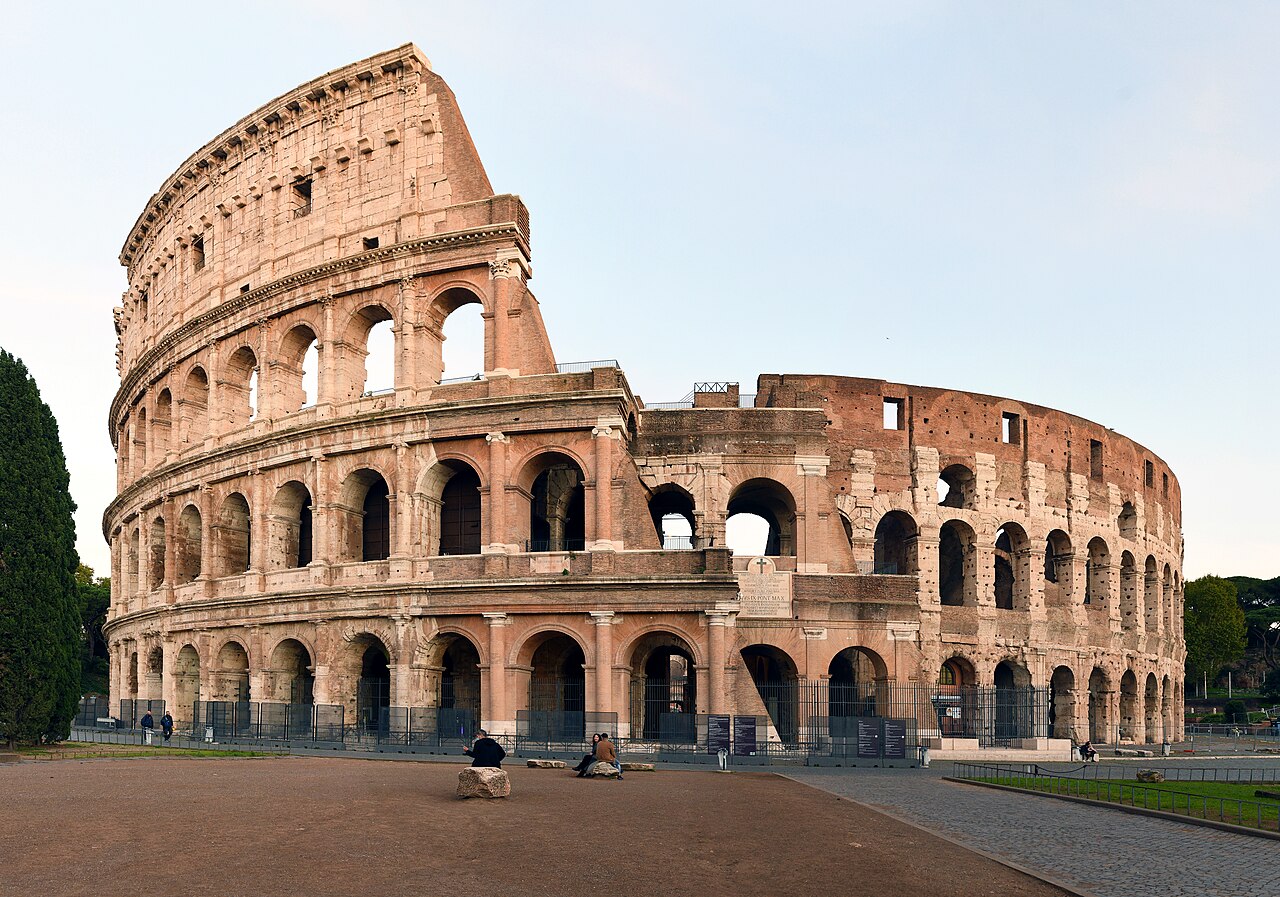
The Colosseum — formally the Amphitheatrum Flavium, or Flavian Amphitheatre — is the largest amphitheatre ever built, and the defining monument of Roman Imperial architecture. Emperor Vespasian began its construction around 70 CE on the site of Nero's artificial lake, a gesture that reclaimed the extravagant private pleasure grounds of an unpopular tyrant and returned them to public use. His son Titus inaugurated the building in 80 CE with 100 days of games, and his younger son Domitian added the hypogeum (the underground staging level) and the uppermost seating tier. The building accommodated between 50,000 and 80,000 spectators, arranged by social class from the ringside marble seats of senators to the wooden bleachers of women and the poor at the very top — a spatial encoding of the Roman social hierarchy made permanent in stone.
The games hosted in the Colosseum included gladiatorial combat (munera), wild animal hunts (venationes) in which thousands of exotic animals imported from across the empire were killed, public executions, and occasionally theatrical spectacles. The last gladiatorial combat is generally dated to 404 CE, when Honorius officially banned the practice, though animal hunts continued into the sixth century. After the fall of the Western Roman Empire, the building was converted variously into a fortress, a Christian church (disputed), a quarry for building materials, and eventually a monument — a trajectory that explains why the outer shell is only partially intact.
Architectural significance
The Colosseum represents the culmination of Roman concrete (opus caementicium) and arch engineering applied to the problem of mass public assembly. Its most remarkable functional achievement is the vomitoria system — 76 numbered public entrances leading to a network of barrel-vaulted corridors, ramps, and staircases that distributed spectators to their assigned sections and could empty the entire 50,000-person crowd in approximately fifteen minutes. Each spectator received a ticket (tessera) stamped with an entrance number, a level, a wedge section (cuneus), and a seat number — an organizational system sophisticated enough that modern stadium designers study it. The geometry of the elliptical plan (188 meters by 156 meters) is itself a crowd-management decision: the ellipse allows sight lines from all seats to converge on the arena floor, unlike the circular or rectangular alternatives.
The exterior facade deploys the superimposed orders — each of the four stories uses a different classical column order as applied decoration on the arched piers, progressing from Doric (ground floor) through Ionic (second), Corinthian (third), and a flat Corinthian pilaster treatment on the attic (fourth) story — a hierarchy of ornamental complexity that the Romans borrowed from Hellenistic architecture and deployed systematically. This compositional system was directly copied by Renaissance architects studying Roman ruins and became a standard element in the design of later European palaces, churches, and civic buildings. The Colosseum's influence on the language of Western monumental architecture is therefore as much about its decorative vocabulary as its structural logic.
Key features
- Elliptical plan: 188 meters by 156 meters, with the long axis oriented roughly north-south. The ellipse allowed every spectator an unobstructed view of the central arena floor, which measured 83 by 48 meters and was covered with sand (the Latin harena, from which the English word "arena" derives).
- Four-story facade with superimposed orders: Eighty arched bays per story on the lower three levels, each bay framing a free-standing column of the appropriate order; the fourth story features flat Corinthian pilasters alternating with windows and solid panels. The exterior material is travertine limestone, much of it stripped for reuse in medieval and Renaissance buildings.
- 80 entrance arches: Seventy-six were numbered for public use (I through LXXVI); the four cardinal entrances were reserved for the emperor, officials, gladiators, and the dead. The numbers carved above entrances are still visible on surviving sections.
- The hypogeum: The underground level — a two-story labyrinth of corridors, cages, and machinery — was added by Domitian and is now partially exposed. It contained the hoists and pulleys that could rapidly raise animals or scenery through trapdoors in the arena floor, creating the theatrical surprise of beasts suddenly appearing in the middle of the arena.
- Vomitoria: 78 vaulted exit passages radiating outward from the seating bowl, each numbered to correspond to the ticket system, allowing the entire crowd to evacuate without congestion in approximately 15 minutes.
- Velarium: A retractable canvas awning covering the seating tiers, rigged by sailors of the Misene fleet using ropes attached to 240 wooden masts socketed into corbels at the top of the attic story. The corbels are still visible around the top of the surviving wall.
- Social stratification in seating: The podium (ringside) was reserved for senators and the Vestal Virgins; the maenianum primum above for the equestrian class; the maenianum secundum for ordinary male citizens; the wooden maenianum summum in ligneis at the very top for women and the poor.
Preservation status
The Colosseum is a partial ruin. The southern exterior wall was largely destroyed by earthquakes, most severely in 1349 CE, and the exposed cross-section of its interior structure is now its most recognizable view. Approximately two-thirds of the original travertine exterior cladding was stripped for reuse between the fifth and eighteenth centuries — the marble seats, bronze clamps, and decorative elements went first, then the structural stone itself. What remains is a skeletal framework of brick-faced concrete piers and arches that reveals the building's internal logic with unintentional clarity. The arena floor was removed in the nineteenth century for archaeological excavation, exposing the hypogeum.
Major restoration work was completed in stages through the 2010s and 2020s, funded partly by a 25-million-euro donation from the shoe company Tod's. The exterior has been cleaned of centuries of grime and biological crust, restoring the pale travertine to something approaching its original appearance. In 2023, a new retractable arena floor was installed, allowing events to be held on the arena level for the first time in modern history. The Colosseum receives approximately 7 million visitors annually, making crowd management and surface wear ongoing conservation concerns. It is a UNESCO World Heritage Site as part of the Historic Centre of Rome.
Think you can place this building on the map?
Play Building Guessr