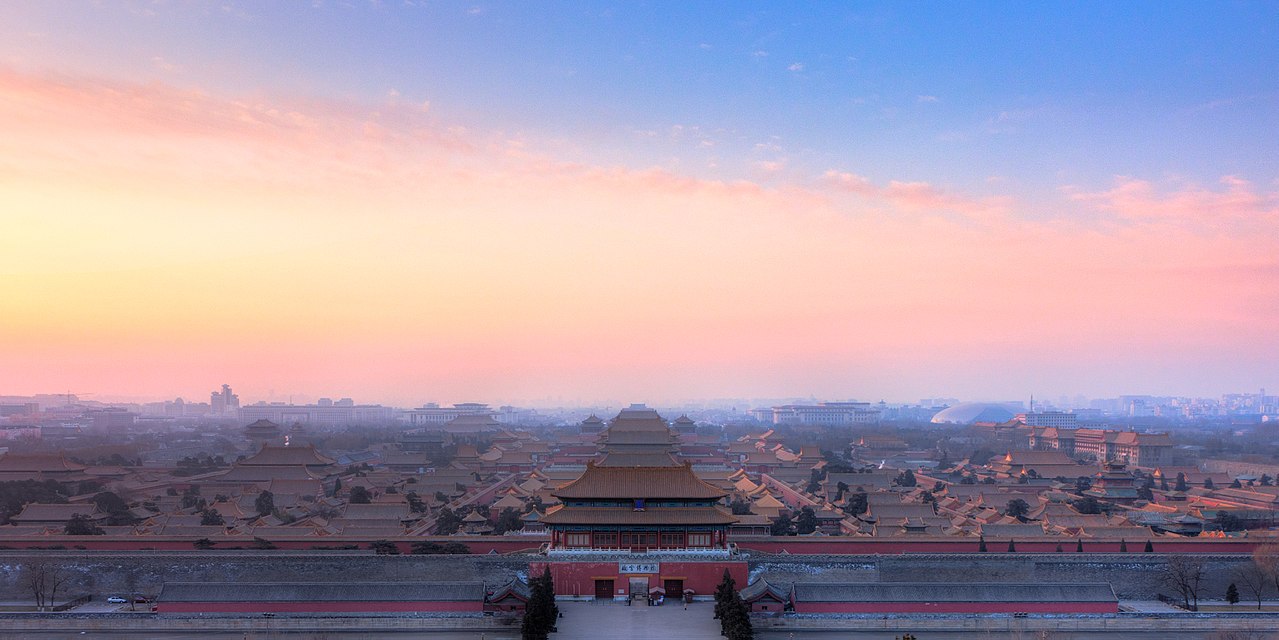
What it is
The Forbidden City — known in Chinese as Zijin Cheng (Purple Forbidden City), and now officially called the Palace Museum — is the imperial palace complex at the heart of Beijing that served as the home of Chinese emperors and the political center of the Chinese empire from its completion in 1420 until the abdication of the last emperor, Puyi, in 1912. It was built under the Yongle Emperor of the Ming dynasty, who ordered the construction of a new capital at Beijing and the palace complex at its center between 1406 and 1420. The construction mobilized an estimated one million workers and required enormous quantities of materials: timber from the forests of Sichuan and Yunnan provinces, stone from quarries in Fangshan county outside Beijing (slabs so large that workers flooded artificial roads in winter and slid them to the city on ice), and glazed roof tiles produced in specialist kilns to the south of the city.
The complex covers approximately 72 hectares — roughly the area of 100 football pitches — and is surrounded by a 52-meter-wide moat and 10-meter-high walls. Within these walls stand 980 surviving buildings containing 8,707 rooms (historical counts vary; the number 9,999.5 is a traditional round figure used in popular accounts, representing the maximum allowed for a subject — the heavenly palace of the Jade Emperor was said to have 10,000 rooms). Twenty-four emperors lived in the Forbidden City across the Ming (1420–1644) and Qing (1644–1912) dynasties. After the fall of the Qing dynasty, the palace complex became a public museum in 1925, renamed the Palace Museum. It is now the most visited museum in the world, with approximately 19 million visitors in the years before the COVID-19 pandemic.
Architectural significance
The Forbidden City is the supreme expression of Confucian cosmological hierarchy in Chinese architecture. The entire complex is organized on a strict north-south axis — the same axis that runs through Tiananmen Gate to the south, through the palace, and outward to the Drum and Bell Towers to the north — encoding the emperor's role as the pivot of the cosmic order between heaven and earth. Movement through the complex is a choreographed procession from the public outer court to the increasingly private and sacred inner court, with each successive gate and courtyard representing a step deeper into the emperor's world and further from ordinary civic life. The sequence of spaces — from the broad public plaza south of Tiananmen, through the Meridian Gate, across the Golden Water River, through the Gate of Supreme Harmony, to the great ceremonial platform of the Hall of Supreme Harmony — is one of the most deliberately planned axial progressions in world architecture.
The symbolic system encoded in the buildings is extensive and precise. The number nine is woven throughout the complex because nine is the highest single-digit number and associated in Chinese cosmology with the emperor: each pair of wooden doors in the main ceremonial buildings carries 9 by 9 = 81 gilded studs; the Hall of Supreme Harmony stands on a triple-tiered marble terrace of nine-step staircases; the moat is nine times wider than the walls are thick. The yellow glazed roof tiles used throughout the Forbidden City were reserved by law exclusively for imperial buildings — no subject, however wealthy, was permitted to use yellow glazed tiles on their own buildings. The deep red of the walls was similarly restricted. The color system of the palace was therefore not merely aesthetic but a legally enforced visual declaration of the emperor's unique status. The timber-frame construction system — using interlocking wooden brackets (dougong) to distribute roof loads to columns without stone vaulting — represents the pinnacle of Chinese timber engineering, refined over more than two millennia.
Key features
- Meridian Gate (Wumen): The main south entrance to the Forbidden City, with five arched openings — the central opening reserved for the emperor alone (or the empress on her wedding day, and examination top scholars leaving after results). The gate is a U-shaped plan with corner towers, forming a dramatic enclosed approach to the outer court.
- Hall of Supreme Harmony (Taihe Dian): The largest timber-frame building in China, used for the most important imperial ceremonies including enthronement, the emperor's birthday, and the announcement of major military campaigns. It stands on a three-tiered white marble terrace with dragon-carved ramps flanking the central staircase.
- Yellow glazed roof tiles: The iconic golden-yellow color of the palace roofs results from iron oxide glazing on terracotta tiles, fired in specialist imperial kilns. The color was legally reserved for imperial buildings throughout the Ming and Qing periods.
- Red walls: The 10-meter-high outer walls and most interior walls are painted deep Venetian red, a color associated with imperial authority. The paint contains ferrous oxide and is renewed through ongoing maintenance.
- Golden Water River (Jinshui He): Five marble bridges cross an artificially created inner moat — the Golden Water River — immediately inside the Meridian Gate, leading to the Gate of Supreme Harmony. The five bridges symbolize the five Confucian virtues.
- Strict axial layout: The entire complex is symmetrically arranged on the Beijing north-south axis, with ceremonial buildings on the central axis and service, residential, and garden structures arranged symmetrically on either side. This axial discipline, maintained across 980 buildings, is unparalleled in world palace architecture for its scale and consistency.
- Imperial garden (Yuhuayuan): The private garden at the north end of the inner court, used exclusively by the imperial family. It contains ancient cypress trees, rockery arrangements of Taihu limestone, and small pavilions, and represents a deliberate tonal shift from the formal grandeur of the outer court to a more intimate, naturalistic setting.
Preservation status
The Forbidden City is a UNESCO World Heritage Site (inscribed 1987) and is in generally good condition, though the scale of the complex and the nature of its timber construction create ongoing preservation challenges. Chinese wooden architecture requires regular maintenance — the exposed structural timber must be periodically repainted and treated against insects and moisture, the glazed tiles replaced as they crack or degrade, and the drainage systems maintained to prevent water infiltration into wooden foundations. An ongoing restoration program, which has been underway in various forms since the 1950s, systematically works through the complex's 980 buildings. The current phase of restoration, begun in the 2010s and scheduled to run through the 2020s, is being conducted with unusually high standards of documentation and material authenticity.
Visitor management is the most active current challenge. The Palace Museum caps daily visitors at 80,000 — a significant number, but a reduction from the unrestricted peak years when daily visits exceeded 100,000. Timed entry, online ticketing, and one-way circulation routes have been implemented. The sheer volume of foot traffic creates wear on the marble paving, the wooden threshold boards, and the drainage channels, and the humidity introduced by large crowds affects the wooden structures. The museum has been experimenting with nighttime opening for special events as a strategy to distribute visitor load. Despite these challenges, the Forbidden City remains the most comprehensively preserved imperial palace complex in the world and continues to expand its conservation and public interpretation programs.
Think you can place this building on the map?
Play Building Guessr