Architecture in Greece
Greece is the birthplace of the Western architectural tradition. The three Classical orders — Doric, Ionic, and Corinthian — were developed and refined in Greece between the 7th and 4th centuries BCE and have defined the grammar of European and American public architecture ever since. Athens, Delphi, Olympia, and Epidaurus contain the canonical examples; the Greek colonies in Sicily and southern Italy (Magna Graecia) spread them across the Mediterranean. Byzantine Christianity, which grew from the Eastern Roman Empire, produced a second great architectural tradition — the centralised domed church — concentrated in Thessaloniki and Constantinople (now Istanbul). Modern Greece overlays both traditions with 19th-century Neoclassicism, adopted as the architectural expression of the new Greek state after independence in 1821, and the concrete modernism of rapid postwar urbanisation that transformed Athens in the 1950s and 1960s.
Notable Buildings
-
Classical Greek
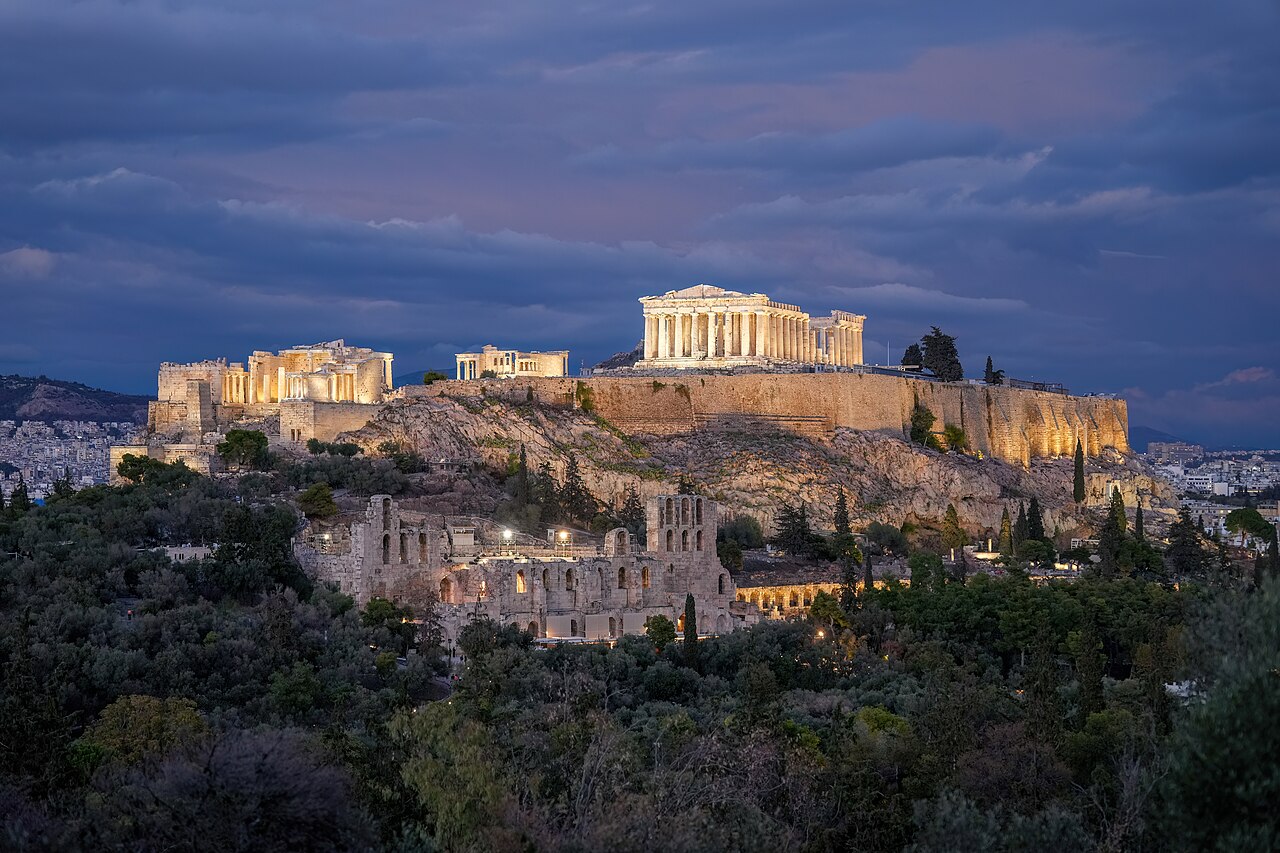
Four 5th-century BCE monuments on a limestone rock above Athens: the Parthenon, the Erechtheion, the Propylaea, and the Temple of Athena Nike. Together they represent the high point of Classical Greek architecture, built during the period of Athenian supremacy under Pericles using funds from the Delian League.
-
Classical Greek
The Doric temple dedicated to Athena Parthenos (447–432 BCE). Its apparent geometric perfection conceals deliberate optical corrections — slightly convex column shafts (entasis), inward-leaning columns, and a subtly curved stylobate — designed to counteract the visual distortions that straight lines create at this scale.
-
Classical Greek / Roman
Temple of Olympian Zeus
The largest temple in ancient Greece, begun in the 6th century BCE and completed under the Roman emperor Hadrian in 131 CE — a building 700 years in the making. Fifteen of its original 104 Corinthian columns survive; a sixteenth fell in a storm in 1852 and was left where it fell.
-
Classical Greek
Theatre of Epidaurus
The best-preserved ancient Greek theatre, built c.340 BCE and famous for its near-perfect acoustics — a whisper from the circular orchestra can be heard in the back row of the 14,000-seat cavea without any amplification. Modern performances are still staged here every summer.
-
Minoan
Palace of Knossos, Crete
The administrative centre of Minoan civilisation (c.1700 BCE), the probable origin of the Labyrinth myth. The palace's multi-storey construction, light wells, flush toilets, and drainage systems represent building technology far ahead of its time. Sir Arthur Evans's 20th-century reconstruction is now itself archaeologically controversial.
-
Byzantine
Byzantine Churches, Thessaloniki
Thessaloniki contains the densest concentration of Byzantine churches outside Istanbul — 15 UNESCO-listed monuments spanning the 4th to 15th centuries, from the brick-domed Rotunda (298 CE, originally a Roman mausoleum) to the 14th-century church of the Holy Apostles with its polychrome brick facades and refined mosaic programmes.
-
Ancient Greek
Sanctuary of Delphi
The sanctuary of Apollo at Delphi, believed by the ancient Greeks to be the navel (omphalos) of the world, where the oracle gave her famously ambiguous pronouncements. The Temple of Apollo, the Treasury of the Athenians, the ancient theatre, and the stadium survive on a dramatic hillside site on the slopes of Mount Parnassus.
Architectural Character
The Classical tradition of Greece rests on three principles: the column-and-lintel structural system, the three-order hierarchy (Doric, Ionic, Corinthian), and the refinement of proportion through mathematical ratios. Greek temples were not primarily spaces of worship but houses for the deity's statue; ritual took place outside, at the altar. This exterior orientation gave rise to the emphasis on the colonnade — the peristyle — as the primary architectural statement. A Greek temple was above all an object to be seen from outside, from all angles, in the clear light of the Aegean.
The refinement of the Classical orders over two centuries was a collective project of extraordinary precision. Architects worked out the proportional relationships between column diameter, height, spacing, and entablature through decades of experiment across multiple buildings in Athens, Corinth, Olympia, and the colonies. The Parthenon is the culmination of this process: every dimension is related to every other by a small set of ratios, creating a building that appears geometrically perfect while actually incorporating subtle curves and tilts that correct for visual distortion.
Byzantine architecture (4th–15th c) inverted the Classical emphasis: the exterior of Byzantine churches is typically plain brick, while the interior achieves complexity through mosaic programmes, centralised domes on pendentives, and hierarchical spatial sequences. Both traditions were intensely influential — Classical forms on European and American civic architecture from the Renaissance to the 20th century; Byzantine forms on Orthodox Christianity worldwide, from Russia to Ethiopia to the Balkans.
Test your knowledge of European landmarks in the game.
Play Building Guessr