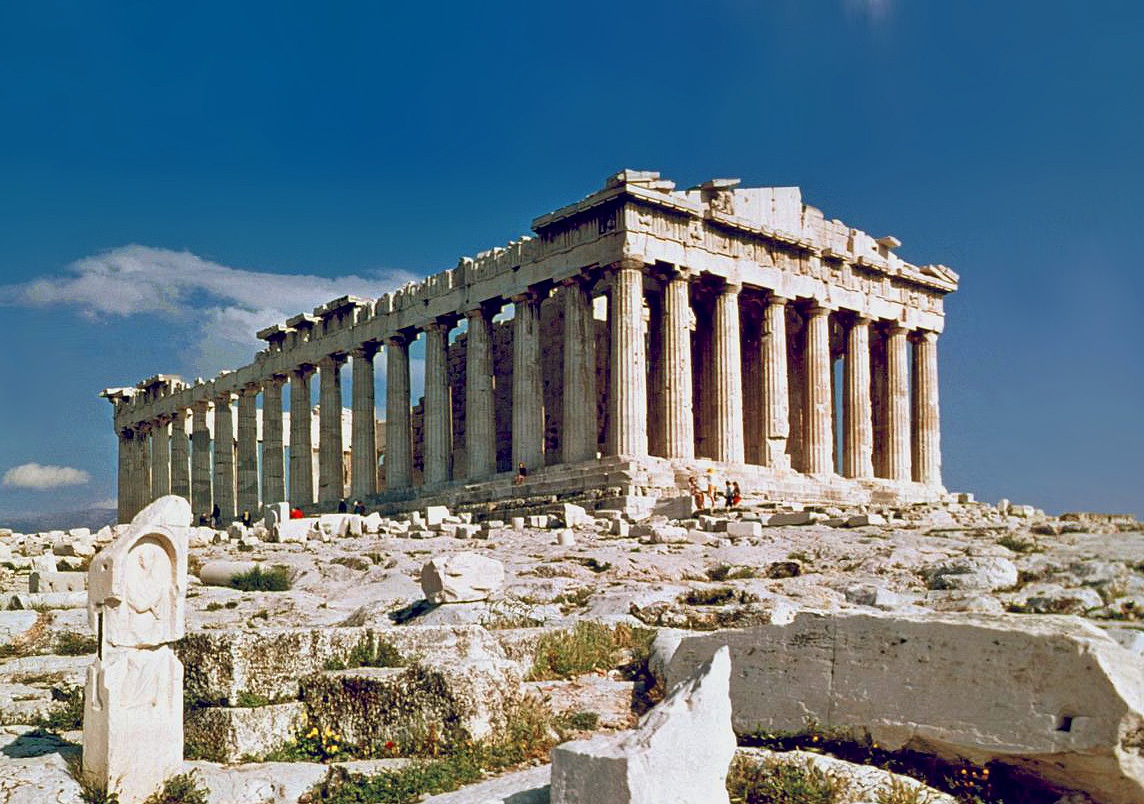
What it is
The Parthenon is the temple of Athena Parthenos (Athena the Virgin) on the Acropolis of Athens, constructed between 447 and 438 BCE under the political patronage of Pericles. The architects were Iktinos and Kallikrates, and the decorative program — including the famous frieze and cult statue — was directed by the sculptor Pheidias. The temple originally housed a colossal chryselephantine (gold and ivory) cult statue of Athena, approximately 12 meters tall, standing in the eastern cella. The statue itself is lost; our knowledge of it comes from ancient descriptions, Roman copies, and a single coin image. The Parthenon represented the height of Athenian imperial ambition: it was funded in part with tribute money from allied city-states of the Delian League, a fact that caused controversy in antiquity as much as it does now.
The building's history traces a complete cycle of religious conversion. It served as a temple of Athena until late antiquity, then was converted to a Christian church (dedicated to the Virgin Mary) in the fifth or sixth century CE — during which the interior was substantially altered, some sculptures were removed or defaced, and the entrance was reversed from east to west. Under Ottoman rule from 1458, it became a mosque, with a minaret added to the southwestern corner. In 1687, during a Venetian siege of the Ottomans, a Venetian artillery shell struck the building, which the Ottomans had been using as a powder magazine; the explosion destroyed the interior, blew out the central columns on both sides, and killed many of the Turkish soldiers and civilians sheltering inside. Much of the remaining sculpture was removed by Lord Elgin between 1801 and 1812 and is now in the British Museum — the subject of an ongoing Greek request for repatriation.
Architectural significance
The Parthenon is the supreme example of the Doric order at its most refined, and its fame rests as much on what it does invisibly as on what it shows visibly. The building appears perfectly geometrical — straight columns on a flat platform, regular spacing, level horizontals — but is actually built with almost no truly straight lines or right angles. The stylobate (the top step of the platform) curves upward at its center by about 60 millimeters on the long sides and 43 millimeters on the short sides, so that the platform is actually a very shallow dome. The columns are slightly convex in the middle (a subtle swelling called entasis), taper as they rise, and lean slightly inward. The corner columns are slightly thicker than the rest and are spaced slightly closer together. These refinements — and there are dozens more — are not arbitrary: each corrects a specific optical distortion that would otherwise make the building look subtly wrong. The result is a building that looks geometrically exact precisely because it is not.
The decorative program is equally significant. The Panathenaic frieze — a 160-meter carved marble band that ran around the top of the exterior wall of the cella, inside the colonnade — was the first time in Greek art that ordinary mortals (the citizens of Athens in the Panathenaic procession) were depicted on a temple frieze alongside gods and heroes. This was a radical departure from convention, which reserved architectural sculpture for mythological narrative. The three sets of temple sculpture — the metopes (carved panels in the Doric frieze), the pediment groups (free-standing sculptures in the triangular gables), and the continuous Ionic frieze — together constitute the largest decorative program in classical Greek architecture and the most influential corpus of ancient sculpture on Western art.
Key features
- 8×17 Doric peristyle: Eight columns on the short (east and west) facades, seventeen on the long (north and south) sides — a ratio that follows the Greek formula of 2n+1 columns on the long side for a temple with n columns on the short side. All columns are of white Pentelic marble from Mount Pentelicus, approximately 10 kilometers from Athens.
- Optical refinements: Entasis (column curvature), stylobate curvature, inward column lean, thickened corner columns, compressed corner intercolumniation — a system of subtle geometric departures from mathematical regularity designed to counteract visual distortions and produce the appearance of perfect straightness.
- Triglyphs and metopes: The Doric frieze alternates carved triglyphs (three-grooved blocks) with metope panels. The 92 metopes of the Parthenon are carved with four mythological battles — the Gigantomachy (gods vs. giants), Amazonomachy (Greeks vs. Amazons), Centauromachy (Lapiths vs. centaurs), and the sack of Troy — each on a different side of the temple.
- Pediment sculpture groups: The east pediment showed the birth of Athena from the head of Zeus; the west depicted the contest between Athena and Poseidon for patronage of Athens. Most figures are now in the British Museum (Elgin Marbles), the Acropolis Museum in Athens, and the Louvre.
- Continuous Ionic frieze: Running around the top of the exterior cella wall, inside the colonnade, the 160-meter frieze depicted the Panathenaic procession — the religious parade held every four years in honor of Athena. The frieze is an anomalous element: the Ionic frieze form is unusual in a Doric temple.
- Mortar-free construction: The entire building is assembled without mortar; marble blocks are held together by iron clamps set in lead (to prevent galvanic corrosion). The precision of the jointing is exceptional — surfaces were polished to within fractions of a millimeter.
- Original polychromy: The marble was not the bare white it appears today. Traces of paint and analysis of protected surfaces confirm that the building was originally painted in bright reds, blues, and greens — the sculptural backgrounds were red, the triglyphs blue, and the carved details were highlighted in multiple colors.
Preservation status
The Parthenon is a partial ruin. The 1687 explosion destroyed most of the interior structure and scattered sculpture across the site. Subsequent centuries of stone quarrying, the removal of sculptures by Elgin and others, and the atmospheric pollution of modern Athens (particularly acid rain from vehicle exhaust) damaged the surviving marble severely. Since 1975, the Acropolis Restoration Project has been systematically dismantling, cleaning, and reassembling the structure using titanium clamps (replacing the corroding iron originals, whose rust expansion had cracked the marble) and, where structural marble had been lost, replacement material from Mount Pentelicus matched for visual continuity.
The Elgin Marbles controversy is the most internationally visible preservation issue. About half of the surviving Parthenon frieze — 17 figures from the east pediment, 15 metopes, and 247 feet of the Ionic frieze — is in the British Museum in London, where it has been since 1817. Greece has persistently requested repatriation; the British Museum Act 1963 prohibits the deaccessioning of objects in the collection, a legal barrier that successive governments have declined to address. The new Acropolis Museum (opened 2009), designed by Bernard Tschumi specifically to house the Parthenon sculptures, includes cast reproductions of the London pieces displayed in situ alongside the surviving Athens pieces — a spatial argument for reunification. The Colosseum in Rome provides a structural comparison for marble conservation challenges, while the Acropolis itself is a UNESCO World Heritage Site.
Think you can place this building on the map?
Play Building Guessr