Architecture in the United States
The United States has the world's most consequential 20th-century architectural tradition, developing the skyscraper, the suburban house, the drive-in, and the highway interchange as global building types. American architecture drew heavily on European emigration — Mies van der Rohe, Walter Gropius, Marcel Breuer, and Eero Saarinen all fled Europe and shaped American modernism. The country's sheer geographic and cultural diversity produced regional traditions: Chicago's commercial architecture and structural innovation, New York's Art Deco towers, the Arts and Crafts movement of the American Southwest, Frank Lloyd Wright's Prairie Style and its organic successors, and the postmodern reaction that produced Philip Johnson's AT&T Building and Michael Graves's Portland Building. Contemporary America is home to the world's largest concentration of LEED-certified sustainable buildings.
Notable Buildings
-
Art Deco
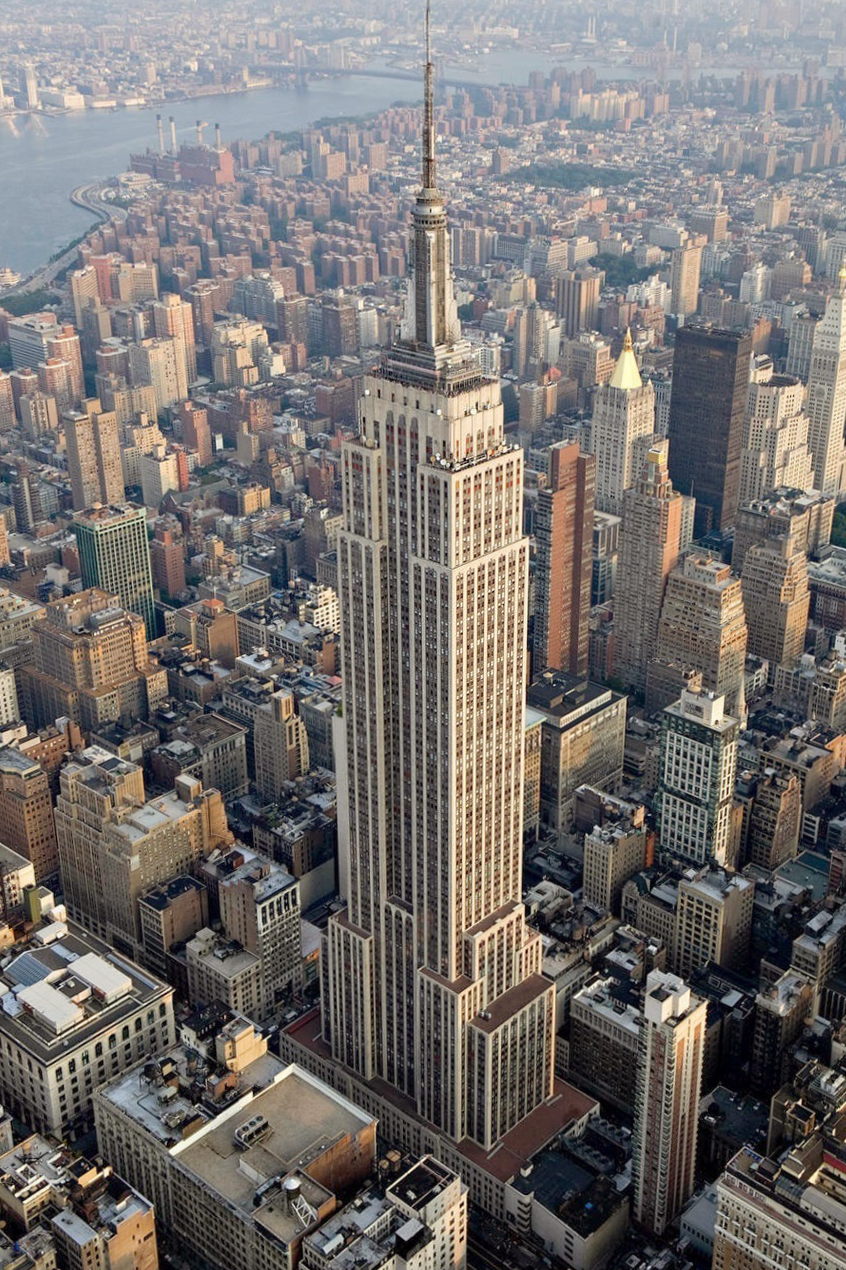
Built in 410 days (1930–31), the 443-metre tower held the world height record for 40 years. Its Art Deco crown — fluted steel set-backs narrowing to a dirigible mooring mast — has become the defining image of New York. The limestone and granite facade conceals 60,000 tonnes of steel.
-
Art Deco
The stainless-steel sunburst crown (1930) was assembled in secret inside the building and raised in 90 minutes to claim the world height record from the Bank of Manhattan — a record Chrysler held for less than a year before the Empire State Building surpassed it.
-
Organic Modernism
Frank Lloyd Wright built the Kaufmann family's weekend house directly over a waterfall in 1936 — not overlooking it, as the clients expected. The cantilevered concrete terraces extend from a central stone fireplace core, integrating structure with landscape to a degree unprecedented in domestic architecture.
-
Neoclassical
United States Capitol
Charles Bulfinch and later Thomas U. Walter expanded the original 1793 building; the cast-iron dome (completed 1868, inspired by St Peter's and the Panthéon) is the most recognisable political symbol in American architecture. The building sits at the intersection of the four quadrants of Washington DC's grid.
-
International Style
Seagram Building, New York
Mies van der Rohe's bronze-and-glass tower (1958) is the canonical American corporate skyscraper — its I-beam mullions expressing the steel structure as pure ornament, its setback plaza creating a civic forecourt on Park Avenue. The Seagram established the typology repeated in thousands of office towers worldwide.
-
Organic
Guggenheim Museum, New York
Frank Lloyd Wright's inverted ziggurat (1959) is the most controversial museum building in America — its continuous spiral ramp was attacked as incompatible with displaying paintings but celebrated as a spatial experience without parallel. It was Wright's only significant New York building, completed six months after his death.
-
Contemporary
Walt Disney Concert Hall, Los Angeles
Frank Gehry's stainless-steel sail-forms (2003) house one of the finest concert hall acoustics in the world (acoustician: Yasuhisa Toyota). The exterior — computer-designed curving metal panels — was partially polished down after residents complained the building was acting as a solar concentrator.
-
Prairie Style
Robie House, Chicago
Frank Lloyd Wright's 1910 house is the definitive statement of Prairie Style: a long, low horizontal form with broad overhanging eaves, continuous bands of art-glass windows, and a plan that flows from public to private spaces without corridors. It influenced European Modernism before the International Style reached America.
Architectural Character
American architectural ambition has been inseparable from technological ambition. The skyscraper was invented in Chicago in the 1880s — William Le Baron Jenney's Home Insurance Building (1885) was the first to use a steel frame rather than load-bearing walls — and refined in New York into the Art Deco tower of the 1920s and 30s. The United States also developed the suburban house as a global cultural product, from the balloon-frame wood construction of the 19th century to Levittown's prefabricated postwar suburbs.
Frank Lloyd Wright's singular career (1893–1959) demonstrated the possibility of a distinctly American architecture rooted in landscape rather than European precedent. The postwar period produced both the International Style glass towers of Mies and the Modernist campuses of Saarinen and Johnson. The postmodern reaction (1970s–1990s) was largely American in origin and was largely American in its commercial success and critical failure.
Test your knowledge of American landmarks.
Play Building Guessr