The opera house is one of the most expensive and politically charged building types in the world — a structure whose cost is almost never justified by its ticket revenue, and whose value to a city is almost never questioned. Every major city in Europe built or rebuilt a central opera house in the 19th century as a statement of cultural ambition and civic wealth. Every major city in the world built or rebuilt a concert hall in the 20th century for the same reasons. The justification is always the same: the concert hall is what makes a city a city, not just a large town. It is the building type that most reliably produces an argument about whether culture is a public good, what cities owe their citizens, and who the performing arts are actually for. The architecture of these buildings records all of those arguments simultaneously.
They are also, technically, among the most difficult buildings to design well. Acoustic performance — the quality of sound experienced by the audience — is not a decorative consideration but a physical one, governed by the geometry of the room, the mass and surface texture of the materials, the volume-to-seat-count ratio, and dozens of other measurable factors. A concert hall that looks magnificent may sound mediocre; one that looks awkward may produce the finest orchestral sound in the world. The relationship between appearance and acoustic performance is the central tension of the building type, and it has generated some of the most interesting architectural thinking of the last two centuries.
The Italian Opera House
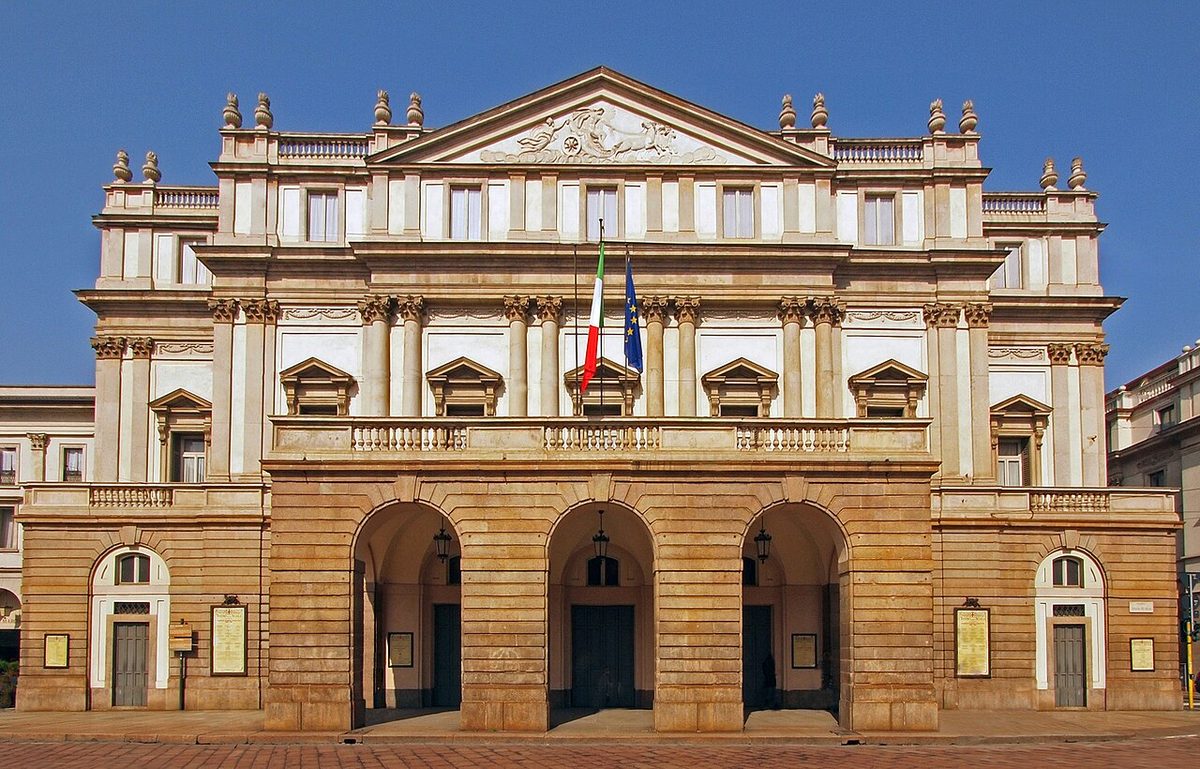
The Italian opera house developed its characteristic form in the 17th and 18th centuries and established the template that 19th-century opera houses worldwide would follow. La Scala in Milan, opened in 1778 and rebuilt after bombing in 1943, is the most prestigious example: an intimate horseshoe-shaped auditorium of approximately 2,000 seats arranged in six tiers of boxes around the perimeter and a stalls area on the floor. The horseshoe plan is the acoustic and social geometry that defines Italian opera: the curve of the horseshoe brings every seat into proximity with the stage, no seat is more than 30 meters from the proscenium, and the geometry ensures that direct sound from the stage reaches every position with roughly equal strength. The tiers of boxes create intimate cellular compartments — each box holds four to six people — that were historically rented by aristocratic and wealthy families as private boxes, brought with their own furniture and sometimes their own food. Attending the opera was as much a social event as a musical one; the boxes provided a private space from which to see and be seen.
La Fenice in Venice, originally built in 1792 and rebuilt after fires in 1836 and again in 1996 (the most recent fire was catastrophic, gutting the building entirely), uses the same horseshoe geometry but in a more ornate Baroque-to-Rococo register. The interior, restored after the 1996 fire to its 19th-century appearance, is covered in gilded plasterwork, painted ceilings, and rich velvet upholstery — an entirely different sensibility from the relative restraint of La Scala's neoclassical interior. La Fenice's acoustic performance benefits from exactly the same spatial logic as La Scala: the horseshoe concentrates sound reflections from the curved rear wall back toward the stage, the tiers of boxes create diffusing surfaces that prevent flutter echo, and the relatively modest volume (around 6,000 cubic meters) ensures that the sound has sufficient energy without excessive reverberation. The Italian opera house optimized itself over two centuries of empirical adjustment rather than acoustic science, and the results consistently outperform later halls designed with much more theoretical rigor.
The acoustic logic of the Italian opera house is inseparable from the social logic of Italian opera itself. Opera in Italy was a popular entertainment before it became a high-culture institution, and the horseshoe plan reflects this: the cheap standing room in the stalls (the loggione, or upper gallery) was occupied by the most demanding and vocal section of the audience — the loggionisti, who threw vegetables at singers they disliked and were the ultimate arbiters of operatic success. The plan that served the social hierarchy of the boxes also served the social democracy of the standing gallery.
The 19th-Century Civic Opera House
The grandest expression of the opera house as civic monument is the Paris Opéra Garnier, designed by Charles Garnier and completed in 1875 after fourteen years of construction. It is the building that most completely realized the Second Empire vision of a city — Haussmann's Paris — in architectural form: a building of extraordinary scale and ornamental richness, designed not primarily for music but for spectacle and social display. The auditorium at the Opéra Garnier seats approximately 1,900 people in a horseshoe of five tiers — similar in plan to Italian precedents but very different in atmosphere, with the stage dominated by the largest chandelier in the world at the time of construction (7 tonnes of bronze and crystal) and the ceiling famously repainted in 1964 by Marc Chagall.
But the auditorium is not what makes the Opéra Garnier extraordinary. What makes it extraordinary is the grand staircase — a double-branching cascade of white marble flanked by columns of colored onyx, rising through the full height of the entrance foyer and visible from multiple levels simultaneously. Garnier designed the staircase as the real performance space of the building: not the stage, but the staircase, where the audience performs for each other, descending in evening dress to be seen. The stage and the auditorium are the pretext; the staircase and the grand foyer are the purpose. This insight — that the opera house exists as much for the audience's self-display as for the performance — shaped opera house design from Garnier's day onward. Every subsequent opera house has wrestled with how much space and money to give to the foyers, the entrance sequence, the public areas that exist before and after the music.
The Shoebox Concert Hall
For orchestral music without theatrical staging, the acoustic requirements are different from opera, and the 19th century developed a different room type in response: the shoebox concert hall. The name is descriptive: a tall, narrow rectangular room with parallel side walls, a flat floor, and a high ceiling, shaped like the interior of a shoebox. The acoustic properties of this form are very specific and very favorable for orchestral music. The parallel side walls produce strong lateral sound reflections that reach the audience from the sides — this lateral energy is what creates the sense of spaciousness and envelopment that listeners experience in a great concert hall. The high ceiling produces early reflections from above, adding fullness to the direct sound. The relatively narrow width (typically 20–26 meters) ensures that lateral reflections arrive within the critical 80-millisecond window after the direct sound, before which they are heard as part of the sound rather than as echo. The result is a warm, enveloping acoustic that has never been bettered by any other room type for large-scale orchestral music.
The Vienna Musikverein (1870), designed by Theophil Hansen, and the Concertgebouw in Amsterdam (1888), designed by Adolf Leonard van Gendt, are the canonical shoebox halls and remain the acoustic standard against which every subsequent concert hall is measured. Both are approximately 45 meters long, 20 meters wide, and 18 meters tall — proportions arrived at empirically, without acoustic science, by architects who copied successful predecessors and trusted the evidence of their ears. Both have reverberation times at low frequencies of approximately 2.0 seconds in full audience — the figure that acoustic scientists have since identified as optimal for romantic orchestral repertoire. The discovery that these empirically arrived-at proportions could be explained by acoustic physics was made only in the 20th century; the halls themselves are the data from which the science was derived.
The decorative richness of both halls is not purely aesthetic. The gilded plasterwork, the caryatid figures, the coffered ceiling panels, and the irregularly shaped balconies all contribute acoustically by creating diffusing surfaces that scatter sound energy in multiple directions rather than focusing it into reflection patterns. A smooth box with perfectly flat walls would produce strong flutter echoes; the ornate surfaces of the shoebox hall absorb and scatter those echoes into a rich, blended reverberation. This is one of the rare cases in architectural history where the decorative tradition and the functional requirement happen to coincide exactly: the 19th-century tendency toward ornamental richness, applied to the shoebox, produced acoustics that cannot be replicated in a plain room of the same geometry.
The 20th-Century Rethinking
After the Second World War, acoustic science had advanced sufficiently that architects and acousticians believed they could design concert halls from first principles rather than by copying historical models. The results were mixed. The Royal Festival Hall in London (1951, LCC Architects' Department under Leslie Martin and Peter Moro) was the first major concert hall designed using acoustic calculations from scratch. It was the centerpiece of the Festival of Britain, intended to announce postwar Britain's cultural renewal. Its acoustic performance was immediately controversial and has been adjusted through physical modifications several times since, most recently in a major refurbishment in 2007. The shoebox proportions were abandoned in favor of a fan-shaped plan that was considered more democratic (no seat too far from the stage) but which sacrificed the lateral reflections that make the shoebox warm.
Hans Scharoun's Berlin Philharmonie (1963) represents the most radical rethinking of concert hall geometry. Scharoun organized the seating in a series of irregularly angled terraces surrounding the orchestra on all sides — what acoustic scientists would later call the vineyard format, because the terraces resemble the stepped vineyards of the Rhine. The orchestra is placed at the center and lowest point of the room, with the audience rising on all sides. The ceiling is an asymmetric composition of canopied reflector panels at varying heights and angles. The design was controversial — many musicians and listeners initially found the acoustic dry and analytical compared to the great shoebox halls — but it has been refined over decades and is now considered one of the finest acoustic environments in the world for the 20th-century orchestral repertoire. It also established the vineyard format as the primary alternative to the shoebox, influencing hall design worldwide.
Sydney Opera House and the Acoustic Problem
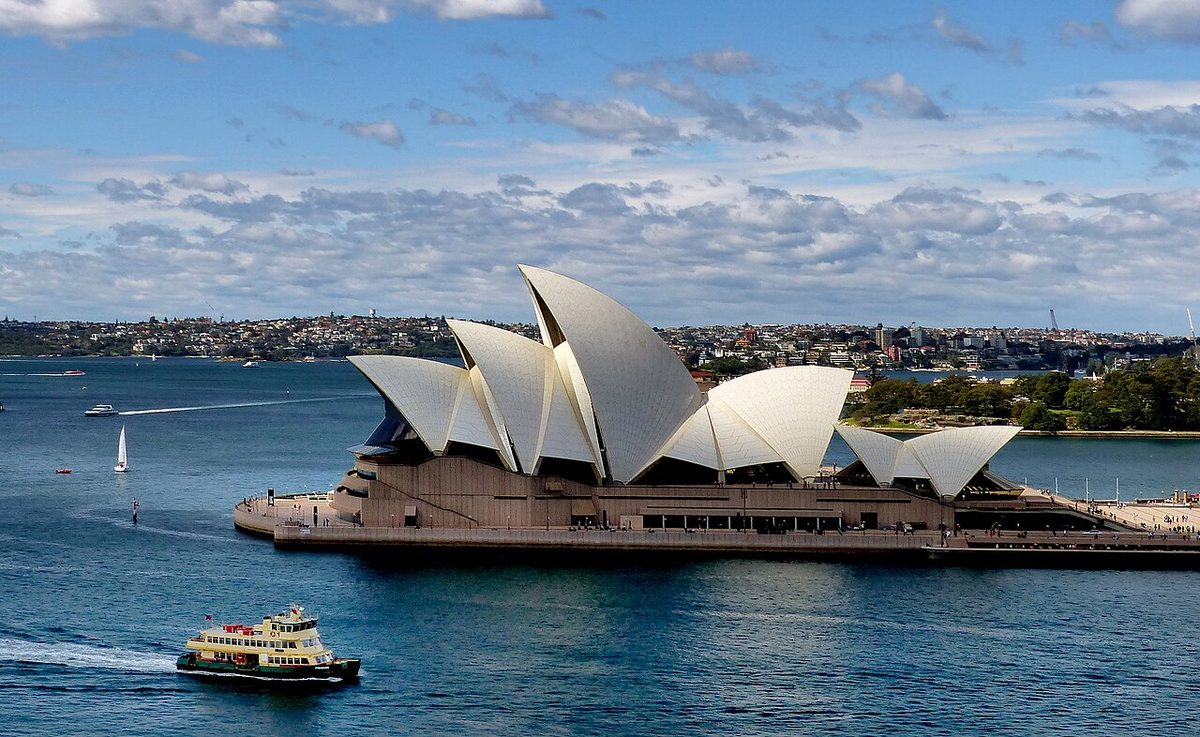
Jørn Utzon's Sydney Opera House (1973) is the most architecturally celebrated concert hall in the world and acoustically one of the most troubled. The building's history is long and painful: Utzon won the international design competition in 1957 with a concept showing shell-like roof forms over two main halls, resigned from the project in 1966 following a dispute with the New South Wales government, and did not return to Australia before his death in 2008. The interiors were completed by a government architect without Utzon's involvement, and the result is a building whose exterior — the soaring concrete shell vaults, now recognized as among the most beautiful building forms of the 20th century — bears almost no relationship to its interiors, which are competent but undistinguished. The main Concert Hall, the largest of the two principal auditoria, seats 2,679 people and has been acoustically problematic since opening: the volume is large for the seating count, the geometry is complex, and the acoustic panels installed under the ceiling have been modified several times without achieving the warmth of the great European halls. The Sydney Opera House is the building that most completely separates the iconic exterior from the acoustic interior — it is proof that the most recognizable building in the world does not need to be the best-sounding.
Contemporary Acoustic Architecture
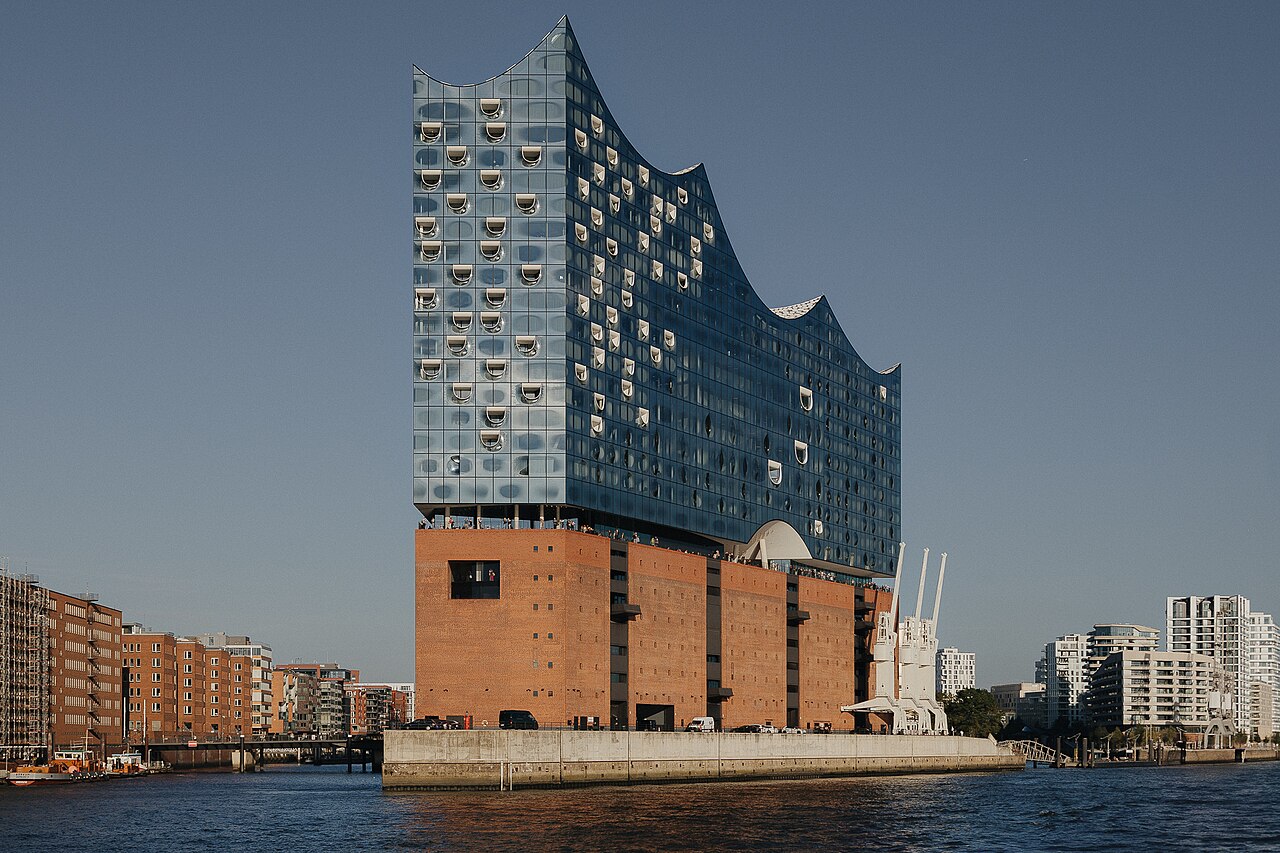
The Elbphilharmonie Hamburg, designed by Herzog & de Meuron and completed in 2017, represents the state of the art in acoustic concert hall design and is the most discussed new concert hall of the 21st century. It is built on top of a 19th-century brick warehouse on the Hamburg waterfront — the warehouse preserved and converted to apartments, hotel, and public space below a new glass superstructure containing the main concert hall. The exterior profile, with its wave-like undulating glass facade rising above the warehouse base, has made the building an instant urban icon, replacing the Speicherstadt as Hamburg's most recognizable architectural image.
The main concert hall, designed by acoustic engineer Yasuhisa Toyota, uses the vineyard format with 2,100 seats rising steeply around the orchestra on all sides. Its most distinctive feature is the white skin — the interior surface of walls and ceiling covered in over 10,000 individually shaped panels of gypsum fiber, each with a unique geometry of indentations and projections designed by computer algorithm to scatter sound energy in the specific patterns required for the acoustic result. No two panels are identical; the ceiling appears as a continuous irregular texture, like the interior of an enormous white shell or coral formation. The acoustic performance has been unanimously praised as extraordinary; the visual effect of the interior is unlike anything in previous concert hall design. The Elbphilharmonie demonstrates that the tension between architectural beauty and acoustic performance that plagued 20th-century halls can be resolved — but at a cost (the project ran from an estimated €186 million to a final €789 million) and with a degree of technical complexity that may not be replicable.
Regional Variations
The opera house tradition is most deeply embedded in Central Europe, where Italian opera culture spread northward in the 17th and 18th centuries, producing a chain of court opera houses from Vienna to Dresden to Munich, each commissioned by absolutist rulers as demonstrations of cultural sophistication and political power. The Vienna State Opera (1869), the Dresden Semperoper (1878, rebuilt 1985 after wartime destruction), and the Munich National Theatre (1818, rebuilt 1963) all use the horseshoe plan in a Central European decorative tradition of slightly greater restraint than the Italian models. The Budapest Opera House (1884, Miklós Ybl) is one of the most beautiful opera houses in Europe and one of the least known internationally — an extraordinary building of neoclassical and neo-Renaissance richness that deserves wider attention.
In Russia, the Bolshoi Theatre in Moscow (originally 1825, substantially rebuilt 1856, completely renovated 2011) is the most politically significant opera house in the world: its stage has been the site of major political announcements as well as great performances, and its neoclassical facade — a portico of six Ionic columns surmounted by a quadriga of Apollo — is as much a symbol of Russian cultural identity as the Kremlin. The Mariinsky Theatre in St. Petersburg (1860) is its equal in musical importance and its complement in historical significance: together, the two houses defined Russian operatic and ballet culture. Both were expanded with adjacent new halls in the early 21st century, each raising questions about how to add new buildings to institutions so deeply embedded in national identity.
In the Americas, the 19th century produced a series of ambitious opera houses in cities that wanted to announce their cultural seriousness. The Teatro Colón in Buenos Aires (1908) is frequently cited as one of the five best opera houses in the world for acoustic performance: a horseshoe auditorium of exceptional quality built at a moment when Argentina was among the wealthiest countries on earth. The Manaus Opera House in Brazil (1896) is the most romantically improbable: an Italian Renaissance opera house built in the middle of the Amazon jungle during the rubber boom, served by an ensemble brought from Europe, its supply lines running thousands of miles upriver. Contemporary Latin America has produced the Gran Teatro Nacional del Perú in Lima (2012) and the Centro Nacional de las Artes in Mexico City, both sophisticated concert complexes that reflect the maturity of the region's own artistic culture rather than colonial aspiration.
East Asia has invested heavily in concert hall construction since the late 20th century, producing some of the most technically accomplished acoustic buildings in the world. The National Centre for the Performing Arts in Beijing (Paul Andreu, 2007) — a titanium-and-glass ellipsoid that appears to float on a reflecting pool — is the most visually dramatic: a building that deliberately departs from Chinese architectural tradition in scale and form, asserting China's claim to global cultural modernity. The Esplanade Theatres on the Bay in Singapore (Michael Wilford, 2002), with its distinctive durian-fruit-like facade of triangulated sun screens, performs a similar function for Singapore. Japan has a long tradition of high-quality concert hall design that synthesizes the acoustic requirements of Western orchestral music with Japanese spatial sensibilities; the Suntory Hall in Tokyo (1986, Yasui Architects) was one of the first vineyard-format halls outside Germany and set the template for subsequent Japanese concert hall design.
Key Identifiers: Opera Houses and Concert Halls
- Horseshoe or fan-shaped auditorium for opera — the characteristic curved seating geometry visible in cross-section or floor plan, with tiers of boxes rising from the stalls to the upper gallery
- Grand staircase as primary entrance experience — the processional approach sequence, with monumental stairs, foyers, and promenades that function as social spaces separate from the auditorium
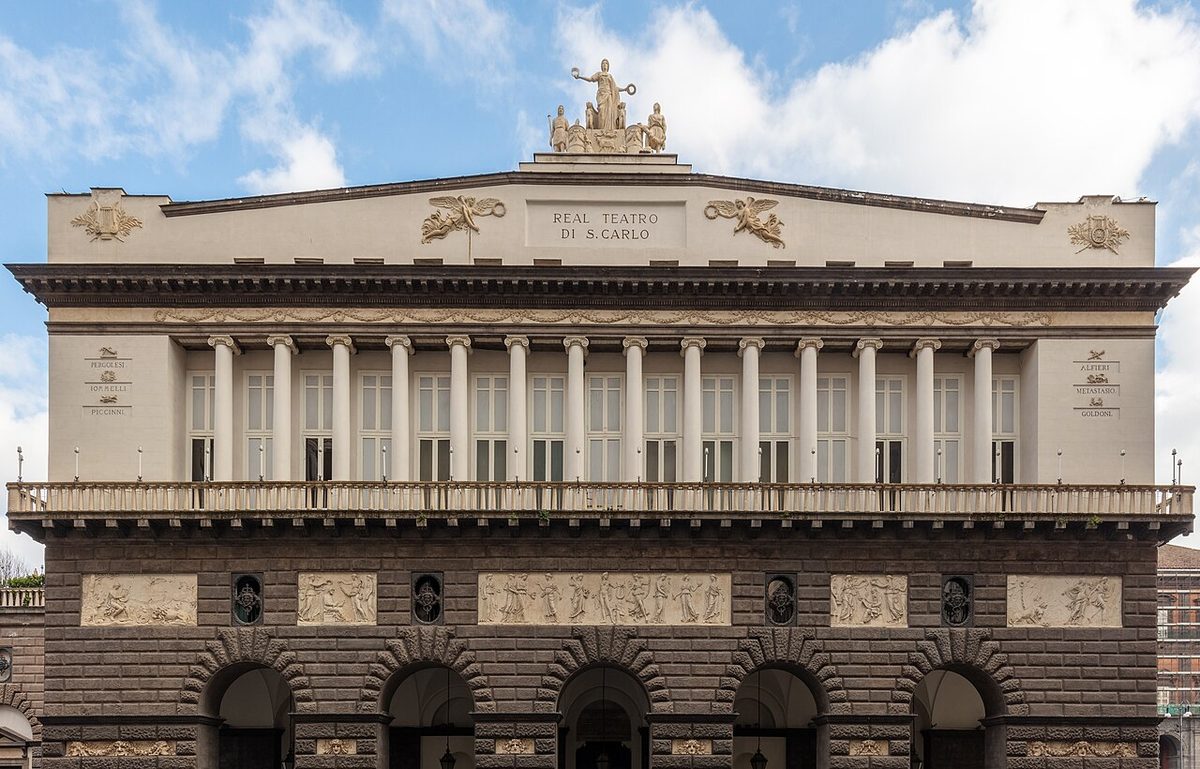
- Ornate classical facade for 19th-century type — projecting portico, sculptural program, elaborate cornice, and figural decoration announce the building's cultural status from the street
- Irregular or dramatic roofline for contemporary type — the 20th-century and 21st-century concert hall often announces itself through its roof, which may cantilever, curve, or fragment in ways that signal architectural ambition
- Acoustic fins or ceiling panels visible in auditorium photographs — suspended reflector panels, canopied ceiling elements, or differently angled surfaces overhead that are the visible evidence of acoustic engineering
- Prominent position in urban plan — opera houses and concert halls are typically sited at important urban nodes, on waterfronts, at the termination of boulevards, or as part of cultural precincts
- Shoebox proportions for 19th-century concert halls — tall, narrow rectangular rooms with high ceilings, gilded plasterwork, and multiple tiers of shallow balconies along the side walls
- Vineyard seating for post-1960s concert halls — steeply raked seating blocks at various angles surrounding the orchestra platform, visible in section as a series of irregular terraces
A Closer Look: Paris Opéra Garnier
The Opéra Garnier was not the most distinguished acoustic building of its time, but it may be the most complete architectural statement of what the opera house was supposed to mean in 19th-century civic life. Charles Garnier won the competition for the building in 1861 at the age of 35, a relatively unknown architect who beat out established figures including the great Eugène Viollet-le-Duc. Garnier's response to Napoleon III's demand for something monumental was to take every element of the Baroque and Renaissance traditions and push each of them to its maximum expression simultaneously: the most ornate columns, the richest stone materials, the most elaborate sculptural program, the grandest staircase. The building is not subtle. It is exuberant to the point of excess, and that excess is the point. The Opéra was to be the cultural crown of Haussmann's rebuilt Paris, and a restrained building would have failed the assignment.
The exterior presents a sequence of layers that rises from the colonnade at street level through a richly decorated intermediate zone to the arched attic and the low dome above the auditorium. The principal facade is crowned by sculptural groups including Jean-Baptiste Carpeaux's La Danse (now replaced by a copy, the original in the Musée d'Orsay) — a group of ecstatic dancing figures that was considered scandalously sensual when installed and which remains the most vital piece of public sculpture on the building. The flanking pavilions house the imperial entrance (on the west) and the public entrance (on the east), each with its own staircase and carriage approach, maintaining the social hierarchy in the circulation system of the building itself.
The grand staircase of the Opéra Garnier is perhaps the finest single room in 19th-century architecture. It occupies approximately the same footprint as the auditorium but feels larger because of its soaring height (it rises through three full stories), the branching geometry of its marble flights, and the cascading natural light from the lantern above. Garnier designed it with complete awareness of what it would be used for: he specified the height of the steps as lower than building standards required, so that women in formal evening dress could ascend without effort or ungainliness, and the landings are generously sized to accommodate the pauses for conversation and display that are as much the point of an opera evening as the music. The staircase is a social machine of extraordinary refinement, and it has been used as the model for grand public staircases ever since. The film industry discovered it early: the Phantom of the Opera's chandelier, the galas of a hundred costume dramas, the chase sequences of spy films — the Opéra Garnier has been the setting for visual drama on screen as well as on stage, because Garnier designed a building so theatrical that no additional decoration is required.
Spotting It in Building Guessr
Opera houses and concert halls are among the most architecturally distinctive building types in the game because they combine an unusual plan geometry (the horseshoe or vineyard auditorium) with a strong civic presence (monumental facade, central urban position) in ways that are readable even in exterior photographs. The 19th-century opera house is identifiable by its ornate classical facade — projecting portico, sculptural program, large arched windows, and a general richness of detail that distinguishes it from other civic buildings of the period like banks, courts, or government offices. The low dome or barrel vault over the auditorium is often visible above the roofline, a distinctive silhouette that signals the large enclosed volume within. The grand entrance stairs and multiple entrance bays reflect the need to admit and eject large audiences quickly — wider than a theatre or cinema, with more visible approaches than either.
Contemporary concert halls are harder to categorize visually because they range from the understated (the Berlin Philharmonie's modest exterior belies its interior drama) to the spectacular (the Elbphilharmonie's undulating glass facade, the Sydney Opera House's shell vaults). The common thread is a building that seems to have an unusually complex or deliberate exterior geometry, often in a prominent waterfront or cultural precinct location, and which sits in an open plaza or forecourt that allows the exterior to be read from a distance. If the building appears to be a cultural institution from the outside — generous public space, sculptural exterior, careful siting — and is clearly not a museum or library, it is likely a concert hall or opera house. The acoustic fins or reflector panels visible in interior photographs of the auditorium are the most specific identifying marker, but exterior photographs alone will usually establish the type through scale, setting, and decorative character.
Find opera houses and concert halls in the cultural buildings filter.
Play Building GuessrFurther Reading
Sources & further reading
Reference material this page draws on, and where to read further. External links open third-party sites.
- Opera house · Wikipedia
- Sydney Opera House · Wikipedia
- La Scala · Wikipedia
- List of concert halls · Wikipedia
- Elbphilharmonie · Wikipedia
- Architectural acoustics · Wikipedia
- Palais Garnier · Wikipedia
- World Heritage listing: Sydney Opera House · UNESCO World Heritage Centre