What it is
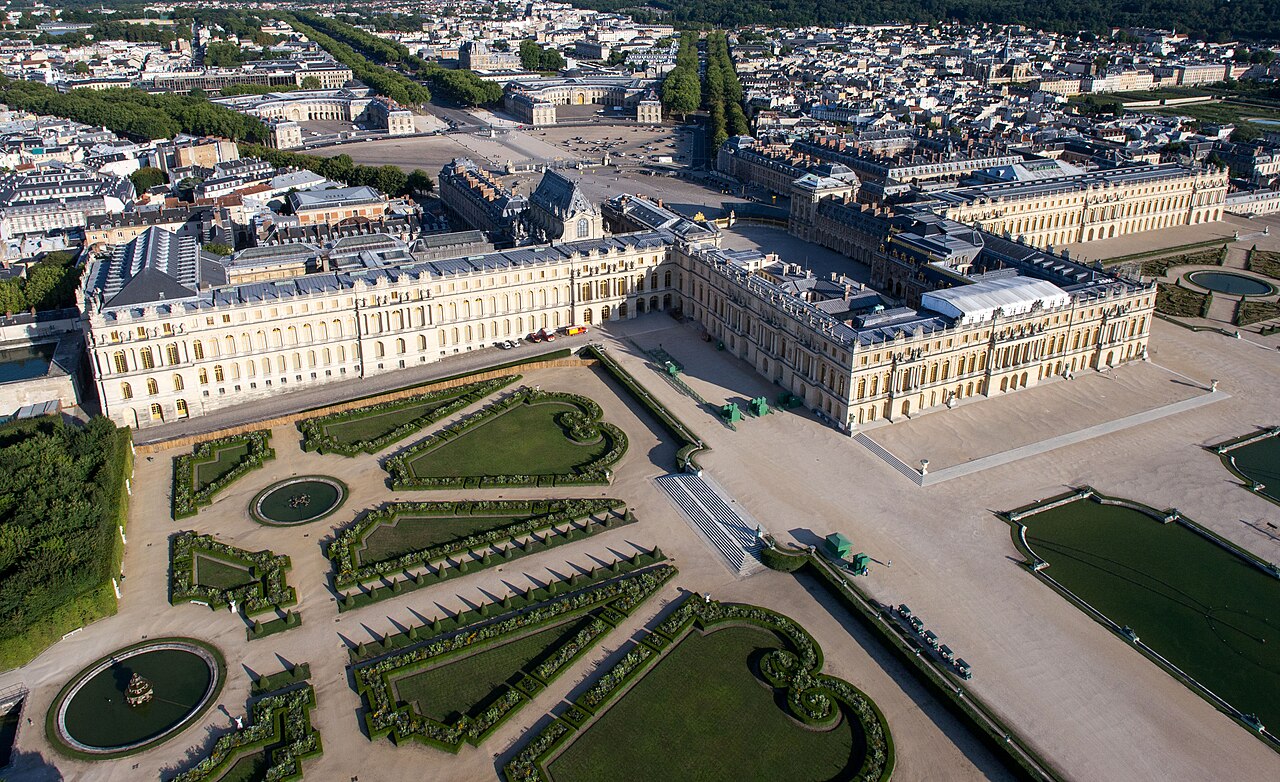
The Palace of Versailles began as a modest hunting lodge built by Louis XIII in 1623 on marshy ground twelve miles southwest of Paris. What stands today — one of the largest palaces ever built, stretching 700 meters across its garden facade — is the result of Louis XIV's extraordinary transformation of that lodge into the seat of French royal government, an ambition pursued almost without interruption between 1661 and 1710. The architects Jules Hardouin-Mansart and Louis Le Vau directed most of the construction, while Charles Le Brun coordinated the decoration of the interiors. At its operational peak, the palace housed approximately 20,000 people: members of the court, servants, guards, and tradespeople occupying every available corner of the main building and its outbuildings.
Moving the court from Paris to Versailles in 1682 was not simply a logistical decision — it was a political act of the first order. By requiring nobles to attend at court, Louis XIV ensured that the aristocracy who might otherwise have been building independent power bases in their provincial estates were instead competing for his attention in his own building, on his terms. The palace was an instrument of control as much as a residence. Attendance at the lever (the king's morning rising) and the coucher (the evening ritual of going to bed) were not social niceties but coded demonstrations of proximity to power, and position in these ceremonies was fought over with the intensity of a military campaign. Louis XIV understood, as few rulers have, that architecture and ceremony could function as politics.
Architectural significance
The interior of Versailles culminates in the Hall of Mirrors — the Galerie des Glaces — completed by Hardouin-Mansart and Le Brun in 1684. The gallery is 73 meters long, 10.5 meters wide, and 12.3 meters high. Along one side, 17 arched windows look out over the formal gardens; opposite each window, 17 arched mirror bays reflect the light back into the room, with the mirrors themselves composed of 357 individual glass panels — a deliberate statement of French industrial mastery at a time when Venetian mirror-makers held a near-monopoly on the technology. The painted ceiling, executed by Le Brun, depicts 30 episodes from the early years of Louis XIV's reign. Taken as a whole, the Hall of Mirrors represents the most ambitious unified statement of French Baroque interior design, and it set the standard for ceremonial spaces across the European monarchies for a century.
Beyond the building itself, the gardens designed by André Le Nôtre extending from the palace's central axis constitute a full expression of Baroque design ambition. The formal garden extends the palace's east-west axis for three kilometers, organizing the landscape into geometrically precise parterres, bosquets, fountains, and a canal 1,670 meters long and 62 meters wide. Le Nôtre's insight was that the garden was not an independent space but a continuation of the architectural order of the building — the same axes, the same hierarchy of spaces, the same subordination of every element to a central logic. Versailles became the definitive model for royal palaces across Europe. Schönbrunn in Vienna, Peterhof outside St. Petersburg, and the Royal Palace of Caserta in Italy were all built in conscious dialogue with what Louis XIV had achieved at Versailles.
Key features
- Garden facade: The east-facing garden facade is 680 meters long, with a flat roof balustrade concealing the pitched roofs, gilded ornament at the central block, and a rigorous ordering of pilasters, arched windows, and sculptural groups that reads as a single composition despite its immense length.
- Hall of Mirrors (Galerie des Glaces): 73 meters long, 357 individual mirror panels opposite 17 garden-facing arched windows, Le Brun ceiling paintings depicting Louis XIV's military campaigns, used today for state dinners and diplomatic receptions as it was in the seventeenth century.
- Formal French garden: Le Nôtre's composition extends the palace's central axis 3 kilometers into the landscape, with the Grand Canal, the Latona Fountain, the Apollo Fountain, and dozens of geometric garden rooms (bosquets) arranged in strict bilateral symmetry.
- Royal Chapel: Completed 1710, with a two-story nave, white stone arcades, royal gallery at upper level, and a painted vault by Antoine Coypel depicting God the Father in Glory — one of the finest Baroque religious interiors in France.
- The Orangerie: Designed by Hardouin-Mansart in 1686, beneath the southern parterre, capable of housing 3,000 orange trees during winter; its scale makes it remarkable as a purely functional building treated with full architectural seriousness.
- Grand Trianon: A single-story retreat palace at the northern end of the gardens, built in pink-and-white marble in 1687 and used by Louis XIV for private audiences and dinners away from the formality of the main palace.
- Marble Courtyard: The original hunting lodge survives at the core of the palace complex, its courtyard still paved in the original black-and-white marble, visible as a reminder of the building's origins within the vast accumulation of later construction around it.
Preservation status
The Palace of Versailles is managed by the Établissement public du château, du musée et du domaine national de Versailles, a public institution under the French Ministry of Culture. It was inscribed as a UNESCO World Heritage Site in 1979, encompassing both the palace buildings and the historic gardens. The site receives approximately six million visitors per year, making it one of the most visited monuments in the world. Major restoration programs have addressed the Hall of Mirrors — a comprehensive restoration completed in 2007 revealed the gallery's painted ceiling in its original brilliance — and the Royal Chapel, whose painted vaults were restored in the early 2000s. The garden fountains, which require enormous quantities of water from a hydraulic system designed in the seventeenth century by the engineer Arnold de Ville, are maintained in working order, with the grands eaux (full fountain displays) staged on weekends during summer.
The ongoing challenge at Versailles is managing the tension between conservation and use. The palace must accommodate millions of visitors while protecting surfaces that are inherently fragile — gilded stucco, historic parquet floors, painted ceilings — from the humidity, vibration, and abrasion that large visitor numbers inevitably generate. Strategic ticketing, visitor routing, and continuous monitoring of environmental conditions in the principal apartments are the primary tools used to manage this tension.
Think you can place this building on the map?
Play Building Guessr