What it is
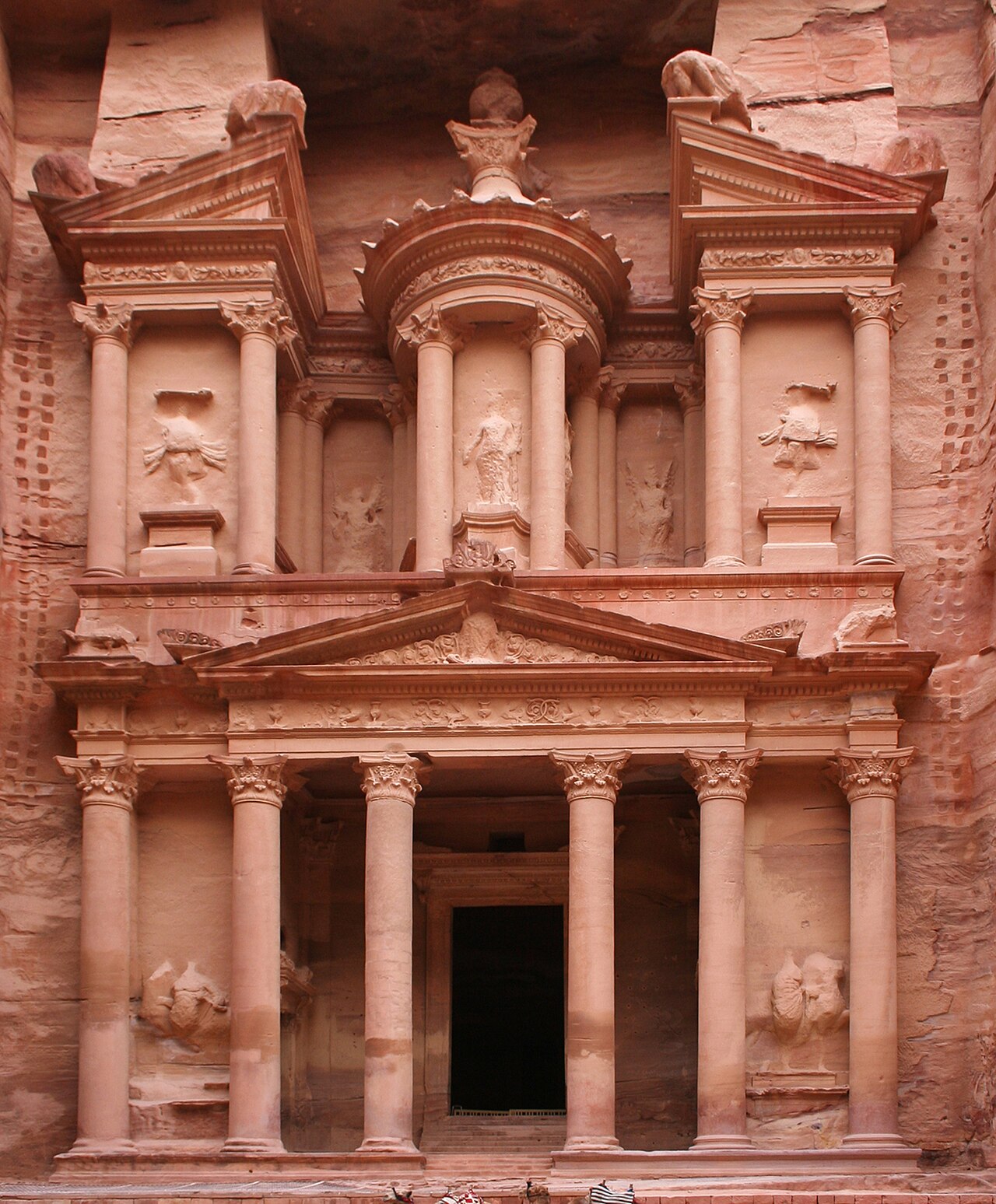
The Khazneh — Arabic for "The Treasury" — is the most famous monument in the ancient Nabataean city of Petra, carved directly into a cliff face of rose-pink Nubian sandstone in what is now southern Jordan. The Nabataeans were an Arab people who controlled the lucrative caravan trade routes between the Arabian Peninsula, Egypt, and the Mediterranean from approximately the fourth century BCE onward, accumulating enough wealth to build a city of extraordinary architectural sophistication in the desert. The Khazneh was almost certainly a royal tomb — probably for the Nabataean king Aretas IV (9 BCE–40 CE) — and the name "Treasury" is a later Bedouin invention. The legend ran that a pharaoh had hidden his treasure inside the urn carved at the top of the facade; the bullet marks visible in that urn today were made by Bedouin tribesmen trying to shoot it open in hopes of releasing the gold inside. The interior is entirely undecorated — a single rectangular chamber — because the function of a Nabataean tomb monument was the facade itself, not any interior experience.
The city of Petra was the Nabataean capital and one of the great trading cities of the ancient world. At its peak in the first and second centuries CE, it may have housed 20,000–30,000 people, and its wealth funded not only tomb facades but colonnaded streets, a Roman-style theater, temples, baths, and an elaborate hydraulic system of dams and cisterns that managed the desert's scarce water supply. The city declined after the Roman annexation of the Nabataean kingdom in 106 CE and was eventually abandoned. It remained largely unknown to the Western world until the Swiss explorer Johann Ludwig Burckhardt visited in 1812, disguised as an Arab pilgrim. The city's rediscovery made it famous; the Khazneh's photograph — especially the shot framed through the narrow slot of the Siq gorge — became one of the defining images of the nineteenth century's fascination with lost civilizations.
Architectural significance
The Khazneh's significance lies in what it reveals about how Hellenistic architectural forms traveled and transformed as they moved through different cultures. The facade is organized in two stories: the lower story presents a standard Hellenistic arrangement of six Corinthian columns, a triangular pediment at the center, and side extensions — elements that would be entirely at home on a public building in Alexandria or Antioch. The upper story, however, is distinctly Nabataean in its complexity: a central circular tholos (a round temple form) flanked by broken pediments and populated with eagles, Gorgon heads, and figures of the goddess Tyche, arranged in a deliberately complex interplay of projecting and receding planes. The Nabataeans were not simply copying Hellenistic architecture; they were using its vocabulary selectively, combining elements according to their own iconographic program while demonstrating command of the source material.
What distinguishes the Khazneh from any built building is also its most important architectural fact: it was carved, not constructed. Every column, capital, cornice, and sculptural figure was produced by removing material from the living sandstone, working from the top of the facade downward. No scaffolding was required, because the workers stood on the level of uncut rock as they excavated. The result is a building that is, structurally speaking, the cliff itself — the columns are not structural members but representations of columns sculpted in place. This means that the Khazneh has no foundations to settle, no joints to fail, and no structure to collapse; it is as permanent as the rock of which it is made, except insofar as the surface is vulnerable to erosion by wind and water over millennia.
Key features
- Two-story carved facade: The facade rises 39 meters and 28 meters wide, carved entirely from the living sandstone cliff, presenting a complete Hellenistic architectural composition executed in subtraction rather than construction.
- Corinthian columns in two registers: Six freestanding columns across the lower story and four engaged half-columns in the upper story, all with fully carved Corinthian capitals displaying acanthus leaves and volutes in the Hellenistic tradition.
- Broken pediment with central tholos: The upper story's central element — a circular domed temple form — flanked by broken pediment wings creates a compositionally complex upper register that has no close parallel in Hellenistic architecture.
- Eagle sculptures and Gorgon ornament: Eagles (symbols of the Nabataean deity Dushara) and Gorgon heads (borrowed from the Hellenistic tradition but given Nabataean meaning) populate the spaces between the architectural elements of the upper story.
- Urn finial: The urn at the summit of the tholos, which local legend identified as the hiding place of the pharaoh's treasure, is visibly pocked by bullet impacts from attempts to break it open — a record of the legend's persistence across generations.
- Rose-pink sandstone: The Nubian sandstone of the Petra cliffs shifts dramatically in color depending on the angle and time of day, moving from pale cream to deep amber to vivid rose-pink; morning light in the narrow Siq gorge approaching the Khazneh produces the building's most dramatic appearance.
- The Siq approach: The 1.2-kilometer narrow gorge that leads to the Khazneh, in places only a few meters wide, acts as an architectural experience in its own right — the restriction of view, the sound of echoing footsteps, and the final reveal of the facade at the gorge's end constitute one of the most theatrically effective approaches to any building in the world.
Preservation status
The Khazneh requires no structural restoration because it is structurally inseparable from the cliff. The primary conservation threats are surface erosion from wind-driven sand, flash flooding through the Siq and across the facade base, and salt crystallization within the sandstone that causes surface spalling over time. Tourism pressure — the site receives approximately half a million visitors per year — accelerates erosion at the base of the facade through physical contact and the vibration and humidity generated by large crowds in a confined space. UNESCO inscribed Petra as a World Heritage Site in 1985. A comprehensive Petra Archaeological Park Master Plan, developed in cooperation with international conservation organizations, guides visitor management and site protection.
Think you can place this building on the map?
Play Building Guessr